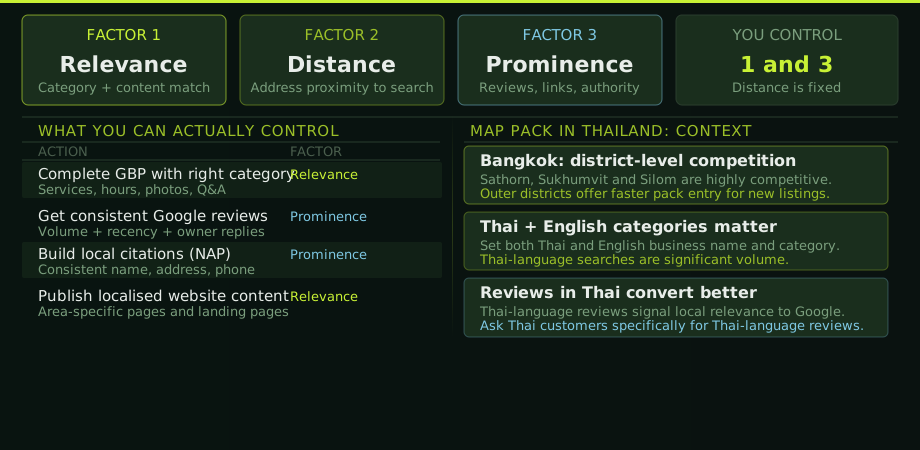
Google's own documentation describes three factors it uses to rank local results: Relevance, Distance, and Prominence. Understanding what each actually means in practice, and which ones you can influence, is the starting point for any map pack strategy.
The map pack and the standard organic results are related but not identical ranking systems. A business can rank in the top 3 of the local pack without ranking particularly well in organic results for the same query, and vice versa. This means local businesses need to invest in both systems but in slightly different ways. The broader local SEO service in Thailand covers both channels together.
The three factors you need to understand
Relevance is how well your business profile and associated website content match what the user is searching for. This is the factor most influenced by how you have set up your Google Business Profile. The primary category you select, the services you list, the keywords in your business description, and the content of the website linked to your GBP all contribute to relevance. A business registered as "Marketing Agency" will be less relevant for "SEO agency Bangkok" searches than one registered as "SEO Agency" with SEO listed as a primary service.
Distance is how far your physical business location is from the searcher. When someone searches "SEO consultant near me" in Bangkok's Silom district, businesses located in Silom have an inherent distance advantage over those in Sukhumvit, regardless of their profile quality. This factor cannot be gamed. If your business is located in Chiang Mai, you cannot rank in the Bangkok map pack for a distance-dependent query. What you can do is ensure your service area is set correctly so Google understands the geographic range you serve.
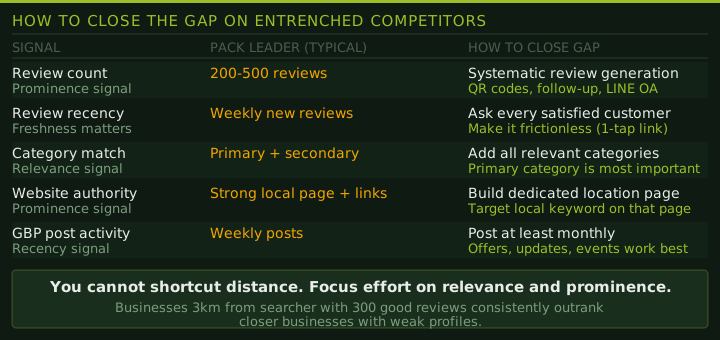
Prominence is how well-known your business is. This is the broadest factor and the one with the most components you can influence: review volume, review rating and recency, owner reply rate, website authority, backlinks from local sources, and consistency of your business information across citations. A business with 300 good reviews, active review replies, a strong local landing page, and consistent citations across Thai directories will outrank one with 30 reviews and a sparse GBP, assuming comparable distance and relevance.
What you can and cannot control
Distance is fixed. You cannot move your business address to rank in a different geographic area. Service-area businesses, which serve customers at their location rather than having customers come to them, can set a service area that expands their geographic reach, but this is less powerful than a physical address for the pack ranking algorithm.
Relevance and prominence are both highly actionable. Most businesses that are not ranking in their local pack are losing on one or both of these factors, not on distance. The practical implication is that the first audit step for any map pack campaign is to check relevance (profile completeness and accuracy) and then check prominence (review quality and volume) before assuming the distance is the problem.
In the Thai market specifically, one consistently underused action is setting both Thai and English language in the business profile. A significant portion of local searches in Thailand are conducted in Thai, and a GBP that has only English content is less relevant for those searches. Setting the Thai business name and ensuring Thai-language content appears in the profile and reviews extends the relevance to both audiences.
Optimising for relevance: profile and content
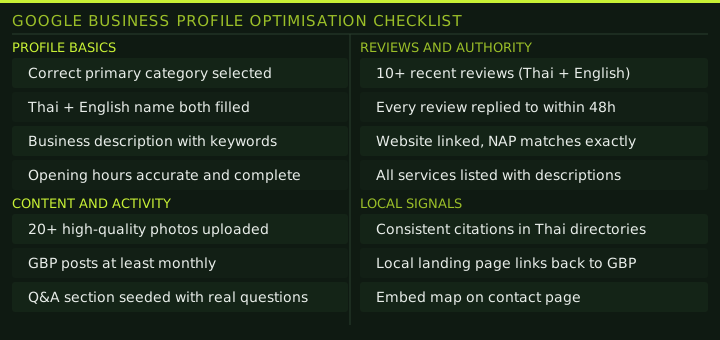
The GBP primary category is the most important relevance signal. Choose the most specific category that accurately describes what you do. "SEO Agency" ranks better for SEO queries than "Marketing Agency." "Thai Restaurant" ranks better for restaurant queries than "Restaurant." For sector-specific guidance, the local SEO for Bangkok restaurants and hospitality post covers the patterns that work in F&B. Add secondary categories for the other services you genuinely offer, but do not add categories for services you do not provide. Irrelevant categories dilute relevance rather than expanding it.
The business description (750 characters) is an opportunity to include natural keyword mentions: the service, the location (Bangkok, specific districts), and the audience (Thai and English clients, specific industries). Do not keyword-stuff. Write it as a reader-first description that happens to include the terms you want to rank for.
The services section is a relevance signal that most businesses leave empty or incomplete. List every service with a description. If you offer SEO, local SEO, PPC management, and web design, list all four with individual descriptions. This signals to Google the breadth of what you provide and improves relevance for the full range of related queries.
Your website's local landing page is part of the relevance equation. A dedicated page that targets "SEO agency Bangkok" with structured content, a map embed, and consistent NAP (name, address, phone) reinforces the relevance signal your GBP sends. This is discussed in more detail in the broader local SEO for Thailand guide.
Building prominence: reviews and citations
Reviews are the most visible prominence signal and the one most businesses focus on. For Bangkok businesses in competitive categories, 50 or more reviews with an average above 4.3 is the minimum to be competitive. In less competitive areas outside Bangkok, 20 to 30 high-quality recent reviews can be sufficient.
Recency matters significantly. A business with 200 reviews accumulated over five years, with none in the last six months, will be ranked below one with 50 reviews from the last three months. Google treats review recency as a signal of current business quality. An active review generation system that produces a steady stream of new reviews outperforms a historical volume advantage.
Review response rate also signals prominence. Businesses that reply to every review, positive and negative, within 48 hours show Google an actively managed listing. For Thai businesses, replying in the same language as the review (Thai replies to Thai reviews, English to English) shows local authenticity and is appreciated by customers.
Citations, which are mentions of your business name, address, and phone number (NAP) on external sites, directories, and business listings, contribute to prominence by corroborating your existence and location. Thai business directories, industry associations, and local news mentions all count. The critical requirement is NAP consistency: if your address or phone number appears differently across different citations, the signal is weakened. Consistent NAP everywhere Google can find it reinforces prominence.
Bangkok-specific context
Bangkok's map pack competition varies dramatically by district. Sathorn, Sukhumvit, and Silom are the most competitive for business service queries. A business entering these districts is competing against listings with hundreds of reviews and years of established prominence. Winning pack positions in these areas takes 6 to 12 months of consistent review generation and profile optimisation.
Outer districts are a different story. Ladprao, Bang Na, Ramkhamhaeng, and the areas beyond the inner ring road have significantly less pack competition for most business service categories. A new business with a well-optimised GBP and 30 to 50 recent reviews can enter the map pack for its primary category in these areas within 2 to 3 months.
The Thai-language dimension is an opportunity that most non-Thai-speaking business operators ignore. Setting both Thai and English business names, ensuring Thai-language services are listed, and actively encouraging Thai customers to leave Thai-language reviews signals local authenticity to Google and captures search volume that English-only profiles miss entirely.
A full assessment of your current Google Business Profile, plus a clear plan for improving your map pack ranking in your specific location and category, is a core part of the local SEO service engagement.
Map pack ranking questions
What are the three factors Google uses to rank the map pack?
Relevance (how well the profile and website content match the search query), Distance (how close the business is to the searcher), and Prominence (review volume, ratings, website authority, citations). You can control Relevance and Prominence. Distance is fixed by your business address.
How many Google reviews do I need to rank in the map pack?
In competitive Bangkok central districts, top-3 listings typically have 50 to 500 reviews above a 4.3 average. In outer Bangkok districts or provincial cities, 20 to 50 recent reviews may be sufficient. Review recency matters as much as volume. Recent reviews from the past 6 months are weighted more heavily than older ones.
Does my website help my map pack ranking?
Yes. Website authority and local landing page content contribute to the Prominence signal. A well-optimised local page targeting the same keywords as your GBP reinforces relevance. NAP consistency between your website and GBP is also important for corroborating your business information.
Why is my competitor ranking with fewer reviews?
Because reviews are only one component of Prominence, which is one of three ranking factors. Your competitor may have a more complete GBP profile with better category match, a stronger local landing page, more consistent citations across Thai directories, or simply be closer to where most of your target searchers are located.
How long does it take to rank in the Google map pack?
In lower-competition areas, pack visibility can improve within 4 to 8 weeks of optimisation. In competitive Bangkok central districts, building into a consistent top-3 position typically takes 3 to 6 months of review generation, citation building, and content improvement.
In tourist markets the map pack is often the entire competition, because visitors rarely scroll past it. That is the whole argument behind our Phuket local SEO work, where a business can be well-optimised for its own district and still invisible from the beach twenty minutes away.