Search intent is the reason behind a query. It is what the person actually wants, not just the words they used. Two queries can contain the same keyword and have completely different intent. The filtering step in a structured competitor analysis is unpacked in how to run a competitor SEO analysis. "SEO consultant" from someone trying to understand what the role involves is not the same query as "SEO consultant Bangkok" from someone who has a budget and wants to hire one this week. Building the same type of page for both queries is a mistake that produces poor results even when the technical execution is perfect. The SaaS-specific intent ladder across the buying committee sits in SEO for IT and SaaS businesses in Bangkok.
Google has spent years getting better at identifying intent, and its ranking signals increasingly reward pages that satisfy the intent correctly over pages that just contain the right keywords. Understanding intent is therefore not optional in modern SEO consultant , it is the foundation of page strategy.
The four intent types
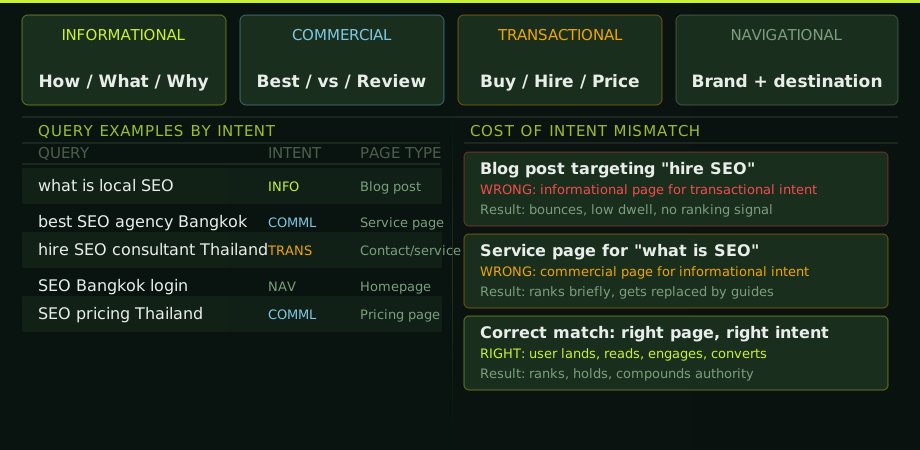
Intent falls into four categories. Most SEO-relevant queries live in the first three.
Informational. The user wants to learn something. The query contains signals like "how," "what," "why," "guide," "explained," or "tutorial." The correct page type is a blog post, guide, or explainer. Examples: "what is search intent," "how does Google crawl a site," "why is page speed important." If you target these queries with service pages, users will bounce because you are answering the wrong question.
Commercial investigation. The user is evaluating options before making a decision. They are not ready to buy yet, but they are moving in that direction. Signals include "best," "vs," "review," "top," "compare," and "alternatives." The correct page type is a comparison guide, a "best of" roundup, or a well-structured service page that answers comparative questions. Examples: "best SEO agency Bangkok," "SEO vs PPC which is better," "Shopify vs WooCommerce for SEO."
Transactional. The user is ready to act. They want to buy, hire, download, sign up, or contact. Signals include "hire," "buy," "price," "cost," "agency," and direct service-type language. The correct page type is a service landing page or a contact page with a clear call to action. Examples: "hire SEO consultant Thailand," "SEO agency Bangkok," "book discovery call SEO." If you send these users to a blog post, you lose them.
Navigational. The user wants to reach a specific site or page. They already know where they want to go. Examples: "SEO Bangkok login," "Ahrefs dashboard," "Google Search Console." These queries rarely offer ranking opportunities for anyone other than the brand being navigated to.
Why intent mismatch kills rankings
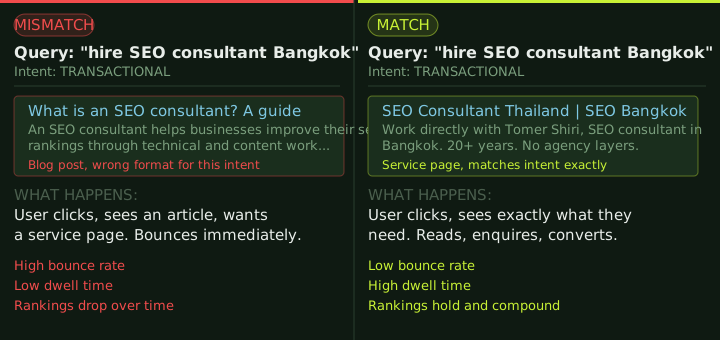
The mechanism is straightforward. When Google serves a result for a query, it measures what users do after clicking. If they land on the page, read it, and either convert or navigate deeper into the site, that is a positive signal. If they land, see immediately that the content is not what they were looking for, and click the back button within a few seconds, that is a negative signal called pogo-sticking.
A blog post targeting "hire SEO consultant Bangkok" will generate this exact pattern. The user wants a service provider. They get an article. They leave. Google interprets this as a poor match and reduces the ranking over subsequent updates. The page may rank for a week or two based on technical quality, but the behavioural signals pull it down. This is one of the most common reasons that technically well-optimised pages fail to hold their rankings.
The inverse is also true. A service page targeting an informational query like "what is SEO" will also struggle. Users searching that term want an explanation, not a sales page. They bounce, the signal turns negative, and the ranking drops. The correct page for "what is SEO" is a well-structured guide, see also the existing SEO fundamentals post.
Intent mismatch is also one reason why keyword research without SERP analysis produces poor results. Looking only at volume and difficulty without checking what format is currently ranking means you may build the wrong type of page and struggle to understand why it is not performing.
How to identify the intent behind any query
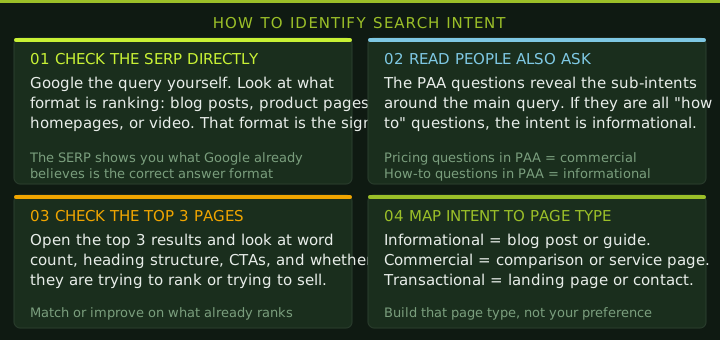
The most reliable method requires no paid tools and takes about three minutes per query.
Step 1: Google the query yourself. Look at the format of the top three results. Are they blog posts, guides, product pages, service pages, or homepages? The format that is currently ranking is Google's revealed preference for what satisfies this intent. If all three results are detailed guides, the intent is informational and you need a guide. If all three are service pages with CTAs, the intent is transactional and you need a landing page.
Step 2: Read the People Also Ask questions. The PAA box surfaces the sub-intents around the main query. If all the PAA questions are "how to" questions, the intent is strongly informational. If they include pricing questions ("how much does X cost"), the intent is shifting toward commercial or transactional. PAA questions also make excellent H2 headings for informational content.
Step 3: Check the top three pages directly. Open them. Look at word count, structure, whether there is a call to action, and how much of the page is content versus conversion. A 2,000-word guide with no contact form serves informational intent. A 600-word service page with three CTAs serves transactional intent. Match what is working, then do it better.
Step 4: Map the intent to a page type and assign it. Informational queries map to blog posts. Commercial queries map to comparison guides or service pages. Transactional queries map to service pages with conversion elements or contact pages. If a query maps to a page type you already have, optimise that existing page rather than creating a new one. This also prevents keyword cannibalisation, where two of your own pages compete for the same intent.
Intent in the Thai market context
Intent patterns in Thailand differ from Western markets in a few notable ways. Thai buyers tend to do more research in social media channels before moving to Google, which means by the time they search, they are often further along in the decision cycle than their search query suggests. A query that looks informational in a UK context may carry stronger commercial intent in the Thai context because the searcher has already done their comparison research on Facebook or LINE.
This means that informational-looking Thai queries around professional services often convert better than their format would suggest. A post answering "what does an SEO consultant do in Thailand" may generate qualified leads at a higher rate than the same post would in a US market, because the searcher is often already close to a decision. That is an opportunity worth building for rather than ignoring because the intent looks purely educational.
It also means that the volume numbers from Thai keyword research tools are often underestimated, because significant search behaviour happens in Thai language. A keyword that shows 40 monthly searches in English may have ten times that volume when Thai-language equivalents are included. If your site targets Thai businesses, bilingual keyword research is not optional. The local SEO service in Thailand covers this as part of keyword and content strategy for Thai and English audiences.
Intent and keyword volume: the right relationship
Volume and intent are both useful signals. Neither is sufficient alone.
A high-volume keyword with the wrong intent match will generate traffic that does not convert and rankings that do not hold. A low-volume keyword with perfect intent match and low competition will produce rankings, traffic, and conversions that compound over time. Given the choice between targeting a 1,000-search term with unclear intent and a 50-search term with precise transactional intent and near-zero competition, the 50-search term is often the more valuable investment for a business focused on leads rather than metrics.
The practical approach is to use intent as the primary filter and volume as a tiebreaker. Among terms with the same intent type and similar competition, prioritise higher volume. But never target a high-volume term at the expense of intent match. A page that does not satisfy what the user wants will not rank, regardless of how well it is optimised by every other measure.
Understanding intent is the prerequisite for keyword research that produces results rather than just lists. The keyword research guide covers the practical method for building a keyword list using free tools, with intent mapping built into the process from the start.
Search intent questions
What are the four types of search intent?
Informational (the user wants to learn something), Commercial (the user is evaluating options before a decision), Transactional (the user is ready to act), and Navigational (the user wants to reach a specific site or page). Most SEO-relevant queries fall into the first three types.
Why does matching search intent matter for rankings?
Google measures what users do after clicking a result. If they land on the wrong type of page and leave immediately, that pogo-sticking behaviour signals a poor match. Google reduces the ranking over time. A page that correctly satisfies intent generates engagement, dwell time, and conversions, which are positive signals that reinforce and improve the ranking.
How do I identify the search intent behind a keyword?
Google the query yourself and look at the format of the top three results. That format is Google's revealed preference for what satisfies this intent. Cross-check with the People Also Ask box and the content structure of the top pages. Between those three inputs, the correct page type is almost always clear.
Can the same keyword have mixed intent?
Yes. Some queries sit between informational and commercial, especially in professional services. When intent is mixed, look at what format dominates in the top results. Usually one type ranks more consistently. Build for the dominant format, but include elements that serve the secondary intent where they fit naturally.
Does search intent affect which page type I should build?
Yes, directly. Informational intent maps to blog posts and guides. Commercial intent maps to comparison or service pages. Transactional intent maps to landing pages and contact pages. Building the wrong page type for the intent is one of the most common reasons technically sound pages fail to rank and hold position.