
International SEO for businesses targeting more than one country.
Based in Bangkok, working with Thai businesses targeting foreign markets and international companies entering Thailand and ASEAN. Our international SEO services cover hreflang implementation, URL structure decisions, multilingual keyword research, and market-specific content strategy. Getting international SEO wrong can suppress rankings in every market simultaneously. Getting it right builds durable traffic in multiple countries from a single, well-structured site.
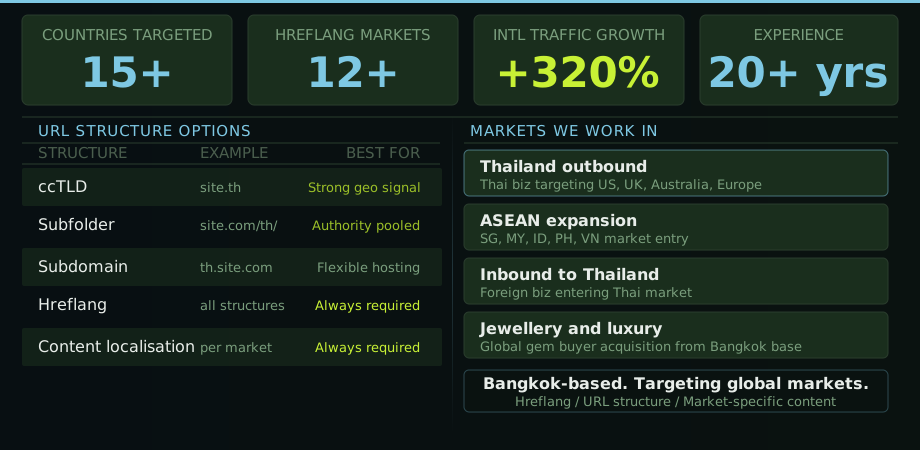
Thai businesses going global, and global businesses entering Thailand.
Most international SEO content is written for US or European companies expanding outward. This is different. A Bangkok-based practice that has spent 20+ years working with Thai businesses targeting foreign markets understands the specific problems that come from building international SEO from a Thai domain, on Thai hosting, for markets in Australia, the US, the UK, or Europe.
We also work in the opposite direction: foreign businesses entering Thailand who need to rank in Thai Google search alongside local competitors, and ASEAN businesses building regional search presence across Singapore, Malaysia, Indonesia, the Philippines, and Vietnam.
If the basics are still being built, our existing guide on what changes in international SEO is a useful starting point before this conversation.
Weak targeting that confuses every market at once.
The most common international SEO failure is not bad translation. It is launching multiple country versions without clear targeting signals, hreflang, or URL structure that separates the markets. Google ends up seeing near-duplicate content with no clear signal about which page belongs to which market, and rankings in all markets suffer as a result.
The second most common failure is treating international SEO as a content translation project. Translation is one part of it. The technical infrastructure, the URL structure decision, the hreflang implementation, and the link-building approach for each market are the parts that determine whether the content actually ranks where you want it.
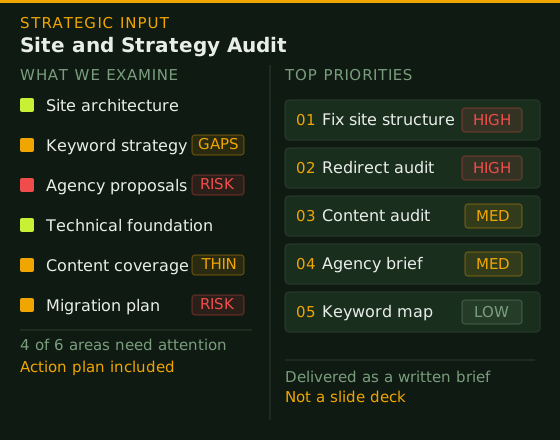
Before expanding, it also helps to run a proper SEO audit. Weak structure and indexation problems in one market multiply across every market you add.
International SEO from structure to market presence.
Every international SEO project starts with the structural decisions and works outward to content and authority.
URL structure and domain strategy
ccTLD vs subfolder vs subdomain: the decision that affects authority, targeting signal, and long-term maintenance cost. We assess the right approach for each project based on existing domain authority, hosting setup, and how distinct each market needs to be.
Hreflang implementation
Correct hreflang requires self-referencing tags, return tags for every alternate, correct locale codes, and consistency between the sitemap, HTML, and HTTP headers. We build it correctly the first time and validate it fully in Google Search Console. Common errors including missing return tags, wrong locale codes, and orphaned hreflang clusters are all identified and fixed.
International keyword research
Keyword research in each target market, including markets where the primary language is not English. Practical methods using Google Trends by region, Search Console data, and competitor gap analysis to identify what each market actually searches for rather than assuming a translated term maps to the same intent.
Content localisation strategy
Translation is one component. Market-specific search intent, local examples, local trust signals, currency, and cultural context determine whether translated content actually ranks and converts. We define what needs to change beyond language for each market version.
International link building
Authority signals need to come from domains in or relevant to the target market. Local directories, market-specific publisher relationships, and translated or adapted content distributed to relevant foreign sites. We assess what is realistic for each market and prioritise by impact.
ASEAN market expansion
Country-by-country strategy for businesses expanding regionally: Singapore, Malaysia, Indonesia, the Philippines, and Vietnam. Each market has different competition levels, different platform preferences, and different search behaviour. We plan the expansion in phases based on market opportunity and implementation cost.
66 tracked queries in position one.
An anonymous international B2B wholesale client increased tracked visibility from 22.14% to 63.37% between November 2024 and December 2025. A later Semrush snapshot estimated 22.9K monthly organic visits.