A working content strategy answers four questions before a single word gets written: who is this for, what are they searching, what do they need from the page, and how does this piece connect to the rest of the site. Most content programmes skip three of those questions and produce a calendar of vaguely on-topic posts that read as generic, rank for nothing in particular, and accumulate as dead weight in the site's index.
This post is the practical version of content strategy: not the theoretical framework that fills consulting decks, but the operational decisions that determine whether the content you publish over the next year actually produces traffic, leads, or sales. The measurement framework that should sit alongside the strategy is in how to measure SEO content performance. The framework is simple. The execution is where most programmes fail.
Why most content strategies fail
The pattern is consistent across businesses of every size. A new SEO programme starts with an editorial calendar that lists 30 to 50 topics chosen because they sound relevant to the business. Posts get written, published on a regular cadence, and added to the site map. Six months later, organic traffic has barely moved, none of the posts rank for anything commercial, and the conversation shifts to whether SEO works for this business.
SEO works. The strategy was wrong. The posts were written because they sounded plausible, not because they served a defined search audience with a specific question. They covered topics broadly rather than answering specific queries. They had no clear conversion path. They competed against pages on much larger sites without offering anything those pages did not already have. None of these failures show up in the editorial calendar; they all show up in Google Search Console six months later as zero-impression pages.
The fix starts before the editorial calendar. It starts with three decisions that get made once and apply to every subsequent piece of content.
Decision one: a primary audience, not a market
The first content strategy decision is who you are writing for, defined narrowly enough to make actual writing decisions. A market is not an audience. "Thai businesses" is a market. "Bangkok B2B service companies between 10 and 50 staff considering SEO investment for the first time" is an audience. For SaaS-specific content programmes built around the buying committee, the breakdown is in SEO for IT and SaaS businesses in Bangkok. The difference matters because one of those gives you direction on what to write and the other does not.
For most professional service businesses, the right primary audience is the buyer or decision-maker in your target client profile, defined by industry, company size, role, and stage of the buying journey. Three or four pieces of demographic data and one or two pieces of psychographic context (what are they worried about, what have they tried before, what would make this purchase feel safe) are usually enough. More detail than that becomes academic; less becomes vague.
The exercise that forces clarity is to write a one-paragraph description of your primary audience that is specific enough that someone outside your business could match it to real people. If the description fits half the country, it is too broad. If it fits half a dozen specific companies you can name, it is right. The output of this step is a single audience definition you can hold against every content idea: "Would this piece serve that specific reader?" Topics that do not serve them get cut, even if they would attract traffic.
Secondary audiences exist. They get their own content, written for them specifically, not blended into pieces meant for the primary audience. The mistake is trying to serve two audiences with one piece of content; it usually serves neither.
Decision two: search intent before keywords
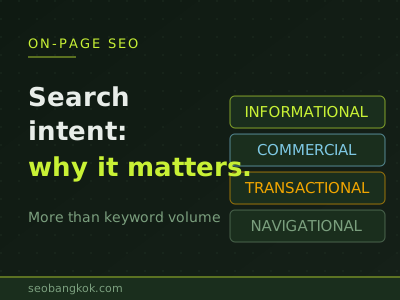
The second decision is what kind of search the content is targeting. Every commercial keyword has an intent layer that determines what users expect when they search, and matching that intent is more important than getting the exact keyword right. Search intent comes in four broad categories: informational (looking to learn), commercial (looking to compare options), transactional (ready to buy), and navigational (looking for a specific brand or page).
The intent shapes the content type. An informational query like "what is SEO" wants an explainer page; the same audience six months later searching "best SEO agency Bangkok" wants a commercial comparison or service page. The same business can produce both pieces, but they look completely different and serve completely different jobs.
The trap is producing informational content when the business needs commercial content, or vice versa. A consultancy that writes 30 informational blog posts on SEO topics generates traffic from people researching SEO concepts, not from people looking to hire a consultant. Both audiences exist; only one of them generates revenue. The strategic question is what mix of intents you actually need given your business model and the gap between informational traffic (cheap to attract, hard to convert) and commercial traffic (harder to attract, easier to convert). The diagnostic that feeds this kind of strategy lives in how to run a competitor SEO analysis.
For more on the intent layer in practical detail, the search intent post covers the four types with examples of how each appears in real SERP results. The pattern recognition is what matters: looking at the current top results for a query tells you what intent Google has decided the query represents, and content that targets that query needs to match the dominant intent or it will not rank regardless of how good the content is.
Decision three: where this piece fits in the site
The third decision is structural: how does this piece connect to the rest of the site, and what is its job in the wider content architecture? A piece of content that sits in isolation, linked from the blog index and nothing else, has limited value. A piece that is part of a defined topic cluster, with clear internal links to and from related content and from a parent service page, accumulates SEO value through the cluster relationship.
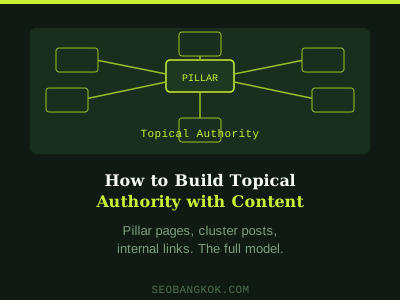
The topic cluster model is the cleanest framework for this. Each cluster has a pillar page (a broad, commercial page targeting a high-volume term) and a set of supporting posts (narrower, more specific pieces that link up to the pillar and across to each other). The pillar page benefits from the link equity flowing in from supporting content; the supporting content benefits from sitting in a coherent topical neighbourhood that Google can recognise.
Before writing any post, the question is: which pillar does this support, and which other posts in this cluster will it link to and from? If the answer is "none, it is standalone," the piece is probably not worth writing unless it serves a very specific commercial purpose that justifies the isolation. Strategic content sits in clusters; isolated content sits in the index as dead weight.
The prioritisation matrix: what to write first
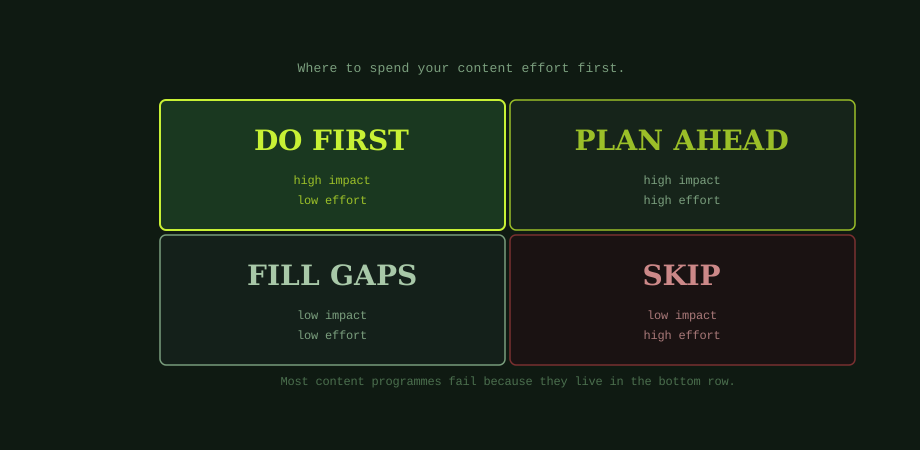
With audience defined, intent understood, and structure in place, the next question is sequencing. Most content programmes have many more good ideas than they can produce in the available time. The matrix that resolves this is straightforward: plot every candidate piece on two axes, business impact and effort to produce.
High impact, low effort is the top-left quadrant and where the first six months of writing should live. These are usually keywords with clear commercial intent, manageable competition, and topics where the business already has working knowledge that can be turned into content without weeks of research. The hero matrix above labels this "do first" because it is the only quadrant that produces traffic and revenue quickly enough to fund the rest of the programme.
High impact, high effort is the top-right quadrant. These are the cornerstone pieces that need to exist eventually: definitive guides, comprehensive resources, pillar pages that take weeks to produce properly. They belong on the roadmap but do not need to come first; they tend to require depth that early-programme bandwidth cannot easily supply.
Low impact, low effort is the bottom-left quadrant. These pieces fill gaps in the content cluster, link into more important pages, and serve users who arrive on the site through related queries. They are not the priority but they are cheap to produce and accumulate value over time. The right move is to batch them between higher-impact pieces.
Low impact, high effort is the bottom-right quadrant. These pieces should not get written, even though every business has a list of them. They are usually topics that feel important to the company but do not serve a real search audience or a real business outcome. The discipline is recognising them and not writing them, regardless of how interested internal stakeholders are.
The brief: five things to define before writing
Once a topic clears the prioritisation matrix and gets scheduled, the next discipline is the content brief. Most posts that fail do so because they got written without a defined brief; the writer made up the audience, the intent, and the structure as they went. The result is generic content that satisfies no specific reader. A one-page brief written before any drafting prevents this almost entirely.
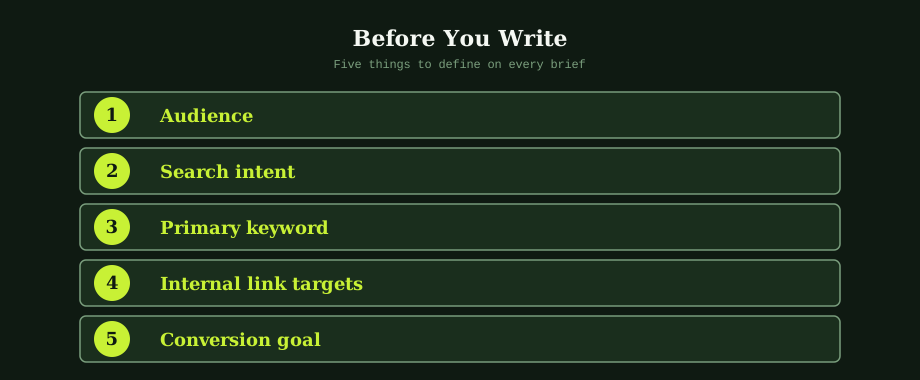
Audience repeats the discipline from earlier, applied at the piece level. Even within a content programme targeting one primary audience, individual pieces may serve different segments at different journey stages. The brief names the specific reader for this piece.
Search intent categorises the target query and dictates the content type. Informational queries get explanatory pieces; commercial queries get comparison or service content; transactional queries get conversion-focused pages. Mismatched intent is the most common reason that good content does not rank.
Primary keyword is the one query the piece is targeting, with secondary queries listed for natural inclusion in the body. The primary keyword should appear in the title, the H1, and the first paragraph. The secondary queries appear naturally in the body without forced placement.
Internal link targets are the existing site pages this piece should link to (typically the relevant service page, the pillar page in its cluster, and 2 to 4 related supporting posts), and the pages it should be linked from when published (typically the pillar page and any related posts that should add a contextual reference). The mechanics of refreshing old content as part of that programme sit in content refresh for SEO. Internal linking is the single most consistent driver of new-content ranking speed; pieces that arrive into a strong internal link structure rank within weeks rather than months.
Conversion goal is what reader action this piece is meant to enable. For commercial pieces, the goal is usually a contact form submission or service page visit. For informational pieces, it may be an email signup or a related-post click that moves the reader toward more commercial content. Without a defined conversion goal, the post becomes a dead-end traffic generator that produces no business outcome.
How to tell if the strategy is working
Content strategy is a long-cycle game. Most pieces take 3 to 6 months to show meaningful ranking data, and the strategy as a whole needs 6 to 12 months before it can be judged fairly. The leading indicators that show up sooner are useful for course correction but not for final judgment.
The earliest signal is impressions in Google Search Console, which appear within 2 to 4 weeks of publication. A new piece that earns no impressions after 4 to 6 weeks is either not indexed (check coverage), not matching any queries (check intent alignment), or competing in a SERP where it has no chance (check competition). Each diagnosis suggests a different fix.
The next signal is impressions converting to clicks at a reasonable rate. A piece earning 1,000 impressions and 5 clicks has a CTR of 0.5%, which is below the average for any reasonable position; the title tag and meta description need work. A piece earning 1,000 impressions and 60 clicks has a CTR of 6%, which is competitive; the work is to drive more impressions through better positioning.
The lagging indicators take longer: organic sessions, conversion rate from organic traffic, and reduced cost per acquisition compared to paid channels. These show up at 6 to 12 months and are the metrics that actually justify the content investment. Strategies that look terrible at month 3 frequently look excellent at month 9; this is normal and should be expected rather than treated as failure.
For businesses that need help structuring a content strategy that produces business outcomes rather than just publication volume, our digital consultancy service works through audience definition, cluster planning, and the prioritisation matrix for your specific business. If you want stronger SEO in Bangkok, we can also audit your existing content for the gaps between what you have published and what your audience is actually searching.
Common questions
How much content does my business actually need for SEO to work?
Less than most agencies will tell you, but more than most business owners want to commit to. The practical floor for a service business with three to five core service areas is 25 to 40 focused pieces of content built over 12 to 18 months: a strong pillar page per service, plus 4 to 8 supporting cluster posts under each pillar that answer specific questions buyers ask. For e-commerce, the equivalent is well-optimised category pages plus 15 to 30 buying-guide and comparison posts. What does not work: weekly thin blog posts on whatever feels topical that week. Volume without strategy produces a graveyard of pages that get a few impressions and no conversions. The discipline is to write less but with intent, then update what is already published rather than constantly producing new pieces.
How do I prioritise which content to write first?
Plot every potential topic on two axes: business impact (does ranking this topic actually generate enquiries or sales?) and effort (how much work to produce a competitive piece?). The high impact, low effort quadrant is your starting point. These are usually keywords with clear commercial intent, manageable competition, and topics where you already have working knowledge. The high impact, high effort topics need planning but should be on the roadmap. Low impact topics should be deprioritised regardless of how easy they are to write. The single biggest content strategy mistake is publishing a long string of low-impact pieces because they are familiar topics, while neglecting the harder but higher-value pieces that would actually move business outcomes.
What is wrong with writing content for everyone?
Content written for everyone speaks to no one in particular and ranks for nothing in particular. The clarity that wins search rankings comes from specificity: a clear primary audience, a clear search intent, and content that demonstrably serves that specific reader better than alternatives. Generic content tries to be helpful to a broad audience and ends up being shallow on every dimension. Google's helpful content systems have become better at detecting this pattern; pages that feel written to attract traffic rather than serve a specific reader increasingly fail to rank.
How do I tell if my content strategy is working?
The leading indicator is impressions in Google Search Console, not rankings or traffic. New content typically takes 3 to 6 months to show ranking data; impressions appear within 2 to 4 weeks of publication. A piece that earns impressions but few clicks is ranking for the right queries but losing the click. A piece earning neither impressions nor clicks after 8 weeks is not ranking for its target queries, which usually means search intent or keyword targeting was misaligned. The lagging indicators that prove the strategy is working are organic traffic to commercial pages, qualified enquiries from organic search, and reduced cost per acquisition compared to paid channels.