The underlying idea is straightforward. If a site has one good page on local SEO and a competitor has a pillar page on local SEO plus ten in-depth supporting posts covering every aspect of the topic, Google has more evidence that the competitor understands local SEO thoroughly. The competitor gets more topical authority. That authority lifts all their related pages, including the commercial ones.
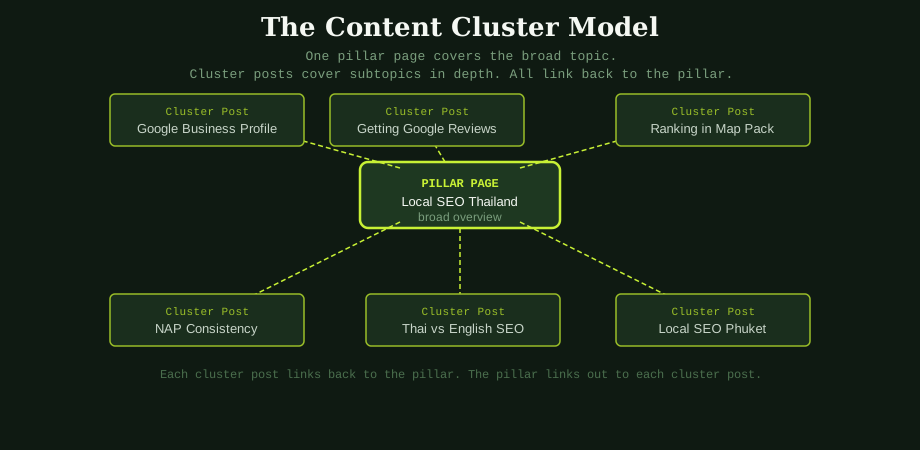
The cluster model formalises this by creating a deliberate hub-and-spoke structure: one central pillar page covering the broad topic, surrounded by cluster posts that each go deep on a specific subtopic, with consistent internal linking tying the whole thing together.
What a pillar page actually is
A pillar page is not just a long blog post. It is a comprehensive overview of a broad topic that functions as the authoritative hub for everything your site covers on that subject. It targets the head keyword for the topic. It touches on all the major subtopics but does not go deep on any of them. It links out to the cluster posts that cover each subtopic in depth.
For a law firm in Bangkok, the pillar page might be "Business Law in Thailand: A Complete Guide." For a restaurant group, it might be "Fine Dining in Bangkok: What to Know." For an SEO consultancy, it is the local SEO Thailand overview page that acts as the entry point into all the more specific local SEO content.
The pillar page should be longer than a typical post because it is covering more ground. Two thousand words is a reasonable floor. It does not need to be exhaustive on every subtopic because the cluster posts handle that. What it needs is clear structure, good keyword coverage of the broad topic, and links to every major cluster post.
What cluster posts do differently
Cluster posts go deep where the pillar page goes broad. Each cluster post owns one subtopic and covers it as thoroughly as a reader would need to actually understand or implement it. A cluster post should answer the specific question a reader has about that subtopic, not just touch on it.
The relationship between pillar and cluster is visible in the internal link structure. Every cluster post links back to the pillar page using relevant anchor text. The pillar page links out to every cluster post. This bidirectional linking tells Google that these pages form a coherent subject group, which is what triggers the topical authority signal.
Cluster posts also target more specific, lower-competition long-tail keywords than the pillar page. The pillar targets "local SEO Thailand." A cluster post targets "how to optimise your Google Business Profile in Thailand" or "NAP consistency for Thai businesses." These more specific terms are easier to rank for individually and, when clustered together, reinforce the authority of the central pillar page for the broader term.
Planning the cluster
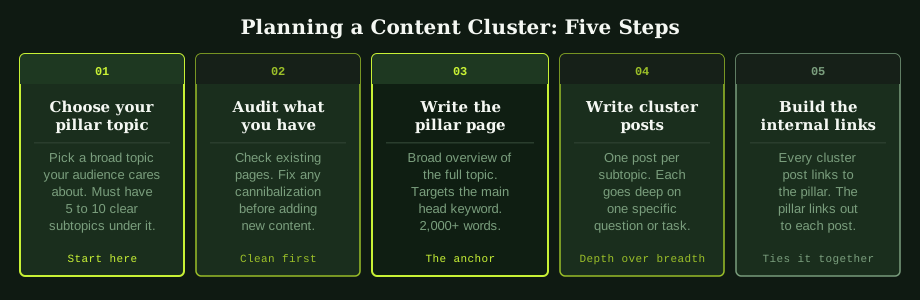
Choose the pillar topic. It should be broad enough to have five to ten genuine subtopics under it, but specific enough that your site has a realistic chance of being seen as authoritative. "Marketing" is too broad. "Local SEO for Thai businesses" is about right. The topic should also map to something your target audience genuinely searches for and that connects to what you sell.
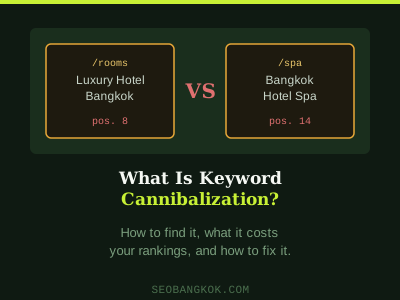
Audit what you already have. Before writing anything new, check whether pages already exist that cover this ground. If they do, look for keyword cannibalization and fix it before adding more pages into the mix. A cluster built on top of a cannibalised foundation will not work properly because the internal link signals will be confused from the start.
Write the pillar page first. This gives you the anchor for the whole structure. The cluster posts can reference it before they are published. The pillar can link out to cluster posts as they go live, adding links progressively rather than waiting for all of them to be ready.
Write the cluster posts in priority order. Start with the subtopics that have the highest search volume or the most direct relevance to the commercial outcome you are trying to drive. If the cluster is about local SEO and your main service is Google Business Profile management, write that cluster post first.
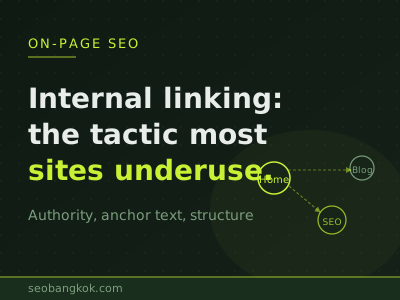
Build the internal links consistently. Every cluster post must link back to the pillar. The pillar must link out to every cluster post. Cluster posts can also link to each other where the topics are adjacent. This is what makes it a cluster rather than a collection of unrelated posts on the same general subject. The internal linking guide covers the mechanics of how anchor text and link placement affect how authority flows through the structure.
How many clusters does a site need?
This depends entirely on the scope of the business and the number of distinct subject areas it needs to be authoritative in. A single-service business might need only one or two clusters. A multi-service agency might need five or six to cover each service area properly.
The more useful question is how many the business can actually maintain. A cluster only works if the content is genuinely good and consistently updated. Five clusters with excellent content are more valuable than fifteen clusters where most of the posts are thin and outdated.
The approach I recommend to clients starting from scratch is to build one cluster completely before starting another. Get the pillar page and five to eight strong cluster posts live, link them up properly, and let Google process the structure before expanding. Trying to build three clusters simultaneously often results in three incomplete structures, none of which generates enough topical coverage to move rankings.
Clusters and commercial pages
The most commercially effective cluster structure is one where the pillar page is a service page, not a blog post. A blog post pillar can rank well but it generates informational traffic that does not convert easily. A service page pillar generates topical authority while also being the page you want potential clients to land on.
As an SEO specialist Bangkok-based consultant, the content strategy I build for clients typically involves mapping each core service to a cluster, with the service page at the centre and supporting blog content around it. This gives each service page the topical authority signal from the cluster while also directly earning the commercial rankings that drive enquiries. The SEO services Thailand page is an example of a service page designed to function as a pillar, with supporting content in the blog covering every major aspect of SEO strategy.
Common questions
How many cluster posts do I need for a pillar page?
There is no fixed number, but a minimum of five to six cluster posts gives Google enough coverage to register topical authority around the pillar topic. More is better up to the point where you run out of genuinely distinct subtopics. Writing ten shallow cluster posts is less effective than writing six thorough ones. Quality and genuine coverage matters more than volume.
Does the pillar page need to be longer than the cluster posts?
Generally yes. The pillar page covers the full topic at overview level, which typically means 1,500 to 3,000 words. Cluster posts can be shorter if the subtopic does not warrant more, but they should go deeper on their specific focus area than the pillar does. The relationship is breadth on the pillar, depth on the clusters.
Can a service page be a pillar page?
Yes, and this is often the most commercially valuable structure. A service page targeting a broad keyword like Local SEO Thailand acts as the pillar. Blog posts covering subtopics act as the cluster posts. All cluster posts link back to the service page. This drives ranking signals to a page with a direct conversion path, rather than to a blog post that generates informational traffic without converting.
How long does it take for a content cluster to show results?
Typically three to six months before the cluster structure begins to influence rankings noticeably. Google needs time to crawl all the pages, process the internal link signals, and re-evaluate topical relevance. Publishing all cluster posts within a short window and linking them up immediately tends to produce faster results than dripping them out one per month.