
What Is AI SEO? A Practical Explanation Without the Hype
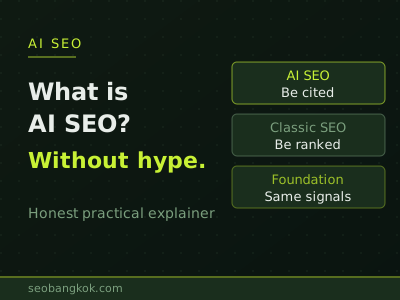
The honest version of what AI search optimization actually is, what it can and cannot do, and why it starts with fixing your regular SEO first.
Read the AI SEO explainerAI SEO services in Thailand build on strong search foundations. We improve structured content, entity signals, crawlability and answer-ready page sections so Google AI Overviews, ChatGPT, Gemini and Perplexity can understand and cite the business.
AI search engines like Google AI Overviews, ChatGPT, and Perplexity synthesise answers from sources they already trust. They do not discover your business anew. They pull from the web's existing authority structure, weighted toward sites with strong technical foundations, clear entity signals, genuine expertise, and content structured to answer specific questions.
Every structural problem that traditional SEO tolerates, AI search amplifies. A site that struggles on page two is not getting cited in AI answers. A brand with thin authority is not being recommended by ChatGPT. Vague, generic content that holds a decent organic position through age alone is being skipped by AI systems that evaluate information quality sentence by sentence.
The path to AI visibility runs through the same work as strong SEO. There is no separate trick. Businesses that appear in AI answers consistently have the strongest traditional SEO foundations, plus structured content that AI systems can extract cleanly.
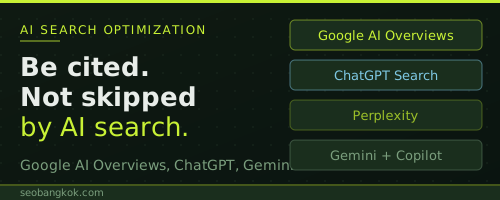
Most businesses invisible in AI search have at least one of these problems. Many have all four.
AI systems cannot cite what they cannot access. If Google cannot cleanly crawl, index, and parse your site architecture, AI systems have nothing to work with. Technical SEO is still the foundation. Everything else depends on it.
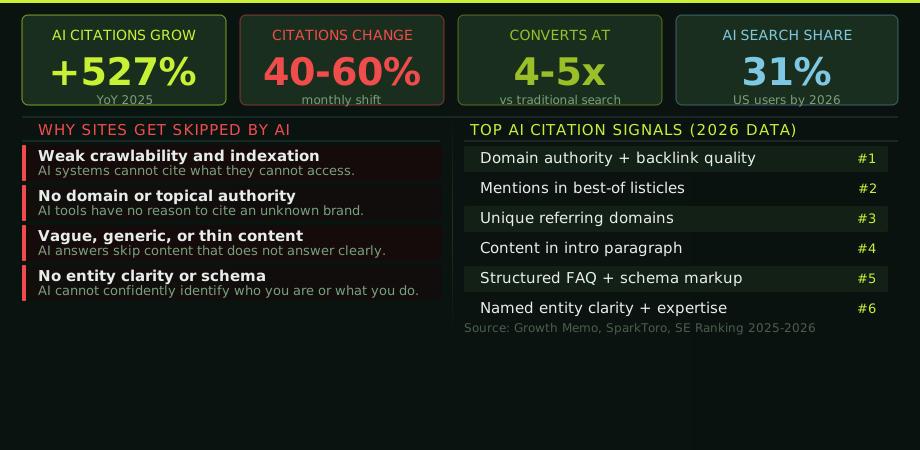
AI tools have no reason to cite a brand with no external validation. Authority from relevant backlinks, external mentions, and E-E-A-T signals determines who gets referenced. Research across thousands of ChatGPT prompts consistently shows domain authority as the strongest citation predictor.
AI answers skip content that does not answer clearly. Vague service descriptions, generic category pages, and thin blog posts that say nothing specific are invisible to AI synthesis. Content must directly answer specific questions with factual claims that can be extracted and attributed.
AI systems work with entities, not just keywords. Your business, its location, its expertise, and its relationships need to be unambiguously defined through structured data and on-page signals. Without clear entity definition, AI systems cannot confidently identify who you are or what you do.
This is not a separate channel from SEO. It is a more demanding version of good SEO, with additional work on content structure, entity signals, and citation-worthiness.
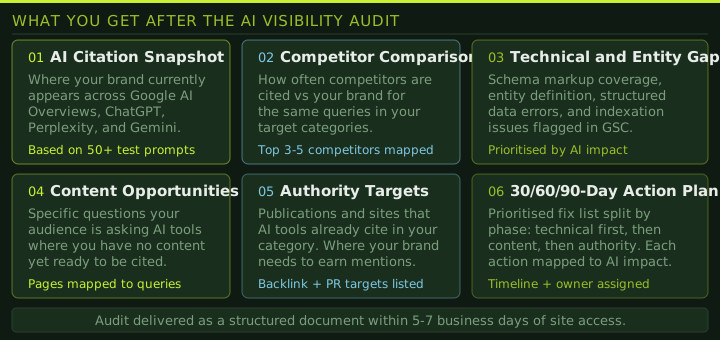
Systematic testing across Google AI Overviews, ChatGPT, Perplexity, and Gemini to establish your current citation presence and identify gaps relative to competitors. Search Console data reviewed where Google exposes useful AI and Search Appearance signals.
Crawlability, indexation, schema markup, Core Web Vitals, and structured data reviewed to ensure AI systems can cleanly parse every important page on your site. If Google cannot access it, no AI system can cite it.
Organisation, LocalBusiness, Person, Product, and FAQ schema implemented correctly. Your business, its location, its expertise, and its relationships unambiguously defined across structured data and on-page signals.
Content restructured to directly answer the questions AI systems synthesise answers for. Clear definitions, direct answers in opening paragraphs, concise FAQs, and factual claims that AI systems can extract and attribute.
AI citation follows authority. We work on earning coverage in relevant publications, building links from domains AI tools already cite, and creating the external validation signals that increase the probability of AI reference.
Monthly tracking of AI citation presence across platforms, Search Console data where AI signals are available, branded search volume trends, and traditional ranking data. Transparent about what can and cannot yet be reliably measured in this evolving field.
The audit produces six specific deliverables in a structured working document. Not a slide deck of recommendations. Something you can act on directly or hand to your development or content team.
AI citation tracking is genuinely immature. The major AI platforms do not share query volumes or selection criteria. SparkToro research from January 2026 found there is less than a 1-in-100 chance that ChatGPT gives the same brand list in any two responses to the same question. Between 40 and 60 percent of cited sources change month-to-month.
Anyone promising guaranteed AI Overviews placement is overstating what the field allows. What this service delivers is building the foundations demonstrably correlated with AI citation: stronger authority, cleaner structure, more specific and directly useful content, and clear entity signals.
What the data does support: AI-referred sessions grew 527% year-over-year in 2025. Traffic from AI platforms converts at 4 to 5x the rate of traditional search. The window to build early AI visibility in Thailand and ASEAN markets is open. Most competitors have not started.
Sources: Growth Memo Feb 2026 · SparkToro Jan 2026 · SE Ranking Aug 2025
TOP AI CITATION SIGNALS (2025-2026)
The honest version of what AI search optimization actually is, what it can and cannot do, and why it starts with fixing your regular SEO first.
Read the AI SEO explainer
Three acronyms, one underlying discipline. What each term means, how they overlap, and which to focus on with limited time and budget.
Read the AEO vs GEO guide
The structural and content signals that correlate with appearing in Google AI Overview citations. Practical, based on current data, honest about limitations.
Read the AI Overviews guide