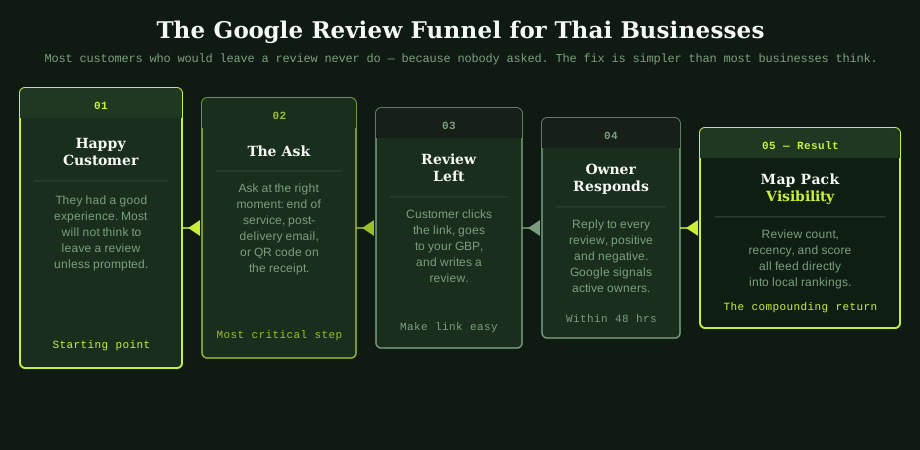
Before getting into the how, it is worth being clear about why reviews matter beyond just looking credible. Google uses review signals, specifically the volume, recency, and average rating, as part of the prominence component of its local ranking algorithm. A business with 80 recent five-star reviews will consistently outrank a competitor with better on-page SEO but 12 reviews from three years ago, assuming everything else is roughly equal.
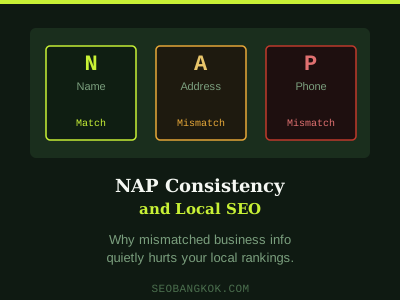
This makes review acquisition a genuine SEO activity, not just a reputation management task. It belongs in the same conversation as Google Business Profile optimisation and NAP consistency, because all three feed into the same local ranking outcome.
Why Thai businesses get fewer reviews than they should
There are a few patterns I see repeatedly with local clients in Bangkok. The first is that nobody asks. The customer has a good experience, leaves, and the business hopes they will think to write a review. Most do not. The window between having a good experience and actually writing a review is very short, and unless something prompts it that window closes.
The second is that the ask is too complicated. A business sends a customer to their website, which has a link to their Facebook page, which has a link to their Google profile. By the third click most people have moved on. The ask needs to go directly to the review form with one tap or one scan.
The third is cultural. Thai customers, and many Asian customers more broadly, are less inclined to leave reviews publicly without a personal prompt than customers in Western markets. A generic automated email asking for a review gets ignored far more often than a direct, personalised ask from the person who served them.
Getting your review link
The first practical step is getting the direct link to your Google review form. Log into your Google Business Profile, find the "Get more reviews" section, and copy the short link it generates. This link takes customers directly to the review entry screen with no extra steps. This is the link you will use in every channel.
Create a short, memorable redirect for it. Something like yourwebsite.com/review that forwards to the Google link. This is easier to say out loud, easier to put on a printed card, and easier to include in a WhatsApp message.
How to ask: three channels that work in Thailand
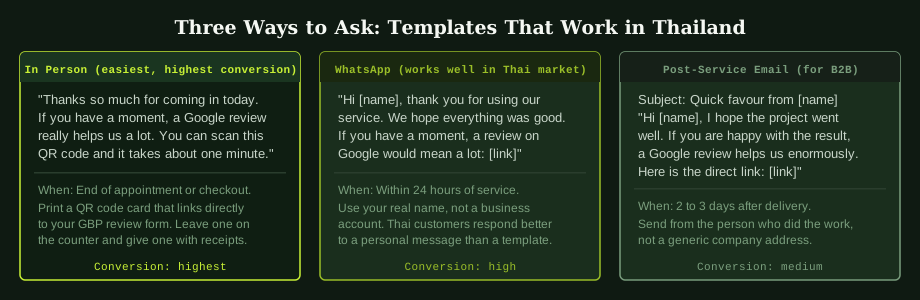
In person with a QR code. Print a small card with your review QR code and a single line of instruction. "Scan to leave us a Google review, it takes one minute." Put it on the counter, include one with every receipt, and hand one to the customer when they are leaving. For restaurants, salons, hotels, and any business with a physical customer interaction, this is the highest-converting method. The customer is still on-site, still in the good experience, and the friction is minimal.
WhatsApp. Thailand has one of the highest WhatsApp and LINE penetration rates in Asia. Many service businesses already communicate with customers through WhatsApp for bookings and updates. Following up with a personal review request through the same channel, within 24 hours of service, works well. The key is that it comes from a named person, not a business account, and it sounds like a genuine ask rather than a template blast.
Email for B2B clients. For consultancy, professional services, or any business where the relationship is more formal, a short personal email two to three days after project completion is the right approach. The subject line should include the sender's name, not the company name. The body should be two or three sentences. A direct link to the review form closes the loop with no extra steps for the recipient.
Timing matters more than most people realise
The best moment to ask for a review is immediately after the peak of the positive experience. For a restaurant, that is when the bill arrives or when the customer is saying goodbye at the door. For a spa or salon, it is at checkout. For a service business, it is the moment the work is completed and the client has confirmed they are happy.
Waiting a week to send a follow-up email is significantly less effective than asking at the moment of positive emotion. This is not theory. I have seen clients go from a trickle of reviews to four or five per week by simply shifting their ask from a follow-up email seven days later to an in-person ask at checkout. The experience is the same. The timing is the difference.
Responding to reviews: why it is not optional
Google looks at owner activity as a signal. A profile where the owner responds to reviews, both positive and negative, shows Google that the listing is actively managed. This correlates with higher local rankings independently of review count.
For positive reviews, the response should be personal and brief. Use the reviewer's name if they used one. Mention something specific from the review rather than a generic thank you. It takes 30 seconds and signals to the next potential customer reading the reviews that a real person runs this business and cares about the feedback.
For negative reviews, respond within 48 hours, stay calm, and address the specific concern raised. Do not argue, do not apologise excessively, and do not offer refunds or free services in public responses. A professional, measured reply to a negative review often does more for a business's reputation than a wall of five-star responses, because it shows how the business handles problems.
The one thing to avoid with negative reviews is ignoring them. An unanswered one-star review sitting on a profile for six months tells every potential customer that the business either does not monitor its profile or does not care what customers think.
What not to do
A few practices will get a Google Business Profile suspended or reviews removed. Do not offer incentives for reviews: discounts, free products, or anything of value in exchange for writing a review is a direct violation of Google's policies. Do not ask employees or friends to write reviews. Do not use a third-party service that generates reviews from accounts Google will identify as fake.
Fake reviews do get caught. Google's detection systems flag clusters of reviews from new accounts, reviews from the same IP address, and review patterns that look unnatural. The short-term boost is not worth the risk of a suspended listing.
For businesses working on local SEO in Thailand as a broader strategy, reviews are one of three pillars alongside the GBP itself and citation consistency. None of the three works well in isolation. Getting the review count up while the GBP is incomplete or the NAP is inconsistent limits how much the reviews can do for rankings. The map pack ranking guide covers how all three signals interact in more detail.
Common questions
Can I ask customers to leave a Google review?
Yes. Google explicitly allows businesses to ask customers for reviews. What Google prohibits is incentivising reviews (offering discounts or gifts in exchange), posting fake reviews, or discouraging negative reviews. A straightforward ask at the right moment is not only allowed but encouraged.
What should I do about a fake negative review?
Use the flag function in Google Business Profile to report it as policy-violating content. This is the only route to removal. Google reviews cannot be deleted by the business owner directly. When reporting, select the most accurate reason: spam, off-topic, or fake. If the review is from a real customer describing a genuine problem, the right response is a professional reply rather than a removal attempt.
Do Google reviews affect rankings outside the map pack?
Primarily they affect map pack and local panel visibility. For standard organic results, reviews have an indirect effect through click-through rate: a listing showing 4.8 stars and 200 reviews in the search snippet gets more clicks than one with no rating, and higher click-through rates are a positive ranking signal. Reviews also appear in Google Shopping results for product-based businesses.
What is the ideal number of reviews for a Thai business?
There is no universal threshold. It depends entirely on your competitors in the local market. A spa in Sukhumvit competing against listings with 400 reviews needs substantially more than a niche B2B consultancy where the top competitors have 15. Search your main keyword, look at the three businesses in the map pack, and check their review counts. That is your benchmark, not a generic number.