The most common Google Ads budget conversation goes like this: a business owner asks how much they should spend, gets told "it depends on your goals," and then sets a number that sounds reasonable based on what feels affordable that month. The campaigns launch, the spend goes out, and three months later the conversation is whether Google Ads even works for this business. Often the answer is yes, but the budget was set wrong from the start.
A workable Google Ads budget is calculated, not guessed. It starts from what you can afford to pay per customer, multiplies by how many customers you want to acquire, and produces a budget figure that maps to a business outcome. It also accounts for a structural reality that most budget conversations skip: below a certain threshold, the budget cannot work regardless of how good the campaigns are, because Google's automated bidding systems need enough conversion data to learn from.
Work backwards from your CPA, not forwards from a feeling
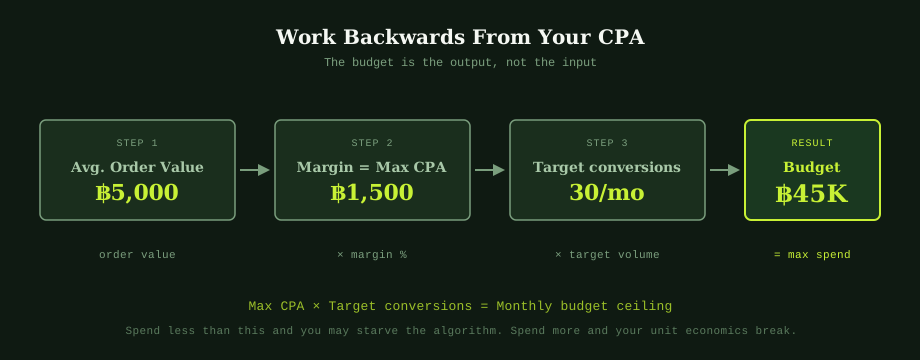
The number that should determine your Google Ads budget is your cost per acquisition target, derived from your unit economics. The chain is straightforward: average order value (or lifetime value for subscription businesses) multiplied by your margin percentage gives the maximum you can afford to pay for a new customer before you lose money on every sale. Your target CPA should sit below that maximum to leave room for actual profit.
Worked example: a Bangkok property agency averages 80,000 baht commission per closed deal. Their margin after agent splits, marketing costs other than ads, and overhead is roughly 25%, so max CPA before they lose money is 20,000 baht. Target CPA is 12,000 baht (60% of max), leaving healthy margin. If they want to close 10 deals per month from Google Ads, the budget ceiling is 120,000 baht per month.
That is the upper bound. The actual budget should respect that ceiling but may need to be lower if the business does not need that many deals, or higher in early phases when conversion rate is still being established. The point is that you can defend the number with a business reason, not a feeling.
For e-commerce, the same logic applies with smaller numbers and faster conversion data. A store with 5,000 baht average order value at 30% margin has a max CPA of 1,500 baht; target CPA of 1,000 baht and a goal of 30 orders per month produces a 30,000 baht monthly budget. The conversion rate from click to sale then determines what CPC you can sustain at that CPA, which feeds back into whether the keyword set is realistic. See also how to write Google Ads copy that gets clicks.
The minimum viable spend in competitive Thai markets
Beyond the calculation, there is a practical floor that applies regardless of what your CPA target suggests. Google's automated bidding systems (Smart Bidding, Performance Max, target CPA) need approximately 30 conversions per campaign per month before they have enough signal to optimise confidently. Below 15 conversions per month, the bidding is essentially noise; the algorithm cannot distinguish lucky variation from real performance signal.
For most competitive Thai commercial keywords, the budget needed to reach that conversion threshold is around 20,000 to 30,000 baht per month per campaign. Less than that, and you typically get too few conversions per week for Smart Bidding to work, and the campaign performs as if it were on manual bids without the optimisation benefit. The number scales with your CPC: low-competition niches can work on smaller budgets, high-CPC verticals like legal, insurance, or premium property in Bangkok need substantially more.
This is the awkward truth that does not appear in most Google Ads guides: very small budgets often do not work at all. A 5,000 baht monthly budget in a vertical with 30-baht CPCs gets you roughly 165 clicks, which at a 3% conversion rate produces 5 conversions. Smart Bidding cannot learn from 5 conversions per month. The campaign settles into spending the budget without optimising what is being spent on, and the results look random because they essentially are.
The honest advice for businesses with budgets below the viable threshold is either to wait until budget allows for a serious campaign, focus on SEO and organic channels until paid becomes affordable, or run a deliberately narrow campaign targeting only the highest-intent keywords with manual bidding (and the right negative keyword list) and accept that the upside is limited.
Concentration beats spreading across many campaigns
The single most common budgeting mistake is splitting a modest budget across many small campaigns. The instinct is reasonable: cover more keywords, address different audience segments, separate brand from non-brand. The result is that each campaign falls below the learning threshold individually, even though the total spend is substantial.
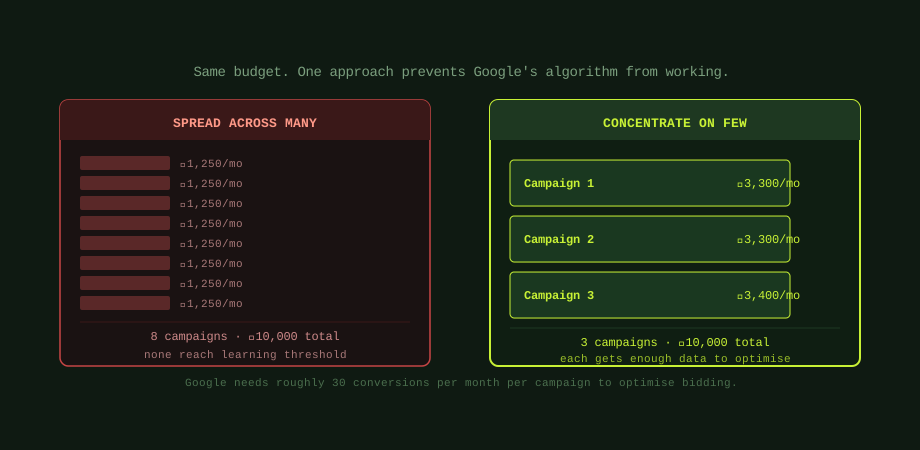
Imagine a 10,000 baht monthly budget spread across eight campaigns at 1,250 baht each. Each campaign generates 2 to 3 conversions per month at most. Smart Bidding has no useful data. Every campaign performs poorly. The same 10,000 baht concentrated on three campaigns at 3,300 baht each produces 8 to 10 conversions per campaign, enough for the algorithm to start learning. The total conversion count is higher even though the structure looks less comprehensive.
This is the strongest argument for the account structure principles more in the Google Ads account structure post: fewer campaigns, each with enough budget to reach the learning threshold, beats more campaigns starved of data. The structural decisions around what gets its own campaign and what gets bundled into ad groups within a shared campaign are budget decisions as much as organisational ones.
The exception is when you have genuinely distinct objectives, audiences, or budget caps that require separation. Brand campaigns belong in their own campaign because they need separate spend protection. Different conversion goals (lead form vs ecommerce purchase) often need separation. But "different keyword themes" alone is rarely a strong enough reason to separate when budget is constrained; ad group separation within a single campaign is usually sufficient.
Budget allocation when you do have several campaigns
For accounts with budget above the minimum viable threshold and a real need for multiple campaigns, allocation across them follows a different logic. The principle is that high-intent campaigns get fed first, then mid-funnel, then prospecting or upper-funnel work, with reserve capacity held for testing.
A typical allocation pattern: 40 to 50% of budget on bottom-of-funnel commercial keyword campaigns (the ones where searchers are ready to buy or hire), 20 to 30% on branded terms (cheap and high-converting, worth protecting), 20% on remarketing audiences who visited the site without converting, and 10% on testing new keyword groups or audiences. The exact split varies by business model: e-commerce stores typically need higher remarketing percentages, lead-generation businesses concentrate more heavily on bottom-of-funnel commercial intent.
One specific Thai market consideration: brand campaigns deserve their own budget allocation even though the volume is low and the CPC is cheap. Without a brand campaign, competitors can bid on your brand name and run ads above your organic listing. The defensive cost is usually small (often 1,000 to 5,000 baht per month for a SME) and the alternative is letting competitors capture searches by your existing customers. Treat it as a defensive line item, not an optimisation target.
When to increase the budget (and when not to)
The question of when to scale spending up has a clear answer: when CPA is at or below target and you have evidence that increasing spend will not deteriorate that CPA significantly. The way to test is to increase budget on the best-performing campaign by 20 to 30%, hold for 2 to 4 weeks, and watch what happens to CPA. If CPA stays flat, you have headroom; if CPA rises sharply, you have hit the point of diminishing returns for that campaign.
The mistake is increasing budget on a campaign that has not yet proved its CPA. New campaigns need to reach the learning threshold and stabilise before scaling makes sense. Throwing more budget at a fresh campaign just produces more uncertain data faster; the algorithm is no closer to optimisation than before.
The other mistake is not scaling when scaling would clearly help. Some businesses settle into a comfortable monthly budget and never test what would happen with more, even though the campaign is clearly performing within target. If the math says you can afford 50 more conversions at current CPA, and the campaign has been stable for months, the worst outcome of a budget test is that CPA rises slightly and you scale back. That is significantly less risky than leaving demand on the table indefinitely.
What to do if budget is the constraint
For businesses that genuinely cannot fund a viable Google Ads spend at their target CPA, the right answer is usually not to run Google Ads inefficiently. It is to either change the unit economics (higher-value products, longer customer lifetime, better conversion rates so each click is worth more), focus on organic channels in the interim, or run a deliberately limited Google Ads programme targeting only the highest-intent queries with the smallest viable campaign structure.
The decision to invest in Google Ads management should be a strategic one based on whether the campaigns can produce profitable outcomes, not a default because everyone else seems to be running ads. For businesses where the budget math does not work, the honest conversation is whether to fix the underlying constraint or to direct resources elsewhere until the constraint is fixed. An experienced PPC consultant Bangkok can help structure that decision rather than just spending the budget regardless of whether it should be spent.
Common questions
What is the minimum viable Google Ads budget in Thailand?
For competitive commercial keywords in Thailand, the practical floor is around 20,000 to 30,000 baht per month for a single campaign to generate enough clicks and conversions for Smart Bidding to optimise. Below this level, you are typically getting too few conversions per week for the algorithm to learn what works, and the campaign performs roughly the same as a manually bid one without any of the optimisation benefit. For very narrow niches with low CPCs, you may be able to start lower; for highly competitive verticals like legal, insurance, or property in Bangkok, the floor is often higher. The honest answer is that very small budgets (under 10,000 baht/month total) usually do not produce results that justify the management overhead, even though Google will gladly accept the spend.
How do I work out my target cost per acquisition?
Start from your average order value or customer lifetime value, multiply by your margin percentage, and the result is the maximum you can afford to pay to acquire a customer before the unit economics break. For a 5,000 baht average order at 30% margin, your max CPA is 1,500 baht. In practice, you want target CPA to be below max CPA to leave room for profit. A common starting point is 50 to 70% of max CPA as your target. Then your monthly budget is target CPA multiplied by the number of conversions you want to generate. This produces a budget figure that maps to a business outcome rather than a guess based on what your competitors might be spending.
Why do small Google Ads budgets often fail completely?
Google's automated bidding systems need conversion data to optimise. The threshold is roughly 30 conversions per campaign per month before Smart Bidding has enough signal to make confident decisions. Campaigns with fewer than 10 conversions per month essentially perform as random bidding, which is rarely better than a manual setup. Small budgets are usually spread across too many campaigns, and each campaign falls below the learning threshold. The same total budget concentrated on one or two campaigns produces more total conversions because each campaign reaches the data volume needed for optimisation. This is why the same spend produces wildly different results depending on how it is allocated.
Should I match my competitors' Google Ads spend?
No. Your keyword match types are a key control here. Competitor spend has almost nothing to do with what your budget should be. Your budget should be derived from your own unit economics: what you can profitably pay per conversion, and how many conversions you want. A competitor outspending you ten to one might be losing money on every click, hoping for market share or for LTV that justifies the spend. Or they might have a higher-value product that supports a higher CPA. Either way, their numbers do not apply to your business. Set your budget from your CPA target and what you can afford to spend, then optimise within that constraint. If your unit economics genuinely require more spend than you can afford, the business model needs to change, not the budget.