When you have ever logged into a Google Ads account and felt like you were looking at a filing cabinet someone forgot to label, you are not alone. The structure is not complicated, but it is rarely explained well. Once you understand what each of the four levels controls, the rest of Google Ads makes sense, and the work of fixing a poorly structured account becomes a series of clear decisions rather than guessing.
This post explains the hierarchy from the top down: what an account is, what a campaign is, what an ad group is, and what keywords and ads actually do. The goal is not to make you a Google Ads specialist; it is to give you enough structural understanding to look at your own account, see whether it is organised sensibly, and have an informed conversation with whoever manages it.
The four-level hierarchy
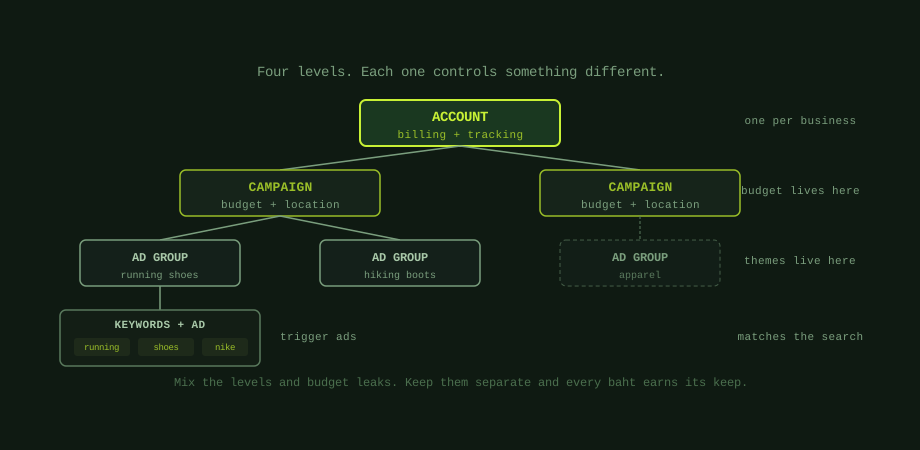
Every Google Ads account has the same four-level structure. The account sits at the top. Inside the account are one or more campaigns. Inside each campaign are one or more ad groups. Inside each ad group are keywords and ads. That is the entire system. Everything Google Ads does, every setting, every report, every change, happens at one of those four levels.
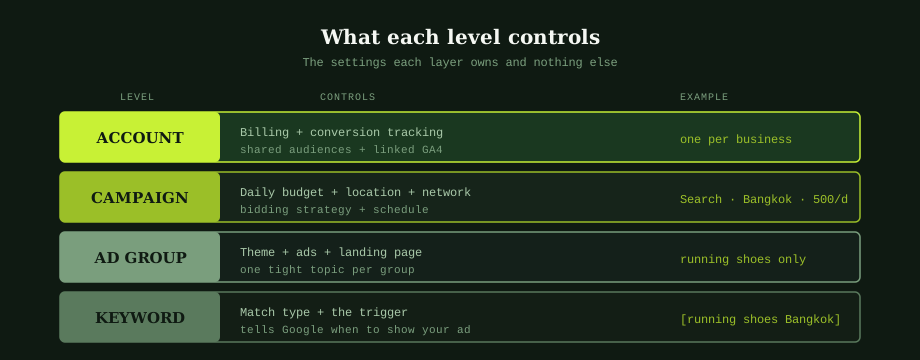
The thing that confuses most people first looking at the interface is that some settings appear at multiple levels (you can see keyword data on a campaign report, for example, even though keywords technically belong to ad groups). This is just the interface aggregating data upward; it does not change the underlying structure. Settings are controlled at one level only. If you want to change the daily budget, you change it on the campaign. If you want to change the ad copy, you change it on the ad group. See also how to write Google Ads copy that gets clicks. The level a setting lives at is fixed.
Level 1: the account
The account is the top-level container, usually one per business. It holds your billing information, your conversion tracking setup, any shared audience lists, and the link to your GA4 property. The account also stores account-wide negative keyword lists, scripts (if you use them), and the user permissions for who can log in and make changes.
Most things at the account level you set once and rarely touch. Billing setup, currency, time zone, account name. The exception is conversion tracking, which lives at the account level but needs ongoing attention to make sure conversions are being recorded correctly. A surprising number of underperforming accounts turn out to have broken conversion tracking; the campaigns look like they are not converting, but actually conversions are happening and just not being measured, so Smart Bidding has nothing to optimise toward.
One account per business is the right default. Some agencies create multiple accounts for the same business to separate work, but this fragments the data Google needs for bidding algorithms and makes audience sharing harder than it needs to be. Unless you have a specific reason (different legal entities, different currencies, different regions managed by different teams), one account is the cleaner choice.
Level 2: the campaign
Campaigns are where budget lives. Each campaign has its own daily budget, its own bidding strategy, its own location targeting, and a setting for which Google network it runs on (Search, Display, YouTube, Shopping, or some combination). If you want to spend more on one part of your business than another, you put them in separate campaigns. If you want to test a different bidding approach, you put it in a separate campaign.
The structural decision at the campaign level is how many to have. Too few campaigns and you cannot allocate budget by business priority; everything competes for the same daily spend. Too many campaigns and each one has too little volume for Google's bidding algorithms to learn from; Smart Bidding needs a few dozen conversions per month per campaign to optimise effectively, and fragmenting your spend across twenty thin campaigns prevents that.
The practical rule for most businesses: one campaign per distinct service or product category that has its own budget, its own bidding goal, or its own geographic targeting. A Bangkok law firm might have separate campaigns for corporate law, immigration, and family law if those are genuinely different practice areas with different lead values. A simple service business may need only two or three campaigns total. A medium e-commerce store with diverse categories may justify five to eight. Beyond that, the question is whether the additional campaigns are earning their data overhead.
Level 3: the ad group
Ad groups are where topics live. An ad group contains a set of closely related keywords that share the same ads and point to the same landing page. The theme should be tight: all the keywords in one ad group should answer the same intent and lead to the same destination. This feeds directly into your Quality Score. If a search for one keyword in the group should land on page A and a search for another should land on page B, those keywords belong in different ad groups.
The mistake most accounts make at the ad group level is mixing intents. A single ad group containing "running shoes," "running shoes review," and "buy running shoes Nike Bangkok" looks logical because they all involve running shoes, but the searches behind those queries are different. The first is generic browsing, the second is research, the third is buying intent for a specific brand in a specific location. One generic ad and one generic landing page cannot serve all three well. Split them into three ad groups, each with tight keyword variations and a specific ad and landing page combination, and the same budget produces materially better results.
This is also where the broader question of search intent matters as much as it does in SEO. Keywords with the same words but different intent need different ad group treatment. The keyword research you might already do for organic search, the breakdown is in the keyword research guide, applies directly to Google Ads at this level: you are not just finding keywords with volume, you are grouping them by what the searcher actually wants.
Level 4: keywords and ads
Keywords trigger ads. When someone searches a query that matches one of your keywords (subject to match type rules), Google considers your ad group's ads for display. The keyword level also controls match type for each keyword (broad, phrase, exact), the maximum cost-per-click (if you use manual bidding), and any keyword-specific landing page overrides.
Ads sit at the same level as keywords, also inside the ad group. Modern Google Ads uses Responsive Search Ads (RSAs), which means you provide multiple headlines and descriptions and Google's algorithms test combinations against different search queries. The work at this level is writing strong headlines that match the ad group's theme, choosing which to pin if you have specific messaging requirements, and reviewing performance data to see which combinations work.
The reason ads sit at the ad group level (not the campaign or keyword level) is that they should match the theme of the ad group. If your ad group is tightly themed around one topic, the ads can speak directly to that topic. If your ad group is broad and mixed, the ads have to stay generic, which lowers CTR and quality score. This is one of the strongest practical reasons for tight ad group themes: it lets the ad copy do its job.
Why poor structure wastes budget
The connection between structure and money is direct. Three specific ways poor structure costs you.
Mixed intent in one ad group means generic ad copy and generic landing pages. Some users click and bounce because the page does not match their query, costing you money without conversion. Others convert despite the mismatch, but the conversion data lumps together different intents, so bidding algorithms cannot learn what is working. The same budget produces fewer conversions because each click is less likely to match the user's actual need.
Second, single mega-campaigns prevent budget allocation by priority. If your law firm runs one campaign covering all practice areas with a 1,000 baht daily budget, that budget gets spent on whatever keywords get clicks first that day. If immigration queries come in earlier and consume the budget, family law and corporate law searches never see your ad even though those are higher-margin services. Separate campaigns let you control where money flows.
Third, fragmented structure (the opposite mistake) prevents bidding algorithms from accumulating the conversion data they need. Google's Smart Bidding strategies need roughly 30 to 50 conversions per month per campaign to optimise effectively. If you have 15 campaigns each with two conversions per month, none of them have enough data, and Smart Bidding cannot help any of them. Consolidating to four campaigns with eight conversions each gives the algorithms something to work with.
What a well-organised account looks like
The principles that produce a clean account: campaigns reflect business priorities and budget structure, not arbitrary divisions. Ad groups reflect tight thematic clusters where one ad and one landing page can serve all the keywords inside. Keywords are grouped by intent, not just by topic. Naming conventions are consistent so anyone looking at the account can navigate it without explanation.
A practical example for a Bangkok-based service business with three distinct service lines: three campaigns, one per service line. Within each campaign, three to six ad groups depending on how the service breaks down (by use case, by audience type, or by geographic sub-area). Within each ad group, five to fifteen tightly themed keywords sharing the same ads and landing page. Total: maybe 9 to 18 ad groups across the account, around 100 to 200 keywords, with conversion data flowing into each campaign in volumes that bidding algorithms can use.
This is significantly tidier than the structure most accounts arrive at after a couple of years of additions without periodic cleanup. The work to restructure an existing messy account is real (you need to plan the new structure, build it in parallel, migrate carefully, and accept a temporary performance dip while Google relearns), but the payoff is usually a 20% to 40% improvement in cost-per-conversion within three months as the new structure stabilises.
How this connects to SEO strategy
When you are running both SEO and Google Ads, the account structure question intersects with the wider SEO versus PPC strategy decision. The keyword research and intent mapping you do for one informs the other; the conversion data from Google Ads tells you which queries actually drive revenue, which then informs SEO content priorities. Treating PPC and SEO as completely separate disciplines wastes the cross-channel intelligence both can provide.
For businesses that want a structured review of their current Google Ads account, our PPC agency in Bangkok includes account structure audits as standard. If your account has been running for more than a year without restructuring, there is almost certainly budget being lost to structural issues that a focused review would identify. An SEO agency in Bangkok who also works with PPC can map the gaps and prioritise the fixes that produce the most lift in the shortest time.
Common questions
How many campaigns should my Google Ads account have?
As many as you have distinct businesses to manage budget for, but no more. The mistake at the small end is one campaign for everything, which means you cannot allocate budget separately to your priority services. The mistake at the large end is one campaign per keyword, which fragments budget so badly that no campaign accumulates the conversion data Google needs for bidding algorithms to work. A practical guide for most small to mid-size businesses: one campaign per distinct service or product category that has its own budget, its own bidding goal, or its own audience. A single e-commerce store typically does not need more than three to six campaigns unless the catalogue is very large.
What is the difference between a campaign and an ad group?
Campaigns control budget, location targeting, bidding strategy, and which Google network the ads appear on (Search, Display, YouTube, Shopping). Ad groups sit inside campaigns and control the theme: a set of related keywords that share the same ads and point to the same landing page. The simple way to think about it: campaigns are how you allocate money; ad groups are how you organise topics. If a setting affects budget or where ads appear, it belongs to the campaign. If a setting affects what the ad says or what page the user lands on, it belongs to the ad group.
Should I use single keyword ad groups (SKAGs)?
In most cases no, not anymore. SKAGs were useful when match types were rigid and keywords matched only the exact phrase typed. With Google's expansion of match type behaviour (broad match now expands aggressively, phrase match captures variations, even exact match matches close variants), the precision SKAGs were designed for is no longer achievable through structure alone. Modern best practice for ad groups is tight thematic grouping: 5 to 15 closely related keywords per ad group, sharing the same intent and the same landing page, rather than one keyword per group. The exception is high-value head terms where the small organisation overhead is worth the precision.
Why does poor account structure waste budget?
Three specific ways. First, mixed intent in one ad group means the same generic ad copy serves different searches; some clicks land on the wrong page and bounce, others convert but the data gets lumped together and bidding algorithms cannot learn what works. Second, single mega-campaigns prevent budget reallocation: if your campaign budget for the day is 1,000 baht, that thousand baht is consumed by whichever keywords get clicks first, even if those are the lowest-value queries. Third, fragmented structure prevents Smart Bidding from accumulating the conversion data it needs to optimise, leaving you on manual or basic automated bidding that performs worse.