When a tourist in Bangkok types "best rooftop bar Sathorn" into Google, they are searching in English. The Thai-market search engine share data that underpins this is in Google's market share in Thailand. The results they see are drawn from Google's English-language index. When a Thai professional types บาร์แดยว์ตามเน์นสาทร into the same search bar, the results come from an entirely different pool of indexed content. The restaurant that dominates the English results may not appear at all in the Thai results, and vice versa.
This is not a quirk of Google's system. It is how multilingual search is designed to work. Google matches the language of the user's query to the language of indexed content. A page written only in English will not rank for Thai queries. A page written only in Thai will not rank for English queries. They do not compete with each other and they do not reinforce each other's rankings.
The two indexes in practice
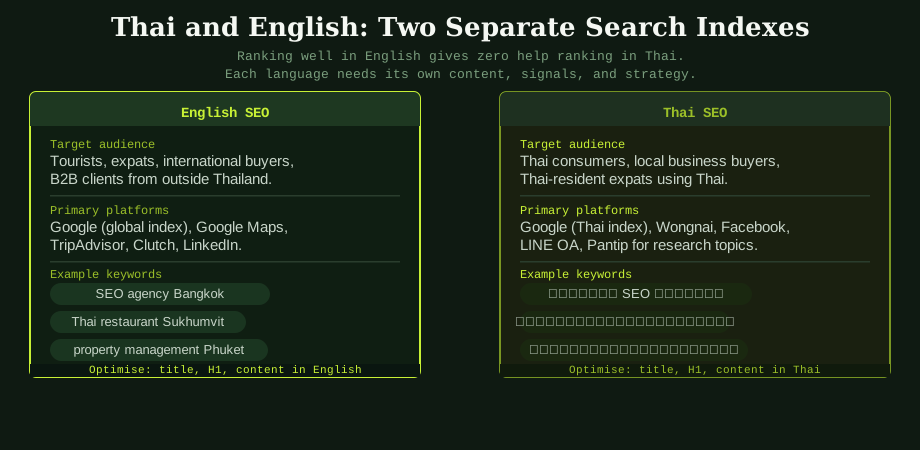
English SEO in Thailand targets three main groups: international tourists, long-term expats conducting their research in English, and overseas businesses looking for Thai suppliers, manufacturers, or service providers. The platforms are Google Search and Google Maps, with TripAdvisor, Clutch, and LinkedIn playing supporting roles depending on the sector.
Thai SEO targets Thai nationals and Thai-speaking residents. The primary platform is Google's Thai-language index, but Wongnai (for restaurants and hospitality), Facebook (for discovery and peer recommendations), and LINE Official Accounts (for direct communication) all play significant roles that have no direct equivalent in the English search ecosystem.
A hotel in Phuket Town that has excellent English-language SEO will appear when an Australian tourist searches for hotels on Google. It will not appear when a Thai family from Bangkok searches for the same thing in Thai, even if the hotel is a perfect match for what they want. These are two separate marketing problems requiring two separate solutions.
Should your business target both?
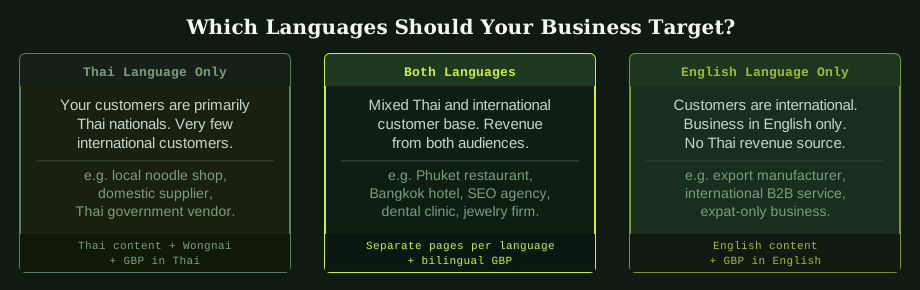
The answer is almost always yes for businesses in Thailand that serve a mixed market. A Bangkok dental clinic treating both Thai patients and expat patients needs both. A Phuket diving school with Thai instructors teaching Thai customers alongside international tourists needs both. A jewelry manufacturer in Silom selling to domestic buyers and international wholesale clients needs both.
The businesses that can justify English-only are those with genuinely international-only customer bases: export manufacturers, companies providing services exclusively to multinational corporations, or businesses catering only to foreign nationals with no Thai-speaking customer base.
The businesses that can justify Thai-only are those serving exclusively domestic Thai markets with no meaningful international revenue: local food vendors, domestic B2B suppliers, Thai-language content publishers. The multi-language application for export-focused Thai manufacturers is in SEO for B2B manufacturers in Thailand.
Everyone in the middle, which is most businesses I work with in Bangkok, Phuket, and Samui, needs to think about both. The question is not whether to do it but how to prioritise and where to start.
What the bilingual strategy actually looks like
The most practical structure for a bilingual website in Thailand is separate pages for each language rather than a single page with mixed content. The bilingual education vertical that runs heavily on dual-language content tracks is in SEO for schools in Thailand. A Thai-language service page and an English-language service page covering the same offering can coexist on the same domain without competing. Google treats them as serving different audiences and indexes them independently.
The URL structure matters. A clear setup is either language subdirectories (/th/ for Thai, /en/ for English, or the default domain for the primary language) or separate language designations in page names. What to avoid is a single page that mixes Thai and English paragraphs, which confuses Google's language detection and ranks for neither language cleanly.
For the Google Business Profile, complete all fields in both languages. The vertical-specific application of bilingual SEO to legal services is in SEO for law firms in Thailand. The business name, description, and posts should have Thai and English versions. This is the fastest win available for bilingual local search visibility because GBP directly controls how a business appears in the map pack for both language queries. The full setup process is explored in the GBP Thailand guide.
Thai keyword research: a separate exercise
One mistake that costs businesses significant ranking potential is translating their English keywords into Thai rather than researching Thai keywords independently. Thai users do not search for the direct Thai equivalent of English phrases. They search in ways that reflect Thai language structure, Thai consumer culture, and Thai discovery habits.
A jewelry company that ranks for "custom silver jewelry Bangkok" in English might assume its Thai equivalent is simply that phrase translated. But Thai buyers searching for jewelry use different terms, often including price signals, location markers, or material descriptions that have no direct English equivalent. The only way to know what Thai customers actually type is to research it specifically using Thai keyword tools, Google Suggest in Thai, and input from Thai native speakers familiar with the product category.
For local SEO in Thailand across both languages, the GBP is the highest-leverage starting point. For website content, start with your single most important page. Translate and Thai-keyword-optimise that one page first. Measure what Thai traffic it generates over 60 to 90 days. Then expand to the next most important page. This sequential approach is more effective than translating the entire site at once with less care per page.
Platforms beyond Google: the Thai ecosystem
English SEO strategy is largely Google-centric with some additional platforms depending on the sector. Thai digital marketing operates across a wider set of platforms where Google is dominant but not the only meaningful channel.
Wongnai matters for any food or hospitality business targeting Thai customers. Facebook matters for discovery and community recommendation across almost every Thai consumer sector. LINE OA is the primary customer communication channel for many Thai businesses and plays a role in retention that has no English equivalent. Pantip influences research decisions for technology, consumer goods, and services in a way that forums rarely do in Western markets.
The full local SEO Thailand playbook covers the platform landscape in more detail. For businesses targeting both Thai and international customers in specific Thai markets, the Phuket and Samui guides go deeper on the local dynamics for those island markets where the Thai and international audiences overlap most heavily. The SEO Samui page covers the Ko Samui search landscape specifically.
For businesses deciding how to structure a bilingual SEO strategy, or those who are currently investing in English SEO and want to understand the Thai opportunity they may be missing, an SEO specialist Bangkok-based review of both your English and Thai presence can identify the gaps and prioritise the effort that will move the needle fastest.
Common questions
Does having an English website help you rank for Thai searches?
No. Thai and English are separate search indexes. A page written in English will not rank for a Thai-language query even if the topic is identical. Google matches the language of the search query to the language of the content. To rank for Thai searches you need Thai-language content, not a translation note or a mixed-language page.
Is it enough to just translate my English pages into Thai?
Translation is the starting point, not the finishing line. Thai search queries use different phrasing, different keyword structures, and often reflect different intent from their English equivalents. A direct translation may use the right language but miss the actual terms Thai users search for. Thai-language keyword research is a separate exercise from English keyword research and should be done independently.
Do Thai and English pages on the same site compete with each other?
No. They serve different indexes and different queries. A Thai-language page and an English-language page covering the same topic on the same domain do not compete. They rank independently for their respective language audiences. Hreflang tags can help signal the language relationship to Google, though for most Thai-English setups the simpler approach of separate language subdirectories or pages is sufficient.
What is the minimum Thai SEO setup for a business with some Thai customers?
The minimum effective setup is a Google Business Profile completed in both Thai and English, and at least a Thai-language version of your most important landing page. This covers the two highest-impact touchpoints for Thai searchers: the map pack result (GBP) and the organic click destination (website). Beyond this minimum, adding Thai content to other key pages increases visibility progressively as resources allow.