I have worked with businesses in Phuket across several sectors over the years. A dive operator in Chalong, a restaurant group in Phuket Town, a villa rental company in Rawai, a dental clinic near the old town. Every one of them came to me with the same initial assumption: they needed to rank on Google for their main service and location. That assumption is correct as far as it goes. But Phuket's search landscape is more complicated than most businesses realise, and the complication is the audience split.
This guide covers the full local SEO strategy for Phuket businesses, from Google Business Profile setup to the district-level keyword approach that most competitors are not using.
Understanding the three-audience problem
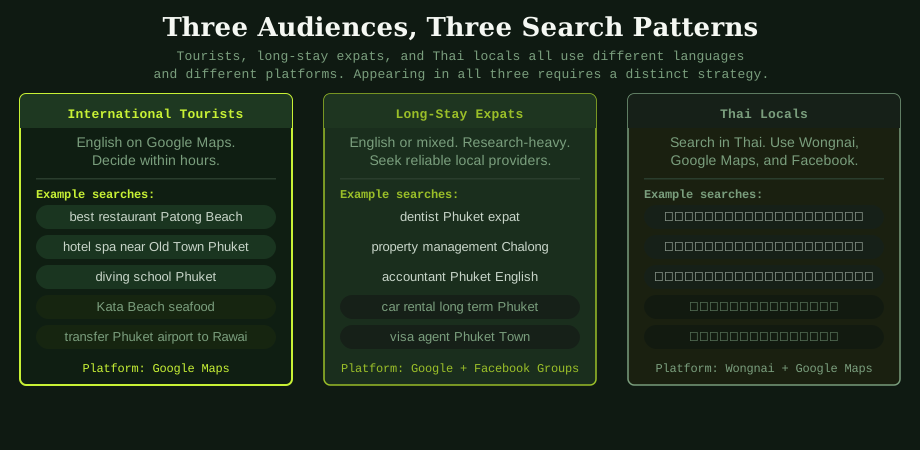
International tourists are Phuket's highest-volume search audience in season. They search in English, almost exclusively on Google Maps, and they search fast. Someone who landed in Phuket three hours ago and is deciding where to eat dinner tonight is not doing deep research. They are looking at the top three map results, reading a handful of recent reviews, and making a decision. For this audience, Google Business Profile completeness, photo quality, review recency, and star rating are everything.
A tour operator I worked with in Patong had a perfectly functional website but almost no walk-in or online enquiry traffic from tourists. The GBP had five photos from 2022, 34 reviews with no owner responses, and the opening hours had never been updated from the original setup. Within three months of fixing all three, enquiry volume from organic search tripled during peak season.
Long-stay expats are a different buyer entirely. They are not deciding in the next hour. They are looking for a dentist they can see every six months, a property manager for their villa, an accountant who speaks English. They research more carefully, read more reviews, visit the website, and sometimes ask in expat Facebook groups before deciding. For this audience, a well-built website with clear service descriptions, good reviews across platforms, and an active social presence matters alongside the GBP.
Thai locals are often the most overlooked segment by foreign-owned Phuket businesses. Phuket has a large Thai-resident population working in tourism and services who spend money locally. They search in Thai, use Wongnai for restaurants and Google Maps for most other services, and they follow Facebook pages actively. A restaurant that is not on Wongnai is invisible to this audience regardless of how well its English Google presence performs.
Google Business Profile: Phuket-specific setup
The full approach to optimising a Google Business Profile in Thailand applies here, but Phuket businesses need to pay particular attention to a few additional details.
Service area vs single location. Many Phuket businesses serve customers from across the island. A transfer company, a catering service, a yacht charter. If you serve customers at their location rather than requiring them to come to you, set your GBP as a service area business covering the relevant districts. This makes you visible in searches from areas you serve, not just your home location.
Bilingual information. Complete all GBP fields in both English and Thai. The business name, description, and category should be set in English as the primary, but Google allows alternate language entries that appear for Thai-language searchers. A Phuket Town restaurant that has its name in both scripts, a Thai-language description, and Thai-language posts will appear for Thai-language searches that an English-only profile misses entirely.
District-specific photos. Include exterior photos that show recognisable local landmarks or street context where possible. A restaurant that includes a photo clearly showing the Phuket Town old-town architecture in the background gets indexed with that geographic context. A hotel near Kata Beach with photos showing the beachfront view is confirming its location visually to Google in a way that text alone does not. The hospitality-specific playbook is in SEO for hotels in Thailand.
Posts and Q&A. Phuket businesses should run GBP posts that address the tourist decision cycle. "Open daily 11am to 11pm including public holidays." "Free pickup from Patong, Kata, and Karon hotels." "English-speaking staff." These are not marketing messages. They are answers to the questions tourists are typing before they decide to visit or call. The Q&A section of GBP allows you to pre-populate questions and answers that appear prominently on the profile.
The district keyword strategy: where most Phuket businesses get it wrong
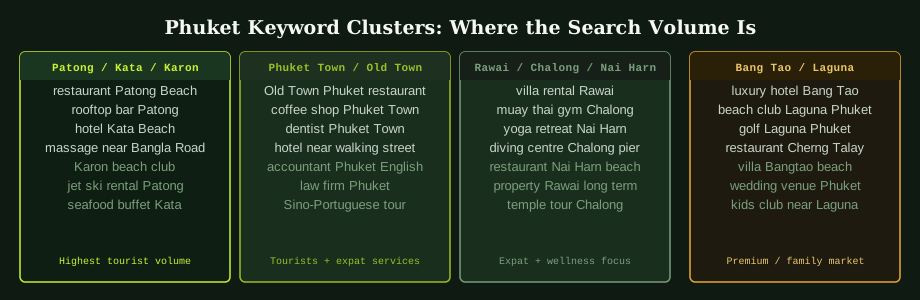
Patong, Kata, Karon, Phuket Town, Rawai, Chalong, Bang Tao, Laguna, Nai Harn, Cherng Talay. These are not interchangeable. Each has its own visitor profile, its own search patterns, and its own competitive landscape on Google. The dive school in Chalong that optimises only for "diving Chalong" is invisible to the tourist staying in Kata who searches "diving Phuket Kata pickup."
The Rawai villa rental company I mentioned works with clients from across the island and internationally. When we audited their site, every page said Rawai. No mention of Bang Tao, no mention of Patong, no mention of the airport transfer inclusion. They were capturing Rawai searches and nothing else. We created a simple location landing page for each district they served, each 400 words targeting the searches from that area. Within four months, organic enquiry leads from outside Rawai accounted for 40% of their website contacts.
The keyword structure that works for Phuket businesses covers three levels. The island-level terms ("diving Phuket," "restaurant Phuket") are high competition but worth targeting on the homepage. The district-level terms ("diving Chalong," "restaurant Patong Beach") are the core of any local SEO strategy and where most of the conversion traffic comes from. The hyperlocal terms ("diving near Chalong pier," "restaurant walking distance from Bangla Road") are low competition and high intent, worth targeting on specific pages or blog posts.
Reviews: the seasonal dimension
Phuket has a pronounced seasonal pattern that affects how Google evaluates reviews. The businesses that rank consistently through the year are the ones collecting reviews year-round, not just in high season. A restaurant with 200 reviews where 180 are from November to March and almost nothing from May to September will see its local ranking decline as those reviews age and the recency signal weakens.
The practical solution is to maintain a consistent review collection habit through off-season, even when customer volume is lower. Ten reviews in August from genuine customers who came in are worth more to the algorithm than the same ten would be in January when they are just adding to a large existing batch. The review collection guide for Thai businesses covers the mechanics. In Phuket specifically, the WhatsApp follow-up after service works particularly well because many tourist customers are still in Thailand when you send it and are more likely to act on the request.
Wongnai and Thai-language platforms
Any Phuket business that serves Thai customers needs a Wongnai profile. This is not optional for restaurants and it is increasingly relevant for spas, entertainment venues, and any business that the Thai-resident Phuket population uses regularly. A restaurant in Phuket Town without Wongnai is simply not in consideration for a large portion of its potential customer base.
Set up the Wongnai profile with complete information in Thai, including the menu if applicable. The photos should include food and interior shots. Reviews on Wongnai are separate from Google and need to be requested separately. Many Phuket restaurant owners ask Thai customers specifically to leave a Wongnai review while asking international customers to use Google. This builds both platforms simultaneously without splitting review volume.
Facebook remains heavily used by both the Thai-resident and expat communities in Phuket. An active Facebook business page with regular posts, accurate business information, and responsive messaging is a meaningful part of the discovery funnel for both groups. It is not a substitute for Google optimisation, but it is a platform that influences trust when customers research a business before visiting.
For Samui and other island markets
The three-audience framework applies across Thailand's island and resort markets. Koh Samui, Koh Phangan, and Krabi each have their own version of the tourist, expat, and Thai local dynamic. The SEO Samui guide covers the specific approach for the Samui market including the ferry and transfer search patterns unique to that island.
For businesses with locations across multiple southern Thailand markets, the local SEO Thailand playbook covers the full citation and GBP management approach at scale. And for businesses trying to understand their current position before starting any optimisation work, the SEO review gives a clear picture of where you are, who is outranking you, and what the fastest path to map pack visibility looks like in your specific district and category.
As an SEO specialist Bangkok-based consultant working with clients in Phuket and across Thailand, the most consistent finding is that the gap between the businesses ranking in the top three on Phuket's map pack and the ones on page two is not large in most categories. The top-ranked businesses are not doing something extraordinary. They have simply completed the fundamentals properly and maintained them consistently. That is a more achievable target than most business owners assume.
Common questions
Is local SEO for Phuket different from Bangkok?
In several important ways, yes. Phuket has a higher proportion of international customers relative to most Bangkok businesses, so English-language search optimisation carries more weight. The tourist cycle is also stronger, meaning review recency matters more because a business that has a great run of reviews in high season and then goes quiet drops in local rankings. Phuket also has more distinct geographic sub-markets that each require their own keyword targeting rather than just optimising for Phuket broadly.
Should a Phuket business optimise for both Thai and English?
Yes, if it serves both audiences. Thai and English are separate search indexes and separate discovery platforms. A restaurant in Phuket Town that is only optimised in English will not appear when Thai customers search for it in Thai. The minimum is a Google Business Profile completed in both languages. If the website has a Thai-language section, Thai-language keyword targeting on key pages is worth the investment.
How important is Wongnai for a Phuket restaurant?
Very important for the Thai customer segment. Wongnai is Thailand's dominant restaurant discovery platform and its usage in Phuket reflects the island's large Thai-resident population. A restaurant without a Wongnai listing is invisible to this audience regardless of how well its Google presence performs. Wongnai also contributes to citation consistency which supports local rankings on Google. Treat it as a second Google Business Profile for the Thai market.
What is the biggest local SEO mistake Phuket businesses make?
Optimising only for their own district and ignoring adjacent areas. A diving school in Chalong gets customers from tourists staying in Patong, Kata, Karon, Bang Tao, and Phuket Town. If the website and GBP only mention Chalong, it will not appear when someone staying at a Patong hotel searches for diving. Adding area references and creating specific pages for the pickup-point areas a business serves captures this traffic without requiring any additional services.
If you would rather have this done than do it, our local SEO service for Phuket businesses works through exactly this: the audience split, the district targeting, the Google Business Profile setup and the Thai-language visibility most foreign-owned businesses on the island are missing.