Thailand has one of the most digitally engaged populations in the world. Internet penetration is high, social media usage is among the heaviest globally, mobile-first behaviour is near-universal, and e-commerce is mature and growing. None of that means a foreign business can drop its home-market digital playbook into Thailand and expect it to work. The market is digitally sophisticated and structurally different from Western markets at the same time, and the difference is exactly where foreign businesses lose money.
This guide covers the platform dynamics, consumer behaviour, and structural realities that determine whether a digital marketing budget produces returns in Thailand. It is written for businesses entering the market or expanding into it, with the practical detail that generic "marketing in Thailand" content tends to skip. It is the strategic layer; the channel-specific execution (LINE, social platforms, local SEO) has its own dedicated posts.
Why the Western playbook does not translate
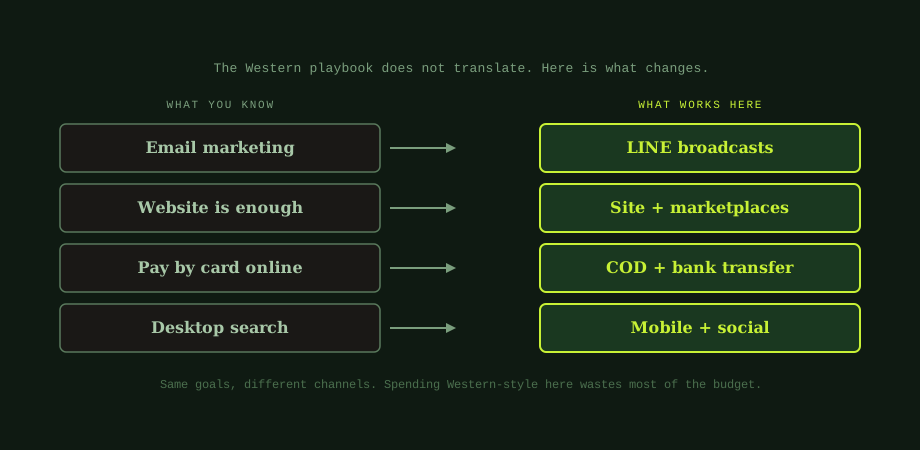
The marketing goals are universal: build awareness, move people toward consideration, convert them, and retain them. What differs between markets is which channels accomplish each goal and how consumers move between them. The Western default channel mix (website, Google Ads, email, maybe some paid social) maps poorly onto Thai consumer behaviour, and applying it unchanged wastes budget on channels that Thai consumers either do not use or use differently.
The four biggest mismatches: email marketing has weak engagement in Thailand while LINE broadcasts achieve the open rates email used to. A standalone website is treated as sufficient in many Western markets, but in Thailand a large share of product discovery and transactions happen on marketplaces and through messaging apps. Online card payment is the Western default while Thailand still runs heavily on cash on delivery and bank transfer. And Western markets still have meaningful desktop usage while Thailand is overwhelmingly mobile-first with social-driven discovery.
The practical implication is that a budget allocated the Western way (heavy on Google Ads and email, light on LINE and marketplaces) underperforms a budget of the same size allocated for the Thai channel mix. The fix is not more money; it is a different distribution of the same money.
The platform landscape: the channels you cannot skip
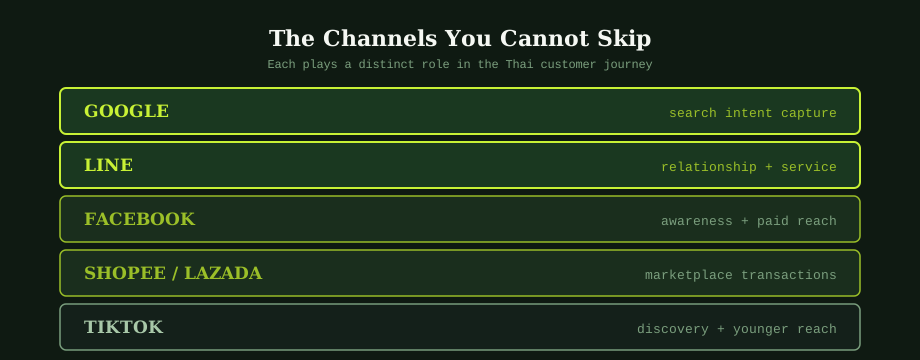
Google remains the search engine in Thailand with overwhelming market share, so SEO and Google Ads matter for capturing the intent of people actively looking for products and services. The difference from Western markets is what surrounds Google: in Thailand, a Google search is often the start of a journey that continues on LINE, a marketplace, or social, rather than ending on the company website. Google captures intent; it rarely closes the transaction on its own.
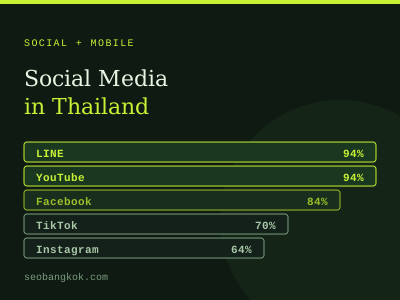
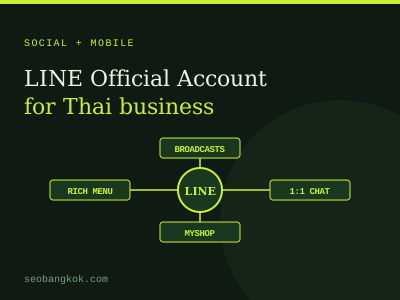
LINE is the channel foreign businesses underrate most consistently. It is the dominant messaging app, the primary customer service channel for most Thai consumer businesses, and an increasingly important broadcast and commerce platform. A foreign business without a LINE Official Account is invisible in the channel where Thai customers expect to reach businesses. The mechanics are the breakdown is in the LINE Official Account guide, but strategically, LINE is not optional for consumer-facing businesses.
Facebook retains broad reach in Thailand, higher than in most Western markets, and functions as both an awareness channel and a paid advertising surface. Organic Facebook reach has declined as elsewhere, so the Facebook strategy in 2026 is primarily paid. TikTok drives discovery, particularly among younger audiences, and TikTok Shop has made it a commerce channel as well. The platform-by-platform breakdown is in the social media in Thailand post.
Marketplaces (Shopee and Lazada) are where a large share of Thai online product purchasing happens. For consumer product businesses, ignoring marketplaces means ignoring a major share of the addressable market, even though marketplaces commoditise the product and own the customer relationship. The marketplace decision is one of the most consequential a foreign business makes entering Thailand.
The marketplace question: Shopee and Lazada vs your own website
This is the strategic decision that most distinguishes the Thai market from Western e-commerce. In the West, the default assumption is that a brand drives traffic to its own website and owns the transaction and customer data. In Thailand, a large share of consumers begin and complete product purchases on Shopee or Lazada, comparing listings, reading reviews, and checking out within the marketplace, never visiting the brand's own site.
The tension is real. Marketplace presence gives access to a huge pool of active buyers and the discovery that comes from being where they already shop. But it commoditises the product (your listing sits next to identical or similar products competing primarily on price and reviews), takes a commission on every sale, and gives the brand minimal access to customer data or relationship. The property-specific playbook is in SEO for property and real estate in Thailand. The marketplace owns the customer; the brand is a supplier.
The approach that works for most consumer product businesses is hybrid: maintain marketplace presence for discovery and volume, particularly for lower-consideration products, while building a direct channel (own website plus LINE) for higher-margin sales, repeat purchases, and customer retention. The marketplace becomes a customer acquisition channel that feeds the direct relationship rather than the entire business. For service businesses and high-consideration B2B, marketplaces are usually irrelevant and the focus should be on Google, LINE, and direct channels.
Consumer behaviour: mobile, social, and trust
Thai digital behaviour has several characteristics that affect how marketing needs to be structured. Mobile-first is near-absolute: the overwhelming majority of digital activity happens on phones, which means every asset (website, landing pages, content, ads) needs to be designed mobile-first rather than adapted from desktop. A website that works on desktop but is awkward on mobile fails for most of the Thai audience. The page speed and mobile considerations from the page speed post are amplified in a market this mobile-dominant.
Social commerce is mainstream: a meaningful share of Thai purchasing happens directly through social platforms and messaging, not through traditional e-commerce flows. Consumers discover products on Facebook, Instagram, or TikTok, ask questions and negotiate via LINE or direct message, and complete the purchase through bank transfer or COD. This "social commerce" pattern means the path to purchase often runs entirely outside the channels Western analytics tools are set up to measure.
Trust signals differ: Thai consumers are cautious about online scams and place high value on signals of legitimacy, including verified LINE Official Accounts, active social presence with real engagement, visible reviews, and responsive customer service. A foreign business that looks legitimate by Western standards (professional website, secure checkout) may still fail Thai trust tests if it lacks the LINE presence and social proof Thai consumers look for. The local trust signals matter as much as the global ones.
Payment behaviour: why COD still matters
Cash on delivery and bank transfer remain significant payment methods in Thailand, particularly outside the most affluent urban segments. Card penetration and digital wallet adoption have grown rapidly (PromptPay and LINE Pay are widely used), but a foreign business that offers only card payment online cuts off a meaningful share of potential customers who either prefer COD or do not have or trust online card payment.
The practical requirement is to offer the payment methods Thai customers actually use: PromptPay, bank transfer, COD for physical products where feasible, and the digital wallets that have gained adoption. Restricting to card-only payment because that is the home-market norm is one of the quieter ways foreign businesses lose Thai sales without realising why their conversion rates are low.
The language question
For reaching the broad Thai consumer market, Thai-language content is essential. English-only marketing reaches a small segment: affluent urban Thais, the expat community, tourists, and English-speaking professionals. For businesses targeting those specific audiences, English works for that audience. For businesses targeting the broad Thai market, Thai-language content created or reviewed by native speakers is required, not machine translation, because Thai search behaviour, idiom, and the subtle trust signals in language do not survive direct translation.
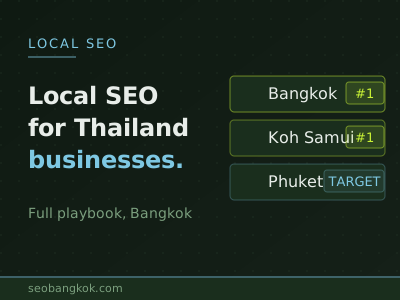
The practical path for businesses entering the market is to start with professionally localised Thai content for the highest-value pages (the core service or product pages, the most important landing pages) and expand Thai coverage as the market validates. Trying to launch with a fully bilingual site from day one is often premature; starting with strong Thai content on the pages that matter most and growing from there is more realistic. The keyword and content considerations for serving Thai-language audiences connect to the broader local SEO for Thailand businesses approach.
Where the budget should actually go
The single most common foreign-business mistake is over-allocating to Google Ads because it is the familiar channel, and under-allocating to LINE, marketplace presence, and Thai content production. Google Ads has a role (capturing high-intent search traffic) but it is one component, not the centre of a Thai digital strategy.
A more balanced entry allocation spreads across foundational SEO and Thai-language content (the long-term compounding asset), a LINE Official Account programme (the channel Thai customers expect), selective paid social on Facebook and TikTok (for awareness and discovery), and marketplace presence where the product fits. Google Ads sits within this mix rather than dominating it. The same total budget allocated this way produces substantially better returns than a Western allocation heavy on search ads.
The sequencing also matters. The foundational work (a mobile-fast website, Thai content on core pages, Google Business Profile, a LINE Official Account) should come before the paid acquisition spend, because paid traffic directed at a weak foundation converts poorly. Building the foundation first and layering paid acquisition on top produces better unit economics than running ads against an unprepared destination.
The most common foreign-business mistakes
Several patterns recur across foreign businesses entering Thailand. Treating the website as the whole strategy: building a polished website and expecting it to carry the business the way it might at home, while ignoring the LINE, marketplace, and social channels where Thai purchasing actually happens. Email-first communication: building marketing around email sequences that Thai consumers largely ignore, instead of the LINE broadcasts that achieve real engagement. Card-only payment: restricting payment options to the home-market norm and losing the COD and transfer-preferring segment. English-only or machine-translated content: failing to invest in proper Thai localisation and reaching only the narrow English-comfortable segment.
The underlying error in all of these is assuming that what worked at home will work here because Thailand is digitally advanced. The market's sophistication is exactly why the differences matter; Thai consumers have well-developed digital habits, and those habits are different from Western ones. Meeting them where they are produces results; importing the home-market playbook does not.
For foreign businesses planning a Thailand market entry, our digital consultancy service covers the strategic channel allocation and sequencing decisions specific to the Thai market. An experienced SEO expert in Bangkok who understands both the Western expectations and the Thai realities can help avoid the budget waste that comes from applying the wrong playbook.
Common questions
Why does Western digital marketing not work in Thailand?
The goals are the same (awareness, consideration, conversion, retention) but the channels that deliver them are different. Email marketing, a workhorse in Western markets, has low engagement in Thailand where LINE broadcasts do the same job with far higher open rates. A standalone website is sufficient for many Western businesses, but in Thailand a meaningful share of transactions happen on marketplaces (Shopee, Lazada) and through LINE rather than on company websites. Card payment online is normal in the West but a large portion of Thai e-commerce still runs on cash on delivery and bank transfer. Desktop research is common in mature Western markets while Thailand is overwhelmingly mobile-first with social-driven discovery.
Do I need to be on Shopee and Lazada to sell in Thailand?
It depends on the product category and business model, but for most consumer product businesses the answer is effectively yes for at least part of the strategy. Shopee and Lazada are where a large share of Thai online product discovery and purchasing happens, particularly for lower-consideration goods. The trade-off is that marketplaces commoditise your product and own the customer relationship. The common approach is a hybrid: maintain marketplace presence for discovery and volume while building a direct channel (own website plus LINE) for higher-margin sales and customer retention. Service businesses and high-consideration B2B generally do not need marketplace presence.
Should foreign businesses market in Thai or English in Thailand?
For reaching Thai consumers, Thai-language content is essential; English-only marketing reaches only a small, mostly urban and affluent segment plus the expat market. For businesses targeting the expat community, tourists, or English-speaking professionals, English works for that specific audience. Most businesses serving the broad Thai market need Thai-language content created or reviewed by native speakers, not machine-translated, because Thai search behaviour, idiom, and trust signals do not survive direct translation. A practical middle path is to start with professionally localised Thai content for the highest-value pages and expand coverage as the market validates.
How much should a foreign business budget for digital marketing in Thailand?
There is no single figure because it depends on category competitiveness, goals, and timeline, but the more useful framing is where the budget goes rather than how much. The common mistake is over-allocating to Google Ads (because that is the familiar channel) and under-allocating to LINE, marketplace presence, and Thai-language content production. A balanced entry budget typically splits across foundational SEO and Thai content, a LINE Official Account programme, selective paid social, and marketplace presence if the product fits, with Google Ads as one component rather than the centre.