Most social media advice for businesses is written for the US or UK market and applied unchanged in Thailand (a mistake covered more broadly in the digital marketing in Thailand guide), which is how you end up with companies pouring effort into LinkedIn for a consumer audience and ignoring the platforms where their actual customers spend hours every day. The Thai social media landscape has its own shape, and the implications for businesses operating here are different enough that generic global advice misleads more than it helps.
This post is the data view. Which platforms have the reach, who uses them, and which business types win on each. It is not a guide to running ads on any specific platform (those are platform-specific posts) and it is not a strategy framework. It is the prior layer: deciding where your business should be present before you decide what to do there.
The numbers that matter in 2026
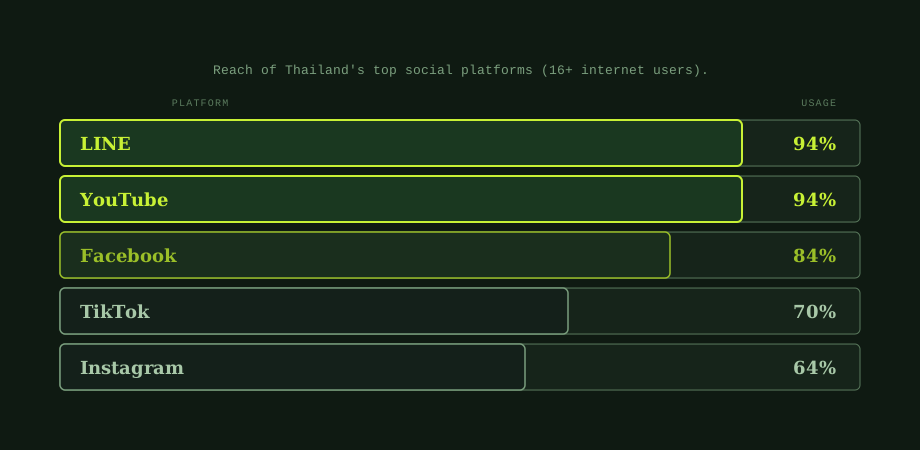
The headline figure: roughly 94% of Thai internet users aged 16 and above use both LINE and YouTube. Facebook is at 84%, still well ahead of most Western markets where it has declined among younger users. TikTok sits at approximately 70%, and Instagram at 64%. These figures come from the most recent DataReportal Digital Thailand reports and broadly match what businesses see in their own analytics and ad targeting.
The five platforms together cover essentially everyone online in Thailand. The strategic question is not whether your audience is present on social media (they almost certainly are) but which platforms they actively engage with, and whether the way they engage on each one is compatible with what your business is trying to do.
LINE: the platform foreign businesses underrate
LINE is the messaging app that dominates Thailand the way WhatsApp dominates much of South America or Europe. The reach figure (94%) understates how much of Thai consumer behaviour runs through it. LINE handles personal messaging, group chats, brand communication, customer service, payments, food delivery, and increasingly e-commerce through LINE MyShop. For many Thai consumers, the path from awareness to purchase runs through LINE rather than through a website.
The implication for businesses is that having a LINE Official Account is closer to required than optional for any consumer-facing Thai business. A surprising number of foreign-managed businesses in Thailand operate without one, treating LINE as a personal-messaging app rather than a business platform, and losing enquiries that would have converted to someone with an active LINE OA. The Thai customer trying to enquire about your service will look for the LINE Official Account first; if there is no LINE option visible on the website, a meaningful percentage will not phone or email instead, they will simply move to a competitor with a LINE channel.
The mechanics of setting up and running LINE OA are more on that in the LINE Official Account guide for Thai business. For the strategic question of platform choice, the answer for almost any Thai consumer business is: yes, LINE has to be on the list.
YouTube: the search engine in disguise
YouTube's 94% reach in Thailand is shared with LINE, but the way it gets used is different. For a significant portion of Thai users, particularly younger ones, YouTube is where they go for how-to content, product research, and tutorials, often in preference to reading text-based search results. The pattern is similar globally but more pronounced in Thailand because of the cultural preference for video and demonstration content over written explainers.
The implication is that businesses with any educational or demonstration component (how products work, how services are delivered, what to expect from a process) have a YouTube opportunity that text content alone does not capture. For service businesses with a strong educational angle, this can mean the YouTube channel is the primary content hub and the blog plays a supporting role rather than vice versa. For e-commerce, YouTube serves as both ad placement and organic discovery for product research queries.
What YouTube is not, in Thailand or elsewhere, is a particularly good direct response channel for most service businesses. People on YouTube are usually in research or entertainment mode, not buying mode. Treat it accordingly: invest in YouTube for awareness and consideration, not for direct conversion.
Facebook: the workhorse
Facebook's 84% reach in Thailand is higher than in most Western markets and the platform retains broader cross-generational usage. Older users are heavy Facebook users; younger users still maintain accounts even when they spend more time elsewhere. For most local service businesses and SMEs in Thailand, Facebook is still the primary social media presence and the platform where business pages, reviews, and local community interaction happen.
The angle that has changed in the last few years is paid versus organic. Organic reach on Facebook Business Pages has continued to decline, and businesses relying on organic posts to reach their followers see a small fraction of what they once did. The platform now functions more as a paid ad surface with an organic complement, particularly for posts that include video or that prompt comments and engagement. The implication is that a Facebook strategy for a Thai business in 2026 needs a paid component to produce meaningful reach; pure organic Facebook strategies underperform.
For local service businesses, Facebook Business Page reviews remain a significant local search signal alongside Google Business Profile reviews, see also the local SEO Thailand guide. The page itself does work even when the organic reach is minimal.
TikTok and Instagram: the younger split
TikTok at 70% reach in Thailand skews younger than the other platforms but the skew is less extreme than in some markets; meaningful audiences exist in the 35 to 45 bracket as well. The platform's strength is short-form video that travels far on its algorithmic discovery, and the businesses that win on TikTok in Thailand tend to be lifestyle, F&B, fashion, and entertainment-adjacent rather than professional services.
Instagram at 64% reach is the smallest of the five but the most concentrated in specific audience segments: urban Thai users aged 20 to 40, with strong representation in lifestyle, fashion, beauty, F&B, and travel. Instagram in Thailand functions similarly to its global pattern: a visual-first platform that rewards consistent aesthetic content and works well for brands with strong visual assets.
The choice between TikTok and Instagram for businesses that fit the lifestyle category is often a question of bandwidth and content type. TikTok rewards frequent, less polished content with a viral algorithmic engine; Instagram rewards more polished content with a stronger brand-building emphasis. Many lifestyle businesses run both, repurposing similar content across the two with platform-specific adjustments.
Matching platforms to business type
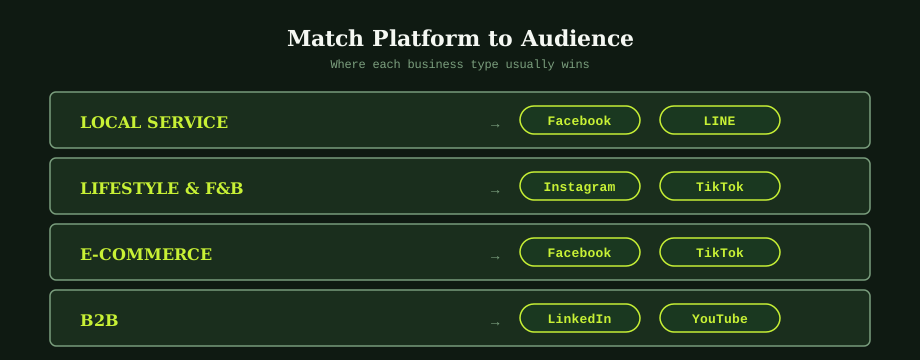
The mistake most businesses make is trying to be present on every major platform with equal effort. The honest pattern is that audience attention and engagement concentrate sharply by demographic and business type, and a focused presence on two platforms produces more than a thin presence on five. The matrix above is a starting point, not a rule.
Local service businesses (clinics, salons, restaurants, repair services) generally win on Facebook (business page, reviews, local community) and LINE (customer messaging, broadcast updates to existing customers). The combination covers discovery, reviews, and direct customer communication.
Lifestyle and F&B businesses (cafes, boutique retailers, wellness brands) typically win on Instagram and TikTok. Both platforms reward visual content and align with the discovery patterns of the target audience. Facebook can be a third platform but usually as a support channel rather than primary.
E-commerce businesses split between Facebook (broad reach, ads to existing audiences, business catalogue) and TikTok (younger audiences, viral product discovery, TikTok Shop where applicable). The exact mix depends on product category; fashion and beauty skew TikTok, household goods skew Facebook.
B2B businesses selling to companies typically win on LinkedIn (decision-maker audience, professional content distribution) and YouTube (demonstration content, deeper product explainers). Facebook can play a recruiting or brand awareness role but rarely drives B2B leads at scale.
The case against being on everything
Every business has at some point tried to maintain presence on five social platforms simultaneously, and the pattern is consistent: the content quality drops across all of them, posting cadence becomes inconsistent, the team gets exhausted, and within 6 months 3 of the 5 platforms are dormant. The same logic that the Google Ads budget post applies to paid spend applies to social: concentration beats fragmentation, and the same total effort produces more output if it is focused on two channels than spread across five.
The pragmatic test for whether to add a third platform is whether your existing two are running at a high enough standard that the marginal time spent on a third would produce more than maintaining quality on the first two. For most businesses with limited social media resourcing, the answer is no, and the right move is to invest deeper in the existing channels rather than adding new ones.
Social and SEO: how they interact in Thailand
Social media does not directly affect Google rankings, but the indirect effects are meaningful. Active social presence builds brand awareness, which produces branded search queries (people searching for your business by name), which is a strong signal of authority that Google rewards. Social content distribution earns links from people who discover your content via social and then reference it from their own sites or blogs. And review activity on Facebook and other platforms contributes to local SEO signals alongside Google Business Profile reviews.
For Thai businesses specifically, the LINE Official Account also serves an indirect SEO function: it captures customer enquiries that would otherwise be lost, which means the analytics data on the website (more in the GA4 setup post) becomes more meaningful because the businesses that have a LINE channel see a higher proportion of website visits convert into enquiries that the funnel can actually measure.
For structured help deciding on the right social and SEO mix for a Thai business, our social media marketing service works alongside SEO to define platform strategy and content cadence. As a Bangkok SEO agency, we can also audit your current platform mix and identify where time is being wasted on channels your audience does not actually use.
Common questions
What is the most-used social media platform in Thailand?
LINE and YouTube share the top spot in Thailand, each used by roughly 94% of internet users aged 16 and above. LINE is the dominant messaging platform and increasingly a business channel (broadcasts, chatbot automation, LINE MyShop). YouTube serves as both an entertainment platform and a de facto search engine for Thai users who prefer video answers to how-to and explainer queries. Facebook follows at around 84% reach, still significantly higher than in most Western markets. TikTok and Instagram round out the top five at approximately 70% and 64% respectively.
Should my Thai business be on every social platform?
No. The same logic that applies to PPC budget spread applies to social: a presence stretched across five platforms with low effort on each produces less than concentrated effort on the two platforms where your audience actually engages. The practical approach is to pick the two platforms that best match your target audience and business type, build a real cadence and presence there, and add others only if there is bandwidth left over. For most local service businesses, that means Facebook and LINE. For lifestyle and F&B businesses, Instagram and TikTok.
How important is LINE for Thai businesses?
More important than most foreign businesses entering Thailand realise. LINE is not just a messaging app in Thailand; it is the dominant customer service channel, a major broadcast medium (LINE Official Accounts let businesses send messages to opted-in followers), and increasingly a transaction layer through LINE MyShop and LINE Pay. Many Thai consumers will not call a business phone number; they will look for the LINE Official Account and message there. Businesses without a LINE OA frequently lose enquiries that would have converted on a different platform.
Does social media activity help SEO in Thailand?
Indirectly, yes; directly, not really. Google has consistently said that social signals (likes, shares, follower counts) are not direct ranking factors. What social media does affect is the indirect signals that do matter: brand awareness leads to more brand searches, content distribution leads to more backlinks from people who discover the content via social, and active social presence contributes to E-E-A-T signals that quality raters consider. For Thai-market SEO specifically, having visible LINE and Facebook presence also affects local SEO indirectly through brand recognition and review activity.