If someone tells you SEO takes 90 days, they are either targeting terms with essentially no competition, or they are not being straight with you. If someone tells you it takes three years and there is nothing you can do to influence the pace, they are also not being straight with you. The real answer sits between those two extremes and is determined by a handful of factors you actually have some control over.
This post covers four scenarios: new sites, established sites, post-penalty recovery, and e-commerce. It also covers the six variables that move timelines in either direction and what a realistic month-by-month picture looks like for most businesses investing in SEO consultant and beyond. The downstream question of mapping that timeline onto ROI reporting is in how to track SEO ROI. See how much SEO costs in Thailand.
The short answer first
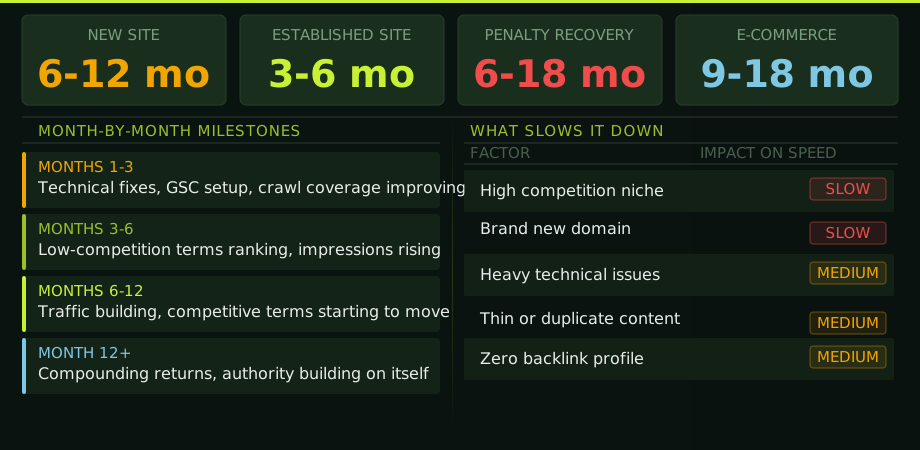
The companion post on how to set realistic SEO targets covers how to translate these timelines into specific milestones to track at month 3, 6, and 12. For most business websites, here is the realistic range depending on your starting point:
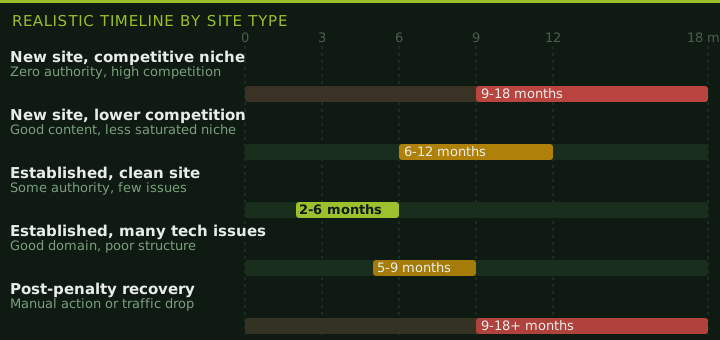
- New site, competitive niche: 9 to 18 months before consistent meaningful traffic
- New site, lower competition: 6 to 12 months
- Established site, clean foundations: 2 to 6 months to see meaningful ranking improvements
- Established site, heavy technical issues: 5 to 9 months
- Post-penalty or traffic drop recovery: 9 to 18 months, sometimes longer
- E-commerce, large site: 9 to 18 months for category-level traffic
These timelines assume consistent, ongoing work throughout. Sporadic effort resets the clock. A three-month SEO push followed by six months of nothing does not produce results that compound. It produces a brief spike and then stagnation.
Why does it take this long at all?
Three things drive the timeline, and none of them have a shortcut.
Google needs time to crawl and index your pages properly. A new page does not rank the day it is published. It has to be discovered, crawled, indexed, and then assessed relative to competing pages. For a large or technically messy site, this process alone can take months to stabilise.
Second, Google applies a degree of trust-building to both new domains and newly improved content. A site that suddenly starts publishing well-optimised pages and acquiring links after doing neither for years will be assessed cautiously. The trust signals need time to accumulate and prove consistent.
Third, competitive positions take time to shift. If you are trying to rank for a term where the top three results have held their positions for three years, built 500 backlinks, and published 40 pages of relevant content, you are not moving them in a month. You are building toward a position over quarters, not weeks.
This is not a flaw in SEO as a channel. It is why established organic positions are so defensible once they are built. The same friction that makes it hard to enter a competitive market makes it hard for competitors to displace you once you are there. A business that started SEO two years ago and has built topical authority is in a genuinely stronger position than one starting today. The best time to start was earlier. The second best time is now.
New sites: what actually happens
A brand new domain starts with zero authority, zero indexed pages, and zero trust signals in Google's eyes. Even with a technically clean build, strong content, and active link acquisition from day one, the first three months are almost entirely invisible in the rankings.
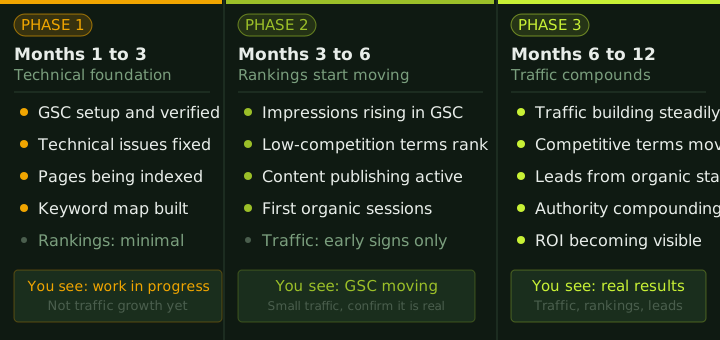
Months 1 to 3 are technical and structural. You are getting the site crawled correctly, submitting sitemaps, fixing any technical errors that appear in Google Search Console, and publishing the core pages. You should expect to see impressions rising in GSC. You should not expect to see traffic or ranking positions that produce leads.
Months 3 to 6 is when lower-competition terms start to move. Not your primary commercial terms. Supporting terms, long-tail variations, informational queries that relate to your topic area. A Bangkok-based B2B software company I worked with saw their first meaningful GSC impressions at month 3 and their first organic lead at month 5. By month 7 they had 12 ranking blog posts and three of their service pages were on page two for competitive terms. That pace, while not spectacular, is realistic for a new site in a moderately competitive space.
Months 6 to 12 is where the compounding starts if the work has been consistent. More pages indexed, more content linking to each other, more external links pointing in, and the trust signals starting to accumulate. Primary commercial terms start moving. Traffic becomes meaningful enough to show in GA4. Leads from organic begin appearing regularly.
Established sites: much faster starting point
An established site with existing domain authority changes the equation significantly. Google already trusts the domain to some degree. Pages are indexed. There may be backlinks worth building on. The question is usually why it is not ranking better despite those advantages, and the answer is almost always one of three things: technical problems that are suppressing the good content, content gaps that mean you are not targeting the right terms, or weak internal linking that is not distributing authority to the right pages.
When those issues are addressed, ranking improvements for an established site can be visible within 8 to 12 weeks. Not full competitive position. But meaningful movement in a direction that is measurable in GSC. An established site with a clean technical base and strong content can reach its competitive ranking ceiling within 3 to 6 months of focused work, whereas a new site would still be in its early growth phase at that point.
The variable that most people underestimate in this scenario is internal linking. An established site often has the content needed to rank but is not linking its strong pages to its weaker ones, is not using correct anchor text, and is not channelling authority toward the pages that matter most commercially. Fixing internal linking alone can produce ranking improvements within four to six weeks on an established site.
What actually affects the speed
Six variables determine whether your timeline is at the fast end or the slow end of the range.
Competition level. This is the biggest variable. Ranking for "SEO agency Bangkok" is more difficult than ranking for "technical SEO consultant for jewelry brands in Thailand." Lower competition means faster movement, and the smart approach early on is to identify terms where you can rank and build authority before going after the most competitive primary terms. The evaluation framework that comes before signing with an agency is in how to pick the best SEO agency.
Domain age and authority. A five-year-old domain with 200 backlinks from relevant sites is not the same starting point as a domain registered last month. Authority built over years cannot be replicated quickly. This is not an argument against starting; it is an argument for starting now rather than later.
Technical health. A site with significant technical problems, such as pages blocked from indexing, duplicate content issues, slow Core Web Vitals, or broken canonical tags, will be suppressed regardless of content quality. Fixing technical issues is usually the first phase of any engagement, and it is also the phase that produces the fastest measurable improvements in GSC data. The DIY technical audit guide covers what to check first.
Content depth and quality. Thin content, duplicate product descriptions, or pages that answer the query less thoroughly than competing pages will not rank and hold position. The content quality ceiling matters as much as the technical floor.
Publishing frequency. A site that publishes two well-researched posts per week builds topical authority faster than one that publishes two per quarter. Frequency compounds the effect of everything else, because more indexed pages means more opportunities to rank, more internal linking opportunities, and faster authority accumulation in your topic area.
Link profile. Starting with zero backlinks is a slower starting point than having some. External links remain one of the clearest signals to Google that a site is worth ranking. Building a clean, relevant link profile takes time and cannot be forced without risk. But ignoring it entirely also extends the timeline.
Post-penalty recovery: a different problem
Recovery from a manual action or a significant algorithmic traffic drop follows a different timeline than standard SEO. The starting point is negative: Google has actively reduced its trust in the site. Recovery means first identifying and fully resolving whatever caused the penalty or drop, then rebuilding the trust signals that were damaged, and then waiting for Google to reassess the site over subsequent algorithm updates.
This process rarely takes less than six months and often takes 12 to 18. The single most common mistake in recovery projects is declaring the fix done before the root cause is actually resolved. Partial fixes produce partial recoveries that stop moving. Full recovery requires fully addressing the issue and then being patient while Google's reassessment works through its update cycle.
Anyone dealing with a traffic drop and are not sure whether it is technical algorithmic, or a manual action, the first step is a structured audit. Our digital consultancy covers penalty diagnosis and recovery planning as a specific engagement type.
What "working" actually means
SEO is working long before it is producing leads. This distinction matters because it affects how you evaluate whether an engagement is on track or not.
Months 1 to 3 success looks like: technical errors dropping in GSC, impressions increasing for target keywords, core pages being indexed correctly, and crawl coverage improving. If these are moving in the right direction, the work is on track.
Months 3 to 6 success looks like: ranking positions appearing for lower-competition terms, GSC click data beginning to show up, and organic sessions in GA4 starting to register. Not necessarily leads yet. Movement in a measurable direction.
Months 6 to 12 success looks like: competitive terms ranking on pages two and three, organic traffic contributing meaningfully to total site traffic, and leads or enquiries from organic search beginning to appear regularly.
Anyone three months in and there are no impressions and no indexed pages improving something is wrong with the execution or the strategy. If you are three months in and impressions are rising but there are no leads yet, that is likely on track. Knowing the difference between "this is going too slowly" and "this is normal" requires understanding which phase you are in.
Working with an SEO specialist in Bangkok who sets clear milestones at each phase and reviews them honestly is significantly more useful than one who promises outcome targets upfront and then blames Google's algorithm when they are not met.
What does a sensible timeline look like for your site, specifically? That conversation is exactly where our SEO consulting service begins.
SEO timeline questions
How long does SEO take to show results?
For most business websites, meaningful ranking improvements take 3 to 6 months when the site has some existing authority and the technical foundations are clean. For new sites with no history, expect 6 to 12 months before consistent organic traffic appears. These timelines assume consistent work throughout, not periodic bursts.
Why does SEO take so long?
Google needs time to crawl and index your pages, assess the quality of your content relative to competitors, and observe how users engage with your site. Links from other sites take time to acquire and for Google to evaluate. There is no shortcut to these trust signals accumulating. Any service that promises fast results is either targeting very low competition terms or using tactics that create short-term gains and long-term risk.
How long does SEO take for a brand new website?
A brand new domain with no authority, no backlinks, and no prior indexation history should expect 6 to 12 months before seeing meaningful organic traffic, even with strong content and technical execution from day one. Google applies a degree of caution to new domains and it takes consistent performance over time to build ranking trust. Lower competition niches move faster. Higher competition niches can take longer.
Can SEO results be faster for established sites?
Yes. An established site with existing domain authority, some backlinks, and already-indexed pages can see meaningful ranking improvements in 2 to 6 months when technical issues are fixed and content is strengthened. The site already has trust signals. SEO work in this case is improving on an existing foundation rather than building one from zero.
How long does Google penalty recovery take?
Recovery from a manual action or algorithmic penalty typically takes 6 to 18 months, sometimes longer depending on how severe the penalty is and what caused it. The recovery starts only after the underlying issues are fully resolved, a reconsideration request is approved where applicable, and Google reassesses the site over subsequent algorithm updates. There is no reliable fast path.
Timelines make more sense with real tracking periods attached. Our case studies publish the start and end dates alongside the ranking movement, so you can see how long each result actually took.