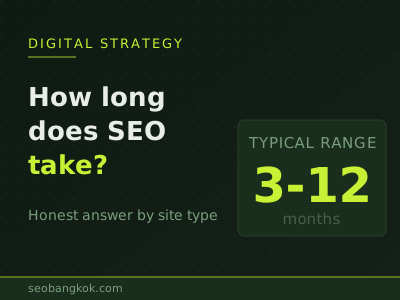
The single most common source of client disappointment in SEO is misaligned expectations set before the work starts. Someone promises first-page rankings in 90 days. The client believes them. Three months later, nothing has moved. Either the consultant was lying, the targets were wrong, or the client did not understand what they were buying. Often all three.
Setting realistic targets protects both parties. It protects the client from paying for something that cannot be delivered in the timeframe discussed. It protects the consultant from being evaluated against the wrong success criteria. And it sets up a framework for honest progress assessment instead of constant expectation management.
The prerequisite to any target-setting conversation is understanding how long SEO actually takes for different site types. If you have not read that, start there. This post goes one level deeper into what specifically you should expect to see at each stage and how to know whether your campaign is on track. See which SEO metrics actually matter.
Why any guarantee of rankings is dishonest
No SEO practitioner can guarantee specific rankings within a specific timeframe, and any who claim they can are either targeting terms with essentially no competition (which will produce negligible traffic), using short-term tactics that create risk, or making a claim they know to be false to win the business.
Google's ranking algorithms consider hundreds of signals, many of which are influenced by competitors, algorithm updates, and user behaviour that no consultant controls. A site that ranks at position 3 today can be at position 8 tomorrow after a core update, through no fault of the SEO work. Guaranteeing against this is like a financial advisor guaranteeing market returns.
What a consultant can guarantee is the quality and consistency of the work: audits done thoroughly, technical issues fixed correctly, content built to a standard, links acquired from relevant sources. The outcomes of that work over time are strongly predictable in direction and range. They are not guaranteeable in specific positions by specific dates.
The five variables that determine your timeline
Every site starts from a different position. These five factors determine where on the timeline range your site falls.
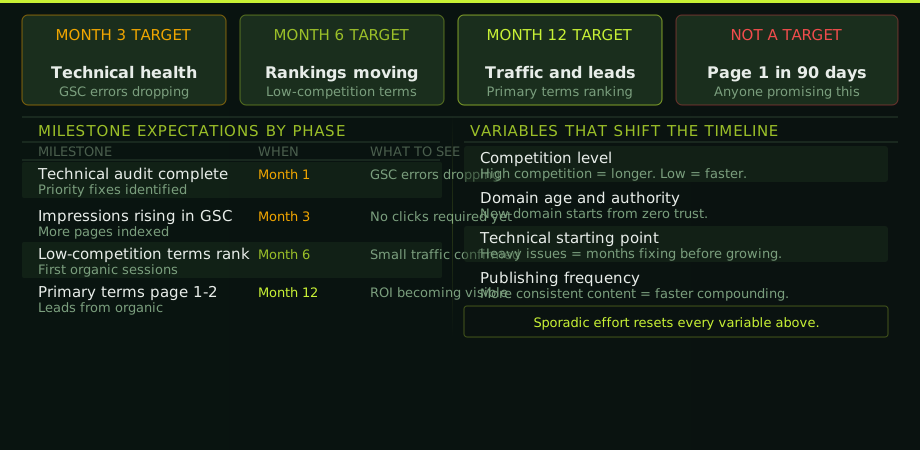
Competition level. The most significant variable. Trying to rank for "SEO agency Bangkok" competes against established sites that have been building authority for years. Trying to rank for "SEO consultant for jewelry importers in Bangkok" competes against almost nothing. Every market has a range of competition levels, and smart target-setting starts by identifying which terms are winnable first rather than chasing the most competitive terms from day one.
Domain age and history. A five-year-old domain with some existing backlinks and indexed pages starts from a fundamentally different position than a domain registered last month. The older domain has trust signals Google has been observing for years. The new domain needs to build that trust from zero, which takes time regardless of how good the work is.
Technical starting point. A site with significant technical problems, including indexation errors, duplicate content, slow Core Web Vitals, or broken canonical tags, will spend the first phase of an engagement fixing problems rather than building. A technically healthy site gets to build immediately. The technical audit guide covers what to check before you start.
Content depth and publishing frequency. A site with a well-structured content plan publishing consistently compounds authority faster than one that publishes sporadically. Frequency is not a substitute for quality, but consistent good content produces results that compound. Sporadic bursts with long gaps produce spikes that do not sustain.
Previous penalty or traffic drop history. A site recovering from a manual action or an algorithmic traffic drop is not starting from neutral. It is starting from negative, and the recovery timeline is longer than a normal new site engagement. The causes of the drop must be fully resolved before the recovery clock even starts.
Realistic milestones month by month
The following milestones apply to a new or early-stage site with no major technical problems, in a moderately competitive market, with consistent work throughout. Established sites with existing authority can compress these timelines significantly.
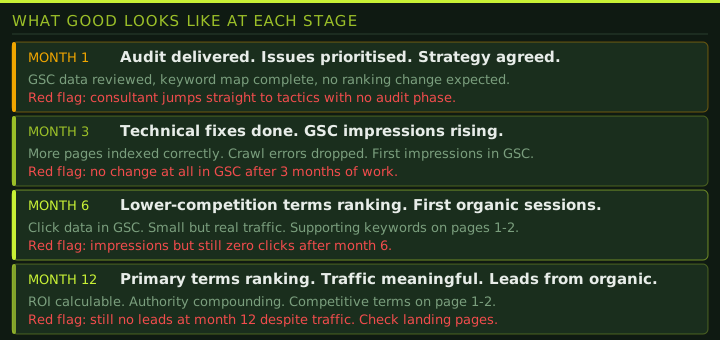
Month 1: The audit is complete. Technical issues are identified and prioritised. The keyword map is finished and agreed. Strategy is documented. No ranking change is expected and none should be claimed. A consultant who is showing you ranking improvements in month 1 of a new engagement is either cherry-picking terms with no competition or fabricating early wins to build confidence before the relationship has delivered anything real.
Month 3: Google Search Console should show a measurable increase in impressions for target keyword clusters. Crawl errors should be dropping. More pages should be indexed and in a healthy state. Keyword positions will appear for supporting terms. Traffic is unlikely to be meaningful yet, but the signals in GSC should be clearly moving in the right direction. If there is no movement at all in GSC at month 3, the work is not having an effect and the reason needs to be found.
Month 6: Lower-competition terms should be ranking on page 1 or 2. Google Analytics should show small but real organic sessions. Click data should appear in GSC. Primary commercial terms will typically be on page 2 or 3. The first organic leads may begin to appear. If impressions are rising but clicks are not, the issue is usually title tag and meta description quality for the terms that are ranking.
Month 12: For most sites in moderately competitive markets, this is when the primary commercial terms reach page 1. Organic traffic is building consistently. Leads from organic search are regular and attributable. The ROI of the investment is becoming calculable. Authority from the work done in months 1 to 6 is now compounding into stronger rankings for everything new published.
How to know if your campaign is off track
The wrong way to evaluate an SEO campaign at month 3 is to check whether you are on the first page of Google for your target terms. The right way is to check whether the leading indicators are moving in the right direction.
GSC technical health is the first indicator. Crawl errors dropping, indexed pages increasing, and Core Web Vitals improving are the signals that precede ranking improvements. If these are not improving after three months of work, the upstream issue needs to be identified before expecting downstream ranking results.
GSC impressions are the second indicator. Impressions rising means Google is showing your pages to searchers. This happens before clicks, which happen before conversions. An impression curve that is flat at month 3 is a problem. One that is rising, even slowly, is not.
Conversion rate on landing pages is the third indicator, relevant from month 6 onwards. A campaign that produces traffic but no leads is often not an SEO problem at all. The traffic may be well-targeted, but the landing page is not converting it. Checking whether organic visitors engage with the page and what percentage complete a conversion action identifies whether the issue is traffic quality or page quality.
Evaluating whether your current SEO programme is producing results, or whether bringing in outside help would actually move the needle, is the kind of campaign assessment our SEO consulting service includes as part of the initial conversation. It covers the technical side and the commercial one.
SEO targets questions
What are realistic SEO targets for a new website?
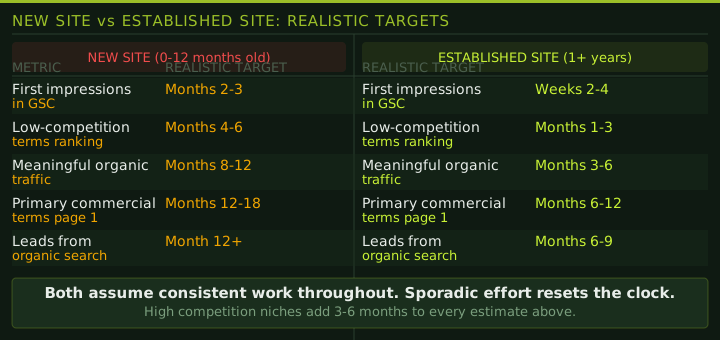
Month 1: audit complete, technical issues resolved. Month 3: GSC impressions rising, crawl errors dropping. Months 4-6: lower-competition terms ranking, first organic traffic. Months 9-12: primary commercial terms on pages 1-2, organic leads beginning consistently. Page 1 rankings in 30-90 days for a new site are not a realistic target.
Why do SEO targets change for established sites?
An established site already has indexed pages, domain authority, and existing ranking signals. Technical improvements and content additions can produce ranking movements within weeks rather than months. The existing trust signals accelerate compounding that new sites spend their first year building from zero.
What should I see in Google Search Console after 3 months of SEO?
Crawl errors dropping in the Coverage report, impressions rising for target keywords in Performance, more pages indexed and healthy, and keyword positions beginning to appear. If there is no change at all in GSC after 3 months, the work is not having an effect and the cause needs to be identified.
How do I know if my SEO campaign is on track?
Month 1-3: GSC technical health improving, impressions rising. Month 3-6: keyword positions appearing, small click data. Month 6-12: traffic building, conversions starting. A campaign with no GSC movement at month 3 is not on track. A campaign with traffic but no conversions at month 9 likely has a landing page issue rather than an SEO issue.
What happens when SEO work stops?
Rankings built over 6-12 months will not disappear immediately but will gradually erode as competitors continue to build. The compounding advantage of SEO requires consistent work to sustain. Stopping resets the growth rate to zero and eventually reverses it. Sporadic bursts produce significantly worse long-term results than consistent lower-effort work.
Targets are easier to set against evidence than against hope. Our case studies show what tracked visibility movement has actually looked like over twelve to eighteen months, and what that scale of work costs is on the pricing page.