Most businesses that end up with a bad SEO provider did not make an obviously wrong choice. They made a reasonable-seeming choice without the right information. The provider had a professional website, claimed relevant experience, offered a reasonable-sounding price, and gave confident answers. See how much SEO costs in Thailand. The problems emerged three to six months later when promised rankings had not materialised, reporting was vague, and getting a straight answer required persistent chasing.
Understanding how long SEO actually takes before you hire anyone is useful background. The timeline expectations set at the start of an engagement are often where the relationship breaks down. The specific enterprise-scale shape of consulting engagements is in what is enterprise SEO consulting. If you expect page-one rankings in 60 days and the consultant does not correct that expectation upfront, you will be disappointed regardless of what the consultant actually delivers.
The six questions to ask before hiring
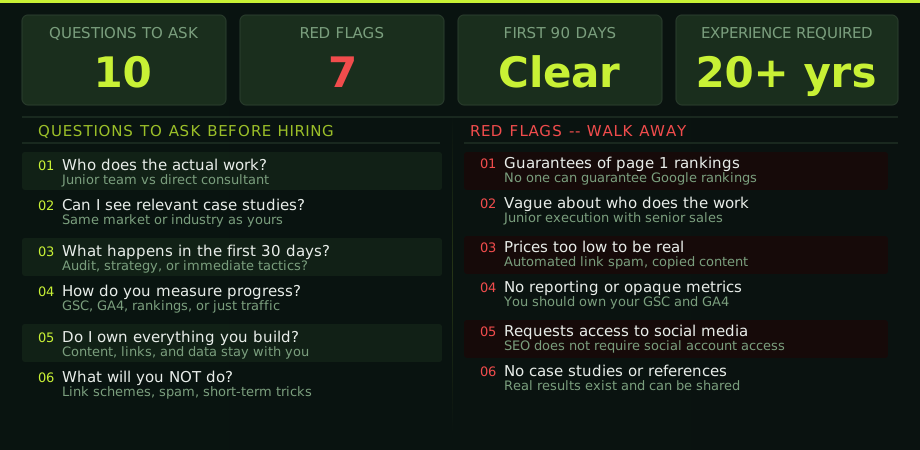
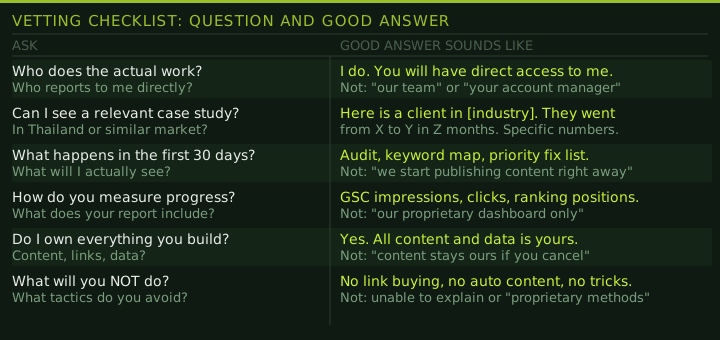
Who does the actual work? This is the most important question and the one most often deflected. In many agencies, the senior person who does the sales pitch hands the account to a junior team member after signing. The client interacts with an account manager who summarises what the juniors produce. The result is that the expertise you thought you were buying does not touch your project after the first meeting. Ask directly: who will audit my site, who will make recommendations, who will I be able to call when I have a question?
Can I see case studies from relevant markets? An SEO provider who has done good work in Thailand should be able to show you results, even if client names are anonymised. Results mean specific improvements: rankings moved from position X to position Y, organic traffic increased by Z percent over a defined time period. Vague statements about "improved visibility" without numbers are not case studies. If the only results are from markets very different from yours, ask directly whether they have worked with businesses similar to yours in Thailand.
What happens in the first 30 days? A credible answer describes a structured audit: crawl analysis, indexation review, keyword mapping, competitive assessment, and a prioritised action list. An answer that immediately jumps to tactics ("we will start building links and publishing content") without mentioning an audit phase is a warning sign. You cannot build effective SEO strategy without first understanding what is already there and what needs fixing.
How do you measure and report progress? Good reporting starts with Google Search Console and Google Analytics 4, both of which you should own and access directly. A provider who reports through a proprietary dashboard that you cannot access independently is obscuring the data. Monthly reporting should include GSC impressions and click data, ranking positions for target keywords, indexation health, and any technical issues identified or resolved. Ask to see a sample report before signing anything.
Who owns everything you build? Content created for your site, links built to your site, and data collected about your site should all belong to you. Some providers retain ownership of content they produce, which means it disappears if the relationship ends. Some lock ranking data into proprietary systems that become inaccessible if you switch providers. These are not hypothetical concerns. Make the ownership question explicit before starting.
What will you not do? A provider who cannot articulate what they avoid is not thinking about risk. The answer should include at minimum: they will not buy links from low-quality sources, will not use automated content generation without editorial review, will not use keyword stuffing or hidden text, and will not take actions they cannot explain or justify to you. If they use the phrase "proprietary methods" or "secret techniques" without being able to describe what those mean, walk away.
The seven red flags that mean walk away
Any one of these is sufficient reason to continue looking.
Guarantees of specific rankings. No SEO provider can guarantee Google rankings. Rankings depend on hundreds of signals that are partly outside anyone's control. Anyone who guarantees page one results within a specific timeframe is either targeting very low-competition terms that will not generate meaningful traffic, or overstating what they can deliver to win the contract.
Prices significantly below market rate. Competent SEO work takes time. A monthly retainer priced at USD 100 or USD 200 cannot involve meaningful human expertise. At those prices, the work is almost certainly automated link spam, keyword-stuffed content generated at scale, or some other low-effort approach that produces short-term fluctuations and long-term risk to your site's standing with Google.
No relevant case studies. Real results exist and can be shown. If a provider cannot demonstrate specific outcomes from work in Thailand or in markets similar to yours, the claim of relevant experience is not verifiable. Anonymous case studies with specific metrics are acceptable. Vague references to "many successful clients" without specifics are not.
Vague about who does the work. If direct questions about who will handle your account are deflected into descriptions of the agency's team size or internal processes, the answer is that a junior person you have not met will do the work. The agency-side version of this evaluation framework is in how to pick the best SEO agency. This may be fine for large-scale commodity SEO work. For strategy, audits, and anything requiring judgment calls about your specific market and site, it is a problem.
Access requests that do not make sense. SEO does not require access to your social media accounts, your hosting control panel beyond what is needed for technical changes, or any credentials that would give control over your business operations. If a provider asks for admin access to accounts they have no clear reason to need, ask specifically why and what they intend to do with it.
No mention of technical SEO. Content and links are two legs of the SEO stool. Technical foundation is the third. A provider who talks only about content production and link building without mentioning site speed, crawl coverage, indexation, structured data, or the technical audit that should precede any strategy has an incomplete approach. The technical audit guide gives a sense of what a proper technical assessment involves.
Pressure to sign quickly. A genuine provider with a good reputation does not need to create urgency to close a deal. High-pressure tactics, limited-time offers, or warnings that a slot will be filled by another client if you do not sign this week are sales techniques, not signals of quality.
What to expect in the first 90 days
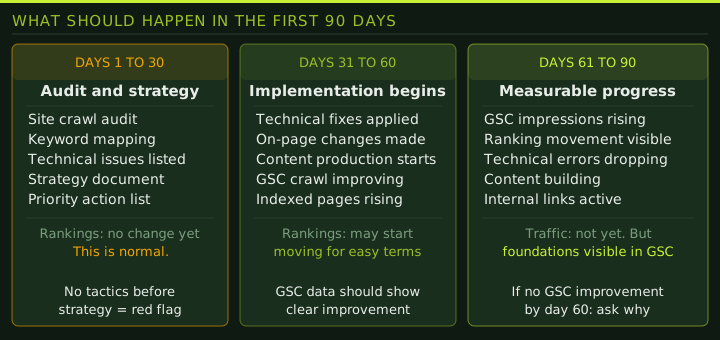
Setting the right expectations before the engagement starts protects both parties. A credible consultant should walk you through a realistic timeline in the initial conversation. If they do not, ask specifically.
Days 1 to 30 should produce a comprehensive site audit, a keyword map with current rankings and targets, a list of technical issues prioritised by impact, and an initial strategy document. This phase is entirely preparatory. No rankings will have moved. That is normal and correct.
Days 31 to 60 should see the beginning of implementation: technical fixes applied, on-page changes made to priority pages, content production starting if that is part of the scope. Google Search Console should show crawl activity increasing and initial improvements in indexed page counts. Rankings may begin to move for lower-competition terms.
Days 61 to 90 should show measurable improvement in GSC data: impressions rising, more pages indexed and healthy, and the first ranking movements for target terms. Significant traffic improvement is unlikely at this stage, but the underlying technical health of the site should be visibly better than it was at the start.
If a provider cannot tell you what these 90 days will look like before you sign, that is a meaningful gap. Providers who do not have a structured process for onboarding and early-stage work are improvising rather than running a repeatable engagement model.
Already decided a direct, experienced hire an SEO consultant in Thailand is the right fit, rather than an agency with account managers and rotating staff? The SEO consulting service page describes how this engagement runs in practice.
Hiring an SEO consultant questions
How do I find a good SEO consultant in Thailand?
Look for someone who can show case studies from the Thai market, who communicates directly rather than through account managers, and who gives honest assessments rather than guaranteed outcomes. Ask specifically who does the actual work, what the first 30 days look like, and how progress is measured. Be sceptical of anyone promising first-page rankings within a specific timeframe.
What should an SEO consultant in Thailand charge?
A monthly retainer for ongoing SEO from an experienced consultant typically ranges from USD 500 to USD 3,000 depending on site size and market. Project-based audits are typically USD 500 to USD 2,000. Pricing significantly below these ranges usually indicates inexperience or the use of low-quality automated tactics that can harm your site long term.
What is the difference between an SEO consultant and an SEO agency?
A consultant typically works directly on your account with full accountability. An agency typically uses account managers for client communication and junior staff for implementation. For most small and mid-size businesses, a consultant provides better value and more direct involvement. For larger projects requiring multiple simultaneous streams of work, an agency may have the bandwidth advantage.
What should happen in the first 90 days with an SEO consultant?
Days 1-30: audit, keyword mapping, technical issues identified, strategy documented. Days 31-60: implementation begins, technical fixes applied, on-page changes made. Days 61-90: measurable improvement in GSC data, more pages indexed, first ranking movements for lower-competition terms. Significant traffic improvement is unlikely before month 3 to 6.
What are the biggest red flags when hiring an SEO company in Thailand?
Guarantees of specific rankings, prices significantly below market rate, no relevant case studies, vagueness about who does the work, unexplained access requests, no mention of technical SEO, and high-pressure sales tactics. Any one of these is sufficient reason to keep looking.
Ask for the number early. If a consultant cannot give you a range before scoping, that is information in itself. Ours is on the SEO pricing page, and the work behind it is documented in our case studies.