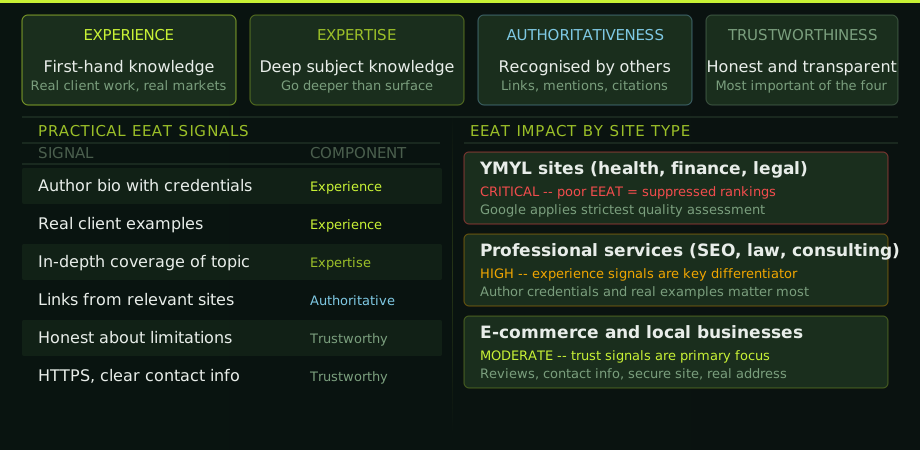
Google's Quality Rater Guidelines have described E-A-T (Expertise, Authoritativeness, Trustworthiness) since 2014. For how this plays out in AI search specifically, see E-E-A-T in the age of AI search. Experience was added as a fourth component in December 2022, making it E-E-A-T. The addition was significant because it acknowledged that first-hand real-world knowledge of a topic is a distinct quality signal, separate from formal expertise. A doctor has expertise in medicine. A patient who has managed a condition for ten years has experience of it. Both are valuable, and they are not the same thing.
The guidelines are used by tens of thousands of human quality raters who evaluate search results and provide feedback that informs how Google's algorithms are trained. The raters do not directly affect rankings, but their assessments shape the systems that do. Understanding what they are looking for gives a practical picture of what Google is trying to reward.
Experience: the newest and most practical signal
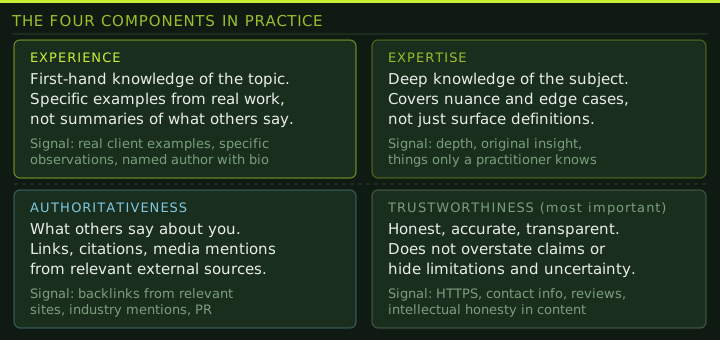
Experience refers to first-hand engagement with the topic being written about. It is the distinction between writing about a place because you visited it and writing about it from a compilation of other sources. Between reviewing a product because you used it and summarising specifications from a manufacturer page. Between advising on an SEO strategy because you have run dozens of client projects and describing SEO strategy from reading about it.
In practical terms, experience signals include: specific real-world examples drawn from actual work or life; observations that could only come from direct engagement; opinions formed from testing rather than from consensus; and details that require being present or involved to know. Generic content that reads as though it could have been written by someone with no direct involvement is low on experience, regardless of how accurate it is.
For a Bangkok-based SEO marketing experts writing about SEO in Thailand, experience means drawing on actual client work in the Thai market rather than applying generic Western SEO advice to a Thai context. That specificity, including what actually works in Bangkok, what the search behaviour differences are, what the competitive landscape looks like, is the signal. It cannot be replicated by someone without the direct experience.
Expertise: going deeper than the surface
Expertise is formal or acquired knowledge of a subject. For YMYL topics (Your Money or Your Life, including health, finance, and legal advice), Google applies particularly strict standards for expertise. The vertical-specific E-E-A-T application for legal services is in SEO for law firms in Thailand. A page advising on medical treatment should reflect genuine medical knowledge, not a general summary assembled from health articles.
For SEO content, expertise means covering topics at a depth that demonstrates real understanding rather than surface familiarity. An article about canonical tags that explains only what a canonical tag is lacks expertise. One that explains when canonical tags are necessary, the edge cases where they are commonly misused, and how to validate implementation in Google Search Console demonstrates expertise. The test is whether the content includes something that only someone who has genuinely worked with the topic would know.
The practical implication for your site is that shallow content, including blog posts that say little beyond what appears in the first paragraph of a Wikipedia article, does not build expertise signals. Depth, specificity, and coverage of nuance do. This connects directly to thin content problems: content that lacks expertise tends to be thin content, and vice versa.
Authoritativeness: what others say about you
Authoritativeness is the component most directly tied to external signals. It is not what your site says about itself but what other sites, publications, and sources say about it. A site is authoritative in a topic area when relevant external sources link to it, cite it, or mention it as a reference. This is why link building and digital PR remain important: they are the mechanism through which external authority signals are built. The brand SEO discipline that operationalises these E-E-A-T signals is in what is brand SEO.
For a consultancy, authoritativeness signals include: links from industry publications or relevant directories; mentions in media coverage; guest contributions to authoritative external sites; being cited as a source in other content; and appearing as a reference in industry discussions. None of these are manufactured quickly, which is why topical authority takes time to build and why it is so defensible once built.
The important nuance here is that authority is topical, not general. A high domain authority site that never discusses SEO has limited authoritativeness for SEO queries. A smaller site that consistently publishes expert content about SEO in Thailand, earns relevant links, and is cited in the Thai digital marketing space has genuine topical authority for those queries. Building strong internal linking within a topic cluster is one way to signal topical depth that contributes to this.
Trustworthiness: the most important component
Google's Quality Rater Guidelines explicitly state that Trustworthiness is the most important of the four components. A site can have real expertise and external authority but still fail the trust assessment if it provides misleading information, conceals its ownership, uses deceptive practices, or creates a poor user experience.
The practical trust signals Google's systems look for include: HTTPS security; clear and accurate business information including a contact method; an author name on content with a verifiable identity; accurate and honest claims that do not overstate what a product or service can deliver; reviews and ratings from genuine users; and a track record of content that proves to be accurate over time.
Intellectual honesty is a particularly undervalued trust signal. Acknowledging when advice depends on context, when data is limited, or when Google has changed something that makes previous guidance obsolete is rarer in SEO content than it should be. That honesty is precisely what builds long-term trust with both readers and search algorithms. Readers who encounter content that accurately reflects complexity are more likely to return, recommend, and link to it than readers who encounter content that oversimplifies to sound confident.
What you can actually do about it
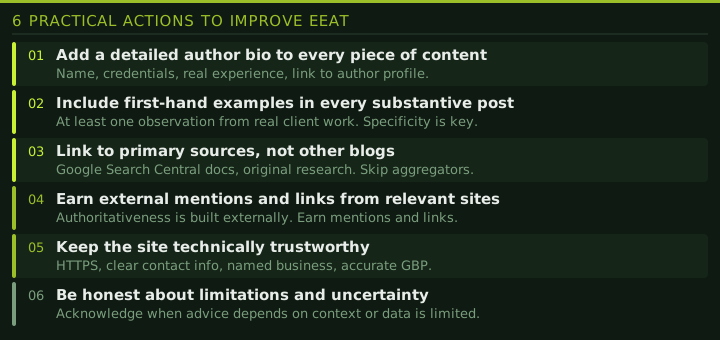
E-E-A-T improvements are practical, not abstract. The following changes produce measurable improvements in the signals that underlie the framework.
Add a detailed author bio to every piece of content. The bio should describe real credentials and experience. For a Bangkok-based SEO practice, this means naming the author, describing their specific experience in the Thai and ASEAN market, and linking to a profile page that further establishes their identity. Anonymous content is a trust deficit regardless of its quality.
Include first-hand examples in every substantive piece. Every blog post about SEO should include at least one observation, example, or outcome drawn from real client work. "In my experience working with e-commerce clients in Bangkok" carries a different signal than generic advice. The specificity is the signal.
Link to primary sources. Google's own documentation, peer-reviewed research, and original data sources are the right references. Linking to other SEO blogs that are themselves citing the same original source adds no authority. Going to the primary source and citing it directly does.
Earn external mentions and links. The authoritativeness component is built externally. Contributing to industry discussions, being quoted as a source, and earning links from relevant publications are the mechanisms. This is slow work, but the result is durable. A strong set of relevant external links is much harder to replicate than a large volume of internally-produced content.
Keep the site technically trustworthy. HTTPS, clear contact information, a named business, and accurate business details on Google Business Profile all contribute to the trust assessment. An SEO site without these basics is undermining its own signals regardless of how good its content is.
All of this work is built into how the SEO consultant in Thailand at this practice approach content strategy. Every client engagement includes an E-E-A-T assessment as part of the content audit, because improving these signals produces durable ranking improvements rather than short-term gains from technical fixes alone.
E-E-A-T questions
What is E-E-A-T in SEO?
E-E-A-T stands for Experience, Expertise, Authoritativeness, and Trustworthiness. It comes from Google's Quality Rater Guidelines and describes the qualities Google's algorithms are trained to reward. Experience was added in 2022 to distinguish first-hand real-world knowledge from formal expertise.
Is E-E-A-T a direct ranking factor?
E-E-A-T is not a single measurable score. It is a framework describing qualities that Google rewards through multiple indirect signals: author credentials, content depth, external links and mentions, site trust signals, and user behaviour. Improving E-E-A-T means improving these underlying signals, which influences rankings indirectly.
How can I improve E-E-A-T for my website?
Add a detailed author bio with real credentials to every piece of content. Include first-hand examples and observations. Link to primary sources. Build external mentions and links from relevant sites. Ensure the site is secure with clear contact information. Be honest about limitations rather than overstating claims. Trustworthiness is the most important component and the one most often neglected.
Does E-E-A-T matter for small businesses?
Yes, though the weight varies by industry. For topics affecting financial decisions, health, or safety, E-E-A-T is assessed most strictly. The vertical-specific E-E-A-T application for financial services (the most regulated YMYL category) is in SEO for financial services in Thailand. For professional services including SEO, legal, and financial advice, demonstrating real experience and expertise is essential for ranking. For e-commerce and local businesses, trust signals are the primary focus.
What is the difference between Experience and Expertise in E-E-A-T?
Expertise is formal or acquired knowledge, such as qualifications or professional training. Experience is first-hand, real-world engagement with the topic. A doctor has expertise in medicine. A patient who has managed a condition for ten years has experience of it. Both are distinct quality signals and both contribute to E-E-A-T.