Every link carries a small piece of evidence about what the destination page is about. The clickable text, the anchor text, is the strongest piece. When that evidence accumulates across hundreds or thousands of links, it teaches search engines what the page should rank for. That much has been true since the late 1990s. What changed is how the evidence is judged.
In 2010, you could win rankings by getting backlinks with the same exact keyword as anchor text, repeated hundreds of times. In 2026, that pattern is the single most reliable predictor that a site is about to lose rankings, not gain them. The signal flipped. Most anchor-text advice did not.
The four buckets
Every anchor text falls into one of four categories. The categories are not formal Google terminology, but they describe the actual buckets that Google's link-analysis models broadly distinguish.
- Branded anchors use your site or brand name as the link text. Examples: SEO Bangkok, Bumrungrad, Apple. These are the most natural anchors on the web, the way most journalists, bloggers, and forum users actually link to companies. A healthy backlink profile is dominated by branded anchors. They are also the safest internal anchor.
- Generic anchors are non-descriptive linking phrases: click here, this guide, read more, the article, here. SEO advice once treated these as wasted, because they carry no keyword signal. The modern view is that they are essential. They are how real people link to things in conversation. Their presence in a backlink profile is part of what makes the profile look natural.
- Partial-match anchors are descriptive phrases that include some of the target keywords without using them verbatim. For a page targeting local SEO Thailand, partial-match anchors include the guide to local SEO in Thailand, Thailand-specific local search, local SEO across Thailand. These are the workhorses of internal linking, since they carry topical signal without looking optimised.
- Exact-match anchors use the target keyword phrase verbatim as the entire anchor text. For the same target page, the exact-match anchor would simply be local SEO Thailand. These are the most powerful per-link ranking signal and also the most dangerous in volume.
The four exist on a spectrum from neutral to optimised. The healthy profile uses all four in rough proportions, with branded anchors most common and exact-match anchors rare.
What a healthy distribution looks like
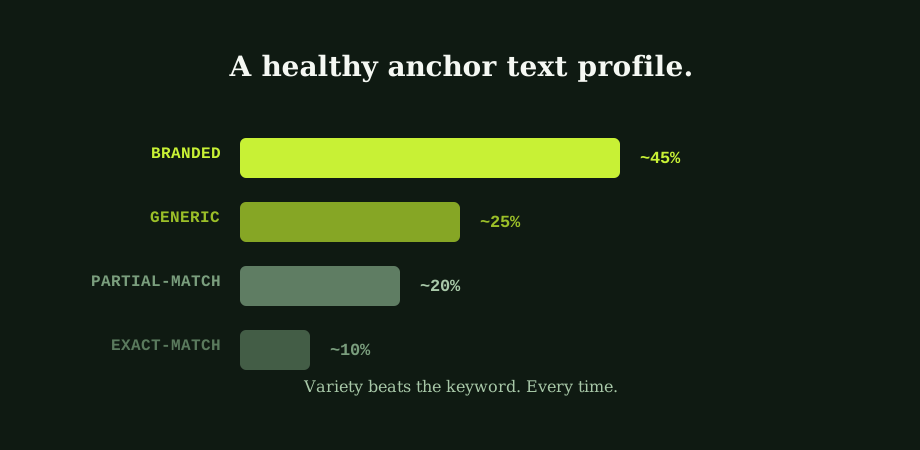
The numbers below are not a rule. They are a working frame that holds up across most natural backlink profiles in 2026. Reasonable variation in either direction is fine. What is not fine is a profile dominated by exact-match.
- Branded: roughly forty to fifty per cent of total anchors. For most healthy sites, this is the largest bucket by a clear margin.
- Generic: roughly twenty to thirty per cent. The natural background noise of the web.
- Partial-match: roughly fifteen to twenty per cent. Descriptive without being forced.
- Exact-match: roughly five to ten per cent. Present, never dominant.
The pattern that consistently triggers algorithmic adjustments is the inverse: exact-match anchors above thirty per cent of the total. That distribution does not happen naturally. It happens when someone is buying links or otherwise forcing a keyword pattern, and Google's models have been trained to recognise it for over a decade.
Internal and external anchors play by different rules
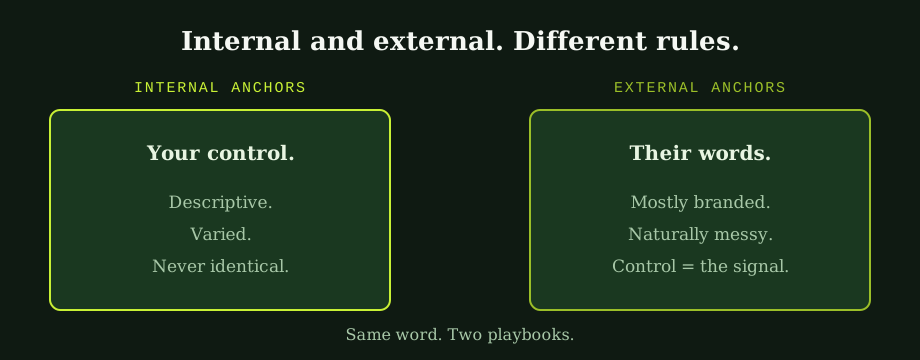
The split that catches most sites out is the difference between internal anchors, which you control completely, and external anchors, which you mostly do not. Each plays by a different set of rules.
Internal anchors should be descriptive and varied. Every internal link is a piece of evidence Google reads. The goal is for each link to use slightly different phrasing rather than the same anchor every time. A service page linked to from twenty blog posts should see twenty different but related anchor variations, not the same phrase repeated. The variety reads as natural editorial work. The repetition reads as a template. Navigation and footer links are different: identical anchors there are normal and search engines weight them accordingly.
External anchors should be allowed to develop naturally. When other sites link to yours, the anchor text they choose reflects their own editorial sensibility. Most journalists, bloggers, and forum users will link to a company using its brand name, with occasional generic anchors and rarer descriptive variations. That is the natural distribution, and trying to force it into something else is itself the manipulation signal Google is looking for. The temptation to ask every publication that mentions your site to use a specific keyword phrase as the link is exactly the temptation worth resisting.
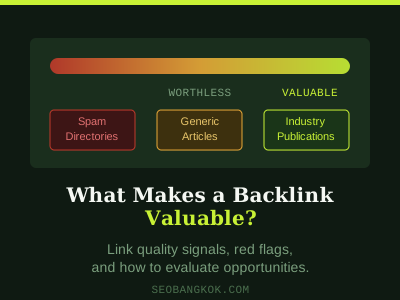
The deeper rules of what makes a link valuable in the first place sit in what makes a backlink valuable, and the broader earning strategy lives in how to earn high-quality backlinks.
Why exact-match anchors are the highest-risk piece
Two reasons, both intuitive once stated.
The first is that exact-match anchors are uncommon in natural writing. When a journalist writes about an SEO agency in Bangkok, the agency is more likely to be named, or linked to with "the agency," than with the phrase SEO agency in Bangkok. A backlink profile heavy in exact-match anchors is, statistically, a profile that has been shaped, not earned. Google's models know this.
The second reason is that exact-match anchors carry such a strong ranking signal that even a small over-allocation can dominate a profile. Twenty exact-match anchors out of a hundred can push a page above where its other signals support. That is exactly the kind of unstable ranking algorithmic adjustments later correct. The penalty is not a moral judgement on the SEO. It is the algorithm regressing the ranking back to where the rest of the evidence supports.
Three habits that quietly fix the distribution
For most sites, the anchor profile cleans up through a small set of editorial habits rather than a big remediation project.
- Vary internal link anchors. Every time you link from a blog post to a service page, pick a different phrasing than your last three uses. Keep a simple log if needed. The variety compounds: ten posts linking with ten different but related anchors signals topical breadth, not template repetition. The mechanics of how internal links work in concert are unpacked in internal linking, the SEO tactic most sites underuse.
- Stop asking for specific anchor text on inbound links. If a journalist or partner wants to link, let them choose their own words. The natural anchor they pick is worth more than the optimised anchor you would have requested, and it does not raise the manipulation flag.
- Run an anchor profile audit twice a year. Pull your top-linked pages, look at the anchor text distribution for each, and check whether exact-match is creeping above fifteen per cent. If it is, the work is not to remove existing links but to earn more branded and generic ones to dilute the ratio.
The signal you actually want
Variety matters not because variety is intrinsically good. It matters because variety is what natural editorial decisions look like. Search engines have invested heavily in telling natural editorial decisions apart from optimised ones. The optimised pattern was useful in 2010 because the algorithms could not tell the difference. Modern algorithms can, and they have been trained to weight against the pattern they spent a decade learning to recognise.
So the question to ask of any anchor text choice is not "does this contain my keyword" but "would a journalist or editor have picked this phrase if they were writing the same sentence?" If the answer is yes, the anchor is doing its job. If the answer is no, the anchor is doing the opposite of what it was meant to do.
Our SEO Bangkok handles anchor text strategy as part of every link-building engagement. That includes the internal anchor distribution and the external profile audit. Our SEO services in Thailand include the audit and the editorial guidance that quietly rebalances the distribution over time. An SEO specialist in Thailand can review your top pages' anchor profiles in less time than reading this post took.
Common questions
What is anchor text and why does it matter for SEO?
Anchor text is the clickable, visible text inside a hyperlink. It matters to SEO for two reasons. The first is that it tells human readers what to expect on the other side of the link, which influences whether they click and how much they trust the source. The second is that it gives search engines a strong signal about what the destination page is about. When many credible sites link to a page using consistent descriptive anchor text, that text becomes part of how the destination ranks. The complication is that the same signal becomes a manipulation indicator when it is too uniform or too obviously optimised.
What are the four types of anchor text?
Branded anchors use the site or brand name itself, like SEO Bangkok or Bumrungrad. Generic anchors are non-descriptive linking phrases like click here, this guide, learn more, or read the article. Partial-match anchors use natural phrases that include some but not all of the target keywords, like the guide to local SEO in Thailand for a page targeting local SEO Thailand. Exact-match anchors use the target keyword verbatim, like SEO services Bangkok for a page targeting that exact phrase. The four exist on a spectrum from neutral to over-optimised, and a healthy anchor profile uses all four in rough proportion.
Are exact-match anchors bad for SEO?
Not bad in isolation. Risky in volume. A single exact-match anchor pointing to a page is normal and helpful. A hundred exact-match anchors from a hundred different sites all pointing to the same page with the same keyword phrase is one of the strongest manipulation signals in Google's algorithm. The rule of thumb is to keep exact-match anchors a small minority of your total anchor profile, ideally well under twenty per cent for external links and used sparingly for internal links. The exact threshold is not public, but the pattern is clear.
How do internal anchor text rules differ from external?
Internal anchors are under your direct control, every one of them, every time. External anchors come from other people choosing how to describe your page when they link to it. The difference matters because Google interprets control as opportunity for manipulation. Internal anchors should be descriptive and varied, with each link to a given page using a slightly different phrasing rather than the same anchor text every time. External anchors should be allowed to develop naturally, which usually means mostly branded and generic.