Google's original insight was that a link from one website to another is a vote of confidence. That logic held up remarkably well, and versions of it still drive rankings today. But the simplicity of the framing obscures something important: not all votes carry the same weight, and some votes are actively disqualified.
In practice this means link building is not an accumulation game. You are not trying to collect the most links. You are trying to earn links that Google actually values. See how to earn high-quality backlinks. Before putting any effort into getting more links, it is worth understanding what value looks like in Google's model.
How link authority actually flows
Every website on the internet has a pool of authority derived from the external links pointing to it. When a site links out to another site, it shares a fraction of that authority through the link. Google calls this PageRank. The mechanism is not mysterious: a site that has earned trust from many credible sources can transfer some of that trust to pages it links to.
What follows from this is that the value of a link is partly a function of the authority of the site giving it. A link from a well-established publication with a strong backlink profile of its own passes more authority than a link from a brand-new blog with no external links pointing to it. This is what people typically mean when they talk about "domain authority," though it should be understood as Google's internal trust metric rather than any third-party score.
The same logic applies to internal linking within your own site. Authority flows through all links, not just external ones. But for this discussion, we are looking at what makes an incoming link from another domain worth pursuing.
The five signals that determine link value
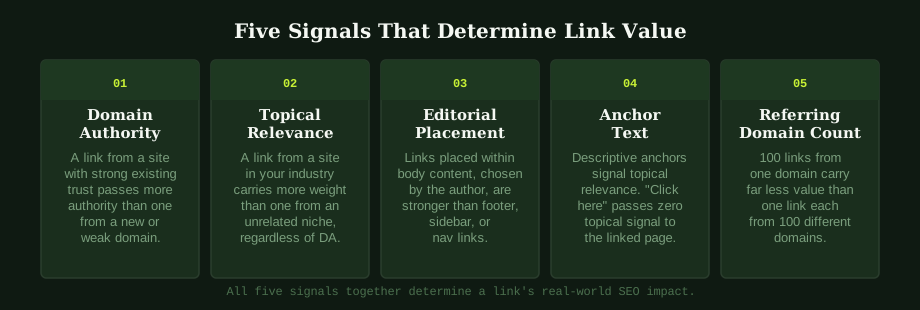
Domain authority. A link from a site that has spent years earning its own credibility carries more weight than one from a site Google has no real reason to trust. Look at how long the domain has been active, what external links it has attracted, and whether it has organic traffic. A site with consistent organic traffic is generally a sign that Google considers it a real resource.
Topical relevance. A Bangkok hotel getting a link from a Thai travel magazine is a very different signal from the same hotel getting a link from a car parts retailer. Google understands what sites are about. A link from a topically adjacent source reinforces your relevance for the subject area you are trying to rank for. An irrelevant link passes little of that benefit, even if the linking site has strong authority in its own niche.
Editorial placement. Where on the page the link sits matters more than most people realise. A link embedded in the body of a written article, where a human author chose to include it as a useful reference, is treated differently from a link buried in a footer or crammed into a sidebar widget. Google has said as much through its quality guidelines: editorially placed links are the kind it values. Site-wide links (the same link appearing on every page of a site via a template) are typically discounted.
Anchor text. The words used to link to your page signal what that page is about. "Thai SEO agency" as anchor text tells Google something about the destination page that "click here" does not. This does not mean you should engineer all your incoming anchor text to be exact-match keyword phrases. An unnaturally uniform anchor text profile is itself a signal, and not a positive one. Natural anchor text varies across branded, descriptive, partial-match, and generic forms.
Referring domain diversity. A hundred links from a single domain count for far less than one link each from a hundred different domains. Each unique referring domain is effectively a separate vote. If all your links come from one source, even a high-quality one, you have a concentrated and fragile profile. The goal over time is breadth: links from many different credible sources across your industry and geography.
What makes a link worthless or harmful
For every signal that adds value, there is a corresponding pattern that subtracts it. Google's spam detection systems have improved substantially over the past decade, and many link types that worked in the early 2010s now do nothing, or worse, attract algorithmic penalties.
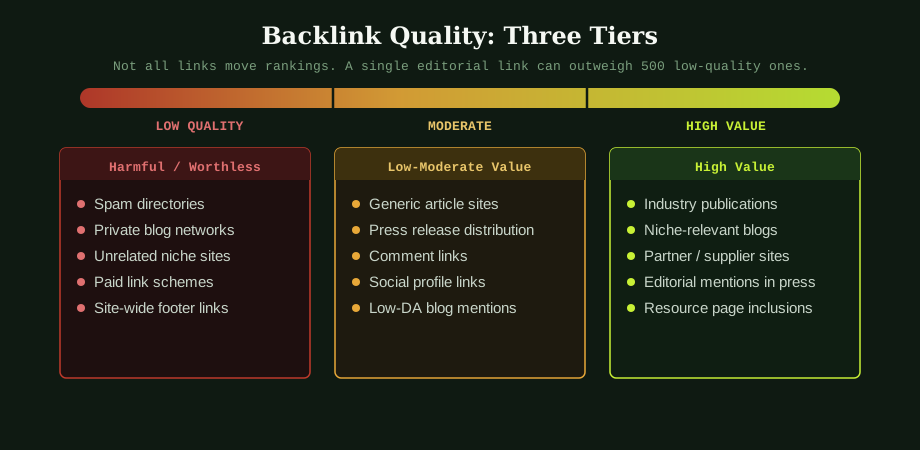
Links from private blog networks (PBNs) are the clearest example of the "worse" category. A PBN is a collection of sites set up specifically to link to money sites, with no real audience and no genuine editorial purpose. Google identifies them through footprint analysis, hosting patterns, and content quality signals. A site with a history of PBN links has to work through that before any legitimate link building can have full effect.
Paid links in the sense Google cares about are specific: money or goods exchanged specifically for a link that is intended to pass PageRank. Guest posts on topically relevant sites with genuine audiences are generally fine. Paying a link broker to place your URL in a template article on a site that exists purely to sell links is not. The distinction matters, and it is worth being clear about it when working with any agency offering link building services.
Generic article directories, press release distribution services, and forum profile links occupy the "mostly worthless" category rather than the actively harmful one. They produce no real value, but a small number of them are unlikely to cause problems. The issue is spending time and resources on them instead of pursuing links that actually move rankings.
Evaluating an opportunity quickly
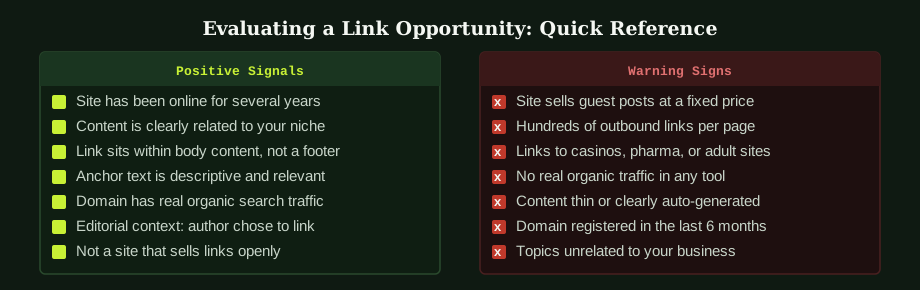
When a link opportunity comes up, whether through outreach, a journalist enquiry, or a partnership approach, the checklist above covers the key checks. A few minutes in Ahrefs (or even the free version) and a look at the site itself gives you enough to make a reasonable judgement.
The strongest positive indicator is genuine organic traffic in a tool like Ahrefs or Semrush. A site with thousands of real monthly visitors has clearly satisfied Google enough to appear in search results. A site with zero or near-zero organic traffic, regardless of whatever domain metrics it claims, is almost certainly not worth pursuing.
One pattern I see consistently across clients I work with as an SEO specialist Bangkok-based consultant: link opportunities that arrive unsolicited and offer placement for a fee are rarely worth the cost. The sites selling links at scale are exactly the kind of sites Google has spent years learning to identify and discount. The effort is better invested in earning links through content, relationships, and genuine industry presence.
What good links look like in the Thai market
Thailand has a smaller English-language web than most markets, which cuts both ways. Competition for links from quality sources is lower, but the pool of potential sources is also smaller. For businesses targeting the local market, a few practical categories tend to produce the most useful links.
Industry associations and chambers of commerce often maintain member directories and resource pages. These links are not glamorous, but they are relevant, trusted, and freely available to members. If you are not listed in every association relevant to your sector, that is an easy gap to close.
Local English-language media (The Nation, Bangkok Post, regional tourism publications) carry real authority in the Thai digital ecosystem. Getting mentioned in editorial coverage takes effort, but a single link from a credible Thai publication outweighs most other options available in the local market.
For businesses with Thai-language content, links from Thai-language news sites and vertical publications carry authority within that language index. This is worth considering if your target audience searches in Thai. The SEO services Thailand page on this site goes into more detail on targeting strategy by market and language.
Supplier and partner links are often overlooked. If you have business relationships with other companies, asking to be listed on their website (and listing them on yours) is one of the most natural and genuinely relevant link-building actions available. It requires no content creation and no outreach to strangers. Most businesses have between five and twenty of these opportunities sitting unused.
Running a technical SEO audit before any link building work is worth doing. Links to a site with indexing problems or crawl errors are partially wasted. The infrastructure needs to be right before the links can work at full value.
Common questions
Does the number of backlinks still matter for rankings?
Quantity matters, but only alongside quality. A site with 50 links from relevant, authoritative domains will typically outrank one with 5,000 links from spam directories and irrelevant blogs. Google's systems have become much better at identifying and discounting low-quality links. The practical goal is to earn more links from credible, topically relevant sources rather than to accumulate volume at any cost.
Is a nofollow backlink completely worthless?
Not completely. Nofollow links instruct Google not to pass PageRank through them, and they carry no direct authority. But they contribute to a natural-looking link profile, they can drive direct referral traffic, and Google has indicated it may treat nofollow as a hint rather than a hard rule in some contexts. A nofollow link from a major publication still has indirect value. That said, in terms of pure ranking impact, focus your effort on earning dofollow links from quality sources.
Can backlinks from bad websites hurt my rankings?
A small number of low-quality links pointing to your site is normal and generally harmless. Google's systems are designed to ignore links it considers spam rather than penalise the recipient. You typically only face a real problem if your site has an unusually large concentration of manipulative links, particularly from paid link schemes. If you have inherited a site with a seriously toxic link profile, the Google Disavow Tool can be used to ask Google to ignore specific links, but it should not be your first response to finding a few low-quality links.
How do I check what backlinks my site has?
Google Search Console shows a sample of your backlinks under the Links report. It is free but incomplete. For a fuller picture, tools like Ahrefs, Semrush, or Moz provide more comprehensive backlink data with metrics on referring domain authority and anchor text distribution. The free version of Ahrefs shows a limited sample but is enough to understand the general quality of your link profile. Checking your profile before starting any link building campaign helps you identify whether you already have problems to address.