The Google Panda algorithm update in 2011 introduced widespread awareness of thin content as a ranking problem. Since then, its definition has been widely misunderstood, often reduced to a word count question when it is really a value question. Google has never published a minimum word count for pages. A 100-word page that concisely answers a specific query is not thin content. A 1,500-word page stuffed with repetitive generalities that says nothing useful is. The distinction is whether the page serves the user who found it.
Understanding thin content correctly is important because the fixes are different depending on the actual problem. Improving SEO services in Thailand starts with an honest assessment of what is on the site before adding more content. Sometimes the right move is to add depth. Sometimes it is to remove pages. Sometimes it is to merge several weak pages into one strong one. None of those decisions is right by default.
What thin content actually means
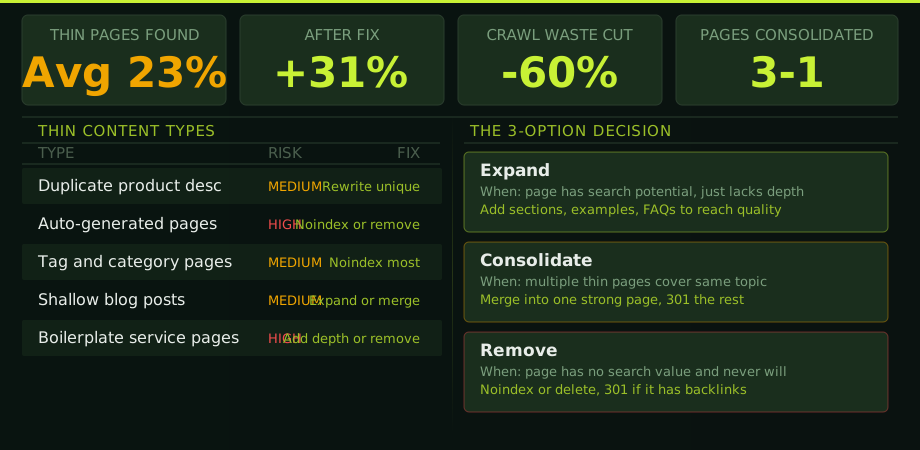
Google's definition, as articulated in its Quality Rater Guidelines, focuses on whether content was created primarily to serve users or primarily to rank in search engines. The types of thin content that consistently suppress rankings fall into five categories.
Auto-generated content. Pages built from templates where the substantive content is filled in programmatically with little or no human editorial input. Common examples include location pages that are identical except for the city name, or product description pages that copy manufacturer copy without modification. These pages may be technically different from each other but provide no unique value.
Duplicate content. Pages that replicate content from elsewhere on the same site, from another site, or from a combination of sources. Internal duplication, such as product pages accessible via multiple URL paths, is especially common on e-commerce sites and often creates thin content problems without the site owner being aware.
Affiliate pages with no added value. Pages that exist only to direct users to affiliate products with no original review, comparison, or editorial content beyond what the merchant already provides. These have been specifically targeted by Google's product review updates.
Doorway pages. Pages created specifically to rank for a search term with the intent of redirecting users to a different page rather than providing the content they expected. These are treated as spam rather than thin content but the underlying problem is the same: no genuine user value.
Shallow informational content. Blog posts or guides that cover a topic at the most surface level, answer no questions that a reader would have after reading, and exist primarily to have something indexed rather than to be genuinely useful. This is the most common type on business sites and the one most often confused with being simply short.
How to find it on your site
The most efficient approach uses three sources in combination.
Screaming Frog crawl filtered by word count. Run a crawl and export all indexed pages with their word count. Filter for pages under 300 words and review them individually. Not all will be thin, but this is the fastest way to identify candidates. Pages under 100 words that are not intentionally minimal, such as a contact page or a checkout confirmation, warrant immediate attention.
Google Search Console impression data. In the Performance report, filter for pages that have impressions but zero or very low clicks over the past three months. A page that appears in search results but never gets clicked is either ranking for the wrong terms or failing to communicate value in its title and description. Both causes are worth investigating.
Pages that have never ranked. In GSC, filter for indexed pages with zero impressions over six months. These pages are being crawled and indexed but are not appearing for any query. Often this is because the content is not meaningfully different from better pages already ranking for the same topic. This is the clearest signal of thin content causing suppression rather than just low competition.
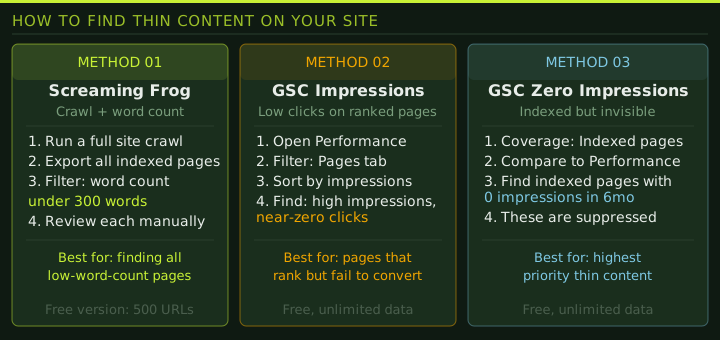
Combining these three filters gives a prioritised list. Pages with zero impressions and low word count are the highest priority. Pages with impressions but zero clicks are a secondary priority. Review each manually before deciding on a course of action.
A structured SEO audit covers thin content identification alongside the other technical and content issues that affect rankings. If you have not run a systematic audit recently, that is usually the right starting point.
The three decisions
Every thin content page falls into one of three categories, and each requires a different response.
Expand. Use this when the page covers a topic that has genuine search demand and ranking potential, but does not yet provide enough depth or quality to compete. The expansion should focus on adding information that is genuinely useful, not on adding word count. Adding a comprehensive FAQ section, real examples, a step-by-step process where one was missing, or data and context that competitors have not covered all constitute meaningful expansion. Simply making a page longer without adding information is not an improvement.
Consolidate. Use this when multiple pages on the same site cover substantially the same topic at a similarly shallow depth. Merging them into a single, authoritative page with 301 redirects from the removed URLs concentrates the ranking signal, eliminates internal competition, and produces one page that can actually rank rather than three that cannot. This is particularly effective for e-commerce sites with multiple category variants, blog archives with overlapping topics, and location pages that differ only in city name.
Remove. Use this when a page has no search value, no backlinks worth preserving, and no realistic path to becoming useful. Noindexing the page removes it from Google's index while keeping the URL accessible. Deleting it and setting a 301 redirect to the closest relevant page is appropriate when the URL itself has no value. The goal is to reduce the proportion of low-quality content on the site, which affects how Google assesses the site's overall quality. A site where 40% of indexed pages are thin content is assessed differently from one where 5% are.
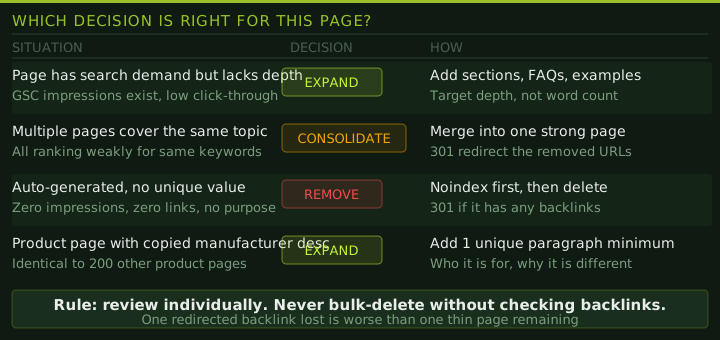
For product pages with manufacturer descriptions, the decision is usually expand or remove. A product page with no unique description that exists alongside 200 identical competitors provides nothing that differentiates it. Even a paragraph of honest editorial review, a note about who the product is best suited for, or a clear explanation of what makes it different from adjacent products is enough to move a page from thin to acceptable.
What Google penalises and what it does not
Most sites with thin content experience gradual ranking suppression rather than a formal penalty. Google's Helpful Content system operates as a site-wide signal, meaning that a large proportion of unhelpful content on a site reduces the visibility of the entire site, not just the thin pages. This is why fixing thin content often produces broader ranking improvements than the specific pages addressed would suggest.
A true manual action for thin content is uncommon and is typically reserved for sites that are substantially composed of auto-generated or scraped content. If you are looking at one or two thin pages on an otherwise healthy site, the concern is not a manual penalty but rather the suppressive effect of those pages on the site's overall quality assessment.
The practical implication is that improving thin content is more valuable as a site-wide quality improvement than as a fix for specific URLs. Reducing the proportion of low-quality indexed pages raises the floor that Google is assessing when it evaluates how much of the site to surface in results. Pairing this with strong internal linking to your best pages ensures the authority from your strong content flows properly rather than being diluted across weak pages.
When you are not sure how much thin content your site has or whether it is suppressing rankings, a technical and content audit is the right first step. Our SEO services in Thailand include a full content quality assessment as part of the initial engagement.
Thin content questions
What is thin content in SEO?
Thin content is any page that provides little or no value to users relative to what they were searching for. This includes pages with minimal text, duplicate content, auto-generated pages with no unique information, and pages that exist primarily to capture search traffic rather than to genuinely help the reader.
Does Google penalise thin content?
Google's quality systems reduce the ranking visibility of thin pages rather than issuing formal penalties in most cases. A manual action for thin content is rare and reserved for sites substantially composed of low-quality or auto-generated content. Most sites with thin content see gradual ranking suppression and a site-wide quality assessment impact, not an instant drop.
How do I find thin content on my site?
Crawl your site with Screaming Frog and filter for low word count pages. Cross-reference with Google Search Console: look for indexed pages with zero impressions over six months, and pages with impressions but very low click rates. These combined filters identify the highest-priority thin content candidates.
Should I delete thin content pages?
Not always. The right decision is one of three options: expand the page with genuine depth, consolidate multiple thin pages on the same topic into one strong page with 301 redirects, or remove the page if it has no search value. Deleting a page with backlinks without redirecting it wastes link equity.
Does word count determine thin content?
No. Word count alone does not define thin content. A concise page that directly answers a query may be perfectly adequate at 100 words. A 2,000-word page full of repetitive filler with no unique insight is thin content despite its length. The question is whether the page provides genuine value to the searcher, not how many words it contains.