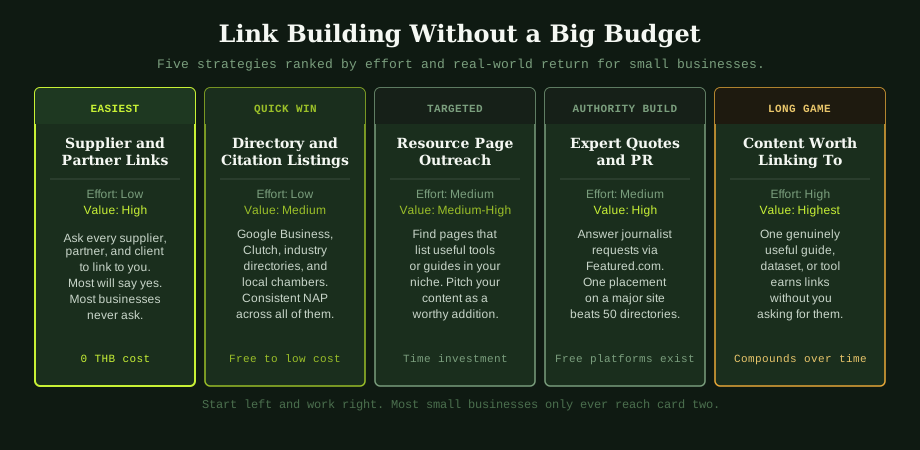
Before anything else, it is worth being honest about what link building actually is for most small businesses. It is not running broken link building campaigns or building link-worthy data studies. It is finding the people who already have a reason to link to you and making it easy for them to do so. That framing changes the strategy considerably.
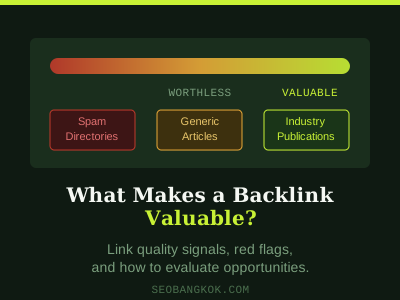
To get to understand what makes a link valuable before reading further, the previous post on what makes a backlink valuable covers the signals in detail. This one is about where to find them.
Start with what you already have
The most overlooked link building opportunity for any small business is the network it has already built. Suppliers. Clients. Business partners. Trade associations. Accountants. Web developers. The businesses you refer customers to and the businesses that refer customers to you.
Every one of these is a potential link source. Most businesses never ask. The ones that do find that the acceptance rate is surprisingly high, because the ask is reasonable and the relationship is already there.
The email is short. You reference the working relationship, ask if they would add a link to your site from theirs, offer to do the same, and provide the URL and a suggested anchor text (your brand name, not a keyword phrase). That is the whole thing. Three or four sentences.
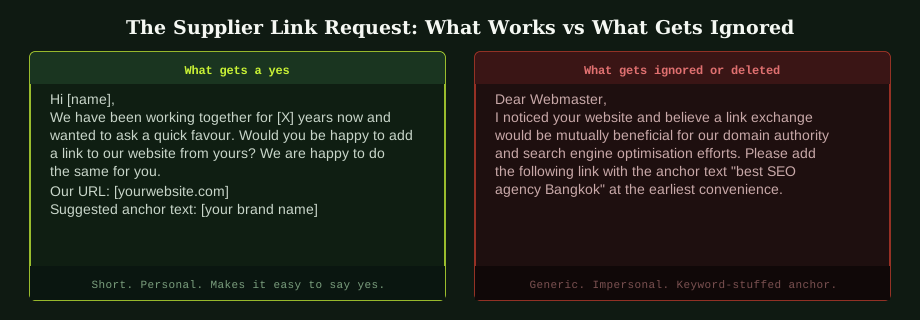
One client I worked with had been in business in Bangkok for eight years. When we sat down and listed every company they had a direct relationship with, we found 22 potential link sources. We sent the email to all of them. Fourteen said yes within a week. That is fourteen links from relevant, real businesses with genuine web presences, acquired in a single afternoon of emails.
No tool. No campaign. No agency. Just asking.
Directory and citation listings: the foundation layer
Every business should have consistent listings across the directories that matter for its market. For a local SEO signal in Thailand this means Google Business Profile first, then the Thai Yellow Pages equivalent, then industry-specific directories, then the broader agency and business directories that buyers in your sector actually use.
The key word is consistent. The name, address, and phone number on every listing needs to match exactly what is on your website. A business called "SEO Bangkok Co. Ltd" on one directory and "SEO Bangkok" on another creates a citation conflict that dilutes the local relevance signal rather than building it. Pick one format and use it everywhere.
For the Bangkok market specifically, the directories worth completing first are Google Business Profile, Bing Places, Apple Business Connect, and then the sector-specific listings relevant to your industry. For a digital agency, that means Clutch, GoodFirms, and the Digital Agency Network. For a restaurant, it is Wongnai, Yelp, and TripAdvisor. The point is not to be on every directory. It is to be on the ones your potential clients actually use, with complete and consistent information.
These links are not going to shift rankings dramatically on their own. What they do is establish that your business is real, that it has a consistent identity across the web, and that multiple independent sources agree on what you do and where you are. That is the foundation that makes every other link building activity more effective.
Resource page outreach: the underused middle ground
Resource pages are pages that exist specifically to link out to useful content on a given topic. "Best tools for Thai small businesses." "Resources for Bangkok expat entrepreneurs." "Useful guides for e-commerce sellers in Southeast Asia." These pages are maintained by associations, educational sites, publications, and individual bloggers who have decided to curate the best material in their niche.
Getting onto a relevant resource page is one of the most efficient link building activities available. The page is already designed to link out. The owner is predisposed to add good resources. You are not asking them to change their content strategy. You are offering them something that makes their existing page better.
The search approach is simple. Use queries like "useful resources for [your industry]," "best tools for [your client type]," or "recommended guides for [your topic]." Look at the pages that come up. If there is a clear gap for the kind of content you have on your site, reach out.
The pitch is even shorter than the supplier email. You say you found their resource page, found it genuinely useful, and wanted to flag a guide you have published that their audience might benefit from. Include the URL. That is it. No explanation of why backlinks matter. No mention of SEO. Just a relevant resource offered to someone who collects relevant resources.
Expert quotes and PR coverage: the high-return play
One placement on a publication with genuine authority is worth more than fifty directory listings. This is the frustrating but true version of link building reality for small businesses: the best links come from being treated as an expert source, not from submitting forms.
The accessible entry point for this is journalist request platforms. Featured.com absorbed HARO and operates a similar model: journalists post questions seeking expert input, you respond with a specific and useful answer, and if selected your response runs in their article with a credit and a link back to your site. The platform is free at the basic level. The time investment is the response itself, usually a few hundred words.
As an SEO specialist Bangkok-based consultant, the queries I respond to are not always specifically about SEO. They cover digital marketing for SMEs, doing business in Thailand, e-commerce strategy, local search for international businesses. The expertise transfers across categories. A business owner with twenty years of experience in a specific market has more to say than they usually give themselves credit for.
The Thai market also has its own version of this. The Thaiger, Bangkok Post, Nation Thailand, and Marketeer Online all cover business and digital marketing topics. A well-placed pitch from a practitioner with a specific local angle, a real example, and an opinion worth reading stands a reasonable chance of getting a response. The link from any of these domains carries more weight than most other options available in this market.
Content worth linking to: the long game
The only truly scalable link building strategy is producing something that people want to link to without being asked. This is the hardest category and also the most valuable over time, because the links accumulate passively after the initial effort.
For most small businesses, this does not mean a data study or an interactive tool. It means one genuinely thorough guide on the topic your customers ask about most often. Not a list of ten tips. A real answer to a real question, written with enough depth and specificity that someone who finds it via Google actually learns something. See how to earn high-quality backlinks.
A Bangkok-based accounting firm that publishes the clearest guide available on Thai corporate tax requirements for foreign-owned companies will attract links from expat forums, business association sites, law firms, and international companies researching a Thai market entry. None of those link sources need to be contacted. The content earns them.
The question to answer before producing this content: what is the one thing people in your market are most confused about, that you understand better than most, and that nobody has explained properly online yet? That is your target. One page done well outperforms ten pages done adequately.
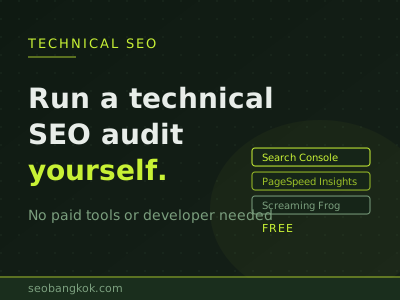
Producing that content and then checking whether it has started earning links via Google Search Console or a basic Ahrefs check is part of any technical SEO audit worth doing. If nothing is linking in after six months, the content either needs to be better or more people need to know it exists.
What not to bother with
Broken link building is frequently recommended and rarely worth the time for small businesses. The process involves finding dead links on other sites, creating replacement content, and pitching the site owner to swap the broken link for yours. In theory it is elegant. In practice the success rate is low, the setup time is high, and the sites with broken link problems are often not the high-quality sources worth targeting anyway.
Reciprocal link exchanges with strangers are generally not worth pursuing. Two sites agreeing to link to each other purely for SEO value is something Google understands and discounts. The supplier and partner links described earlier work because the relationship is genuine and the link is editorially reasonable. A cold exchange with a business you have no connection to is a different thing.
Paying for links from link brokers or content farms carries real risk. Google's spam detection has improved considerably and sites with obviously purchased link profiles do face algorithmic action. The money is better spent on good content or on the time cost of doing the outreach properly. For a more detailed breakdown of what separates good link sources from bad ones, the backlink quality guide covers every signal worth understanding.
For businesses using a consultant or SEO services Thailand-wide, it is worth asking specifically how links are being acquired. The answer should involve some version of the strategies above. If it involves "we have a network of partner sites" or "we submit to high-DA directories," push for specifics.
Common questions
How many backlinks does a small business actually need?
There is no target number that applies universally. What matters is having more referring domains than the sites you are competing against for your specific target keywords. A local service business in Bangkok might need 20 to 30 quality referring domains to rank well for local terms. An e-commerce site targeting competitive national terms needs more. Check what your closest competitors have using a free tool like Ahrefs or the free version of Semrush, and work from there rather than from a generic number.
Is link building still worth it in 2026?
Yes. Links remain one of the strongest signals Google uses to determine how much to trust a page. What has changed is that the bar for what counts as a useful link has risen. Links from irrelevant, low-traffic, or mass-produced sites are discounted. Links from credible, topically relevant sources still carry real weight and move rankings. The approach has to be more selective, but the activity is absolutely still worth the time for most businesses.
Should I buy backlinks?
Buying links in the way Google prohibits, meaning paying for links specifically to manipulate PageRank, carries real risk. Google's spam detection has improved considerably and sites with obviously purchased link profiles do get penalised. The money is better spent on producing content worth linking to, on PR outreach, or on the time cost of building supplier and partner links properly. If an agency is offering you 50 links for a fixed fee with a quick turnaround, the links are almost certainly not worth having.
How long does link building take to show results?
Most link building activity takes three to six months to show measurable ranking movement. Google needs to crawl the linking page, follow the link, recrawl your site, and factor the new signal into its ranking calculations. This process is not instant and sometimes takes longer for newer sites. Supplier and directory links tend to show faster than PR-based links because they are crawled more frequently. Do not judge link building campaigns on a one-month window.