Most product page SEO advice reads like a checklist of every possible factor. That is not useful when you have a thousand SKUs and limited time. What you actually need is a priority order: which signals move rankings, which are nice-to-have, and which can wait until the basics are working.
This post covers the four signals that genuinely matter for product page SEO, how to implement each one without a six-month dev backlog, and the specific complication Thai e-commerce sites face: competing against Shopee and Lazada listings that already rank for your category terms.
The problem with most product pages
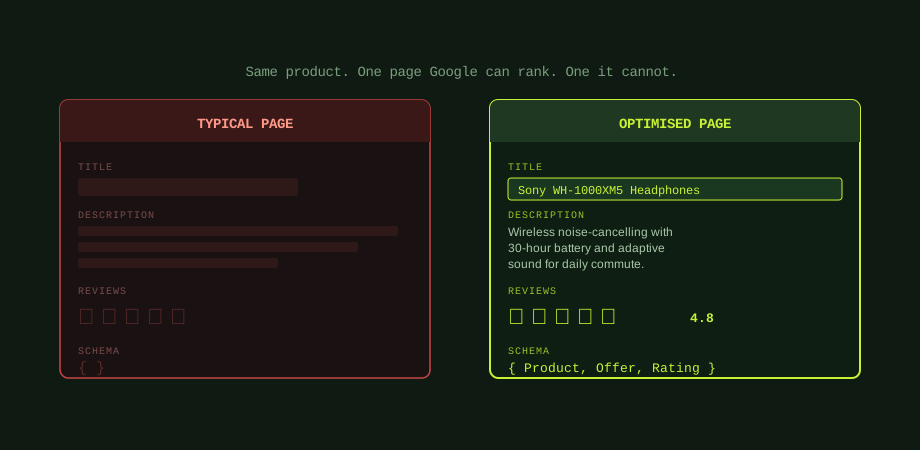
The default state of a product page on most e-commerce platforms looks the same: a manufacturer description pasted in, a stock image from the supplier, no schema markup, no reviews, and a URL that includes a SKU number nobody searches for. See product and review schema. See handling out-of-stock and discontinued products. See image SEO for the full checklist. The page is functional. It is also indistinguishable from the same product page on a hundred competitor sites running the same platform with the same supplier data. Platform-specific guidance for Shopify stores is the breakdown is in the Shopify SEO configuration guide, and category-specific guidance for high-value visual products is in SEO for jewelry brands in Thailand.
Google has no reason to rank your version over any of those competitors. The page does not differentiate. The signals it sends are identical to every other listing of the same SKU. Whatever ranking it achieves comes from your domain authority, not the page itself, which is why most product pages on most stores do not rank for anything more competitive than the exact product name.
Fixing this is not about adding more elements. It is about getting four specific elements right.
1. Unique product copy is the foundation
Doing nothing else from this post means write your own product descriptions instead of using the manufacturer's. This single change does more for product page SEO than any technical implementation, and it is the most common gap on Thai e-commerce sites that have invested in everything else first.
The reason is direct: manufacturer descriptions appear on every retailer site selling that product. Yours is one of dozens or hundreds of identical pages, and Google's deduplication systems have to pick one to rank. They almost always pick the highest authority domain, which is rarely a mid-size Thai retailer. Original copy turns your page into a unique document with content that exists nowhere else, which gives Google a reason to index and rank it independently.
The copy does not need to be long. For most products, 150 to 250 words covers what matters: what the product is, who it is for, the key specifications that affect a buying decision, and any context the manufacturer description leaves out. The structure that works consistently is a short opening paragraph (what this is and the primary use case), a specifications block (the technical details buyers compare), and a closing paragraph (any nuance or compatibility considerations).
For a thousand-SKU catalogue this is genuine work, and the answer is not to try to do everything at once. Prioritise your top revenue products, then your top traffic products from Google Search Console, then work down. Even original copy on 20% of the catalogue can shift overall organic performance significantly because those are usually the same products carrying most of the rankings potential. The remaining 80% can stay on manufacturer copy temporarily without much downside; just make sure the high-value pages get the attention first.
One specific point about AI-generated copy: it works as a starting point, but Google's helpful content systems have become better at detecting generic AI output. Original AI drafts that get edited for accuracy, brand voice, and product-specific detail are fine. Raw AI output published at scale across thousands of pages is now actively penalised on stores that have tried it. The labour goes into editing rather than writing from scratch, which speeds up the work but does not eliminate it.
2. Product schema markup unlocks rich results
After unique copy, structured data markup is the highest-leverage technical change for product pages. Specifically, Product schema with the right properties enables price, availability, and review stars in the search result snippet, which substantially increases click-through rate without changing rankings directly. Higher CTR on the same position does drive rankings up over time, so the second-order effect compounds.
The required properties for Product schema are name, image, description, brand, and offers (with price, priceCurrency, and availability). Adding aggregateRating where you have reviews unlocks the star rating in search results. The schema lives in a JSON-LD script in the page head and should be generated automatically from your product database, not maintained manually per page. Most e-commerce platforms have schema plugins or built-in generators; the question is whether they include the full property set or just the basics.
Common implementation mistakes: missing the brand property (required for many product categories), using "InStock" availability when items are actually backorder or limited, marking up the wrong currency, and including reviews in schema that do not appear visibly on the page (which Google now treats as a structured data violation). Use Google's Rich Results Test to validate every template before deploying to thousands of pages, and revalidate after any platform updates that might have changed the markup.
For Thai stores selling internationally, the priceCurrency property matters more than it seems. THB pricing displays correctly in Thai search results, but if you also serve international customers, you may need different schema for different geographic versions of the page. This intersects with how you handle multi-currency pricing structurally, which is a related but separate topic.
3. Image optimisation that actually moves the needle
Image optimisation for product pages comes up constantly in SEO advice, but most of it focuses on the wrong things. File compression and lazy loading are important for Core Web Vitals, not for ranking specifically. What matters for product page SEO is image alt text, file naming, and image schema.
Alt text on product images should describe the product and include the product name. Not "image1.jpg" alt="product image" (the default for many platforms), but actual descriptive text: a Sony WH-1000XM5 image gets alt text like "Sony WH-1000XM5 wireless noise-cancelling headphones in midnight black." This serves accessibility, image search ranking (which is non-trivial traffic for many product categories), and gives Google additional context about what the page is about.
File names matter for the same reason. Product-name-based file names (sony-wh-1000xm5-black-side.jpg) outperform platform-generated names (img-294827.jpg) for image search visibility. Most platforms let you rename files on upload; the work scales with catalogue size, but it pays back over years of indexed images.
Image dimensions should match your display size, not be uploaded at maximum resolution and resized in the browser. A product page that loads a 4MB hero image to display at 800px wide is wasting bandwidth and damaging Core Web Vitals. Modern e-commerce platforms handle this through image CDNs that serve appropriately sized variants; older or custom platforms often do not, and the fix is platform-dependent but always worthwhile.
4. Reviews and ratings if you can get them
Reviews are the fourth priority because their impact depends on whether you can actually collect them. For categories where customers leave reviews readily (electronics, fashion, beauty), aggregating reviews on product pages and marking them up with schema is high-value. For categories where customer reviews are rare (B2B equipment, niche industrial products, specialty supplies), forcing reviews into the strategy is not productive, and the time is better spent on copy and schema.
If reviews are achievable, the technical implementation involves capturing reviews (through post-purchase email flows, on-site review widgets, or third-party platforms), displaying them on the product page in a way Google can crawl (not loaded entirely through JavaScript that requires interaction), and marking them up with Review or aggregateRating schema as part of the Product schema.
One pattern that does not work: pulling reviews from third-party platforms via JavaScript without server-side rendering. Google sees the empty review section on the initial crawl and does not index the content even if it eventually loads. Reviews should be present in the HTML when the page is fetched, even if they are also enhanced by JavaScript afterwards.
The Shopee and Lazada problem for Thai stores
When you run an e-commerce store in Thailand, one specific challenge shapes your product page SEO: Shopee and Lazada listings often rank above your product pages for the same SKU. These marketplaces have enormous domain authority, millions of indexed pages, and aggressive SEO investment. Competing on identical signals is rarely productive.
What works is differentiating on signals the marketplace listings lack. Shopee and Lazada product pages typically have: short generic descriptions, no expert context, no comparison content, no buying guidance, and minimal content depth beyond specifications and reviews. Your product pages can outrank marketplace listings on specific query types where depth matters: long-tail queries with technical specifications, comparison queries (X vs Y), use-case queries (best for cycling/gaming/professional use), and informational queries that lead to purchase.
For broad category terms like "wireless headphones," the marketplace usually wins regardless of what you do, because the search intent is a marketplace-style browsing experience. Pick your battles. Build content depth on the specific products and queries where expertise and detail can outrank volume, and accept that the broad category terms belong to Shopee and Lazada unless you have comparable domain authority.
For e-commerce stores that want a structured approach to this, our e-commerce SEO Bangkok works through the product page optimisation, schema implementation, and category-level positioning in one engagement. The general e-commerce SEO fundamentals post covers the broader site-level signals; this product page work fits inside that wider context.
URL structure: the one thing not to change once it works
URL structure for product pages should be short, readable, and stable. The pattern most e-commerce sites should use is /category/product-slug/ with the product name in plain language, no SKU numbers in the canonical URL, and no parameters that change with sessions or tracking.
The single most important thing about product URLs is that you do not change them once they are live and indexed. Each URL change requires a 301 redirect, updates to internal links across the site, and a period of search ranking disruption while Google reprocesses the new structure. Most stores that restructure URLs lose 20% to 50% of organic traffic temporarily, and some never fully recover.
When you must restructure (typically because category URLs are unworkable), do it once, comprehensively, with 301 redirects from every old URL to its new location, and accept the short-term ranking impact. Do not do it gradually; gradual URL changes are worse than a clean cutover because they extend the disruption period.
What to do first
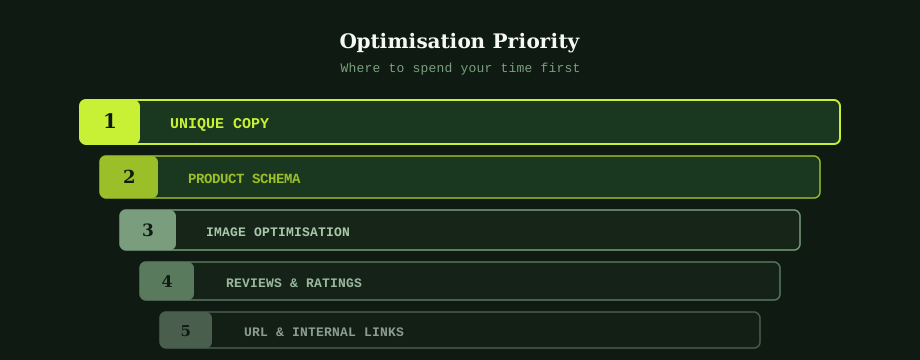
With your e-commerce site has thousands of product pages and limited time, the sequence that produces the most movement in the shortest time is: implement Product schema across all pages first (this is a one-time technical change that affects everything), then write unique copy on your top 50 to 100 products by revenue or organic traffic, then work on images for those same products. Reviews follow if your category supports them. URL structure stays unchanged unless it is actively broken.
This sequence is deliberately backwards from how most SEO advice presents the work. Schema is mentioned as a nice-to-have; unique copy is mentioned as a content task to deprioritise. Both are wrong for e-commerce. The technical change has system-wide impact; the copy change has targeted impact on the products that matter most. Together they produce more ranking movement in three months than every other product page optimisation combined.
For an audit of where your current product pages stand on these four signals, an SEO services Thailand engagement starts with a technical audit and identifies the highest-impact gaps. An experienced SEO agency in Bangkok can also help you sequence the work so the schema implementation comes first and the copy work proceeds against a clear prioritisation, rather than as an undifferentiated backlog.
Common questions
Should I use the manufacturer's product description or write my own?
Write your own. Using the manufacturer description duplicates content that appears on dozens or hundreds of competitor sites selling the same product, and Google has no reason to rank your version over theirs. Unique product copy is not just a nice-to-have for product page SEO; it is the foundational signal that tells Google your page adds something to the index that other pages selling the same SKU do not. The investment scales with catalogue size, but even short original copy (150 to 250 words covering use case, key specifications, and what buyers should know) outperforms long manufacturer text on every product page that has it. Prioritise your top-selling products first, then work down the catalogue.
Do I need Product schema on every product page?
Yes. Product schema is what enables rich results in Google search, including price, availability, and review stars in the search snippet. Without it, your listings show as plain text while competitors with schema get visually richer snippets that earn higher click-through rates. The implementation is straightforward and template-driven; once it works on one product page, it applies to all of them. The schema should include name, image, description, brand, offers (with price, priceCurrency, and availability), and aggregateRating where reviews exist. Missing schema is the single most common technical gap in Thai e-commerce sites and the easiest one to fix at scale.
How can I rank product pages against Shopee and Lazada listings?
Differentiation, not competition on identical signals. Shopee and Lazada have enormous domain authority and millions of pages; competing on volume is not the strategy. What Shopee and Lazada product pages typically lack: detailed buying guidance, expert context, technical comparison content, and depth of original copy. Your product pages can outrank marketplace listings on long-tail queries (specific model numbers, technical specifications, use-case searches, and comparison queries) by offering content the marketplace listings do not. For broad category terms, the marketplace usually wins; pick your battles on the specific queries where depth and expertise differentiate.
What URL structure works best for product pages?
Keep URLs short, readable, and stable. The pattern that works for most e-commerce sites is /category/product-slug/ with the product name in plain English (or your target language) and no SKU numbers, session IDs, or tracking parameters in the canonical URL. Avoid deep nested paths because they push the product slug further from the root and make URL rewrites painful later. Most importantly, do not change product URLs once they are live and indexed; if you must, use 301 redirects from old to new and update internal links throughout the site.