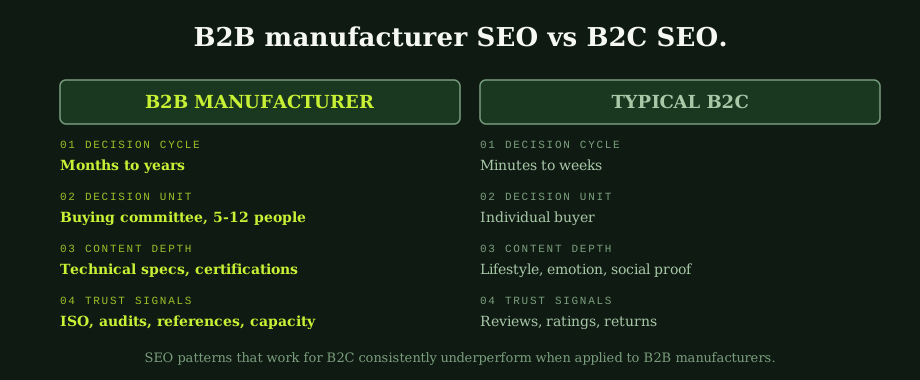
The core observation that frames the whole post. Thai B2B manufacturer SEO is structurally different from typical SEO in ways that go beyond surface-level industry jargon. Decision cycles run months to years rather than minutes to weeks. Decision units are buying committees of 5 to 12 stakeholders rather than individual buyers. Trust signals concentrate on certifications and audit history rather than reviews and social proof. SEO patterns that work brilliantly for B2C and even most B2B services consistently underperform when applied unmodified to manufacturers. The vertical guide unpacks why and what works instead.
Why Thai manufacturers are under-SEO'd
Four structural reasons explain why Thai B2B manufacturers have low SEO maturity despite being commercially substantial businesses.
The trade show legacy. Thai manufacturing buyer discovery has historically run through industry trade shows (THAIFEX for food, Bangkok Auto Salon for automotive, electronica equivalents for electronics) plus government-coordinated promotion (Department of International Trade Promotion, Board of Investment). The systems work well enough that many manufacturers see SEO as redundant rather than complementary. The reality of 2026 is that buyer research increasingly starts on Google and AI search engines well before the trade show conversation, but the discovery models in the industry have lagged the buyer behaviour shift.
The technical content gap. Manufacturer content tends to be either too marketing-thin (capability statements without spec depth) or too engineering-dense (PDF data sheets behind login walls). Neither works for SEO. The middle ground (technical content depth presented accessibly for buyer-research browsing) is the actual SEO opportunity but requires content production capability that most manufacturer marketing teams lack.
The long-cycle problem. When deals take 18 months to close, attributing pipeline to specific SEO inputs is difficult, and marketing budgets for "speculative discovery work" get cut first when financials tighten. Manufacturers that get SEO right treat it as multi-year capability investment rather than quarterly campaign spend; manufacturers that under-invest treat each year's budget as a fresh decision and consistently defund the programme.
The internal organisational structure. Manufacturer marketing often reports through sales rather than as a strategic function, which biases the work toward sales enablement materials (brochures, case studies, capability decks) rather than discoverability work (search-optimised content, technical resource libraries, third-party citations). The structural fix is hard because reorganising the marketing function is rarely a priority.
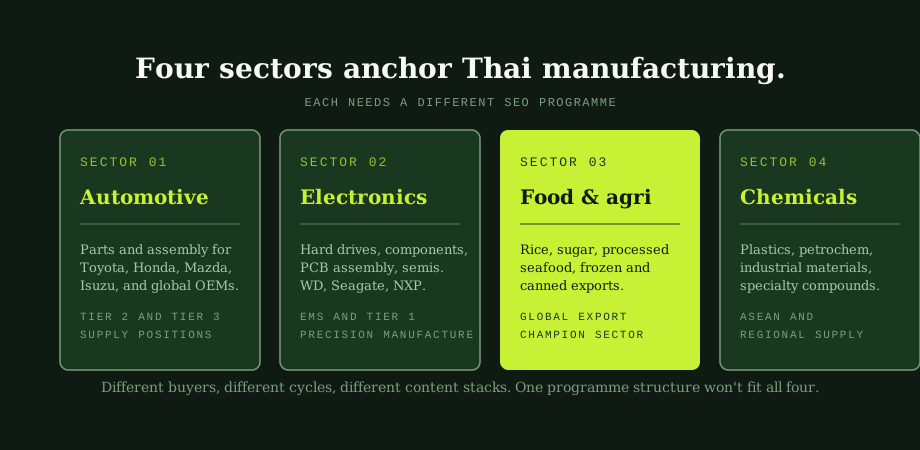
The four Thai manufacturing sub-verticals
Each sub-vertical has its own buyer audience, certification expectations, content depth requirements, and SEO programme structure.
Automotive parts and assembly sits inside the global automotive supply chain serving Toyota, Honda, Mazda, Isuzu, and other regional OEMs. Most Thai automotive manufacturers operate in Tier 2 or Tier 3 supplier positions (component or sub-component) rather than Tier 1 (direct OEM supplier). The SEO buyer audience includes OEM procurement teams researching alternative suppliers, automotive design houses evaluating component options, and aftermarket distributors sourcing parts. Critical certifications include IATF 16949 (automotive quality management), specific OEM approvals, and material composition compliance. Content depth has to cover technical specifications, tolerance ranges, production capacity, and process documentation.
Electronics and hard drives covers a tier-mixed landscape from major brand-name operations (Western Digital, Seagate hard drive assembly) through EMS providers (electronics manufacturing services for PCB assembly) to component suppliers (passive components, semiconductors). The buyer audience is technical and global: electronics design teams, supply chain engineers, contract manufacturing buyers. SEO content has to be precision-heavy (specifications, datasheets, process capability) and AI-search-friendly because increasing volumes of supplier research now route through ChatGPT and similar engines. The wider AI search angle for B2B specifically links into the integrated framing.
Food and agriculture exports is Thailand's manufacturing export champion sector. Rice, sugar, processed seafood, frozen and canned exports, fruit and vegetable processing, animal feed, and an increasingly important plant-based protein subcategory all serve global buyer audiences. Buyers include European food importers, Japanese trading houses (Mitsui, Itochu), Middle Eastern distributors, ASEAN regional buyers, and American specialty importers. Content has to address food safety certifications (HACCP, BRC, FSSC 22000, halal where relevant), traceability documentation, and sustainability credentials. The international buyer audiences mean SEO has to cover multiple languages and regions; the framing for that is in SEO for Thai businesses targeting foreign customers.
Chemicals, plastics, and industrial materials serves regional ASEAN supply and selected global buyers. Petrochemical derivatives, specialty plastics, industrial chemicals, building materials, and industrial textiles all sit here. The buyer audience is more regional than the other sub-verticals (most Thai chemical exports stay within Asia) but the technical content requirements are similar to electronics: specifications, safety data, regulatory compliance documentation. SEO programmes for this sub-vertical typically run in English plus regional languages (Vietnamese, Indonesian, Chinese) more than in Thai because the buyer audiences are not domestic.
The B2B manufacturer buyer journey
The B2B manufacturer buyer journey is among the longest of any commercial discipline. Six recognisable phases.
Initial supplier research (12 to 18 months before order). Procurement teams or buying committees identify candidate suppliers through search, industry directories, AI search engines, and trade publications. Discovery-stage queries are broad: "Thai automotive parts manufacturer," "frozen seafood exporters Thailand," "PCB assembly Bangkok." Manufacturers absent from search at this stage are absent from the consideration list.
Capability verification (9 to 12 months out). Shortlisted candidates have their websites scrutinised for capability, certification status, financial stability, and reference customers. Manufacturers whose websites are sparse, outdated, or hide critical information at this stage get cut.
Formal RFQ stage (6 to 9 months out). Surviving candidates respond to formal Request for Quotation documents covering specifications, pricing, delivery terms, and compliance commitments. SEO no longer drives outcomes at this stage but the perceived professionalism of the candidate's prior digital presence influences how RFQs are evaluated.
Plant audit or sample production (3 to 6 months out). Buyers conduct on-site audits of the manufacturer's facility and processes, or commission sample production runs to validate quality. SEO contributes nothing direct at this phase but the buyer's perception accumulates from every previous touchpoint.
Pilot order or trial contract (1 to 3 months out). Buyer commits to a limited initial order to validate the supplier under real conditions. SEO again contributes nothing direct but informs the buyer's confidence going in.
Master agreement and ongoing supply (year one onward). Successful pilots convert to multi-year supply agreements that often run for the lifecycle of the buyer's product programme. The deal scale dwarfs typical SEO ROI calculations: a single OEM tier-2 supply relationship can be worth 50 to 500 million baht over a five-year programme.
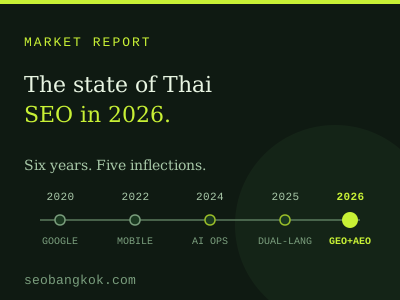
The structural implication for SEO. The work that pays off concentrates in the first two phases (initial research and capability verification). Manufacturers absent from search at month minus 18 are missing from the buyer's consideration set at month minus 12. The wider state-of-the-market context that explains why this matters more in 2026 than in previous years is in the state of Thai SEO in 2026.
Technical content requirements
B2B manufacturer content has to satisfy technical buyers without losing accessibility for buyer-research browsing. Five content categories carry most of the weight.
Capability statements with specific depth. "We make automotive components" is not capability content. "Tier 2 supplier of precision-machined aluminium engine components with capacity for 1.2 million units annually across 14 product families, supplying Toyota Thailand, Honda Thailand, and three Japanese OEM operations in the wider ASEAN region" is capability content. Specificity converts; vagueness does not.
Technical specifications presented accessibly. Buyers want spec depth (dimensions, tolerances, materials, processing parameters, surface treatments) but presented for browsing rather than buried in PDF data sheets. The compromise is structured product pages with detailed specifications visible and downloadable comprehensive data sheets for the buyers who want the full document.
Process documentation. How the manufacturer actually produces what it produces. Cleanroom classifications, quality control checkpoints, in-process testing protocols, packaging standards. Process documentation reassures buyers that the manufacturer has operational discipline beyond the marketing claims.
Certification and audit history. ISO 9001, ISO 14001, ISO 45001, IATF 16949, BRC, HACCP, FSSC 22000, halal, kosher, and industry-specific certifications relevant to the sub-vertical, with verification details and audit history. Hiding certifications behind login walls signals weakness; presenting them transparently signals confidence.
Customer references and case studies. Named relationships where confidentiality permits, anonymised case studies where it does not. The depth and specificity of references is one of the strongest credibility signals for B2B buyers; vague claims of "working with leading global brands" without supporting detail get discounted heavily.
International SEO for export-focused manufacturers
The buyer audiences for Thai manufactured goods are overwhelmingly international. Pure Thai-language SEO captures only the smallest portion of the addressable audience for most manufacturers. The international SEO layer typically covers four to seven target markets depending on the sub-vertical.
English as the base layer for all four sub-verticals because most international buyers conduct primary research in English regardless of their home market.
Japanese for automotive and electronics sub-verticals where Japanese OEMs and trading houses dominate the buyer landscape.
Chinese (simplified) for chemical, electronics, and some food sub-categories where Chinese intermediate-goods buyers and integrators are a significant audience.
Regional ASEAN languages (Vietnamese, Indonesian, Malay) for sub-verticals with strong regional supply chain integration, particularly chemicals and food.
European languages (German, French, Italian) for food exports targeting specialty European importers.
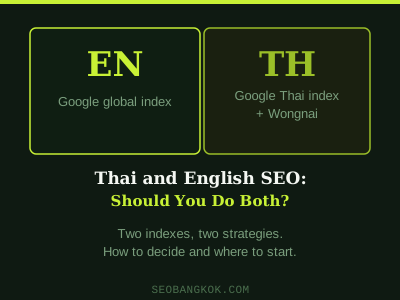
The technical implementation of multi-market international SEO (hreflang, regional content structure, server geography) is well-established and rarely the bottleneck. The bottleneck is content production capacity at the depth international B2B buyers expect. The framework for cross-border SEO that this rests on is in SEO for Thai businesses targeting foreign customers and the bilingual content patterns that scale to multi-language are in Thai and English SEO: should you target both languages.
Common mistakes in Thai manufacturer SEO
- Treating the website as a digital brochure. Static capability decks updated annually do not produce discoverability.
- Hiding specifications behind login walls. Forcing buyer-research browsing through gated content cuts off the early-research phase where opinions form.
- Generic capability statements without specific depth. "Leading manufacturer" claims without specifics get discounted by serious buyers.
- Thai-language-only SEO for export-focused businesses. The buyer audience is global; Thai-only SEO captures a small fraction of the addressable market.
- Stock photography of generic factories. Real photography of the actual facility, equipment, and team carries far more credibility weight than stock.
- Hiding certifications in footer microcopy. ISO and industry certifications are the strongest available trust signals and should be prominent.
- No customer references. Confidentiality is legitimate but vague "working with global brands" claims without any supporting specifics signal weakness.
- Treating SEO as quarterly campaign rather than multi-year capability. Long-cycle deals require long-cycle SEO investment.
- Marketing reporting through sales. The structural bias toward sales enablement starves discoverability work of resource.
- Ignoring AI search. Increasing volumes of B2B supplier research now route through AI engines and manufacturers absent from those surfaces are missing from new buyer consideration sets.
The honest version of B2B manufacturer SEO
Thai B2B manufacturer SEO done well is a multi-year capability investment that compounds across global buyer audiences, technical content libraries, certification visibility, and trust signals. Done badly, it produces a digital brochure that contributes nothing to commercial outcomes and gets defunded the next time the budget tightens. The vertical is structurally under-developed which is paradoxically the opportunity: manufacturers who take SEO seriously when most competitors do not capture market share over the multi-year horizons that B2B deals actually take to close. The work is unglamorous and slow but the deal sizes when it lands are dramatic.
Our work with Thai manufacturer clients spans the full buyer journey from research-stage discoverability through capability verification content and international SEO for export audiences. The SEO marketing agency programme treats manufacturer SEO as a multi-year capability with quarterly milestones rather than as a campaign. For cross-border SEO targeting international buyer audiences specifically, the cross-border SEO programme service covers the multi-language, multi-region work. The technical content depth runs through our technical SEO service. A discovery conversation with our Bangkok SEO consultancy typically identifies whether the manufacturer is ready for the multi-year investment that produces compounding results or needs to build internal alignment first.
Common questions
Why is B2B manufacturer SEO different from typical SEO?
Five structural differences. Decision cycles run months to years versus minutes to weeks. Decision units are buying committees of 5 to 12 stakeholders versus individual buyers. Content depth requires technical specifications and certifications versus lifestyle content. Trust signals concentrate on ISO certifications, third-party audits, and customer references rather than reviews and social proof. Primary conversion is an RFQ form or sample request rather than a direct purchase. SEO patterns that work for B2C consistently underperform when applied unmodified to B2B manufacturers.
What are the four major Thai manufacturing SEO sub-verticals?
Automotive parts and assembly serving Toyota, Honda, Mazda, Isuzu and global OEMs in Tier 2 and Tier 3 supply positions. Electronics including hard drives, PCB assembly, components and semiconductors for Western Digital, Seagate, NXP and similar brands. Food and agriculture exports including rice, sugar, processed seafood, frozen and canned products serving global buyers. Chemicals, plastics, petrochemicals, and industrial materials serving regional ASEAN supply chains. Each sub-vertical has its own buyer audiences, certifications, and SEO programme structure.
What trust signals matter most for B2B manufacturer SEO?
ISO certifications (ISO 9001, ISO 14001, ISO 45001, IATF 16949, BRC, HACCP, FSSC 22000) displayed prominently with verification details. Third-party audit history including customer-conducted audits and accreditation body audits. Verifiable production capacity (plant size, annual output, workforce, equipment list) presented transparently. Customer references with named relationships where confidentiality permits. Documented track record (years in operation, export volumes, geographic reach, regulatory compliance history). Manufacturers who hide these signals lose to those who present them well.
How important is international SEO for Thai B2B manufacturers?
Critical for almost all export-focused Thai manufacturers. The buyer audience for Thai-produced industrial goods is overwhelmingly international. SEO has to capture buyer research happening in source-market languages and geographies. Common international audiences include Japanese OEMs, American electronics brands, European food importers, Chinese intermediate goods buyers, ASEAN regional distributors. Each needs language-appropriate content and credibility signals calibrated to that market. Pure Thai-language SEO captures only the smallest portion of the addressable buyer audience.
A comparable engagement is documented in our B2B case study, where an international wholesale supplier moved from nine position-one rankings to sixty-six across its tracked query set.