A Thai jewelry manufacturer wants to sell to buyers in Europe (a case walked through in SEO for jewelry brands in Thailand). The vertical-specific application of this framework for Thai manufacturers (one of the largest export-focused categories) is in SEO for B2B manufacturers in Thailand. A Bangkok IT company is pitching managed services to Singapore enterprises. A Phuket resort is tired of relying entirely on OTAs and wants to capture direct bookings from Australian families searching for accommodation. All three have the same core problem: they are operating from Thailand but the customers they want are searching in a language and a context that their current site does not match.
This is a specific SEO challenge. It is not the same as local SEO, and it is not quite the same as the general international SEO questions that apply to multinational brands. The vertical-specific application of this framework to international schools (one of the largest expat-targeting categories) is in SEO for schools in Thailand. Pair this with SEO for medical clinics in Thailand for the healthcare-specific application. The dental-tourism vertical specifically (one of the larger cross-border categories for Thai businesses) is in SEO for dental clinics in Thailand. Thai businesses targeting foreign customers occupy a particular position: you have a local domain, local hosting signals, and a business rooted in Thailand, but you need to be found by people who have never been to Thailand and who are searching in a completely different language ecosystem.
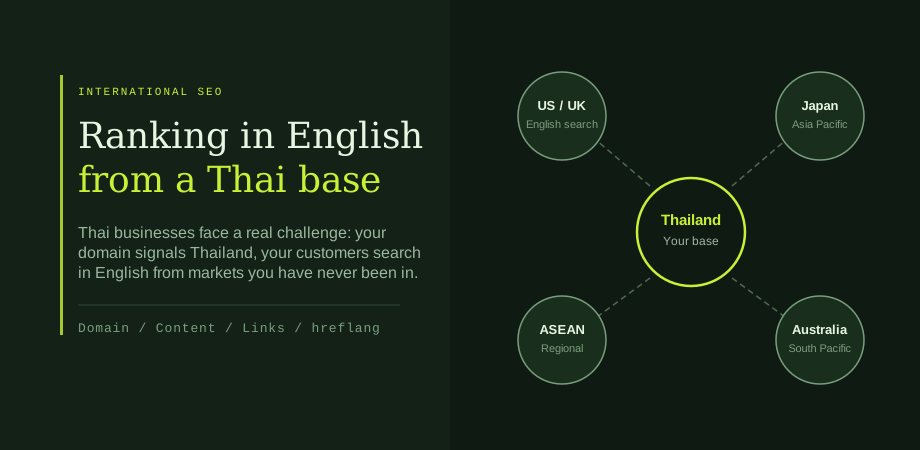
There are four variables that shape whether you can rank in those markets: domain and hosting signals, English content strategy, technical implementation (particularly hreflang), and inbound links from foreign domains. Get all four right and the Thai base becomes less of a disadvantage than most businesses assume.
Domain and hosting: what the signals actually mean
A .co.th or .th ccTLD sends a geographic signal to Google. That is true. But it is one signal among many, and it is not a hard block on ranking outside Thailand. Thai businesses with ccTLDs rank for English-language queries regularly, particularly in less competitive markets and on more specific terms. The domain signal matters more when you are explicitly targeting a single high-competition country such as the US or UK. For ASEAN markets, or for general English-language search, the signal is much less determinative than people assume.
Anyone using a .com domain (as many Thai companies targeting international clients already do) there is no geographic penalty and no disadvantage relative to a competitor from any other country. A .com with strong English content and inbound links from English-language domains will perform in English search regardless of where the business is based.
Hosting location is similarly overrated as a signal. Google uses server location as a weak geographic indicator, but it is easily overridden by content language, inbound links, and the geotargeting settings in Google Search Console. A Thai-hosted site with excellent English content and links from UK or Australian domains will rank for UK and Australian queries. Migrating your hosting to a Singapore CDN or US server adds marginal benefit at most and is rarely worth the operational complexity.
The practical conclusion: if you already have a domain, work with it rather than rebuilding from scratch. The content and link signals you build on an existing domain carry authority that takes time to rebuild on a new one. The exception is if you are starting fresh and specifically targeting one English-speaking country, in which case a local ccTLD for that market (a .co.uk for the UK, a .com.au for Australia) does provide a meaningful signal boost. The regional strategy view of which ASEAN markets to enter is in SEO for Southeast Asia.
English content strategy: writing for the right reader
The most common mistake Thai businesses make when targeting foreign customers is treating English content as a translation project rather than a content strategy project. They take Thai pages, run them through a translator (sometimes a professional, sometimes a tool), and publish the result as their English section. The content ends up technically in English but answers questions Thai users ask, in the framing Thai users expect, with the details Thai users need.
That is a problem because foreign customers searching for the same service have different questions, different concerns, and different search behaviour. A Bangkok law firm targeting foreign clients is not answering "how to find a lawyer in Bangkok" (a Thai user query). It needs to answer "foreign business registration Thailand," "BOI application lawyer Bangkok," and "branch office setup Thailand" -- the queries foreign executives are actually searching when they need that service.
The keyword research process for English content targeting foreign customers starts with the foreign customer's perspective, not a translation of the Thai keyword list. What does a Singapore procurement manager search when they need a Thai manufacturer? What does an Australian couple search when they want to buy a retirement property in Chiang Mai? What does a UK company search when they need a Thai customs broker? These questions produce different keyword sets, different search volumes, and different content requirements than the Thai equivalents.
Structure the English content around those queries. If your Thai content is one long page covering all services, the English version probably needs to be more granular, with separate pages targeting specific queries that foreign users make. A Thai manufacturer selling to European buyers might need separate landing pages for different product categories, each optimised for the specific terms European buyers use in their industry. The vertical-specific application of cross-border targeting for legal services is in SEO for law firms in Thailand.
Write the English content specifically for the international reader. Do not assume they know Thai geography, Thai business conventions, or Thai terminology. Explain things that are obvious to a Thai reader but opaque to someone approaching Thailand for the first time. This is not condescending; it is exactly what the foreign customer needs and what Google's ranking systems reward because it satisfies search intent more completely.
Technical implementation: hreflang and geotargeting
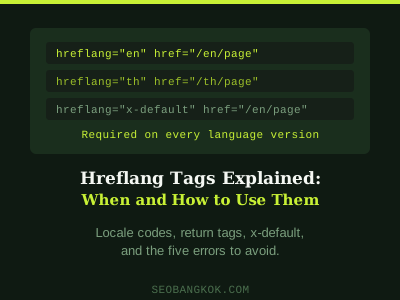
When your site has both Thai and English versions of the same pages, hreflang tags are not optional. Without them, Google has to guess which version to show to which user. You will find Thai pages appearing for English searches, and English pages appearing in Thai results, both of which hurt click-through rates and waste the ranking signals you have built.
The hreflang implementation for a Thai business with English and Thai content uses th for the Thai version, en for the English version, and x-default pointing to the English version (since English is the fallback for any user whose language does not match). Both versions must carry the complete set of alternate tags pointing to each other. The English page must point to the Thai page, and the Thai page must point to the English page. Missing this bidirectional confirmation is the most common implementation error.
Google Search Console's geotargeting tool (under Legacy Tools > International Targeting) lets you specify a target country for your entire domain if you are using a .com. This is useful if your English content is predominantly targeting one country such as Singapore or Australia. If you are targeting multiple English-speaking markets simultaneously, do not set a specific country target; leave it unset and let the content and link signals do the work.
Structured data helps too, though not directly as a ranking signal. LocalBusiness or Organization schema with clear address data and contact information tells Google's understanding layer something concrete about who you are and where you operate. For B2B businesses, adding Service schema with clear descriptions of what you offer and who it is for gives the machine-readable context that supports both traditional rankings and AI-generated overviews. If you sell to other businesses, see B2B SEO: how it differs from B2C.
Link building from a Thai base: the honest picture
This is where most Thai businesses targeting foreign customers fall short, and it is the hardest part to fix quickly. Links from foreign domains are the clearest geographic signal that a Thai business has genuine relevance in a foreign market. A Bangkok IT firm with ten links from Singapore tech blogs and directory listings is telling Google something concrete about its market presence that content alone cannot convey.
The good news is that links from Thai domains still carry SEO value. The domain authority you have built from Thai industry sites, Thai directories, and Thai media coverage is not wasted. It builds the overall authority of your domain, which lifts all your content including the English pages. But to rank competitively in foreign markets, you need some links from domains that are themselves geographically relevant to those markets.
The practical starting points for Thai businesses are: industry directories in your target markets (these are often free or low-cost to list in), supplier or partner pages from any foreign companies you already work with, and English-language media coverage through PR or guest content. If you work with an Australian distributer, ask for a link from their partner page. If you have been covered by any English-language trade publication, make sure those links are in place. If you have not, consider a press release or guest article targeting a relevant English-language publication in your sector.
ASEAN markets are the most achievable starting point. Singapore, Malaysia, and Hong Kong have active English-language business media. Getting coverage or directory listings in those markets is significantly easier than building links from US or UK domains, and ASEAN presence builds on the geographic credibility you already have as a Thai business. Once ASEAN rankings are established, the domain authority those links generate supports rankings in further markets.
A working example: IT services targeting Singapore
Consider a Bangkok-based IT company, Apex Digital Systems, that handles managed cloud infrastructure for mid-size enterprises. Their Thai client base is strong, but they want Singapore clients. Their current site is entirely in Thai, optimised for Thai enterprise searches, with no English content and no links from non-Thai domains.
The approach: first, add an English section at /en/ with separate service pages targeting Singapore-specific queries. Not "managed IT services" generically, but "managed cloud services Singapore SME," "IT outsourcing Bangkok Singapore," and "AWS managed services ASEAN" based on what Singapore procurement managers actually search. Each page is written for the Singapore reader, mentions timezone alignment, references Singapore data residency requirements, and speaks to concerns a Singapore CTO would have about working with a regional vendor.
Second, implement hreflang between the Thai and English versions. Third, claim and complete listings on Singapore business directories and tech vendor platforms. Fourth, reach out to any existing Singapore clients for a case study or testimonial that can anchor a page about Singapore-specific results. Within six months, the English pages start appearing in Singapore search results for long-tail queries. Within twelve months, broader managed services terms begin showing impressions in Google Search Console's Performance data filtered to Singapore.
This is not a quick win. But the structural work, domain signals, English content, and link building compounds over time in a way that paid advertising cannot replicate and that AI-generated overviews increasingly reward for demonstrating real market presence.
Common mistakes to avoid
Targeting the wrong English market first. The US and UK are the largest English-language markets but also the most competitive. Thai businesses typically rank faster and build authority more efficiently by starting with ASEAN English-language markets, where competition is lower and their geographic position is an asset rather than a neutral factor.
Publishing English content without English link building. Content alone is not enough. A Thai domain with strong English pages but no links from English-language domains will rank for very long-tail, low-competition queries but struggle to break into the first page for anything with meaningful search volume. Content and link building need to happen in parallel.
Treating the English section as an afterthought. Some Thai businesses add an English section but give it half the content depth, none of the internal links, and no ongoing publishing. Google's crawlers notice the ratio of maintained Thai content to neglected English content. The English section needs the same care as the Thai section to compete.
Not using Google Search Console's international reports. Once English content is live, the International Targeting report and the Performance report filtered by country are the fastest way to see where you are getting traction. If English pages are showing impressions in Singapore but not Australia, that tells you where to focus the next round of link building. Without this data, you are operating blind.
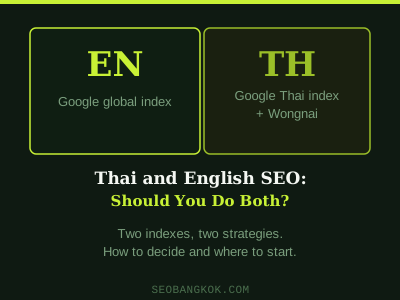
For a full assessment of how your current site is positioned for international rankings, an international SEO review maps the gap between your current signals and where they need to be for your target markets. If you are also exploring the Thai-language side of your strategy, the Thai and English SEO guide covers how to decide where to allocate effort when both audiences matter. An experienced SEO specialist Bangkok can help you sequence the work so early wins fund the longer-term authority building.
Common questions
Can a Thai domain (.co.th or .th) rank in English-language markets?
Yes. A ccTLD like .co.th sends a geographic signal to Google, but it is one signal among many, not a hard barrier. Thai businesses regularly rank for English-language queries when their content quality, technical setup, and inbound link profile support it. The domain signal matters more when targeting a specific high-competition country like the US or UK. For ASEAN markets or general English search, a .co.th with strong English content and some foreign-domain links performs well. The bigger issue is usually content quality and the absence of links from English-language domains, not the ccTLD itself.
Do I need a separate English website or can I add an English section to my Thai site?
Both approaches work, but a dedicated subdirectory (example.com/en/) on your main domain is usually more efficient than building a second site. A second site splits your link equity and requires double the maintenance. Adding an English section to your existing domain lets you concentrate authority in one place. If you go this route, implement hreflang correctly so Google knows which version to serve to which audience. A separate .com domain makes sense only if you are targeting a specific English-speaking country and want maximum geographic signal, or if your brand positioning differs significantly between Thai and international markets.
How long does it take to rank in English-language markets from Thailand?
Longer than ranking locally in Thai. International English markets are more competitive, your domain starts with limited authority in those markets, and link building from foreign domains takes time. A realistic timeline for a new English content section to start generating meaningful traffic is six to twelve months. Pages targeting specific niche queries or long-tail terms with low competition can rank faster. Broad competitive terms in mature markets like UK or US take longer and require sustained link building. Starting with ASEAN markets often produces faster results because competition is lower and your Thai base gives some regional credibility.
Should I translate my Thai pages into English or write separate English content?
Write separate English content rather than translating Thai pages directly. Direct translation rarely works well for SEO because Thai pages answer questions Thai users ask, in the framing Thai users expect. The English version needs to answer questions foreign users ask, which are different queries with different phrasing and different concerns. Translation produces technically bilingual content that satisfies neither audience well. Budget for original English copy written specifically for the international reader and their search context.