Annual industry reviews are usually either too bullish (selling the reader on a vendor's services) or too breathless (chasing trend coverage). The value of an honest review is in pointing out which shifts genuinely matter for the businesses inside the market and which are surface noise. This piece distinguishes the two for the Thai SEO landscape at mid-2026.
The Google near-monopoly continues
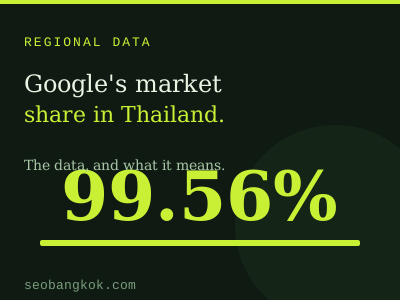
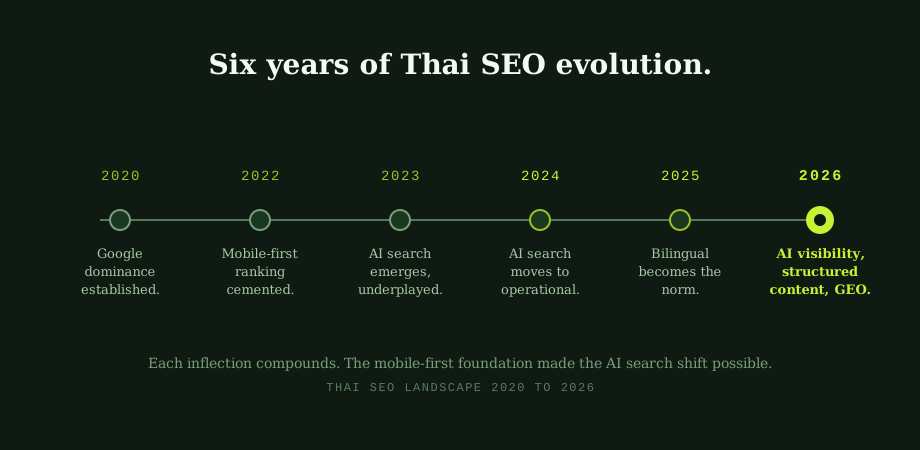
Google's share of Thai search remains around 99.56 percent (StatCounter Global Stats, early 2026), which is the highest concentration of any major ASEAN market and notably higher than equivalent figures in Western markets. The practical implication for Thai SEO has not changed in years: optimisation effort should target Google specifically; other search engines can be effectively ignored in nearly all programmes. The Thai-market structural specifics that drive this concentration are unpacked in Google's market share in Thailand.
The dominance has held steady across the past several years rather than fragmenting. There is no credible scenario for late 2026 or 2027 in which Google's share drops meaningfully in Thailand; the alternative search engines (Bing, DuckDuckGo, Yandex regional alternatives) have made no observable inroads. AI search engines are growing as a research channel but are not displacing Google for the bulk of Thai search queries.
AI search has gone mainstream
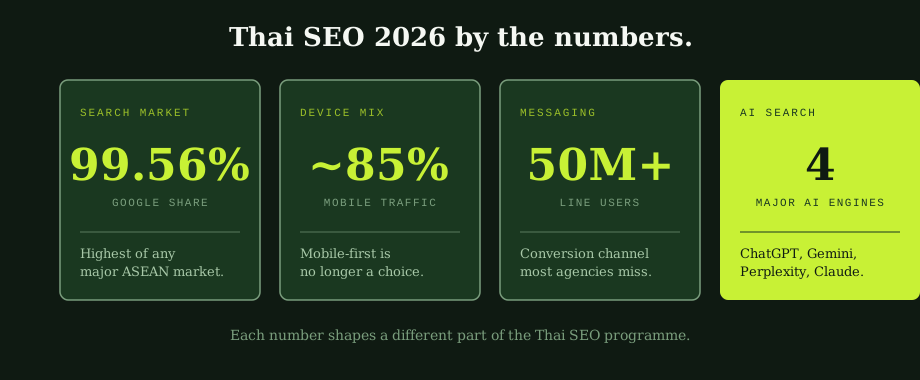
The biggest change in Thai SEO between 2025 and 2026 is the operational mainstreaming of AI search. Through 2024 and early 2025, most Thai businesses treated AI search optimisation as something they would think about eventually. By mid-2026, businesses that have not run a baseline AI visibility audit are losing brand mentions to competitors in AI-generated answers, which feeds back into Google search behaviour as users seeing competitor names in AI answers then search for those competitors specifically.
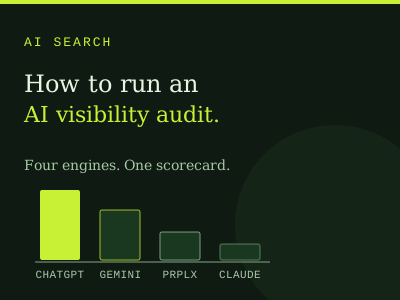
The shift is structural rather than tactical. AI engines (ChatGPT, Gemini, Perplexity, Claude) now process a meaningful share of category research, particularly for B2B purchases, professional services, and complex consumer decisions. The vertical-specific application for Thai manufacturers is in SEO for B2B manufacturers in Thailand. They do not yet dominate everyday transactional queries (a Thai user looking for a nearby noodle restaurant still uses Google maps; a Thai user evaluating ERP vendors might start with ChatGPT). The implication is that AI search optimisation work concentrates on the upper-funnel research-heavy queries while Google optimisation continues to handle the middle and lower funnel.
The conceptual framing of how AI search works as a discipline is in what is answer engine optimization; the measurement methodology that pairs with it is in how to run an AI visibility audit; and the engine-by-engine differences that shape audit interpretation are in ChatGPT vs Gemini vs Perplexity for SEO.
The mobile-first reality has hardened
Around 85 percent of Thai web traffic comes from mobile devices, and the practical SEO implication is that mobile rendering, mobile Core Web Vitals, and mobile-optimised content patterns are no longer a category of optimisation; they are the default mode that everything is designed for. The Core Web Vitals optimisation specifics for Thai network conditions are in Core Web Vitals for Thai networks. Desktop-first sites in Thai 2026 are visibly older operators, and the SEO penalty for poor mobile performance compounds against them. The slow Thai mobile networks (still common outside the major urban areas) make this an even harsher constraint than the headline statistic suggests; sites optimised only for fast urban connections perform poorly across the broader user base.
The implication for image optimisation, page weight, and JavaScript dependencies is significant. Thai sites that pass Core Web Vitals in test environments often fail them in production because the actual network conditions of Thai users are slower than the testing harness assumes.
Bilingual SEO is the table stakes
The single most-shifted area in operational practice between 2024 and 2026 is the treatment of bilingual content. Through 2024, most Thai businesses ran either Thai-only sites (typical of domestic consumer brands) or English-only sites (typical of foreign-positioned brands serving expats and international customers). By 2026, the operational norm for any meaningful Thai business is to run parallel Thai and English content tracks, not because of universal market expectation but because the queries that drive business value increasingly span both languages even within ostensibly Thai-language buyer journeys.
The bilingual operational framing that this requires is in Thai and English SEO: should you target both languages. The technical SEO mechanics specifically for hreflang and parallel-content handling are well-established at this point and rarely the bottleneck; the actual bottleneck is content production capacity to maintain two language tracks at quality.
Local search remains LINE and GBP heavy
The Thai local search landscape continues to centre on Google Business Profile and LINE rather than the discovery channels that dominate other markets. Yelp does not exist as a meaningful factor in Thailand. TripAdvisor matters only for tourism-adjacent businesses. The Thai-specific review platforms (Wongnai, Pantip) carry weight in specific niches but do not aggregate into the kind of cross-vertical authority that GBP carries.
The conversion channel mix sets Thai local SEO apart further. A Thai user who finds your business through GBP often initiates contact via LINE rather than through the website form or phone call. Agencies that build local SEO programmes without LINE integration miss the conversion side of the work even if the visibility side is well done. The GBP-specific optimisation framework is in how to optimise Google Business Profile in Thailand; the wider Thai-market local SEO foundation is in the local SEO foundation for the Thai market.
The agency landscape is consolidating
The Thai SEO agency market has consolidated meaningfully over the past two years. The proliferation of small, generalist SEO agencies that characterised the 2020-2023 market has thinned as buyers increasingly demand demonstrable expertise across the newer disciplines (AI search, bilingual content production, integrated digital programmes). The agencies that survived the transition are typically either specialised (deep in one vertical or one discipline) or scaled enough to run integrated programmes that combine SEO with paid media, content production, and conversion optimisation.
The implication for buyers is favourable: the credibility of mid-market SEO providers is meaningfully higher than it was three years ago, and the worst-case agency relationships have largely been weeded out by market dynamics. The flip side is that agency fees have risen, and the kind of small-budget engagement that produced acceptable results from generalist agencies in 2022 increasingly produces flat results today because the work required to compete has expanded.
The pricing reality that this dynamic has produced is unpacked in how much does SEO cost in Thailand.
The Thai-international audience split is sharper
Thai businesses serving both Thai and international audiences have always run more complex SEO programmes than single-audience businesses, but the gap has widened. International audiences (particularly from the major source markets for Thai medical tourism, dental tourism, real estate, jewellery, and B2B IT services) now expect levels of content depth, trust signal sophistication, and brand presence that take dedicated work to build. Thai businesses targeting these audiences increasingly run parallel content tracks rather than translated content.
The wider framing for Thai businesses serving foreign audiences is in SEO for Thai businesses targeting foreign customers.
What changed in the last twelve months
Five specific shifts hardened between mid-2025 and mid-2026.
AI search visibility audits became standard. Through 2025, AI visibility was a curiosity. By mid-2026, it is a standard component of serious SEO programmes, with quarterly audits running across all four major engines.
Entity SEO graduated from theory to operational. The work of building a brand entity strong enough to be cited confidently by AI engines moved from emerging discipline to standard work. Structured data, named-author content, third-party citations, and Wikipedia/Wikidata presence all matter in ways that mattered less even a year ago.
Generative engine optimisation became a discipline term. What was called "AI SEO" or "AEO" through 2024 is increasingly called "GEO" (generative engine optimisation) in 2026 to distinguish it from older content-and-link SEO. The terminology shift signals professional maturation.
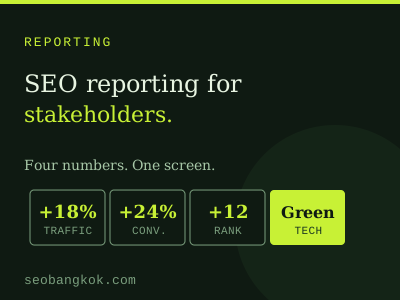
Reporting expectations elevated. Thai businesses buying SEO services in 2026 expect more sophisticated reporting (stakeholder-tuned formats, attribution depth, action-oriented narratives) than they did two years ago. Agencies that ship spreadsheet-style monthly reports are increasingly losing accounts. The reporting framework that meets the new expectations is in SEO reporting: what to show stakeholders.
Vertical specialisation accelerated. Generalist SEO programmes work less well in 2026 because the verticals have built different optimisation requirements. Medical clinics, law firms, financial services, dental tourism, e-commerce, and B2B IT all need vertical-specific work that generalist programmes cannot produce at quality.
What is coming for late 2026 and 2027
Three trends are likely to continue compounding into 2027.
GEO will move from optional to standard. The content structure changes driven by what AI engines need to cite confidently will become the default content production approach rather than an additional layer on top of Google-focused SEO. Sites that ship content for both audiences simultaneously will outperform sites that retrofit.
Bilingual will be assumed baseline. Single-language Thai sites will continue losing ground to bilingual operators across most categories. The exception will be hyper-local Thai businesses (neighbourhood services, small consumer brands) where the international audience does not exist.
Local SEO will continue tightening around the LINE conversion layer. The agencies that win local SEO accounts in 2027 will be the ones that treat GBP visibility and LINE conversion as a single workstream rather than as separate disciplines.
The economic compounding of these trends is what makes them important. Businesses that build operational discipline early get a widening gap over competitors who delay; the cost rises for businesses that delay because the gap between leading and lagging operators widens each quarter rather than staying constant.
What this means for buyers
The implication for Thai businesses evaluating SEO investment in 2026 is that the bar has risen. Engagements that worked at small budgets in 2022 increasingly produce flat results in 2026 because the discipline has widened. The right shape of engagement depends on the business size and maturity, but a few patterns hold.
For established mid-market businesses with internal capability, the consulting-and-execution split that fits enterprise reality is increasingly the right model rather than full-service agency outsourcing. The framework for that engagement shape is in what is enterprise SEO consulting.
For smaller businesses without internal capability, the full-service agency relationship remains the right model, but with the recognition that the budget required to compete has expanded versus three years ago.
For businesses uncertain whether they have outgrown their current agency or in-house arrangement, the decision framework is in in-house SEO vs hiring an agency.
The honest version of Thai SEO in 2026
Thai SEO in 2026 is a more mature, more demanding, and more commercially serious discipline than it was three years ago. The good operators are doing better work than they ever have, the bad operators have been weeded out, and the pricing reflects the increased capability required. Businesses that take the discipline seriously and invest at the level it now requires will continue to outperform competitors who treat SEO as a 2020-era line item. Businesses that under-invest will continue losing organic share to those who do not.
Our positioning as a Bangkok SEO agency spans the modern Thai SEO discipline including AI search visibility, bilingual operations, vertical specialisation, and stakeholder-grade reporting. The integrated programme structure runs through our SEO marketing agency services where SEO sits alongside paid, content, and conversion work. For businesses wanting strategic direction without execution outsourcing, the SEO consulting service covers the advisory-only shape. A discovery conversation with our SEO specialist in Bangkok typically identifies which engagement shape fits the business in front of us.
Common questions
What is the state of Google's market share in Thailand in 2026?
Google holds approximately 99.56 percent of the Thai search engine market as of early 2026 (StatCounter Global Stats). This is the highest concentration of any major ASEAN market and notably higher than equivalent figures in Western markets. The practical implication is that other search engines can be effectively ignored in nearly all Thai SEO programmes; the entire optimisation effort should target Google specifically. The dominance has held steady across the past several years rather than fragmenting.
How has AI search adoption changed Thai SEO?
AI search engines (ChatGPT, Gemini, Perplexity, Claude) moved from emerging to mainstream between 2023 and 2025 and are now a meaningful share of category research, particularly for B2B purchases, professional services, and complex consumer decisions. Visibility audits now have to cover the four major AI engines alongside Google, content has to be structured for both citation by AI engines and ranking on Google, and entity strength matters in ways that mattered less five years ago.
What is the biggest 2026 shift in Thai SEO versus 2025?
The biggest single shift is that AI search visibility audits became a standard component of serious SEO programmes rather than a curiosity. Through 2025, most Thai businesses treated AI search optimisation as something they would think about eventually. By mid-2026, businesses that have not run a baseline AI visibility audit are increasingly losing brand mentions to competitors in AI-generated answers, which feeds back into Google search behaviour and compounds the visibility gap.
What does the next twelve to eighteen months look like for Thai SEO?
Three trends are likely to continue compounding. Generative engine optimisation (GEO) work will move from optional to standard, with content structure changes driven by what AI engines need to cite confidently. Bilingual SEO will be the assumed baseline rather than an optimisation; Thai-only sites will continue losing ground to bilingual operators. Local SEO will continue tightening around Google Business Profile, LINE conversion paths, and Thai-specific review platforms.