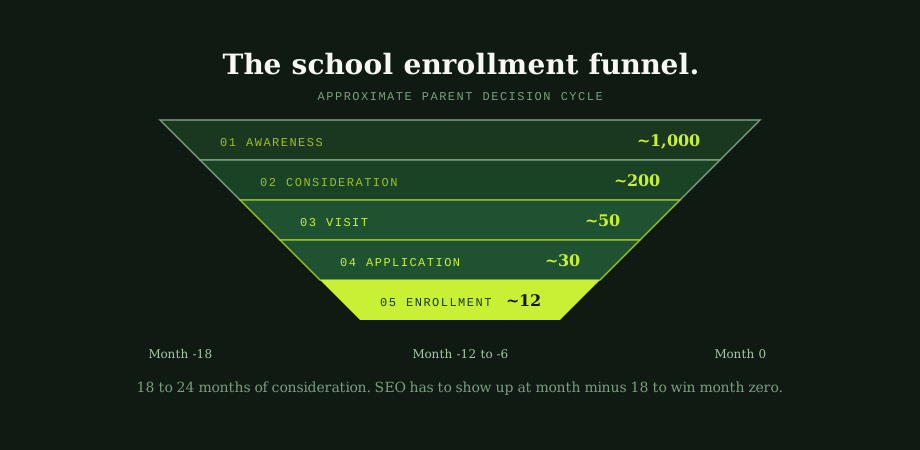
The structural insight that shapes the entire school SEO programme. Parents do not make impulse decisions about their children's education. The high-stakes nature of the decision combined with the financial commitment (international school tuition in Bangkok ranges from 500,000 to 1,500,000 baht per year before fees and ancillaries) produces a buyer journey that resembles luxury real estate more than typical consumer services. SEO has to win the upper-funnel research phase 12 to 24 months before any enrollment-stage interaction, which means the content depth, trust signal layer, and discoverability investments all have to be planned for that horizon.
The four Thai education sub-verticals
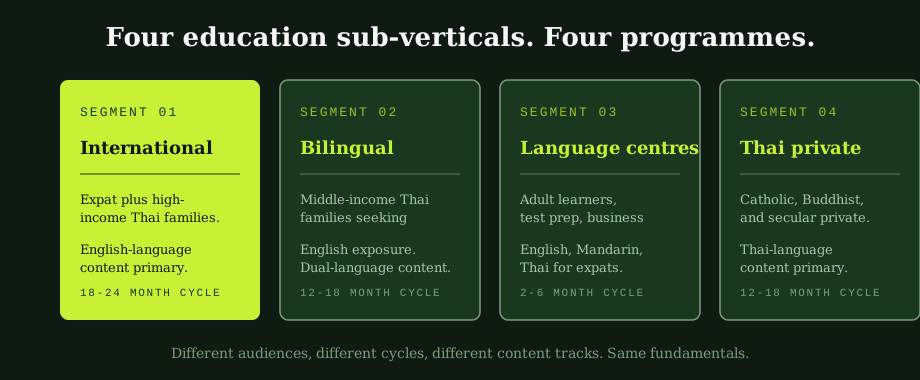
Thai education SEO splits across four meaningfully distinct sub-verticals. Each one has its own audience, decision cycle, content requirements, and competitive dynamics.
International schools serve expat families relocating to or already living in Bangkok plus high-income Thai families opting for English-language education. The audience is bilingual but consumes English-language content primarily for the school research. The competitive set includes the 200-plus international schools operating in Bangkok and surrounding provinces (with concentration around Sukhumvit, Bang Na, and the BTS corridor), the regional alternatives in Phuket, Chiang Mai, and Pattaya, and increasingly the boarding alternatives in Singapore, Malaysia, and the UK. The decision cycle runs 18 to 24 months. The trust signal stack is intensive (accreditation, named leadership, university destinations, facility quality). SEO programmes that succeed here look more like luxury hospitality SEO than typical local-service SEO.
Bilingual schools serve middle-income Thai families who want English-language exposure for their children without the international school price point. The sub-vertical has expanded substantially over the past decade and now sits between the international and Thai private categories in price and audience. Content has to run on parallel Thai and English tracks because parents typically research in Thai but evaluate the English curriculum quality in English. Decision cycles are slightly shorter than international schools (12 to 18 months) but still much longer than typical consumer cycles.
Language centres serve adult learners: English language test preparation (IELTS, TOEFL, SAT), business English for Thai professionals, conversational English for hospitality workers, Mandarin programmes, Thai language programmes for expats. Decision cycles are shorter (2 to 6 months) and more consumer-like; the audience compares centres heavily before committing. SEO has to handle both branded queries (specific centre names) and category queries ("IELTS prep Bangkok", "Thai language school for expats", "business English Sathorn") with adequate depth.
Thai private schools (Catholic, Buddhist, secular non-bilingual) compete in a more conventional local-market structure. Audience is Thai-speaking, content runs primarily in Thai, the competitive landscape is local and stable rather than international. Trust signals concentrate on tradition, alumni achievement, and academic results in the Thai university and professional context. The cycle is 12 to 18 months and the audience is more relationship-driven than transactional.
The implication: a Thai education business operating across multiple sub-verticals (a school group with international, bilingual, and language centre operations, for instance) needs separated SEO programmes for each, not a unified programme.
The international school decision cycle
The international school cycle merits unpacking because it shapes the entire SEO programme. Five recognisable phases.
Initial awareness (18 to 24 months before enrollment). Parents begin general research, often triggered by an upcoming relocation, a child reaching a transition age (age 3 for early years, age 11 for secondary), or dissatisfaction with the current schooling arrangement. Search queries at this stage are broad: "international schools Bangkok", "best primary schools Sukhumvit", "IB curriculum Thailand", "British curriculum vs American curriculum". The SEO work that pays off here is comprehensive category content rather than specific school promotion.
Consideration narrowing (12 to 18 months out). Parents identify a shortlist of five to eight schools they want to investigate further. Search behaviour shifts to comparison queries: "Patana vs Shrewsbury", "international school fees Bangkok", "IB schools Bangkok ranking". Content that wins here is honest comparison information and transparent fee structures rather than promotional brochures.
Campus visits and information sessions (6 to 12 months out). The shortlist gets refined through campus tours, open days, and direct conversations with admissions teams. Search behaviour becomes brand-specific: "school name open day", "school name fees", "school name admissions process". The website's role at this stage is to support and reinforce the in-person experience rather than to be the primary information source.
Application phase (3 to 6 months out). Applications, assessments, interviews, and entrance exams. The SEO work matters less at this stage because the parent has committed to a process; what matters is the operational quality of the application experience itself.
Enrollment and onboarding (0 to 2 months out). The final 12 enrolling parents from the original 1,000 awareness-stage prospects complete enrollment and prepare for the first day. The SEO funnel has done its work; the marketing focus shifts to retention and referral.
The architectural implication is that SEO for international schools is overwhelmingly an upper-funnel discipline. Search investment that targets only enrollment-stage queries captures a sliver of the available audience while ceding the much larger awareness and consideration phases to competitors.
Trust signals for education content
Schools sit firmly in YMYL (your money or your life) territory because the decisions affect children's futures. The trust signal stack has to be unusually strong.
Accreditation displayed prominently. CIS (Council of International Schools), NEASC (New England Association of Schools and Colleges), WASC (Western Association of Schools and Colleges) for international schools; Ministry of Education registration for Thai schools; Cambridge International, IB World School, or equivalent curriculum authorisation. The accreditation logos should be visible site-wide (footer minimum), referenced explicitly on key pages, and linked to the accrediting body's verification page where possible.
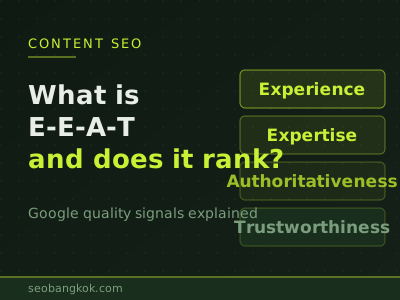
Named senior leadership with credentials. The head of school, head of admissions, heads of section (primary, secondary, sixth form), and named senior teachers should all have biography pages with academic credentials, professional history, and ideally professional photos. The school's E-E-A-T sits substantially on the recognisable people who lead it. The wider E-E-A-T framing this rests on is in what is E-E-A-T and how does it affect rankings.
Documented academic outcomes. University destinations (where graduates went, with named universities and degree programmes), exam results (IB averages, A-level results, SAT/ACT distributions for the most recent years), and notable alumni achievements. The numbers have to be specific (citing "graduates placed at top universities" without naming any is not persuasive); transparency about average results is more credible than only highlighting top performers.
Facility evidence. Comprehensive campus photography (not just exterior shots; classrooms, science labs, libraries, sports facilities, dining halls, performance spaces), ideally video tours and 360-degree virtual visits. The facility quality is much of what families evaluate when choosing between schools at similar price points.
Safety and welfare signals. Child protection policies referenced and accessible. Safeguarding statements. Staff vetting and DBS-equivalent screening information. Wellbeing and counselling programmes documented. For boarding schools or schools with significant boarding components, the boarding house structure and pastoral care arrangements documented in detail. Schools that hide these signals raise red flags; schools that present them transparently build trust.
Local SEO is critical and proximity-driven
School decisions are heavily proximity-driven because families have to commit to a daily commute for ten or more years. International school families typically cluster in specific Bangkok areas (Sukhumvit between Soi 30 and Bang Na, the Lat Phrao corridor for the schools further north, the BTS Skytrain corridor more broadly), which means SEO has to surface for the actual commute geography of the families.
The Google Business Profile optimisation specifics for Thai businesses generally are in how to optimise Google Business Profile in Thailand; the underlying local SEO foundation that schools sit inside is in the Thai-market local SEO foundation. For schools specifically, three local SEO patterns matter beyond the general framework.
Bangkok district-level content is the first lever. A school in Bang Na competes more meaningfully against other Bang Na schools than against Sukhumvit schools 45 minutes away. Content that signals "school in Bang Na" or "international school near Mega Bangna" performs better than generic "Bangkok international school" content because the proximity constraint dominates parent decisions.
Transport and commute content is the second lever. Families researching schools want to understand how their daily commute would work. Content covering school bus routes, BTS proximity, parent pickup logistics, and traffic patterns from major residential areas earns engagement because it answers questions parents actually have.
Neighbourhood context is the third lever. A school's surrounding area (cafes for parents during pickup time, after-school activity providers nearby, family services in the immediate vicinity) factors into parent decisions even though it does not appear in promotional brochures. Content that includes neighbourhood context outranks competitors who treat the school as if it exists in isolation.
Multi-audience content strategy
Schools have to address multiple audiences simultaneously in their content. Parents make the decision but children, current students, alumni, and broader community all need representation in the content. The patterns that work.
Parents are the primary decision-maker and the primary content audience. Most pages should speak to parents directly: tuition, curriculum, outcomes, facilities, admissions process, parent community.
Students (especially older students) are influence-makers. A child's preferences about a school visit can shift parent decisions, particularly for secondary-age admissions. Content that lets students see themselves at the school (student blogs, day-in-the-life videos, student voice in the content) matters even though the parent does the final research.
Current parent community is a trust signal. Testimonials, parent stories, and parent involvement examples reinforce the social proof that prospective parents need. The parents speaking should be from diverse backgrounds (not just the most polished families) to reflect the actual community.
Alumni outcomes are the long-tail trust signal. Alumni profiles, alumni reunion content, and ongoing relationships with university destinations all build the trust that the school produces good outcomes over time.
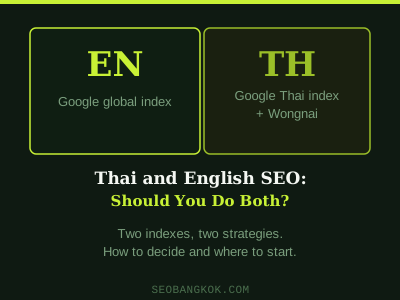
The wider framing for Thai businesses serving expat and international audiences is in SEO for Thai businesses targeting foreign customers; the bilingual content production framing for schools that operate dual-language tracks is in Thai and English SEO: should you target both languages.
Language centre dynamics are different
Language centre SEO deserves separate treatment because the cycle, the audience, and the competitive dynamics differ substantially from school SEO. Adult learners decide on language programmes in weeks rather than months. The audience compares heavily before committing. Branded queries (specific centre names) matter less than category queries because few language centres have strong brand recall outside their immediate audience.
The content patterns that work for language centres. Specific programme detail (course structure, schedule, instructor qualifications, class size, materials, certification path) presented for quick scanning rather than long-form reading. Transparent pricing and scheduling (adults researching language centres want to know when classes run and what they cost before they fill in any enquiry form). Honest level placement information (what level you should enrol at based on your current proficiency). Genuine student outcomes (test score improvements, completion rates) rather than generic testimonials.
The conversion path for language centres typically resembles consumer e-commerce more than the school model: an information-dense site that supports a faster decision rather than a deep storytelling brand site that supports a slow decision.
Common mistakes in Thai education SEO
- Treating all four sub-verticals as one programme. The audience, cycle, content, and competitive dynamics differ enough that unified programmes underperform sub-vertical-specific ones.
- Optimising only for enrollment-stage queries. Schools that compete only at "apply now" stage cede the much larger awareness and consideration phases.
- Hiding accreditation in legal small print. Accreditation is the strongest available trust signal and should be visible prominently.
- Anonymous content. "Our experienced team" content cannot establish the E-E-A-T that named senior leadership provides.
- Stock photography of unrelated children. Parents see through stock immediately. Real (consented) photography of actual students at the actual school is the only acceptable approach.
- Opaque tuition fees. "Contact us for fees" excludes parents from the research stage when most evaluation happens. Transparent fee schedules outconvert opaque ones across the entire cycle.
- Generic content about Bangkok or Thailand. The proximity-driven nature of school decisions means content has to be hyperlocal (district, transport, neighbourhood) rather than general city-level.
- Ignoring the parent community signal. Schools without visible parent community content rank lower on trust regardless of facilities.
- Treating language centres like schools. The cycle, audience, and content format requirements differ; language centre SEO should look more like consumer services SEO than like school SEO.
The honest version of education SEO in Thailand
Thai education SEO done well is a long-cycle, trust-signal-heavy discipline that compounds over years rather than months. Schools that take it seriously and invest at the level the discipline requires accumulate compounding visibility advantages over the time horizons that match the actual parent decision cycles. Schools that under-invest, ship typical local-service SEO, or treat education like a faster consumer vertical consistently miss the upper-funnel research audience that determines who gets shortlisted twelve months later. The market is wide enough that good operators continue to grow even as the overall school landscape becomes more competitive.
Our work with Thai education clients spans the parent decision cycle from awareness through enrollment, with separated programmes for each sub-vertical. The wider SEO marketing agency structure includes education-vertical work as part of integrated programmes that combine SEO with paid acquisition and content production. For international schools targeting cross-border audiences specifically (UK expat families, US relocations, Singaporean and Hong Kong families moving regionally), the cross-border SEO layer runs through our cross-border SEO programme. The local-side proximity SEO runs through standard Thai-market local SEO services. A discovery conversation with our Bangkok SEO consultancy typically identifies which sub-vertical and which audience layer should be prioritised first based on the school's existing enrollment mix and growth targets.
Common questions
How long is the parent decision cycle for Thai international schools?
Most international school decisions in Thailand run 18 to 24 months from initial research to enrollment. Parents typically begin general research roughly 18 to 24 months before the target enrollment date, narrow to a shortlist at around 12 months out, conduct campus visits at six to nine months out, complete applications at three to six months out, and confirm enrollment in the final two to three months. Schools whose SEO does not show up consistently at the earliest research stage rarely make it into the shortlist twelve months later.
What are the four main Thai school SEO sub-verticals?
International schools serve expat families and high-income Thai families with English-language content and 18 to 24 month cycles. Bilingual schools serve middle-income Thai families with dual-language content and 12 to 18 month cycles. Language centres serve adult learners with shorter consumer-style 2 to 6 month cycles. Thai private schools (Catholic, Buddhist, secular) compete in a conventional local market with Thai-language content and 12 to 18 month cycles. Each sub-vertical needs its own SEO programme structure.
What trust signals matter most for Thai school SEO?
Five categories. Accreditation displayed prominently (CIS, NEASC, WASC, Cambridge, IB World School, MoE registration as relevant). Named senior leadership with credentials. Documented academic outcomes (university destinations, exam results). Facility evidence (campus photography, video tours). Safety and welfare signals (child protection policies, safeguarding statements, staff vetting information).
How important is local SEO for schools in Thailand?
Critical. School decisions are heavily proximity-driven because families commit to a daily commute. International school families cluster in specific Bangkok areas (Sukhumvit, Bang Na, the BTS corridor) and SEO has to surface schools that match the family's actual commute geography. Bangkok district-level content, transport and commute information, and neighbourhood context all outrank generic city-level content.