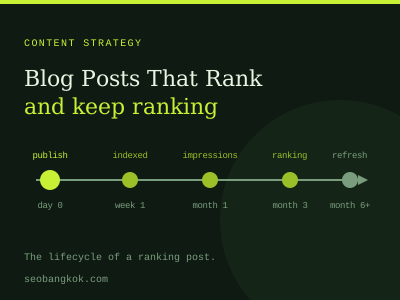
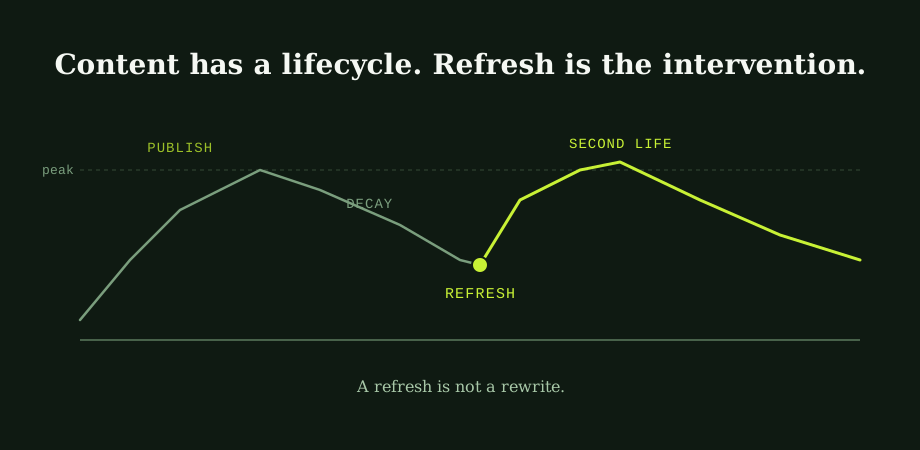
For a content programme that has been running for two or three years, most of the traffic comes from articles that have already been published. The dedicated framework for what to measure across a content portfolio sits in how to measure SEO content performance. The newest pieces are still finding their footing. The middle-aged pieces are at peak performance. The older pieces are quietly decaying. The mix of growth, peak, and decay is the reality of any portfolio of evergreen content, and refresh is the lever that decides how steep the decay curve gets.
Most teams underestimate refresh because publishing feels more measurable. A new article is a thing that did not exist before. A refreshed article is an existing thing that looks the same on the surface but ranks better. The output of refresh is harder to see. The traffic impact is not.
What a content refresh actually is
A content refresh updates an existing article in place. Same URL. Same backlinks. Same history in Search Console. Same topical-authority signals built up over time. What changes is the part of the article that has gone stale: statistics, examples, broken links, screenshots, the publish date, and where necessary the structure of the piece.
A refresh is not a rewrite. A rewrite replaces the article wholesale, loses much of what made the original valuable for SEO, and starts the topical-authority clock again. The two get conflated constantly. They are different operations with different costs and different outcomes.
The right mental model: a refresh is like maintaining a house. You replace the leaking pipes, repaint the walls, update the kitchen appliances. The house is still the same house. A rewrite is demolishing the house and building a new one on the same lot. Sometimes that is the right call, but it is a different decision with a different budget.
Why content decays
Three forces drive the decay curve.
Information goes stale. Statistics become outdated. Examples reference companies that have been acquired or shut down. Software screenshots show a UI that no longer exists. Regulations have been replaced. Prices have changed. Readers who notice stop trusting the article, and Google's quality signals notice the same things over time.
Search intent shifts. The query "remote work tools" meant one thing in 2019. It means a different thing now, with different expectations about format, depth, and tone. An article that was a strong match for the query at publication can drift out of intent match even when its facts are still correct. The wider view of intent matching sits in search intent in SEO.
Competitors update. The SERP your article rank for is shared with other sites that are also publishing and refreshing. If three competitors update their pieces on the same topic, the SERP standard rises and your unchanged article drops in relative quality even if it has not gotten any worse. Decay is sometimes an absolute thing; more often it is a competitive one.
The three forces are independent and compound. An article can be staleness-decayed (old stats), intent-decayed (the query shifted), and competitor-decayed (the SERP improved) all at once. A refresh addresses all three.
When to refresh, when to leave alone, when to delete
Not every article needs refreshing. The honest decision tree.
Refresh. The topic still matters, the article was useful when published, and traffic has visibly declined in the last six to twelve months. This is the largest category for most sites and the place where refresh investment compounds fastest.
Leave alone. The article is currently performing well, the information is still accurate, and there is no signal that competitors have meaningfully improved on it. Touching content that is working risks making it worse for no upside.
Delete or consolidate. The topic has gone permanently obsolete, or the article was thin to begin with and would need to be substantially rewritten to be useful. Better to remove the URL, redirect it to a still-relevant piece, or merge it into a broader article that earns its keep.
The signal that drives all three decisions lives in Search Console. Click and impression data over the last six months, against the same period the year before, shows where decay is happening and how steep it is. The pieces with the steepest decline are the refresh candidates; the pieces holding steady can usually be left alone.
What to update in a refresh
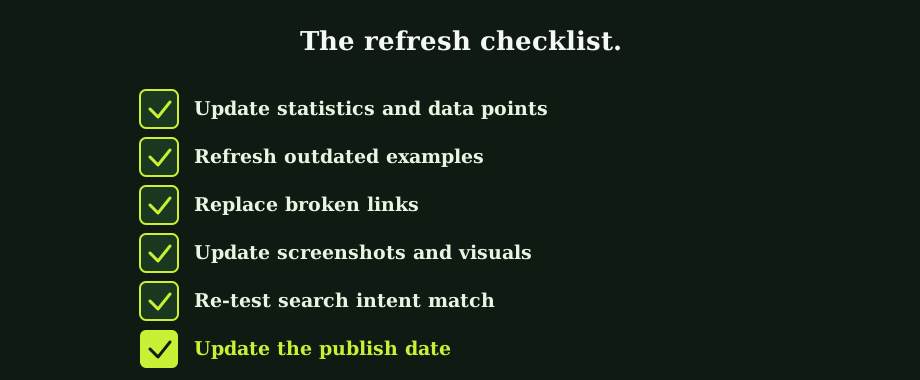
A real refresh works through the checklist substantively. The temptation to declare a refresh "done" after changing the date is constant. Resist it.
- Statistics and data points. Every number in the article should be checked. Is it still accurate? Is there a newer figure available? Is the source still valid? Outdated stats are the single biggest credibility cost in stale content.
- Examples. Companies, products, and case studies referenced in the original may have changed. A 2022 article that uses Twitter as an example needs to say X. Examples date themselves quickly; refresh them or remove them.
- Broken links. Outbound links rot at a predictable rate. After two years, somewhere between 10 and 30 per cent of outbound links on a typical article will be broken or have redirected to something unintended. Fix them all.
- Screenshots and visuals. Interfaces evolve. Screenshots of software UIs go stale faster than text does, because readers can verify visually whether the screenshot matches what they see now.
- Search intent. Re-run the target query in incognito mode. Look at what ranks now. If the SERP looks meaningfully different (different format dominating, different content angle winning), the intent has shifted and the article may need structural work to match.
- The publish date. Update it only after the substantive work is done. The date should reflect the work, not substitute for it.
Two more updates worth considering on serious refreshes: adding sections to cover topics readers now expect (the SERP often surfaces these as "people also ask" boxes), and tightening sections that have become unnecessarily long. Both are content-judgement calls rather than mechanical updates.
The publish date question
Should a refresh just update the date, or should the original publish date stay and a "last updated" date be added separately?
The honest answer is that both approaches work, and the choice matters less than the underlying integrity. The cleaner pattern, used by most well-built sites, is to keep the original publication date visible and add a "last updated" line alongside it. Readers see when the piece was first published and when it was most recently maintained, which is informative and honest.
Some sites take the more aggressive approach of replacing the publish date with the most recent update date. Google's parser treats this as the new "freshness" signal on the page. It can produce a meaningful short-term traffic bump, particularly for queries where freshness matters. The risk is that simply changing the date without genuine updates is something Google's quality signals look for, and sites that get caught doing it lose more than they gained.
The principle that makes both patterns work: the date should reflect actual change. If real work has happened, the date can be updated. If nothing has changed, the date should not change.
Tracking refresh impact
The data work after a refresh is where most teams skip a step. The refresh ships, traffic moves, but the team does not know which part of the refresh produced the movement. Without that, the next refresh is harder to plan.
A minimum data discipline.
- Note the date of every refresh. A simple log per URL: when it shipped, what was changed.
- Compare traffic in the ninety days before and after. Search Console makes this trivial.
- Look at ranking changes for the target queries. Most of the time, the article either moved up a few positions on its main query or stayed flat. Both outcomes are informative.
- Compare to control articles. A site-wide traffic change in the same window may be the real cause, not your refresh. Check site-wide trends.
For sites with a serious content programme, refresh impact compounds: the team that knows which kinds of updates moved which kinds of articles in the past can plan refreshes with better odds than the team starting from zero each time. The wider context of how this fits into a content strategy sits in how to build a content strategy that actually supports SEO.
Common mistakes that reduce refresh return
Patterns worth avoiding.
- Refreshing on a schedule rather than on signal. "Every article gets refreshed annually" sounds disciplined but produces a lot of unnecessary work on articles that are still performing. Refresh by Search Console signal, not by calendar.
- Refreshing the wrong articles. The ones that have decayed steeply usually have a reason: topic obsolescence, intent shift, or original thin quality. Some of those deserve refresh; some deserve deletion. Reflexively refreshing every decayed article wastes effort.
- Refreshing too lightly. Updating one statistic and the date is not a refresh. The work is in the substantive content updates.
- Refreshing too heavily. A "refresh" that rewrites 80 per cent of the article is a rewrite. The article loses much of what made it useful for SEO. If 80 per cent needs rewriting, plan it as a rewrite from the start.
- Forgetting internal links. A refresh is also a moment to add internal links from newer related articles. The piece has been alive for years; some of those years produced related content worth linking to it now.
Pieces of the wider quality framework that refresh interacts with are in E-E-A-T in the age of AI search, since the trust signals that matter to Google's quality models include the freshness markers a refresh produces.
The honest version of content refresh
Most blog posts that ever get any traffic get more of it from being refreshed than from being written. The publishing moment is the smallest single contributor to a piece's lifetime traffic; the maintenance work is much larger. Teams that internalise this end up with content programmes that compound; teams that do not end up with portfolios full of slowly dying articles and a thin pipeline of new ones to compensate.
Our SEO agency Bangkok work routinely starts with a refresh audit of existing content on established sites, because the lift from refresh is usually faster and cheaper than the lift from new publication. Our SEO services Thailand include the Search Console analysis that identifies which articles to refresh, in what order, and with what depth. An SEO specialist Bangkok who knows the lifecycle pattern can usually identify the top refresh candidates on a content portfolio within an hour.
Common questions
What is a content refresh?
A content refresh is the process of updating an existing article to bring its information, examples, structure, and signals up to date, rather than writing a new article from scratch. The article keeps its URL, its backlinks, its history in Search Console, and its existing topical authority. The refresh updates the parts that have gone stale: statistics, examples, broken links, screenshots, the publish date, and where necessary the structure of the piece itself. A refresh is not a rewrite.
How often should I refresh content?
There is no fixed schedule that fits every site. The useful rule is to refresh when the content has visibly decayed in Search Console: impressions falling, rankings drifting downward, click-through rate dropping. For most evergreen articles on most sites, that pattern shows up between twelve and twenty-four months after publication. Highly time-sensitive content needs refreshing more often. The signal to refresh is in the data, not the calendar.
Does just updating the publish date help with SEO?
On its own, no. Google has been clear that simply changing the date on an article without genuinely updating the content is something its quality signals look for and devalue. The publish date should reflect substantive change. If you have done meaningful work on the article, updating the date signals that the work happened. If you have only edited a comma, updating the date is dishonest and Google will eventually treat it as such. The date is a consequence of the refresh, not a substitute for it.
Should I delete old content instead of refreshing it?
Sometimes, yes. The honest test is whether the topic still matters to your audience and whether the article can be brought back to a useful state with reasonable effort. If a topic has gone permanently obsolete, deleting the article or consolidating it with a related piece is usually better than maintaining a low-traffic page. If the topic still matters but the article would need to be substantially rewritten to be useful, the question is whether to refresh aggressively or to write a new piece.