Most articles framing this decision present it as binary: in-house versus agency, with one of them being the right answer for everyone. Once the agency path is the right one, the evaluation framework for picking the actual agency is in how to pick the best SEO agency. The framing is wrong. Both options work for some businesses and fail for others, and the businesses that succeed long-term usually end up with neither pure version. They build a small in-house capability and partner with external specialists for the work the in-house team cannot reasonably cover. That hybrid is the third option that most articles skip and most SMEs eventually discover.
This post lays out the honest cost, control, and capability differences for each of the three options, with Thailand-specific cost figures and the operational realities that decide whether each one actually produces results. It is written from the perspective of someone who has worked alongside in-house teams and as an external consultant on the same engagements, and seen both succeed and both fail. For the narrower external-provider decision, see SEO agency vs consultant in Thailand. The third option that often fits enterprises better than either pure path is in what is enterprise SEO consulting.
The honest cost comparison
Cost is usually the first comparison people make and frequently the one done worst, because the in-house cost gets quoted as base salary while the agency cost gets quoted as the full retainer. Like-for-like, the comparison looks different.
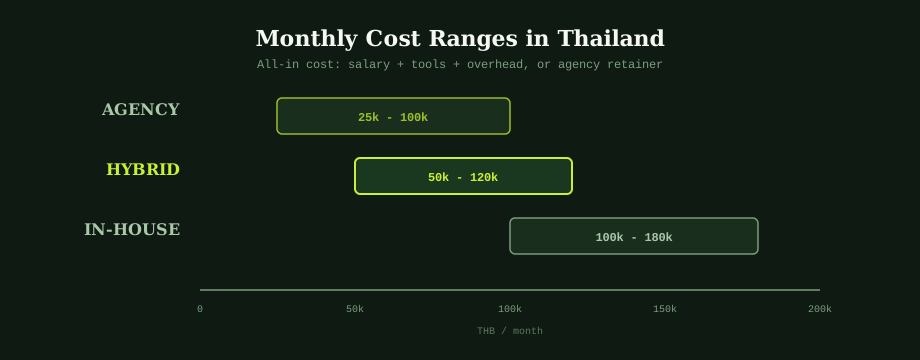
A senior in-house SEO in Thailand in 2026 costs roughly 100,000 to 180,000 THB per month all-in. That all-in figure includes the salary (typically 80,000 to 140,000 THB), social security and benefits contributions, the tools the person needs (Ahrefs, Semrush, or similar enterprise SEO platforms cost roughly 5,000 to 15,000 THB per month), training budget, and the overhead of office space and management time. The bottom of that range is what a mid-senior SEO costs; the top is what a senior with 7+ years of experience and broader strategic responsibility costs.
A mid-level in-house SEO costs roughly 60,000 to 100,000 THB per month all-in. This is the realistic option for many SMEs: someone with 2 to 4 years of experience who can execute consistently with guidance, but is not yet at the senior level where they can independently set strategy.
An SEO agency retainer ranges widely: 25,000 THB at the low end for a small monthly engagement covering basic ongoing work, up to 100,000+ THB for a comprehensive engagement covering strategy, content production, technical work, and reporting. The wide range reflects the wide range in what agencies actually deliver; the bottom end is often closer to "we do some keyword research and write monthly reports" and the top end approaches what an in-house team would deliver.
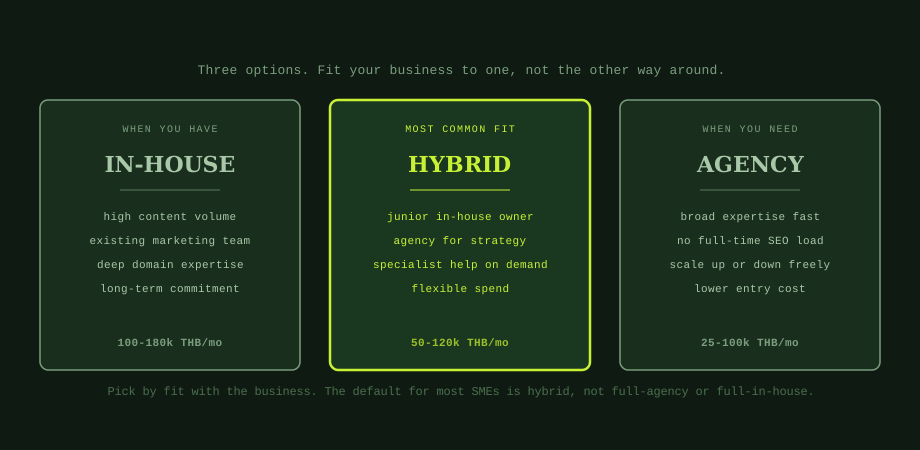
A hybrid setup, where a junior in-house staffer handles execution and an agency or consultant provides strategy and specialist work, typically lands in the 50,000 to 120,000 THB range. The split between in-house cost (junior salary ~40-60k all-in) and agency retainer (~20-60k for ongoing strategic and specialist support) sums to a number that often beats both pure options on capability-per-baht.
When in-house actually makes sense
Pure in-house works well in specific circumstances. The cluster of conditions where it produces better outcomes than the alternatives: high and sustained content volume (more than 8 to 10 long-form pieces per month, ongoing, year after year). At this volume, the in-house person is fully occupied and the cost per piece becomes much better than agency rates. An existing marketing team for the in-house SEO to integrate with, which gives them context, internal collaborators, and a structure that gets the SEO work integrated with the broader marketing programme rather than running parallel to it. Deep domain expertise required, particularly for technical industries (medical, legal, financial services, enterprise software) where understanding the topic well enough to write usefully takes months. An in-house person can build that understanding over time; an external agency rarely will. Multi-year commitment to the SEO programme, which makes the upfront investment in hiring and training pay back.
The pattern of businesses that benefit most from full in-house: mid-sized B2B SaaS companies, large e-commerce operations with deep catalogues, professional services firms with complex domain expertise, enterprise marketing departments. Smaller businesses rarely meet all four conditions and frequently struggle when they hire in-house anyway.
When an agency actually makes sense
Pure agency works well in a different cluster: smaller business with no full-time SEO load. A 5 to 10 person company usually does not have enough SEO work to keep a full-time person busy without including unrelated marketing tasks; an agency engagement scales to the actual workload. Need broad expertise across SEO disciplines: technical SEO, content, link building, local SEO, analytics, and CRO are different skill sets, and most in-house hires are strong in one or two and weak in the others. Agencies typically have specialists across the disciplines. Need to scale up or down based on business cycles, campaigns, or budget changes; firing an in-house staffer is much harder than reducing an agency retainer. Lower entry cost for businesses that are not sure SEO will work for them yet; agency engagement is a smaller commitment than a full-time hire.
The pattern of businesses that benefit most from full agency: small service businesses, early-stage startups, businesses with seasonal or campaign-driven needs, businesses where SEO is one channel among many rather than the primary marketing function. The agency option is also better when the business has zero internal SEO knowledge and would not know how to hire or evaluate an in-house SEO if they tried.
The hybrid model: why most SMEs end up here
The hybrid model is what most SMEs actually run after a few years of figuring out what works. It usually looks like this: one junior or mid-level SEO inside the business (often someone who started in a broader marketing role and grew into SEO ownership), partnered with an external consultant or agency for strategy, specialist work, and ongoing oversight.
The internal person handles execution: implementing recommendations, producing content briefs, coordinating with developers and writers, monitoring performance, and being the day-to-day owner of the work. The external partner handles strategy: setting direction, prioritising work, making the judgment calls that require seniority, handling technical or specialist work that comes up infrequently (Schema markup overhauls, hreflang implementations, link-building campaigns), and providing oversight to the internal person.
The economics work because the internal person doesn't need to be senior (so the salary is lower), the external partner doesn't need to do execution (so the engagement is smaller and cheaper than full agency), and the combined capability is comparable to what a senior in-house person would deliver. The accountability works because someone inside the business owns the outcome, but the strategic judgment comes from someone with broader experience than a junior alone has.
The main failure mode is structural rather than economic: the hybrid only works if the internal person actually has time and authority to own SEO. The marketing manager who also does SEO when there is time is not a hybrid; they are a part-time SEO and will produce part-time results. The hybrid model assumes the internal person has SEO as their primary or sole responsibility.
The biggest mistakes with each approach
In-house mistakes. The most common is hiring junior staff with no senior oversight. A junior SEO without strategic guidance produces activity but not results, and the business often cannot tell the difference for 12 to 18 months. The second is treating SEO as a part-time responsibility for someone whose primary role is something else; SEO requires sustained attention and inconsistent attention produces inconsistent results. The third is single-person risk: an in-house SEO who leaves the company takes the institutional knowledge with them, and rebuilding takes months. All three failures point to the same underlying issue: pure in-house works best when the in-house team has internal depth or external partnership; a single junior person in isolation rarely produces the outcomes promised.
Agency mistakes. The most common is engaging an agency without clear success metrics or accountability. Agencies optimise for what is measured; an engagement with vague goals produces work that is hard to evaluate and easy to underdeliver on. The second is the agency that produces beautiful reports but no measurable ranking or traffic improvement. The third is the agency that runs a templated programme regardless of business specifics; signs include strategies that ignore the actual competitive landscape, content topics chosen from generic keyword lists rather than business context, and recommendations that could apply to any business in any industry. The vetting framework for avoiding these is more detail in the digital consultancy approach we follow ourselves.
Hybrid mistakes. The most common is unclear ownership: when both the internal person and the external partner think the other one is responsible for something, that thing does not get done. The fix is explicit boundaries on what each party owns. The second is the external partner becoming a crutch the internal person never grows beyond; the hybrid should produce a more capable internal team over time, not just maintain the dependency.
The decision framework for your specific situation
The actual decision usually breaks down along a few axes. Content volume: if you need fewer than 4 long-form pieces per month, an in-house SEO will be underutilised. If you need more than 10, an agency that handles content will be expensive compared to in-house. The 4 to 10 range is hybrid territory. Domain complexity: simple consumer categories can be handled by external generalists; complex technical domains usually need internal expertise. Existing capability: if you have no internal SEO knowledge, starting with an agency is lower risk because you do not have to evaluate technical hires you cannot judge. Time horizon: if you are unsure SEO will work for your business, agency engagement is lower commitment; if you are certain SEO is a multi-year investment, in-house economics improve.
The pattern that produces good outcomes for most small to mid-sized businesses: start with an agency or SEO consultant in Thailand for the first 12 to 18 months. Use that period to learn what SEO actually looks like for your business, build internal understanding of the work, and produce enough results to justify deeper investment. After that period, hire a junior or mid-level internal owner and shift to a hybrid model where the agency or consultant continues providing strategic support. This sequence avoids the most common failure modes of both pure options and lets the business grow into the right model rather than committing to it before they know what they need.
When to switch from agency to in-house
The trigger usually has three signals at once. Your monthly agency cost has grown to roughly the cost of a full-time hire: in Thailand, around 100,000 to 130,000 THB per month. Your content production needs are consistent and high enough to fully occupy a person rather than being lumpy. You have built enough internal understanding of SEO through working with the agency that you can hire and evaluate an in-house SEO without being dependent on the agency to do that for you.
If all three are present, the in-house economics start to improve. If any are missing, the agency or hybrid model usually still wins on either cost or capability. Many businesses make this transition prematurely (only one or two signals present) and regret it because the in-house person turns out to need more support than expected; building in a contractor or consultant relationship on top of the new hire often bridges that gap. The companion post on setting realistic SEO targets covers what to expect from the engagement on either side of the transition.
What this means for choosing right now
Most businesses reading this post are at the agency or hybrid stage rather than the pure in-house stage, regardless of where they thought they were. The honest test: do you have enough SEO work to fully occupy a competent person for 8 hours a day, every day, for the next 3 years? For most small to mid-sized businesses the answer is no, even when it feels like there is plenty to do. The fluctuating workload is what makes pure in-house economically inefficient at smaller scales.
The right move for most SMEs is to engage an agency or consultant to establish the SEO programme, learn what your business needs, and produce initial results. Then transition to a hybrid model once the internal owner role is justified by the workload. The pure-in-house option is the right destination for some businesses but the wrong starting point for almost all of them.
For businesses currently weighing this decision, our digital consultancy service includes strategic SEO oversight that fits the hybrid model: working alongside your internal team or developing the internal capability your business will eventually need. An experienced SEO company in Bangkok can also help evaluate which of the three options actually fits your specific business situation rather than the default assumption either way.
Common questions
Is it better to hire an in-house SEO or an agency?
Neither is universally better. The right answer depends on content volume, existing team, domain complexity, and how long the SEO programme needs to run. Businesses with high content needs, an existing marketing team, complex domain knowledge that takes months to learn, and a multi-year commitment usually do better building in-house. Businesses with smaller content needs, no existing SEO knowledge to build on, broad expertise gaps to fill, and uncertainty about ongoing scope usually do better with an agency. Most small to mid-sized businesses end up with a hybrid model: a junior in-house owner who handles execution, working with an agency or consultant for strategy and specialist work.
How much does in-house SEO cost compared to an agency in Thailand?
In Thailand in 2026, a senior in-house SEO costs roughly 100,000 to 180,000 THB per month all-in (salary plus benefits, tools, training budget, and overhead). A mid-level SEO is 60,000 to 100,000 THB per month all-in. An SEO agency retainer ranges widely from 25,000 to 100,000+ THB per month depending on scope; a hybrid setup with a junior in-house plus part-time agency support typically lands in the 50,000 to 120,000 THB range. The agency option has the lowest entry cost but the per-hour cost is higher; the in-house option has the highest entry cost but lower per-hour cost once the person is producing output.
What are the biggest mistakes businesses make with in-house SEO?
Three patterns recur. First, hiring junior staff with no senior oversight: a junior SEO without strategic guidance produces activity but not results, and the business cannot tell the difference until 12 months later. Second, treating SEO as a part-time responsibility for someone whose main job is something else: the marketing manager who also does SEO when there is time produces inconsistent results because SEO requires sustained attention. Third, single-person risk: an in-house SEO who leaves the company takes the institutional knowledge with them, and the business often loses 6 months rebuilding what was lost.
When should I switch from an agency to in-house SEO?
The trigger usually has three signals. First, your monthly agency cost has grown to roughly the cost of a full-time hire (in Thailand, around 100,000 to 130,000 THB per month). Second, your content production needs are consistent and high enough to fully occupy a person rather than being lumpy. Third, you have built enough internal understanding of SEO through working with the agency that you can hire and evaluate an in-house SEO without being dependent on the agency to do that for you. If all three are present, the in-house economics improve. If any are missing, the agency or hybrid model usually still wins.
The comparison only works with real numbers on both sides. Salary and tooling for an in-house hire against published agency and consultant pricing is a more useful exercise than comparing job titles.