Every SEO project eventually arrives at the same uncomfortable conversation. The rankings are improving, organic traffic is climbing, the dashboards look healthy, and the business owner asks the obvious question: where are the extra customers? The honest answer is usually that the customers exist, they are visiting the site, and most of them are leaving without doing anything. The traffic problem got solved. The conversion problem did not. That conversion problem is what CRO addresses, and why anyone serious about SEO eventually starts talking about it. The Thailand-localised application of this framework, with the four levers that western CRO playbooks miss, is in conversion rate optimization in Thailand.
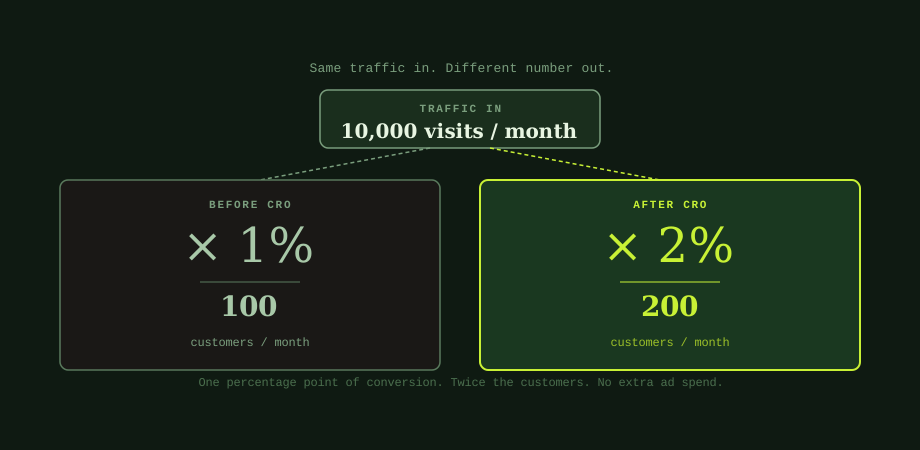
CRO stands for conversion rate optimisation. The conversion rate is the percentage of visitors who take a defined action: contact form submission, purchase, signup, quote request, phone call, or whatever a particular business counts as a success. If 10,000 people visit your site this month and 100 of them buy something, the conversion rate is 1%. CRO is the discipline of moving that number upward through deliberate changes to how the site presents itself, makes its case, and asks for the action.
The math: why a 1% lift is bigger than it sounds
The reason conversion rate matters more than people initially think is that it is multiplicative with traffic, not additive. A percentage point of improvement applies to every visitor who lands on the site, this month and every future month, until the page changes again. The leverage compounds with traffic volume in a way that is easy to undervalue when you write it as a small percentage.
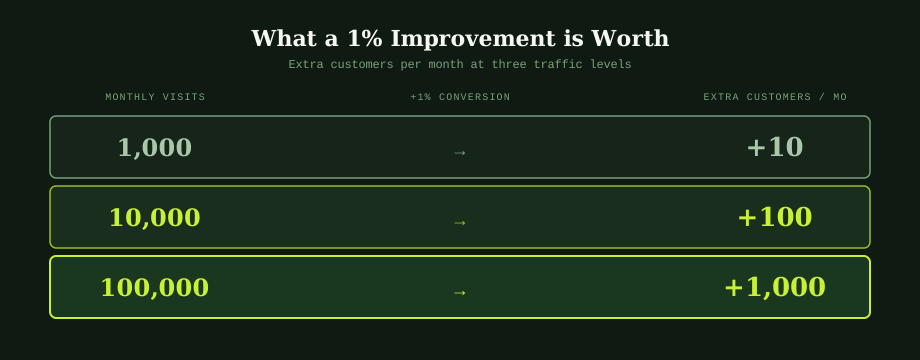
At 1,000 monthly visits, a one percentage point lift adds 10 customers per month. At 10,000 visits, it adds 100. At 100,000 visits, it adds 1,000. The same conversion improvement produces wildly different absolute numbers depending on where on the traffic curve a business sits, but the proportional gain is constant. For a business with an average customer value of 5,000 baht, the 10,000-visit case at +1% adds 500,000 baht of monthly revenue, every month, from the same traffic that was already arriving.
This is the calculation that makes CRO consultants persistent. The math says that for almost any site with meaningful traffic, the gains from moving the conversion rate one or two percentage points are larger than the gains from doubling traffic, and conversion improvements are typically faster and cheaper to achieve than ranking improvements.
Why SEO without CRO solves only half the problem
SEO and CRO answer different questions. SEO asks: how do we get more of the right people to the site? CRO asks: how do we get more of those people to do the thing we want them to do? An SEO programme that succeeds without CRO produces more visits, the same conversion rate, and a proportional increase in customers. An SEO programme that succeeds alongside CRO produces more visits AND a higher conversion rate, and the customer count moves by the product of both gains.
The pattern most consultants have seen many times: a client commissions SEO work, the consultant delivers improved rankings and substantially more organic traffic, and six months later the conversation is whether SEO actually works for this business. The traffic went up. The customer count barely moved. The diagnosis is usually that the site converts at a rate that swallows the traffic gains; the more visitors arrive, the more of them leave without converting in absolute terms, even though the conversion rate is unchanged.
The fix is not to keep adding traffic against a fixed conversion rate. The fix is to move both numbers at the same time, which is why structured engagements increasingly cover SEO and on-site conversion together. The work overlaps anyway; the pages that need to convert are usually the same pages that need to rank, and improving the page for conversion frequently improves it for engagement signals that affect ranking.
What CRO actually involves (it is not button colours)
The public reputation of CRO suffers from a decade of bad blog posts about whether red buttons convert better than green ones. That kind of testing exists, but the meaningful conversion gains rarely come from micro-tweaks. They come from larger structural questions about whether the page answers what the visitor came to ask, whether the next step is obvious, and whether anything is making the action feel risky or effortful.
The clusters of work that consistently produce meaningful conversion lifts: message match, which is whether the page headline and opening confirm that the visitor has arrived at the right place for what they searched. A visitor who clicked an ad or organic result for "Bangkok SEO consultant" should see a page that immediately confirms it is about Bangkok SEO consulting, not a generic "welcome to our agency" page. Message mismatch is the single most common reason landing pages convert poorly. See landing page optimisation.
Form friction, which is how easy or hard the conversion action actually is. Forms with too many fields, too many required fields, or unclear field labels lose a meaningful percentage of visitors who would have completed a shorter form. The trade-off is real: you want enough information to qualify leads, but every additional field reduces submissions. For most service businesses, two- or three-field forms outperform longer forms by enough margin to justify any qualification work happening later by phone or email.
Call-to-action language, which is whether the button text describes what the visitor will get rather than what they will do. "Submit" is generic. "Request an SEO Review" tells the visitor exactly what they are signing up for. The difference between these two CTA styles is measurable across most industries: specific action language outperforms generic action language by 10 to 30% in CTR to the action.
Social proof placement, which is whether evidence of past work and outcomes appears at the moment of decision rather than buried elsewhere on the site. Testimonials and case studies near the conversion point reassure visitors who are otherwise hesitant. A testimonials page that no one visits does not help conversion; the same testimonial placed next to the contact form does.
Page speed, which is more conversion-relevant than most teams realise. Visitors who wait three or more seconds for a page to become interactive often leave before seeing the offer at all. The slower the page, the more conversions you lose at every stage of the funnel, regardless of how well the rest of the page is designed. The relationship between page speed and SEO is significant enough to deserve its own treatment, more on that in how page speed affects rankings and conversion. The broader audit context is in SEO audit checklist; the conversion impact runs parallel and compounds with the ranking impact.
What CRO is NOT (useful disambiguation)
Three things that often get labelled CRO are not what most consultants mean when they use the term. Adding more pop-ups is not CRO; aggressive pop-ups typically reduce overall conversion despite producing more captured emails, because they damage the user experience for everyone else. Running unfocused A/B tests on everything is not CRO; testing without a clear hypothesis just generates noise and consumes traffic that could have been used on a meaningful test. Copying competitor landing pages is not CRO; the competitor's page is optimised for their business and audience, not yours, and what works for them may not transfer.
Real CRO is closer to a discipline than a tactic. It starts with looking at the data (which pages are getting traffic, which are converting, where in the funnel visitors are dropping out), forming a hypothesis about why a specific page is underperforming, making a structural change to test that hypothesis, and measuring the outcome with enough rigour to know whether the change actually moved the metric.
How to start without overcomplicating it
For most businesses without a dedicated CRO programme, three actions produce the largest immediate gains. First, identify your highest-traffic landing pages in Google Analytics, then check each one for message match: does the page headline confirm what the visitor probably searched for? If not, rewrite the headline to match. This single change frequently moves conversion rates by 10 to 40% on previously mismatched pages.
Second, audit your contact and quote forms. Count the fields. If there are more than four, ask which fields could be removed without damaging lead quality, and remove the rest. Most service businesses can get by with name, email, phone, and a single message field; everything else is qualification work that can happen in the follow-up conversation.
Third, look at your call-to-action buttons. Replace generic verbs ("Submit," "Send," "Click Here") with specific descriptions of what the visitor will get ("Request an SEO Review," "Book a Free Consultation," "Get My Quote"). The difference in CTR is usually meaningful and the change costs nothing.
These three actions take a few hours per page and frequently produce measurable conversion lift within the same month. They are not a complete CRO programme, but they remove the most common conversion failures on most sites and provide enough early evidence to justify deeper investment.
Where SEO and CRO meet
The pages that need to rank are usually the pages that need to convert. Service pages, category pages, comparison pages, location pages: all of them serve both a ranking function (capturing search traffic) and a conversion function (turning that traffic into customers). Treating these as two separate concerns produces fragmented work; treating them as the same problem usually produces better outcomes on both axes.
The cross-link with the wider content programme runs through the work pair this with the content strategy post: every piece of content should have a defined conversion goal, not just a ranking target. Posts that rank but never convert are doing only half their job; posts that convert but never rank are not earning the attention they need to do that job at scale. The intersection is where the leverage lives.
For businesses that want a structured approach to both halves of the problem, our conversion rate optimisation service works alongside the SEO programme rather than after it. An experienced SEO specialist in Thailand can audit the current conversion gaps on your highest-traffic pages and identify which changes are most likely to move the metric for your specific business.
Common questions
What does CRO mean in marketing?
CRO stands for conversion rate optimisation. It is the discipline of improving the percentage of website visitors who take the action you want them to take: submit a contact form, buy a product, sign up for a service, request a quote, or any other defined business outcome. If 1,000 visitors land on your page in a month and 10 of them buy something, the conversion rate is 1%. CRO is the work of moving that 1% upward through changes to the page layout, copy, forms, social proof, page speed, and other elements that influence whether visitors take action.
Why does my SEO consultant keep talking about CRO?
Because SEO without CRO is half a job. SEO drives traffic to the site; CRO determines what fraction of that traffic becomes customers. A consultant who only focuses on SEO can deliver more visitors while the business gets the same number of customers, because the conversion rate stayed flat. That outcome makes the SEO investment look unsuccessful even when the rankings are improving. Good consultants address both sides: the traffic side (SEO) and the conversion side (CRO), because the combined effect is multiplicative rather than additive.
How much does a 1% improvement in conversion rate actually matter?
It depends on traffic volume, but the leverage is significant at any scale. A site with 1,000 monthly visits and a current 1% conversion rate generates 10 customers per month; moving to 2% generates 20, which is 10 extra customers per month from the same traffic. At 10,000 monthly visits the same improvement adds 100 customers; at 100,000 visits it adds 1,000. The compounding aspect is critical: once a conversion improvement is implemented, it applies to every visit forever, not just to the current month.
What is the simplest thing I can do to start improving conversion rate?
Look at your highest-traffic landing pages and check three things. First, does the headline immediately confirm that this page is about what the visitor searched for? Second, is the call to action visible without scrolling, and does it use specific action language ('Request an SEO Review') rather than generic language ('Submit')? Third, is the form short enough that someone would actually fill it in? These three checks rarely require designer or developer time and can produce measurable conversion lift in days, not months.