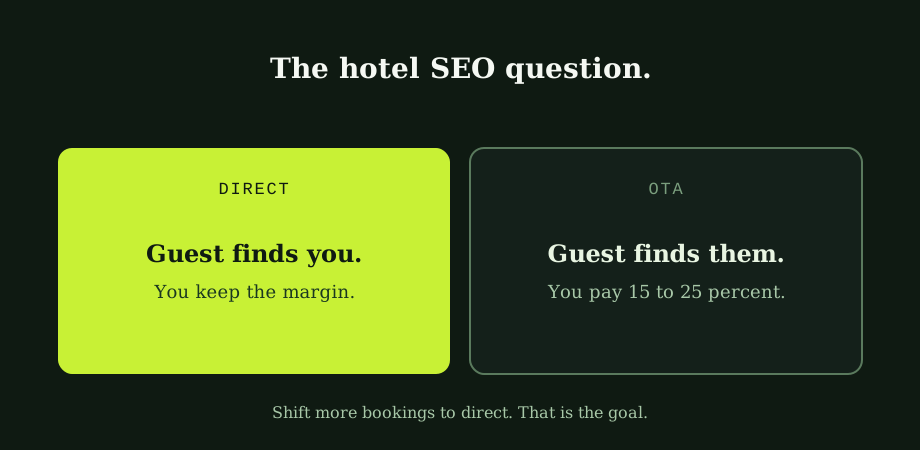
A hotel in Thailand competes on two fronts at once. There are the rival hotels in your area, and there are the OTAs, which spend enormous budgets ranking for every variation of "hotels in Bangkok" or "Phuket beach resort" and then charge you commission when guests book through them. The adjacent wellness-and-spa vertical that overlaps at the high-end spa-hotel edge is in SEO for spas and wellness in Thailand. You cannot out-spend Booking and Agoda on paid search. But you can out-rank them, or at least sit beside them, for the searches that matter most to your property. The property-specific playbook is in SEO for property and real estate in Thailand.
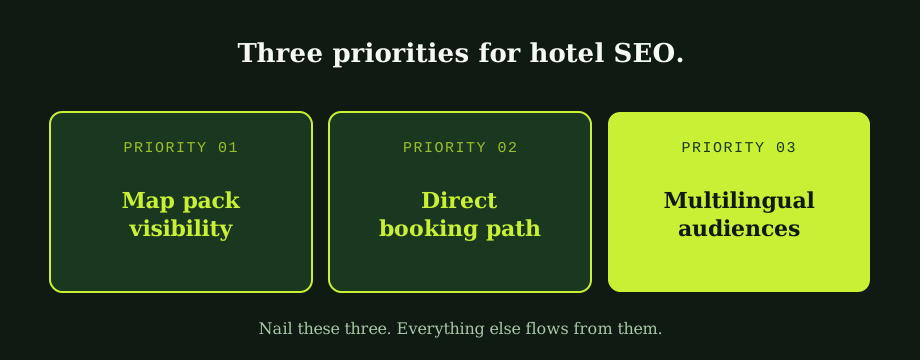
That is what hotel SEO actually is. Not a vague "more traffic" goal, but a focused effort on three things.
Priority 1: Map pack visibility
Most hotel-related searches in Thailand are local in intent, even when the traveller is planning from overseas. Google answers them with the map pack, the box of three local listings at the top of the results, well above the standard blue links. If you are in that box for "hotel Sukhumvit" or "boutique hotel Patong," you get clicks. If you are not, you fight for scraps below the OTAs.
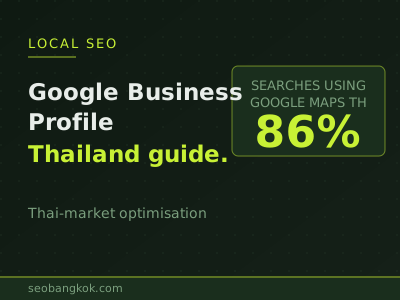
The single biggest lever is your Google Business Profile. It is the most overlooked, under-loved asset on most hotel marketing stacks, and it has more impact on bookings than any individual page on your website. For the detailed Thai-market playbook, see how to optimise Google Business Profile for Thailand. The summary: complete every field, choose the correct primary category, keep your name address and phone identical wherever they appear, post regularly, and accumulate genuine reviews.
A beautiful website with a neglected Profile loses to a plain website with a polished one almost every time. This is where most hotels can win quickly, because most rivals neglect it.
Priority 2: The direct booking path
Owning your brand name in search is non-negotiable. When a guest types your hotel name into Google, your own site should be the first result, well above any OTA listing. If it is not, every brand search you have earned with marketing spend hands a percentage of bookings to a platform. Fixing this is mostly technical: clear branded title tags, a healthy site, no accidental noindex tags, a clean Knowledge Panel.
Once visibility is settled, the next question is whether your booking experience competes. The OTA flow is fast, familiar, and visually clean. Your direct flow should be faster and clearer, and ideally include a small incentive the OTA cannot match: a free room upgrade, breakfast included, late checkout, a discount the OTA's parity rules cannot stop. Combine that with a clear message across your site about why direct is the better deal, and you start moving share.
Even shifting a few percent of room nights from OTA to direct compounds quickly across a year, because every direct booking keeps the commission you would otherwise pay.
Priority 3: Multilingual audiences
Thailand attracts travellers from many language markets at once. A serious hotel site needs to be visible to more than one. English is the baseline for most international travel research, but it is not enough. Thai matters because domestic guests are a much bigger share of the market than overseas owners often assume. And depending on your property, Chinese, Russian, Korean, Japanese, or Arabic versions of the site can be the difference between visibility in those markets and invisibility.
The detail here matters. A single page run through automatic translation is not multilingual SEO. Each language version should be a properly localised site with its own URLs, its own metadata, and clean hreflang signals so Google serves the right version to the right traveller. The principles are the same ones in local SEO for Thailand businesses and the regional approach in local SEO for Phuket.
What most hotels get wrong
The same handful of mistakes show up across properties of every size.
- Treating the Business Profile as set-and-forget. Stale photos, no posts, last review answered two years ago. This is the single biggest unforced error in hotel SEO.
- Ignoring branded search. Letting OTAs outrank you for your own name. Every brand search lost is paid for twice: once to acquire the guest, once again in commission when they book through the OTA they landed on instead.
- A booking flow slower than the OTA's. If your direct booking is harder to use than Booking.com's, even a price advantage will not save you. Conversion friction beats price.
- Treating Chinese, Korean, or Russian traffic as too small to bother with. They are not, especially for resort properties. The few hotels who localise properly capture a market most rivals will not even compete in.
- No reviews strategy. Volume, recency, and response rate all matter for rankings and for conversion. Pair this with how to get more Google reviews in Thailand.
How to start
Where to begin? The order matters more than the effort. Audit the Business Profile first; it is usually where the fastest wins live. Fix branded search next, because every brand query that lands on an OTA is money lost. Then move on to localisation and the deeper site work. Trying to do everything at once is how most hotel SEO projects stall.
Twelve months of serious SEO Bangkok hospitality work usually costs less than one quarter of OTA commission for an established property. The arithmetic favours direct bookings, heavily, the moment the work starts compounding. Our local SEO services in Thailand cover hotels end to end, from Business Profile to multilingual site structure, with destination-specific work including a dedicated SEO Samui playbook for properties on the island. A short audit from an SEO specialist in Thailand is usually enough to tell you honestly which lever moves bookings first.
Common questions
Why is SEO important for hotels in Thailand?
Because every booking that comes through an OTA gives away fifteen to twenty-five percent of the room rate in commission, while every booking that comes directly through your own site keeps that margin. Hotels in Thailand operate in one of the most competitive tourism markets in the world, with thousands of properties from Bangkok to Phuket to Chiang Mai chasing the same searches. Strong SEO is the cheapest, most durable way to make sure travellers find you, not just your OTA listings. That means showing up in the map pack when someone searches for a hotel in your area, being the answer when they search for your hotel by name, and being visible across the languages your audience actually uses.
What is the most important ranking factor for hotels?
Google Business Profile and the map pack, by a clear margin. Most hotel searches in Thailand are local in intent, even when the searcher is sitting overseas planning a trip. The map pack, that block of three local results with a map, sits above the regular blue links and dominates clicks for queries like hotels in Bangkok or beach hotels Phuket. A complete, correct, well-photographed Google Business Profile, with consistent address and contact details, regular updates, accumulating genuine reviews, and the right primary category, is the single biggest lever for hotel visibility. Get this right before anything else.
How do I get more direct bookings instead of OTA bookings?
By making it as easy as possible for travellers to find and book on your own site. That starts with ranking for your branded searches, so anyone searching for your hotel by name finds your site at the top, not just OTA listings. It continues with a booking flow that is faster and clearer than the OTA experience, often paired with a small direct booking incentive like a free upgrade or breakfast included that the OTA cannot match. And it depends on the messaging across your site reminding guests that booking direct is better for them and for you.
Should my hotel website be in English or Thai?
Both, almost always. Thailand attracts international travellers from many language markets at once, so a serious hotel site needs to be visible across more than one. English is the practical lingua franca for most international travellers and a solid baseline. Thai matters for domestic guests, who are a much larger share of the market than many overseas owners realise. Beyond that, the right additional languages depend on your audience: Chinese, Russian, Korean, Japanese, and Arabic are common additions for certain properties. Each language version should be a proper localised site, not just a machine translation, with its own URLs and hreflang signals so Google serves the right version to the right traveller.
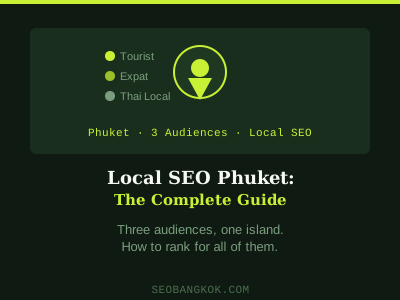
Island properties have a harder version of this problem, because the booking platforms are stronger there and the audience is split three ways. If you are in Phuket, our local SEO service for Phuket businesses covers the district and language layers this guide only touches on; for the smaller island market there is SEO for Koh Samui.