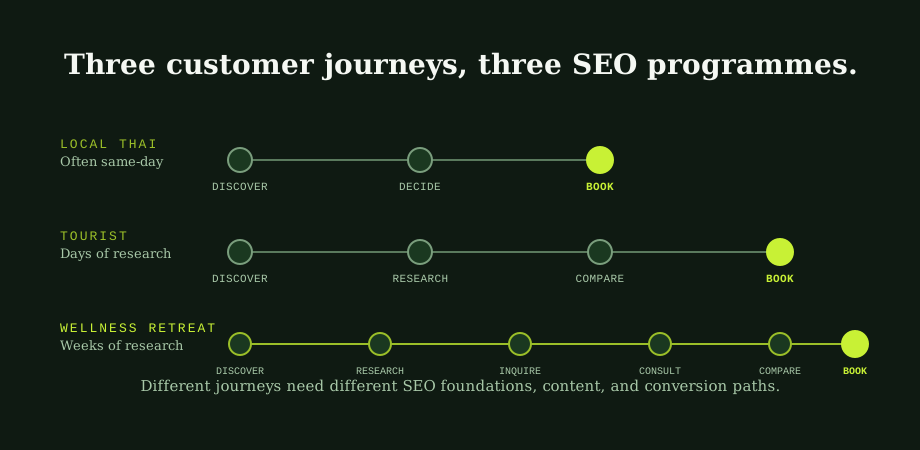
The vertical breaks into three customer segments that need different SEO programmes to serve them properly: the local Thai customer (short journey, GBP-driven), the tourist customer (medium journey, multi-channel research), and the wellness retreat guest (long journey, international, considered purchase). A spa serving all three needs a website that can carry all three journeys simultaneously, which means architectural choices that handle multiple audiences without diluting any of them.
The three customer segments
Local Thai customers typically search for spas or massage in their immediate area, often same-day. The journey runs from a Google search ("spa near me," "massage in Asoke," "นวดใกล้ฉัน") through the local pack results to the booking decision. Many bookings happen via LINE chat after the customer finds the business on Google Maps. The conversion path is short and price-sensitive. Most local Thai spa customers do not visit the website at all; they evaluate from the GBP listing, the reviews, and the LINE conversation.
Tourist customers arrive in Thailand with a vague plan to "try a Thai massage" or "book a spa" but no specific provider in mind. The research happens partly before the trip (TripAdvisor, blog roundups, Google searches) and partly in-country (hotel concierge recommendations, Google Maps when nearby). Tourist customers are willing to pay more than locals for premium experiences but expect English-language service, clean booking flows, and trust signals (reviews, photos, professional staff bios). The website matters more than for local Thai customers because tourists use it to validate before booking.
Wellness retreat guests are a different category entirely. They are typically researching weeks or months before booking, often from their home country, comparing multiple retreats across destinations (Bali, Thailand, India, Costa Rica), and looking at total experience rather than single treatments. The booking decision involves significant spend (typical retreats range from one thousand to ten thousand US dollars per stay), often a video consultation with the retreat team, and detailed itinerary planning. The wellness retreat SEO programme is structurally closer to SEO for hotels in Thailand than to local spa SEO.
The architectural implication for any spa or wellness business serving more than one segment: distinct content, distinct conversion paths, and distinct measurement frameworks for each segment, even though they share the same domain.
Google Business Profile is the primary surface
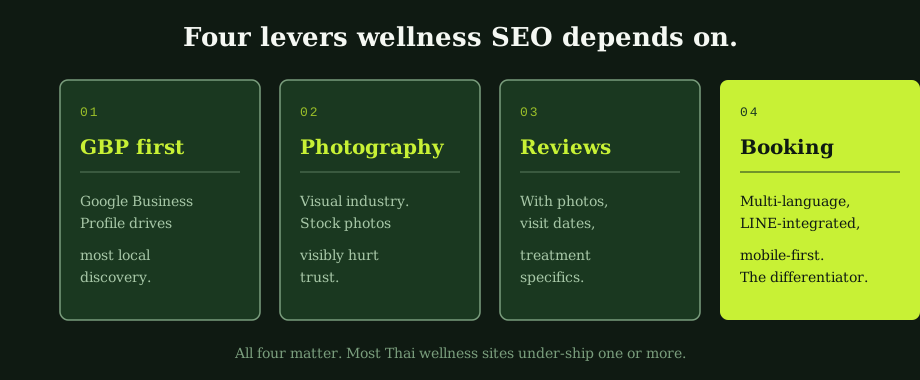
For local Thai and tourist customers (the two segments where the customer is in Thailand at the moment of decision), GBP and the local pack drive the majority of discovery. A poorly optimised GBP loses meaningful share to competitors with stronger profiles regardless of website quality. The GBP optimisation specifics for the Thai market are in how to optimise Google Business Profile in Thailand; the wider local SEO foundation that the GBP work sits on is in local SEO for Thailand businesses.
The GBP elements that move spa and wellness rankings most. Accurate primary category (Spa, Massage Spa, Wellness Center, etc.) plus secondary categories for adjacent services. Complete service list with prices visible where reasonable. Photos that show the actual interior, treatment rooms, and staff (not stock imagery; Google's image-quality signals penalise stock visibly). Posts updated weekly or fortnightly with treatment promotions, events, or content. Q&A section actively managed with treatment-specific questions answered. Reviews managed responsively (the response itself is a ranking factor; spas that reply to every review outrank spas that ignore them).
The NAP-consistency foundation that all of the above depends on is in NAP consistency for local SEO. The wider local SEO operational layer is what our local SEO services handle for spa and wellness operators who want it run rather than DIY.
Photography matters more than for most verticals
Wellness is a visual industry. Customers judge spas and retreats on the photography they see before they ever visit. Two consequences for SEO. First, GBP image quality is a more visible ranking and conversion factor than in most verticals; Google's machine vision can identify stock photos versus original, and the local pack favours profiles with substantial original imagery. Second, the website itself needs photography that builds rather than undermines the brand. Stock spa photography (the recycled lemongrass-and-towels images that appear across hundreds of unrelated sites) reads as low-effort even to users who do not consciously identify the source.
The practical requirements for spa and wellness imagery. Original photography of the actual location, taken in usable lighting (most spa interiors are dimly lit and require professional camera work to photograph properly). Multiple images per treatment area showing different angles and atmospheric details. Photographs of named staff members for the trust signal, especially for higher-priced services where the practitioner matters. Photos of treatment outcomes where appropriate (massage technique, skincare results, yoga poses, food at retreats). All images optimised for web (compressed, properly sized, with descriptive alt text). The page-speed implications of large image sets specifically are in how page speed affects both your SEO rankings and your conversion rate.
Reviews specifically for wellness
Reviews carry exceptional weight in wellness SEO because customers booking a treatment are buying an experience they cannot fully evaluate beforehand. The reviews that move the needle most have specific qualities: customer photos (validates the visit was real), treatment-name specificity (the customer mentions which treatment by name), visit-date timing (recent reviews carry more weight), and balanced sentiment without being negative (the occasional three-star review reads more authentic than a profile of only five-star reviews).
The review-acquisition tactic that works in practice: ask every customer for a review at the moment of payment when the experience is fresh, with a direct link to the GBP review page (the friction kills participation otherwise). Reply to every review within twenty-four hours, including the negative ones; the response pattern is itself a ranking signal and a trust signal for prospective customers reading reviews. Avoid review-incentivisation schemes (offering discounts for reviews violates Google's policies and the penalty when caught is severe).
For wellness retreats serving international guests, reviews on third-party platforms (TripAdvisor, Booking.com, retreat-specific platforms like Retreat Guru, BookRetreats, Wellbeing Escapes) often carry more weight than Google reviews because the international audience defaults to those platforms when researching. The cross-platform review programme is more complex than single-platform GBP work.
Multi-language booking integration
For spas in tourist areas and any wellness business targeting international guests, the booking flow needs to handle multiple languages without forcing the user to switch contexts. The pattern that works: a landing page that detects user language (Thai for Thai users, English for everyone else by default), a booking widget that respects the language choice, integrated LINE Official Account for Thai customers who prefer chat-based booking, and an email or web-form path for international guests who are not LINE users. The Thai-versus-English bilingual SEO framing that this rests on is in Thai and English SEO: should you target both languages; the broader conversion-path framing for the Thai market is in conversion rate optimization in Thailand.
For wellness retreats, the booking flow is usually more involved: inquiry form, video consultation scheduling, detailed itinerary preview, deposit payment, balance payment closer to the visit. The website needs to support each of these stages without creating friction at any single step. Retreats that lose customers between inquiry and consultation usually have a booking-flow problem rather than a marketing-traffic problem.
Wellness retreats and destination-specific SEO
Retreats that operate in specific destinations (Samui, Phuket, Chiang Mai, Hua Hin) benefit from destination-anchored SEO that ties the retreat brand to the location. The pattern that works: a dedicated content cluster about the destination (why Samui for wellness, what makes Phuket different, the climate considerations for a January versus August retreat), which builds topical authority around the location plus the retreat. The destination-specific SEO playbook for Samui is on our SEO Samui page, which carries the Samui-tourism context that wellness retreats benefit from being part of. The dental-tourism vertical that shares the same international-source-market dynamics is in SEO for dental clinics in Thailand.
For retreats targeting specific international source markets (the US is large for many Thai retreats, the UK and Germany for others, Singapore and Hong Kong for short-haul Asian retreats), the international-SEO layer matters. Our international SEO services handle the hreflang, geo-targeting, and source-market optimisation that distinguishes a retreat ranking globally from one ranking only locally.
Common mistakes in Thai wellness SEO
The patterns that recur across underperforming spa and wellness sites.
- Treating all customers as one segment. Building one generic page for "our spa" that has to serve local, tourist, and retreat audiences simultaneously. Almost always underperforms versus segment-specific pages.
- Stock photography. Lemongrass-and-towels images recycled across the industry. Visibly fails as a trust signal.
- Thin treatment pages. Single-paragraph descriptions of complex treatments. Cannot rank against competitors who ship full educational content.
- Ignoring GBP entirely. Building a beautiful website while leaving the GBP profile half-completed. Loses the local pack share that drives most local discovery.
- Reviews left unanswered. Negative reviews especially. The response pattern is a ranking signal and a trust signal.
- Monolingual sites in tourist areas. English-only spas in Bangkok lose Thai-language search traffic; Thai-only spas in tourist districts lose tourist traffic.
- Card-only checkout. Loses PromptPay-preferring customers. The same Thai-market payment reality that applies to all e-commerce.
- Slow mobile site. Wellness images are heavy. Without proper optimisation, mobile load speeds tank and the conversion rate goes with them.
The honest version of wellness SEO in Thailand
Wellness SEO done well runs three programmes simultaneously: a local-first programme anchored in GBP and Thai-language content, a tourist-facing programme anchored in English content and visual trust signals, and (for retreats) an international destination programme anchored in source-market SEO. The work compounds because the underlying foundation (photography, reviews, technical SEO, mobile-first design) carries across all three. Most Thai wellness businesses run one of the three adequately and underinvest in the other two, which leaves competitive openings for operators who run all three at a reasonable level.
Our SEO agency Bangkok work with spa and wellness operators typically begins with the GBP foundation and review acquisition (the highest-leverage work for most operators), then layers content and conversion path improvements across the three segments. The destination-specific work for Samui and Phuket retreats sits on our SEO Samui page and the broader regional services. The wider positioning for vertical-specific work like wellness sits on the SEO marketing agency overview. A short discovery conversation with our SEO marketing experts usually identifies which of the three segments to ship first.
Common questions
What is the most important SEO channel for a Thai spa?
Google Business Profile is by far the most important channel for most Thai spas. The local pack and Google Maps results drive the majority of discovery for in-person services because customers searching for spas, massage, or wellness near them rarely scroll past the map results. A spa with a poorly optimised GBP loses visibility to competitors with stronger profiles regardless of how good the website is. The website still matters but it sits downstream of the GBP discovery moment for most local search journeys.
Does a Thai spa need a multilingual website?
For spas serving only local Thai customers, a Thai-only website is appropriate. For spas in tourist areas (Bangkok central districts, Phuket, Samui, Chiang Mai), a Thai and English bilingual site is typically the right answer because the customer base is structurally bilingual. For wellness retreats targeting international guests specifically, English-first with optional Thai is the usual structure. The bilingual implementation has to handle hreflang correctly to avoid diluting rankings across language versions.
How important are reviews for spa and wellness SEO?
Reviews are critical and weighted heavily in local pack ranking signals. Thai spas with consistent four-star-plus ratings and substantial review volume outrank competitors with sparse or lower-rated profiles even when other factors are equal. The reviews that move the needle most include customer photos, specific treatment names, visit dates, and balanced sentiment. A profile with only five-star reviews looks suspicious; a profile with strong four-and-five-star reviews plus the occasional honest three-star reads more authentic.
Should a wellness retreat prioritise local SEO or international SEO?
For wellness retreats targeting international guests (which most retreats do), international SEO carries more weight than local SEO. Guests typically book months in advance from their home country after extensive research, so the discovery path runs through English-language search in markets like the United States, the United Kingdom, Australia, Germany, and increasingly East Asia. The retreat-side SEO programme is structurally more like a destination hotel SEO programme than a local spa SEO programme.