The core insight that most beginner keyword research misses. Head terms (one-to-two word, high-volume) feel like the obvious targets because the volumes look impressive, but they are also the most competitive and the lowest commercial-intent terms in the universe. Long-tail keywords (four-plus word, low individual volume) feel underwhelming individually but produce most of the actual converting traffic because the specificity signals real intent. A keyword research programme that ignores the long tail in favour of the head terms produces flat results regardless of how strong the page-level SEO is.
What keyword research actually is
Keyword research is the discipline of identifying which search queries the business should target, at what level of competition, with what content treatment, and in what priority sequence. The output is a structured keyword universe (typically several hundred to several thousand queries depending on business size) mapped to intent categories, content types, and target pages. The research compounds as data accumulates: queries the business already ranks for inform which adjacent queries to pursue; queries competitors rank for that the business does not surface gaps worth addressing; queries showing emerging volume signal trends worth investing in early.
The research is also ongoing rather than one-time. Search behaviour shifts as language evolves, as the business expands, as competitors enter and exit, and as the search engines themselves change how they handle queries. Annual full refreshes plus quarterly monitoring of the active keyword set is the typical cadence for a serious programme.
Head, body, and long-tail keywords
The three categories are defined more by characteristics than by hard thresholds, but the distinctions matter operationally.
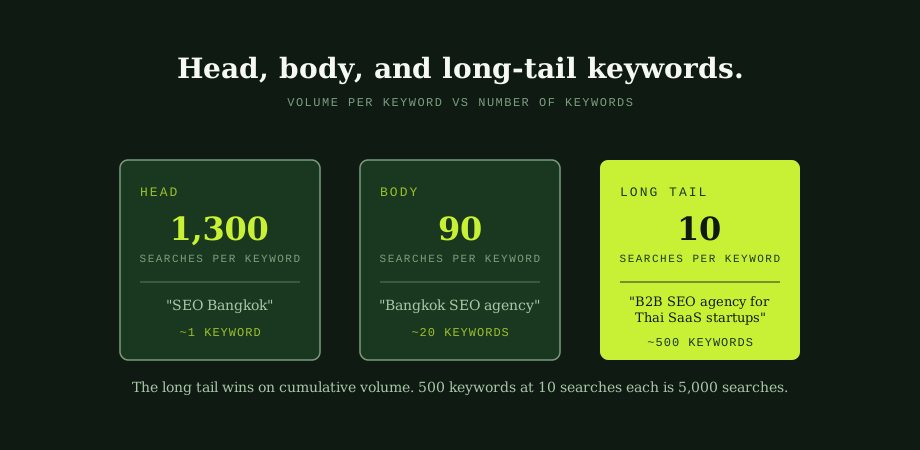
Head terms are one-to-two word queries with the highest search volumes in a category. For a Bangkok SEO agency, the head term is "SEO Bangkok" itself, with roughly 1,300 monthly searches. Head terms have high competition because they attract every player in the category, low click-through rates per ranked position because the audience is broad, and lower conversion rates because the intent is unclear (someone searching "SEO Bangkok" could be researching, comparing, hiring, or studying the industry). Head terms are valuable to rank for as brand signals but rarely as the primary lead generator.
Body terms are two-to-three word queries with moderate volume. For the same Bangkok SEO agency, body terms include "Bangkok SEO agency" (the agency-specific framing), "SEO services Thailand" (the regional service framing), and "best SEO in Bangkok" (the comparison framing). Body terms have moderate competition, clearer intent than head terms (the user has added qualifiers that narrow what they want), and higher conversion rates per visit. Most agencies target body terms as their primary commercial keywords because the volume-to-conversion balance is favourable.
Long-tail keywords are four-plus word specific queries with low individual volume but high specificity. Examples include "B2B SEO agency for Thai SaaS startups," "best SEO consultancy for Thai medical clinics," "SEO agency Bangkok IT industry experience." Each individual long-tail keyword might drive only 10 monthly searches, but the universe of long-tail variants typically runs to several hundred or thousand keywords for any meaningful business. The cumulative volume is large, the competition is much lower than for head and body terms, and the conversion rates are typically the highest of the three categories because the specificity signals immediate commercial intent.
The strategic implication for content planning. Head terms get one heavily-optimised pillar page with the strongest internal linking. Body terms get a small set of category pages tuned to specific commercial framings. Long-tail terms get the bulk of the content investment in clusters of supporting pages that each target a handful of related long-tail variants. This pattern is more or less inverted from how most early-stage SEO programmes allocate effort.
The four search intents
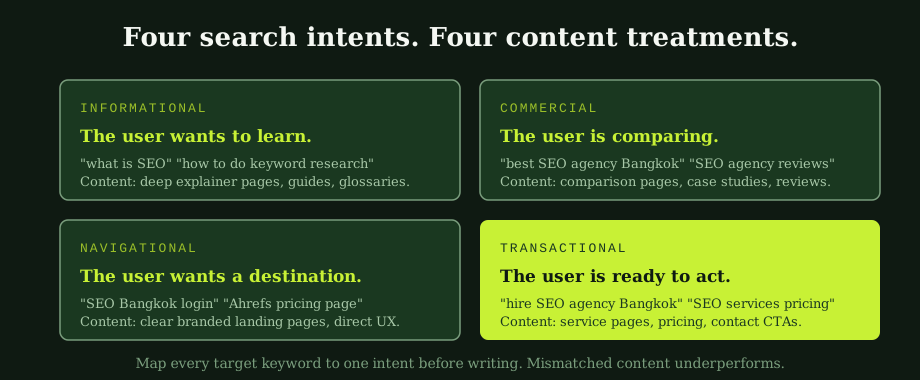
Search intent classification is the second major lens after volume category. Every target keyword sits in one of four intent categories.
Informational queries are research-stage searches where the user wants to learn rather than buy. "What is SEO," "how to do keyword research," "Core Web Vitals explained." The right content treatment is deep explainer pages, guides, glossaries, and educational content. Informational content earns trust and feeds upper-funnel demand but rarely converts directly.
Commercial queries are comparison-stage searches where the user is evaluating options before committing. "Best SEO agency Bangkok," "SEO agency reviews," "Semrush vs Ahrefs." The right content treatment is comparison pages, case studies, reviews, and honest evaluation content. Commercial content converts well because the audience has already self-selected for the category.
Navigational queries are destination-seeking searches where the user has a specific page or brand in mind. "SEO Bangkok login," "Ahrefs pricing page," "Google Search Console help." The right treatment is clear branded landing pages with direct UX; the user wants to get somewhere specific, not be sold to.
Transactional queries are action-stage searches where the user is ready to buy, sign up, hire, or otherwise act. "Hire SEO agency Bangkok," "SEO services pricing," "book SEO consultation." The right treatment is service pages with pricing, contact CTAs, and the operational details needed to close. Transactional queries are the lowest in volume but the highest in conversion rate; programmes that systematically capture transactional queries produce outsized commercial returns.
The mapping discipline. Every target keyword in the universe should be classified into one of the four intents before any content is written. Writing an informational explainer for a transactional query loses the visitor; writing a transactional service page for an informational query produces a high bounce rate. The wider framing of search intent for SEO specifically is unpacked in the state of Thai SEO in 2026 in the broader context of modern Thai search behaviour.
Tools for Thai-market keyword research
The tool landscape for Thai keyword research is similar to the global landscape with some Thai-specific data quality considerations.
Google Keyword Planner remains the baseline. Free, official, the source of truth for Google's own monthly search volumes. The limitations: Keyword Planner groups similar variants into single volume buckets which can hide useful sub-variant data, and the volumes are calibrated for advertiser spend prediction rather than for organic SEO research. Use Keyword Planner as the directional check rather than the only source.
Semrush and Ahrefs are the two paid tools that produce the most reliable Thai-market data at scale. Both run 200 to 500 USD per month for plans suitable for serious keyword research. Semrush typically has slightly better Thai-language coverage; Ahrefs has slightly stronger competitor analysis features. For most Thai SEO programmes, one of the two is sufficient; running both is rarely justified by the marginal data improvement.
Ubersuggest offers a budget alternative under 50 USD per month with adequate quality for smaller operations. The Thai data depth is less than Semrush or Ahrefs but the price-to-coverage ratio works for businesses that cannot justify the paid-tool spend.
Google Search Console provides the actual queries the business's own site already ranks for, which is often the highest-signal data source for established sites. Search Console data shows real impressions and clicks rather than estimated volumes, which makes it the most reliable input for understanding what the existing programme is actually capturing. Sites with reasonable existing traffic should start keyword research from Search Console data and use external tools to expand the universe.
Google Trends is free and useful for seasonality analysis and identifying rising queries. Trend data complements absolute-volume data well; a query showing steady volume growth is often more valuable to target than a higher-volume query that is declining.
For deeper coverage of the budget-tool approach specifically, the practical Thai-market guide is in keyword research without expensive tools.
Thai-language considerations
Three Thai-language considerations meaningfully shape the research process.
Thai search volumes are smaller than equivalent English volumes. Even for Thai-market businesses with a primarily Thai audience, the search volumes for Thai-language queries are typically lower than equivalent English-language queries. This happens partly because Thai users frequently code-switch into English for technical, professional, or international-product terms (a Thai professional might search for "best CRM Thailand" in English even when most of their other queries are Thai-language). The implication: keyword research has to cover both languages for most businesses, not just the primary audience language.
Thai keyword tool data is sparser. Semrush, Ahrefs, and Keyword Planner all have less Thai-language coverage than English coverage. Volumes for niche Thai queries often show as zero or N/A even when meaningful real volume exists, simply because the tools have not aggregated enough Thai search data to estimate volume confidently. Cross-referencing across multiple tools is more important for Thai research than for English; Google Search Console data on existing rankings is correspondingly more valuable.
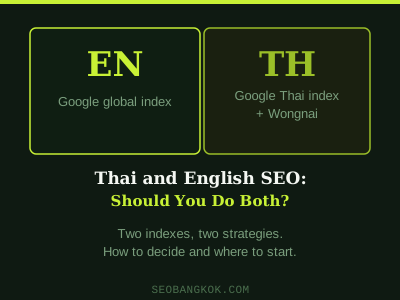
Thai search behaviour skews mobile and conversational. The mobile-first reality of the Thai market means more queries come from voice search and conversational typing than for desktop-heavy markets. Long-tail queries phrased as questions (mai krap, ที่ไหนดี, แนะนำ followed by specific terms) appear more frequently than they would in English markets. The keyword universe has to include these conversational variants; tools that surface only short-form queries miss them. The wider bilingual framing that this rests on is in Thai and English SEO: should you target both languages.
Building the keyword universe
The methodical process of building a keyword universe runs through five stages.
Seed terms. Begin with the 10 to 20 terms that obviously describe the business. For a Bangkok SEO agency, seed terms include SEO Bangkok, SEO Thailand, search engine optimisation Bangkok, Bangkok SEO agency, Thai SEO services. These seeds are the starting points, not the destination.
Expansion. Use the keyword tools to expand each seed into related variants. Each seed typically produces 50 to 200 related queries. Capture them all in a working document; filtering and prioritisation comes later.
Competitor mining. Identify the top 5 to 10 competitor sites in the category and pull the queries they rank for that the business does not. Semrush and Ahrefs both support this analysis directly; the gap between competitor coverage and the business's existing coverage is one of the most useful keyword opportunity sources. The wider analytical framing for competitive SEO research is integrated into our technical SEO service.
Intent classification. Tag every keyword in the working universe with one of the four intents. Filter out queries with mismatched intent for the business (an agency does not need to target informational queries about "how to do SEO yourself" unless the educational content angle is part of the brand strategy).
Prioritisation. Rank the remaining keywords by a composite score of volume, intent quality, competition, and existing ranking position. The top 20 to 50 keywords become the active commercial keyword set; the next 100 to 300 become the supporting content cluster targets; the remainder become a research bank for future content investments. The measurement framework that pairs with this prioritisation is in how to measure SEO content performance.
Competitive keyword analysis
Competitive keyword analysis is the second-highest-leverage activity in keyword research after building the initial seed universe. The analysis answers three questions.
The first question. What are competitors ranking for that the business is not? This identifies content gaps where the competitor has built a position that the business could plausibly compete for. Not every gap is worth addressing (some queries are in the competitor's core territory where the moat is too deep) but the gap analysis surfaces queries worth investigating.
The second question. What is the business ranking for in positions 4 to 15 where competitors are ranking in positions 1 to 3? These are the queries where small ranking improvements would produce disproportionate traffic gains. The on-page and link-earning investment needed to move from position 8 to position 3 on a specific query is usually much smaller than the investment needed to rank for a brand-new query at any position.
The third question. Which queries does no competitor rank well for? These are the under-served queries where the business could establish dominance with relatively modest investment. The opportunities are real but require careful filtering because some queries are under-served for good reason (they have no commercial value or the search demand is too thin to be worth pursuing).
Common mistakes in Thai keyword research
- Researching head terms only. Skipping the long tail concedes the bulk of converting traffic to competitors who invest in cluster content.
- Single-tool research. Volume estimates vary substantially across Keyword Planner, Semrush, and Ahrefs. Cross-referencing produces more reliable inputs than depending on any one source.
- Ignoring Google Search Console. Existing-site rankings are the highest-signal data and most agencies treat them as a footnote rather than a primary input.
- Researching only in one language. Thai-market businesses need bilingual keyword research even if the primary audience is monolingual; cross-language code-switching is too prevalent to ignore.
- Skipping intent classification. Writing transactional service pages for informational queries (or vice versa) produces high bounce rates and weak rankings.
- Treating research as one-time. Annual full refresh plus quarterly monitoring is the minimum cadence; markets and search behaviour shift faster than that.
- Ignoring competitor gap analysis. The single highest-leverage opportunity source is what competitors rank for that the business does not.
- Vanity volume chasing. Targeting high-volume head terms because they look impressive while neglecting the long-tail clusters that actually convert.
- No commercial filtering. Not every high-volume keyword is worth ranking for. Filtering by commercial value before content investment prevents wasted effort.
The honest version of keyword research
Keyword research done well is a structured, ongoing, multi-source discipline that produces a working keyword universe of several hundred to several thousand queries mapped to intent, prioritised by commercial value, and refreshed on a known cadence. Done badly, it produces a spreadsheet of 50 head terms compiled in an afternoon that becomes the unchallenged keyword strategy for the next two years. The difference shows up in the SEO programme outcomes within twelve months: the methodical version compounds, the rushed version plateaus.
Our keyword research process for Thai-market clients runs through the full methodology with both paid tools and existing Search Console data, structured intent classification, and quarterly monitoring of the active keyword set. The wider SEO marketing agency services include keyword research as a standard component of every engagement; the foundational research is part of the audit deliverable rather than a separate billable workstream. For businesses wanting to position themselves as the best SEO Bangkok brand in their specific category, the research determines whether the strategy is feasible against the existing competitive landscape. A discovery conversation with our Bangkok SEO experts typically begins with a brief look at the current keyword universe to identify whether the foundation is sound or needs the structured rebuild this piece describes.
Common questions
What is the difference between head, body, and long-tail keywords?
Head terms are short one-to-two word queries with high search volume and high competition (SEO Bangkok at roughly 1,300 monthly searches). Body terms are two-to-three word queries with moderate volume and competition (Bangkok SEO agency at roughly 90 monthly searches). Long-tail terms are four-plus word specific queries with low individual volume but high commercial intent. The strategic insight: long-tail keywords win on cumulative volume because there are many hundreds of variants. Five hundred long-tail keywords at 10 searches each is 5,000 searches and typically converts at higher rates than head terms.
What are the four search intent categories for keyword research?
Informational queries seek learning. Commercial queries compare options before deciding. Navigational queries seek a specific destination. Transactional queries are ready to act. Each intent needs different content treatment: informational gets deep explainer pages, commercial gets comparison pages, navigational gets branded landing pages, transactional gets service pages with pricing and CTAs. Mapping every target keyword to one intent before writing prevents content that mismatches what the searcher actually wants.
What are the best tools for Thai keyword research?
Google Keyword Planner is the free baseline. Semrush and Ahrefs are the two paid tools at 200 to 500 USD per month that produce the most reliable Thai-market data at scale. Ubersuggest offers a budget alternative under 50 USD per month. Google Search Console provides actual queries the site already ranks for which is the highest-signal data source for established sites. Google Trends is free and useful for seasonality and rising-query analysis. Cross-referencing across multiple tools is more reliable than depending on any single source for Thai-language data.
How do Thai-language considerations change keyword research?
Three considerations. Thai search volumes are typically smaller than equivalent English volumes because Thai users often code-switch into English for technical or professional terms. Thai keyword tools have less data depth than English equivalents so cross-referencing matters more. Thai search behaviour skews mobile and conversational which means voice-style query patterns appear more often. Researching only English keywords for a Thai-market business misses the majority of real search demand; researching only Thai misses the international and technical-professional segments that often carry the highest commercial value.