Bad SEO reporting is recognisable in a single pattern. The agency or in-house team produces a long monthly deck with screenshots of every dashboard, keyword tables that stretch to twenty pages, and a narrative section that lists what was done rather than what changed. The stakeholder reads the executive summary, gets confused by the volume, and decides that SEO is hard to measure. The work continues, the relationship erodes, and within twelve months the engagement quietly ends because no one can articulate what it produced. The data was there. The reporting wasn't.
The three audiences for SEO reports
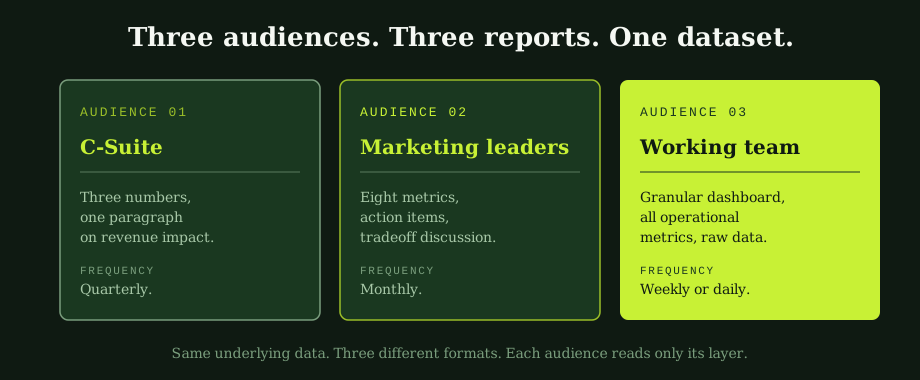
Same underlying dataset, three completely different reports. Trying to serve all three from a single document is the most common reporting failure, and it almost always produces a document that serves none of them well.
The C-suite audience (CEO, CFO, CMO depending on company size) cares about one thing: whether the SEO investment is producing commercial outcomes that justify the budget. They do not want to read about Core Web Vitals or schema markup. The right report for this audience is three numbers and a one-paragraph narrative on revenue impact. Quarterly delivery is the right cadence; monthly is too frequent for the resolution they need. The three numbers worth showing are typically organic-traffic-driven revenue, qualified-lead volume from organic channels, and a single forward-looking indicator (next-quarter pipeline or upcoming content milestones).
The marketing leadership audience (head of marketing, marketing director, demand-generation lead) cares about the integration between SEO and the broader marketing programme. They want eight to twelve metrics with action items and a tradeoff discussion. Monthly delivery is the right cadence. The metrics span traffic, conversions, ranking movement, content performance, and the technical health signal. The narrative explains why the numbers moved (or did not), what is being done about it, and what tradeoffs are being made (where budget or attention is being concentrated and what is being deprioritised). This audience reads the actual report front to back and follows up on action items.
The working team audience (in-house SEO manager, content lead, dev partners) needs the granular operational dashboard. All metrics, raw data, weekly or daily refresh. The format is the dashboard rather than the narrative report; the consumption is reference rather than read-through. This is where the deep technical metrics live (crawl logs, indexing state, individual page performance, ranking volatility by query), and this is what gets actually used to drive day-to-day work.
The three-audience structure has a useful corollary: the same underlying data feeds all three reports, so the cost of producing them in parallel is modest once the data infrastructure exists. The architectural mistake is producing the granular dashboard and emailing it to the C-suite, hoping they will distil the three numbers themselves. They will not. The distillation is the report; producing it is the work.
What each audience cares about
The C-suite reads for commercial conviction. The question in their head is "is this working?" and the report has to answer that in under sixty seconds of reading. Three numbers and a paragraph. Anything more obscures the answer.
Marketing leaders read for direction-setting. The question in their head is "what do we need to do differently?" and the report has to make the recommended next moves obvious. Eight to twelve metrics with action items. Numbers without recommendations are inert; recommendations without numbers are unsupported.
The working team consults the dashboard for operational decisions. The question in their head is "what changed?" and the dashboard has to surface anomalies and movement. Full data, weekly refresh, with alerting on threshold-crossing changes so that they don't have to actively look for problems to notice them.
The structure of a useful report
The monthly report for the marketing leadership audience (the most complex of the three) follows a consistent structure that works across industries and business sizes.
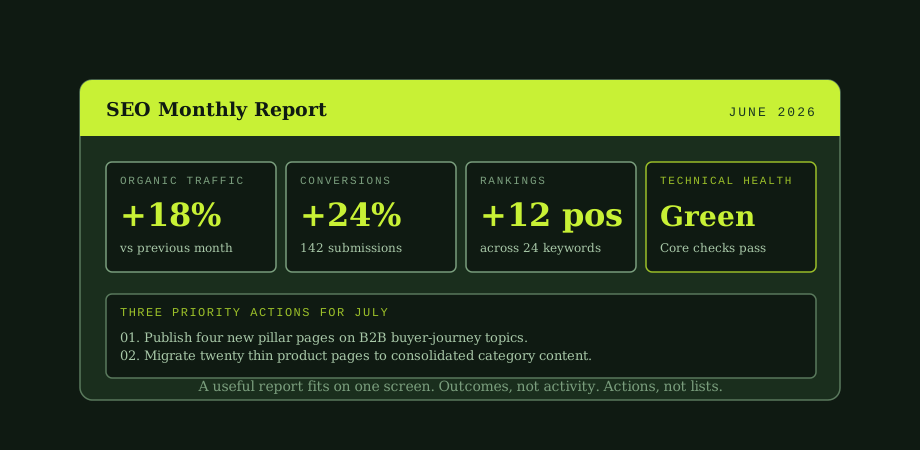
Executive summary at the top. Three numbers and a paragraph. Even though the rest of the report contains more, the summary has to stand alone in case the reader stops there. The summary answers the "is this working" question regardless of what follows.
Headline metrics. Four KPI tiles showing organic traffic, conversion outcomes, ranking trends, and technical health. Each tile shows the current value, the change versus the comparison period, and a single line of context. Visual prominence matters; if the four headline metrics are not the most visible elements after the executive summary, the report structure is wrong.
Trend analysis. Charts showing six to twelve months of historical data on the headline metrics. Trends are more informative than point-in-time values because they show direction. The chart legend explains what the lines represent without requiring interpretation.
Action items. Three to five prioritised actions for the next reporting period, each with an expected impact and an owner. The action items are why the marketing leader is reading; numbers without next moves are descriptive rather than operational. The wider framing of how SEO recommendations should be structured and prioritised is in how to pick the best SEO agency.
Appendix with detail. Granular tables, supporting evidence, and methodology notes for readers who want to dig in. The appendix is reference material, not the report; the report should be readable without it.
Metrics that should be in every report
Four metric categories form the irreducible core of any useful SEO report.
Organic traffic with appropriate comparisons. Month-on-month comparison to capture short-term direction, year-on-year comparison to control for seasonality (most businesses have meaningful seasonal patterns that month-on-month alone obscures), and a comparison versus the same period one year earlier to show longer-term direction. Raw traffic numbers without comparison are noise; comparisons make them signal.
Conversion outcomes tied to the business goal. Form submissions, signups, qualified leads, e-commerce transactions, or revenue depending on the business model. Traffic that does not convert is not commercial; reports that focus on traffic alone implicitly assume the conversion side is solved, which is rarely true. The conversion-tracking setup that this measurement rests on is in how to set up conversion tracking in GA4.
Ranking trends for the tracked-keyword set. Average position is too aggregate to be useful (averages obscure where the brand actually competes). The right ranking metric is movement within a defined tracked-keyword set, broken into commercial-intent and informational-intent buckets, with movements up and down highlighted explicitly. The wider context on which metrics actually correlate with commercial outcomes is in how to measure SEO content performance.
Technical health as a single status. The C-suite does not need to read about crawl errors and Core Web Vitals individually. They need a single status (green, amber, red) backed by underlying detail if they want to dig in. Technical health expressed as a status is interpretable; the same data expressed as a five-line metric panel produces fatigue.
Metrics that should never appear in any report
Vanity metrics that confuse the picture rather than inform it. Including these in reports usually signals an agency or in-house team that cannot point to commercial outcomes and needs the visual volume to compensate.
- Total indexed keyword count. A brand can rank for ten thousand keywords and drive no business. The count is impressive-looking and operationally useless.
- Third-party domain authority scores. Proprietary metrics from SEO tools, not used by Google, easily moved with low-quality work that produces no commercial result. Including them implies they matter, which they don't beyond a directional indicator.
- Average position across the entire indexed keyword set. Averages obscure where the brand actually competes. A meaningful ranking metric tracks specific commercial-intent keywords; the unfiltered average can swing meaningfully on irrelevant queries.
- Pages indexed as a positive metric. More pages indexed is not better. The right pages indexed is better. Reports that lead with rising indexed-page counts often coincide with indexing of low-value pages that should not exist.
- Time-on-site as a primary KPI. Longer time-on-site can indicate confusion as much as engagement. The metric is too ambiguous to drive decisions without significant additional context.
- Backlink count without quality dimension. A thousand low-quality backlinks is not better than one hundred contextually relevant ones. Counts alone mislead.
- Activity volumes. Number of meta descriptions rewritten, number of internal links added, number of pages audited. The work matters because it produces outcomes; reporting the work in lieu of the outcomes is a tell.
Reporting cadence
The cadence matches the audience.
Weekly or daily for the working team. Automated dashboards refreshing on a known schedule. Alerts on threshold-crossing events. The working team should not need to actively look for changes; the dashboard should surface them.
Monthly for marketing leadership. Produced on a consistent day each month, ideally within the first week so the previous month's data is fresh in mind. The same structure month to month; consistency lets readers absorb the report quickly because they know where each section lives.
Quarterly for the C-suite. Tied to quarterly business reviews where the SEO investment is evaluated alongside other marketing spend. Three numbers and a paragraph. The trap is the monthly C-suite update; the cadence is too frequent for the resolution and produces "is this working" anxiety in the senior team rather than confidence.
Across all cadences, the principle is the same: report consistency builds trust. Stakeholders who know what to expect each cycle absorb the information faster and act on it more readily. Reports that change format month to month implicitly signal that the team is improvising, which erodes confidence regardless of what the data actually says. The wider framing of how reporting connects to engagement-level decisions is unpacked in enterprise SEO consulting.
Common mistakes in SEO reporting
- One report for all audiences. The "comprehensive monthly report" that lands in the inbox of the CMO, the marketing director, and the working team simultaneously serves none of them well.
- Activity-focused reporting. Lists of what was done rather than what changed. Stakeholders pay for outcomes, not for activity logs.
- Vanity metrics leading the report. If the first metric the reader sees is total keyword count or domain authority, the report is signalling weak commercial performance.
- No comparisons. Raw monthly numbers without month-on-month or year-on-year comparison are uninterpretable.
- No action items. Reports that describe the past without recommending future moves are descriptive rather than operational. The reader has no obvious follow-up.
- Inconsistent format month to month. Stakeholders learn where to look in a consistent format; rearranging it each cycle imposes cognitive load and erodes trust.
- Missing methodology notes. When numbers change unexpectedly, the appendix should explain what changed about the data collection so the audience can interpret correctly.
- Buried bad news. Negative movements explained transparently build credibility; the same movements obscured behind selective framing destroy it when the audience eventually notices.
The honest version of SEO reporting
SEO reporting done well produces stakeholder confidence in the work even when individual months are mixed. Stakeholders read consistent, audience-tuned reports, see honest discussion of what is working and what is not, follow recommended next moves, and renew the engagement because the SEO programme feels operationally sound. Done badly, reporting becomes the reason engagements end even when the underlying SEO work is producing results, because the stakeholders cannot see the results clearly enough to defend the budget internally.
Our reporting framework for SEO clients runs on the three-audience structure as standard: quarterly executive summaries, monthly leadership reports, and operational dashboards for the working team. The wider SEO company Bangkok approach treats reporting as part of the service rather than an afterthought because we have watched too many otherwise-good engagements end on communication failure rather than on substance. The integrated digital agency Bangkok programme extends the same reporting discipline across paid channels and content alongside SEO. For businesses with internal marketing teams that want the reporting framework as part of an advisory engagement rather than full execution, the enterprise SEO consulting shape covers the structure design alone. A short discovery conversation with our SEO consultant in Bangkok usually identifies which reporting cadence and depth fits the audiences who will actually be reading.
Common questions
What are the three audiences for SEO reports?
The C-suite needs three numbers and a one-paragraph narrative on revenue impact, delivered quarterly. Marketing leaders need eight to twelve metrics with action items and tradeoff discussion, delivered monthly. The working team needs a granular dashboard with all operational metrics and raw data, refreshed weekly or daily. Sending the granular dashboard to the C-suite produces eye-glaze; sending the three-number summary to the working team strips out the operational signal they need.
What metrics should appear in every SEO report?
Four metrics form the irreducible core. Organic traffic with month-on-month and year-on-year comparison. Conversion outcomes tied to the business goal (form submissions, signups, qualified leads, revenue) rather than to traffic alone. Ranking trends for the tracked-keyword set with movement up and down highlighted. Technical health expressed as a single status (green, amber, red) backed by detail on Core Web Vitals, crawl errors, and indexing state.
Which metrics should never appear in SEO reports?
Vanity metrics that confuse rather than inform. Total keyword count, third-party domain authority scores, average position across the entire indexed keyword set, pages indexed as a positive metric, time-on-site as a primary KPI, backlink count without quality dimension, and activity volumes (number of meta descriptions rewritten, etc). These signal an agency or in-house team that cannot point to commercial outcomes and needs the visual volume to compensate.
What is the right reporting cadence for SEO?
Three cadences serve three audiences. Weekly or daily dashboards for the working team monitoring operational health. Monthly reports for marketing leaders covering the full KPI set with commentary on what changed. Quarterly executive summaries for C-suite stakeholders with three numbers and a paragraph on commercial impact. The mistake is monthly C-suite reports (too granular for the audience) and quarterly working-team reports (too coarse for operational decisions).