The asymmetric-information problem in agency buying is real. The agency knows more about SEO than the buyer in almost every case. That asymmetry is precisely why agencies exist as a category. But it also means buyers cannot usually evaluate the technical claims being made to them. A proposal that says "we will optimise your on-page SEO and build a quality backlink profile" sounds reasonable. Whether the specific approach the agency uses to do that work is good, mediocre, or actively harmful is invisible to most buyers until results either arrive or do not, six to twelve months later.
The framework that follows is designed to surface quality despite that asymmetry. It does not require deep SEO knowledge to apply. It does require asking direct questions, expecting specific answers, and walking away when the answers are evasive.
Why picking an SEO agency is harder than picking most service providers
Three structural features of the SEO market make the buying decision unusually difficult.
The results lag the work by months. A bad accountant produces bad numbers within weeks. A bad SEO agency produces six to twelve months of activity reports before the absence of results becomes undeniable. By the time the buyer realises the agency was wrong, the budget is gone and the contract often still has months to run. The timeline reality is in how long does SEO take.
The deliverables look similar across the quality spectrum. Most agencies produce reports, articles, audits, and backlink commentary. The output formats are conventional. Whether the underlying work is genuinely producing competitive advantage requires technical evaluation that most buyers cannot perform.
The market is full of agencies that do not deserve to be in business. The barrier to calling yourself an SEO agency is essentially zero. The barrier to running one well is high. The proportion of agencies that actually move client results is much smaller than the proportion of agencies that exist.
None of this is a reason to avoid hiring an agency. Good agencies exist and consistently outperform what most businesses can achieve in-house. But the buying process needs to be structured to find them rather than the alternatives.
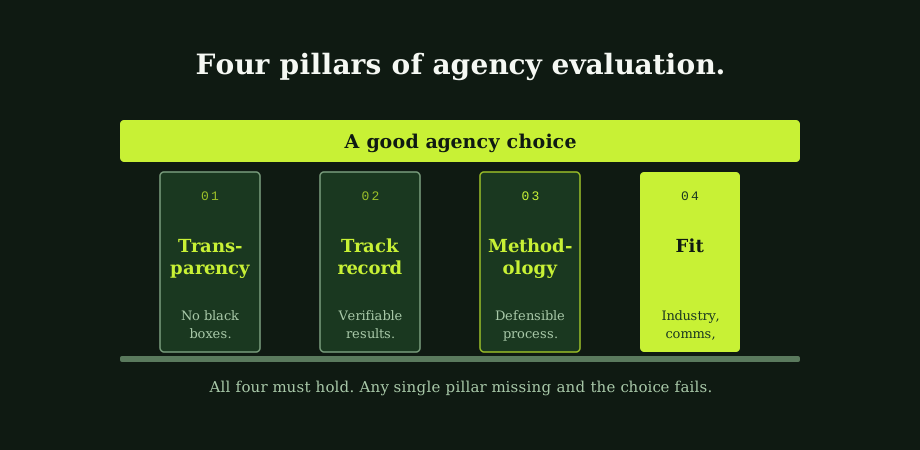
The four pillars of agency evaluation
A good SEO agency holds up on four pillars. Any single pillar missing and the choice tends to fail, even when the other three are strong.
Pillar 1: Transparency
The agency explains what it does in plain English. The methodology is not a black box. The reports show specific work and specific outcomes rather than aggregated activity metrics. The team is named (you know who is actually working on your account). The pricing is broken down into what the budget buys rather than presented as an opaque retainer. Transparency is the easiest pillar to test in the first conversation: ask three direct questions about methodology and see whether the answers are specific or evasive.
Pillar 2: Track record
The agency can show verifiable case studies in your industry or in adjacent industries. References are people you can actually call, not testimonials on a page. Public work (clients the agency has published case studies for, with the client's permission) is a stronger signal than internal-only references. Industry-specific track record matters more than generic results: a B2B SaaS agency that has only worked with consumer e-commerce brands is unlikely to be the right pick for a SaaS company. Cross-checking case studies against what shows up in the wild (search the case-study client's name and see whether they actually rank for the keywords claimed) is a fast sanity check.
Pillar 3: Methodology
The agency has a clear, defensible process it can describe. Not a list of generic tactics, but an actual sequence: how does work get prioritised, how do strategy decisions get made, what happens when results lag the plan, how is the work reviewed for quality. A real methodology takes ten minutes to explain. A weak methodology either takes thirty seconds (because it is generic) or fifty minutes (because it is being made up on the spot). The DIY-audit framework that buyers can use to evaluate methodology quality is in the SEO audit checklist.
Pillar 4: Fit
The agency understands your industry, your market, your business model, and your buying cycle. The communication style works for your team. The contract terms match how your business operates. Fit is the pillar buyers most often underweight in the evaluation and most often regret in the execution. A technically excellent agency that does not communicate well with your team produces worse results than a slightly less technically excellent agency that integrates smoothly into how you work. Industry fit specifically matters: SEO for a hotel is structurally different from SEO for a SaaS company, and an agency that has only done one will struggle with the other. The SaaS-specific context is in SEO for IT and SaaS businesses in Bangkok.
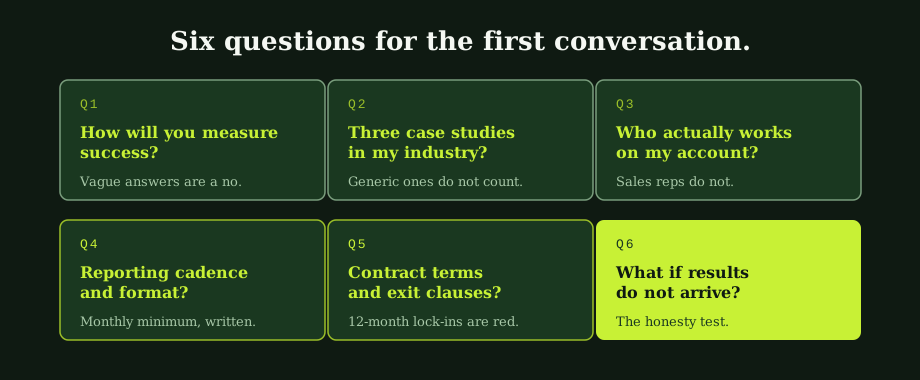
The six questions for the first conversation
These are the questions that surface the four pillars in a single call. Each one has a specific quality of answer to expect.
- "How will you measure success?" A good agency answers in terms of business outcomes (revenue, leads, qualified traffic to specific pages) tied to specific timeframes. A weak agency answers in terms of vanity activity (articles published, links built, "improvements" with no quantification). If the answer is vague, the reporting will be vague too.
- "Can I see three case studies in my industry?" If the agency can produce three, the industry fit is real. If they can produce one and pivot to "but the principles transfer," the industry fit is weaker than they want to admit. Generic case studies do not count for industry-specific work.
- "Who will actually work on my account?" The names matter. The senior person in the room during sales is rarely the person doing the work afterward. Ask who specifically will write the content, do the audits, manage the link earning, and run the reporting. If the answer is junior and they were not introduced, the proposal is misleading.
- "What is your reporting cadence and format?" Monthly minimum, written report, includes both activity and outcomes. Quarterly is too infrequent for course correction. Weekly is usually theatre. The format matters as much as the cadence: dashboards alone are not reports.
- "What are the contract terms and exit clauses?" Twelve-month lock-ins with no exit clauses are a structural red flag. Healthy contracts allow either side to exit with thirty to ninety days notice after an initial period. The agencies most confident in their work offer the easiest exit terms.
- "What happens if results do not arrive?" This is the honesty test. A good agency answers with a specific course-correction framework: what they will diagnose, what they will change, when they will recommend ending the engagement if results still are not appearing. A weak agency either guarantees results (impossible) or has no plan beyond "we will keep doing the work" (also bad).
Run the six questions in the first thirty minutes. The answers either land specifically or they evade. Specific is the only acceptable outcome.
Red flags worth walking away from
The patterns that recur across agencies that disappoint clients.
- Guaranteed rankings. No honest agency guarantees rankings, because the variables (Google algorithm changes, competitive moves, your own site changes) are outside the agency's control. Anyone who guarantees rankings is either lying or doesn't understand the work.
- Twelve-month lock-in with no exit clause. The agency is locking you in because they expect you to want to leave. Healthy commercial relationships do not require lock-ins.
- Pricing significantly below market without a clear scope reason. If the budget is half of what comparable agencies quote, the work being delivered is half. Cheap SEO is one of the most expensive mistakes in marketing because the wasted time compounds.
- Generic case studies. "We helped a client increase organic traffic by 300%" is meaningless without context: in what industry, over what timeframe, from what baseline, in what competitive market. Real case studies have all four.
- Reporting that emphasises activity over outcomes. "We published twelve articles and built forty backlinks this month" is activity. "Organic traffic grew 18%, three target keywords moved into the top ten, qualified lead form submissions grew 11%" is outcomes. Activity reports are easier to produce and tell you nothing about whether the work is working.
- Unnamed account team or bait-and-switch. The senior strategist in sales is not the junior content marketer doing the work. If the team handing off was not introduced, the proposal misrepresented the engagement.
- Black-box methodology. "We have proprietary tools and methods" is fine. "We cannot tell you how we do the work" is not. Trade secrets do not exist in SEO at the level of methodology.
The pricing reality
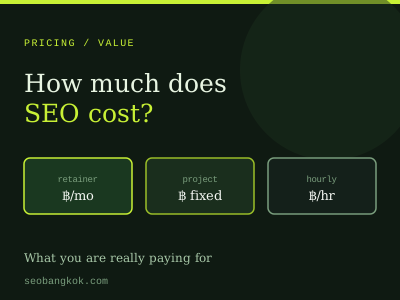
Healthy pricing for SEO in Thailand varies by scope but follows recognisable bands.
Below fifteen thousand baht per month, the work is rarely substantive enough to compound. The agency cannot afford the time required to do the work well at that price point. Most programmes at this tier produce activity without results.
Fifteen to thirty thousand baht per month covers small local programmes: a single-location business with Bangkok-only or one-city targeting, modest content production, basic technical work. Appropriate for restaurants, salons, small clinics, single-property hotels.
Forty to eighty thousand baht per month covers mid-sized programmes: multi-city or English-plus-Thai targeting, regular content production, ongoing technical and link work. Appropriate for established service businesses, e-commerce brands, B2B companies targeting Thailand and one or two regional markets.
Above one hundred thousand baht per month covers enterprise programmes: competitive markets, multi-language and multi-country, sophisticated content, deep technical work, dedicated team. Appropriate for businesses where SEO drives a meaningful share of revenue and the competitive intensity justifies the spend.
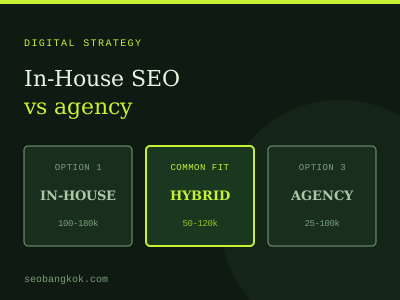
The pricing context across markets and scopes is in how much does SEO cost in Thailand; the agency-versus-in-house pricing comparison is in in-house SEO vs hiring an agency.
When NOT to hire an agency
An agency is the right choice for many businesses but not all of them. The cases where an agency is the wrong path.
The business is too small for the minimum useful spend. If the marketing budget cannot support fifteen thousand baht per month of SEO work, the agency option is not appropriate. The DIY route or a part-time consultant is a better fit. The consulting-shape engagement that sits next to the agency-shape engagement here is in what is enterprise SEO consulting.
The expected ROI does not justify the spend. Some businesses do not have enough commercial search volume in their niche for SEO to be worth the budget. Honest assessment of search volume comes before the budget conversation.
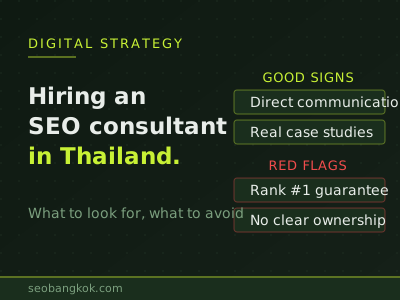
The work needed is strategic, not execution-heavy. Some businesses need someone to tell them what to do, not someone to do it. A consultant is a better fit. The consulting-vs-agency framing is unpacked in what to look for when hiring an SEO consultant in Thailand.
The in-house team is strong enough to handle execution. If the marketing function already has competent SEO people and the gap is occasional expert input rather than ongoing execution, paying for an agency is duplicative.
The honest version of how to pick an SEO agency
Picking well is mostly about asking specific questions and walking away when the answers evade. The four pillars (transparency, track record, methodology, fit) are the structure. The six questions are the test. The red flags are the disqualifiers. The pricing context is the sanity check.
Done well, the buying process takes one to two months and produces a relationship that compounds for two to five years. Done poorly, it produces twelve months of activity reports, no results, and a contract you cannot exit cleanly. The work to do the buying well is small relative to the consequences of doing it badly.
SEO Bangkok follows the same buying principles described here: named senior ownership, transparent priorities and reporting tied to outcomes. If you need broad implementation, review our SEO agency in Bangkok. If you need strategy, an audit or a second opinion, working directly with an SEO consultant in Thailand may be the better fit.
Common questions
What should I look for when picking an SEO agency?
Four pillars decide whether an SEO agency is a good choice: transparency (no black-box methodology, clear reporting, named team members), track record (verifiable case studies in your industry, references you can actually call), methodology (a clear, defensible process they can explain in plain English), and fit (industry experience, communication style, and contract terms that match how your business operates). Any single pillar missing and the choice tends to fail.
How much should an SEO agency in Thailand cost?
Pricing varies dramatically by scope. Small Thai businesses with local-only ambitions can run useful SEO programmes from around fifteen to thirty thousand baht per month. Mid-sized businesses targeting multi-city or English-plus-Thai markets typically sit in the forty to eighty thousand baht per month range. Larger enterprise programmes or competitive international markets push above one hundred thousand baht monthly. Below fifteen thousand baht the work is rarely substantive enough to compound.
What are red flags in an SEO agency proposal?
Several patterns recur in proposals that produce disappointing programmes: guaranteed rankings (impossible to honestly guarantee), generic deliverables not tied to your specific business, unnamed account team or junior delivery hidden behind senior sales, twelve-month or longer lock-in with no exit clause, reporting that emphasises activity rather than outcomes, pricing significantly below market without a clear scope reason, and reluctance to share verifiable case studies or references. Any one warrants a question; two or more is usually a no.
Should I pick an agency or a consultant for SEO?
It depends on the maturity of your in-house team and the breadth of work needed. Agencies are better when you need execution across many workstreams and have limited in-house SEO capability. Consultants are better when you have an in-house team that needs strategy, audits, or specific expertise rather than full execution. The hybrid model (consultant for strategy plus agency or in-house for execution) works well for many mid-sized businesses.
One practical test: can they tell you what things cost before you are in a sales process? Our own SEO pricing in Thailand is published for that reason, and you can see the outcomes behind it in our case studies.