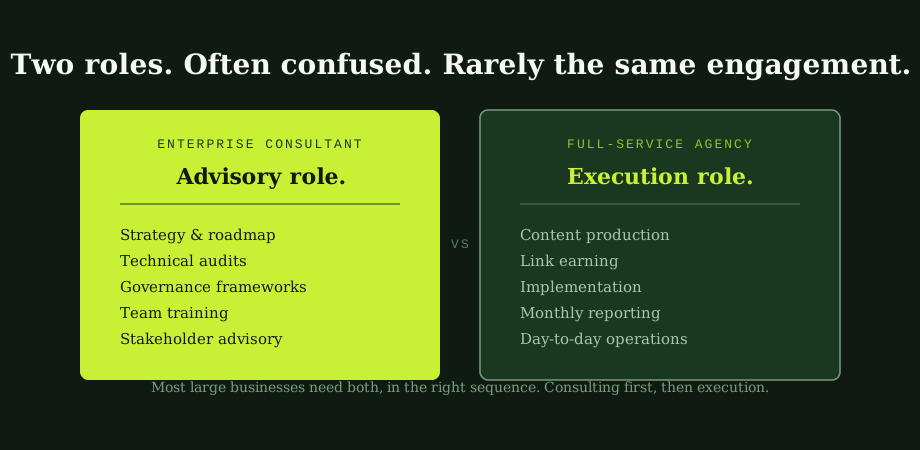
The cleanest way to think about the distinction is to separate the verbs. Consulting is about decisions: what to do, in what order, with what success criteria, governed by what handoff model. Agency work is about delivery: actually producing the content, building the links, shipping the technical changes, running the campaigns. Both can be valuable. Both are expensive in different ways. They are not substitutes for each other in most enterprise contexts; they are sequenced, with consulting typically coming first to set direction and agency or in-house execution following to do the work.
What makes enterprise SEO different from SMB SEO
The "enterprise" qualifier in front of SEO consulting is not marketing language; it points to genuine structural differences in how the work has to be done at scale.
Multiple stakeholders. A small business SEO engagement involves the owner and maybe one marketing lead. An enterprise engagement involves the CMO, the CTO, the head of content, the head of demand generation, the in-house SEO manager, the analytics lead, possibly legal review for any content claims, and sometimes the CEO when the SEO investment crosses a certain budget threshold. The consultant has to navigate this group rather than report to one person.
Multiple systems. Enterprise sites typically run on multiple CMSes (a marketing site on one platform, a help centre on another, a customer portal on a third), often with complex routing rules and access controls. Technical SEO recommendations that take an afternoon to implement on a small business site can take a quarter to implement at enterprise scale because the changes touch multiple owners and code bases.
Higher stakes and longer timelines. A small business making SEO decisions worth thousands of dollars can iterate fast. An enterprise making SEO decisions worth millions of dollars has to validate, document, and align before acting. The pace is slower and the cost of getting it wrong is much higher.
Existing investments to protect. Enterprise sites typically have substantial historical SEO value that can be damaged by changes. Migrations, redirects, domain consolidations, and platform changes all carry meaningful risk that small businesses do not face at the same scale. Consultants spend a disproportionate share of their advice on what not to do.
The four core deliverables
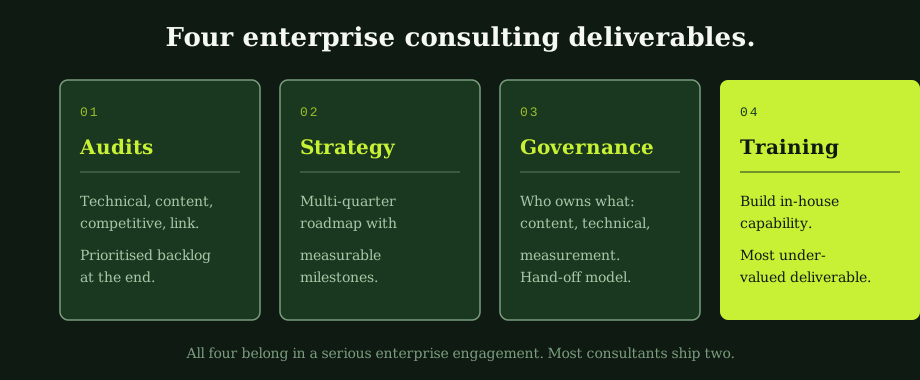
A serious enterprise consulting engagement produces four distinct kinds of work product. Consultants who ship two of the four are common; consultants who ship all four are rarer and produce noticeably better outcomes for the businesses that hire them.
Audits
The diagnostic foundation. Technical audits that catalogue indexability issues, Core Web Vitals problems, internal linking gaps, schema markup state, and crawl efficiency. Content audits that map existing pages against intent clusters, identify cannibalisation, surface thin or outdated content, and prioritise the rewrite-versus-consolidate-versus-deprecate decisions. Competitive audits that map the actual rivalry (not the assumed rivalry) across the keyword universe that matters. Link profile audits that identify both opportunities and risks (toxic patterns that need disavowal, gaps that need link earning). The standard deliverable shape is a prioritised backlog with effort, impact, and risk estimates against each item.
Strategy
The forward-looking document. A multi-quarter roadmap covering which keyword clusters the business will compete on, what content production looks like to support each cluster, what technical foundations need to exist for the content to compound, and what success looks like at six, twelve, and twenty-four months. The strategy document is the artefact that the in-house team or contracted agency executes against; without it, execution drifts. The wider framing on what good strategic SEO documentation looks like is in how to pick the best SEO agency, which covers what to look for in any strategic SEO deliverable regardless of who produces it.
Governance
The most-undervalued of the four. Governance frameworks define who owns what. In an enterprise SEO programme, content owners, technical SEO owners, measurement owners, and content production capacity owners all have to be identified, briefed on their responsibilities, and held accountable. Without governance, even excellent audit findings and strategy documents fail to produce results because no one ends up actually responsible for implementation. A consultant who delivers strategy without governance has done half the work.
Training
The deliverable that builds long-term capability. Training programmes that bring the in-house marketing team up to the level where they can execute the strategy without needing the consultant present for every decision. Training can take many forms: documented playbooks, recurring office-hour sessions, written best practices specific to the business, or formal workshops. The training deliverable is what differentiates a consulting engagement that pays for itself indefinitely from one that creates dependency.
Who should hire an enterprise SEO consultant
The right shape of engagement depends on the maturity of the business and the work that needs doing. Enterprise SEO consulting fits a specific profile.
The business has an in-house marketing team of at least six to ten people including dedicated content, development, and analytics functions. The team has the capacity to execute on recommendations once they are produced; the gap is direction, not labour. The annual marketing budget is large enough to fund the strategic recommendations after the consulting work is done (typically several hundred thousand baht minimum for ongoing implementation across content, technical, and link earning).
There is clear executive sponsorship for the SEO investment. The CMO or CEO has signed off on the budget and the direction; the consultant is not also trying to sell SEO internally to a sceptical leadership team. Either an existing agency relationship needs strategic direction (the agency executes well but lacks the in-house knowledge to set strategy) or in-house capability is sufficient to implement directly.
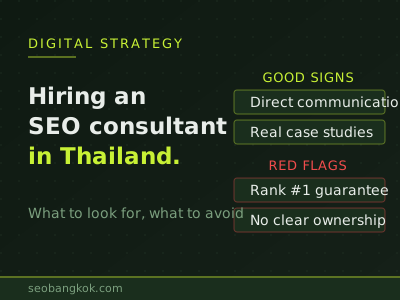
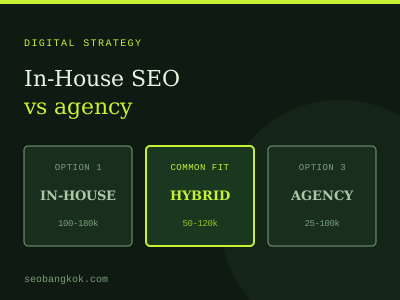
Businesses that do not fit this profile typically get better outcomes from a full-service agency relationship instead. The decision framework that compares the two paths is unpacked in in-house SEO vs hiring an agency, and the consultant-side specifics for the Thai market sit in what to look for when hiring an SEO consultant in Thailand.
The stakeholder landscape
One of the underappreciated parts of enterprise SEO consulting is the volume of stakeholders the consultant has to manage simultaneously. Each stakeholder cares about different aspects of the work and validates the engagement on different criteria.
The C-suite (typically CMO or sometimes CEO depending on the size) cares about the strategic narrative, the budget justification, and the competitive positioning. They want to know what the SEO programme will produce over twelve to twenty-four months in terms of revenue, market share, or brand visibility. They do not want to discuss meta descriptions or schema markup.
Marketing leadership below the C-suite cares about the integration with the broader marketing programme. They want SEO to compound with paid media, content marketing, brand campaigns, and demand generation rather than operate in isolation.
Engineering and development care about implementation feasibility, code quality, and how much SEO work will take from their roadmap. SEO recommendations that ignore engineering capacity get deprioritised. The consultant has to write recommendations that engineering can actually ship.
Content teams care about briefs, editorial standards, and how SEO requirements will affect the work they enjoy doing. SEO that feels like content micromanagement produces resistance; SEO that gives content teams genuine creative latitude within structural constraints produces buy-in.
Legal and compliance in regulated industries care about claim accuracy, disclaimers, and content review processes. The consultant has to know which content categories trigger legal review and build that into the production timeline.
Analytics and measurement care about attribution accuracy, dashboard design, and how SEO performance will be reported up. They want clear definitions and reproducible data.
The in-house SEO manager (when one exists) cares about not being undermined by the consultant. The healthiest engagements treat the in-house SEO manager as a peer collaborator rather than as a junior to be corrected, and produce work that makes the in-house manager more effective rather than redundant.
Pricing reality for enterprise consulting
Enterprise SEO consulting fees vary substantially by scope and engagement length, but follow recognisable patterns.
Project-based audits and strategy roadmaps for established mid-market or enterprise businesses typically run 250,000 to 1,500,000 Thai baht (roughly 7,000 to 42,000 US dollars) depending on scope. The lower end covers a focused technical audit plus a strategy document for a single-site business. The higher end covers comprehensive audit across multiple properties, deep competitive work, multi-quarter strategy, and substantial governance documentation. The pricing context for SEO work more broadly is in how much does SEO cost in Thailand.
Ongoing strategic advisory retainers run 50,000 to 200,000 baht per month (roughly 1,400 to 5,600 USD) for typical engagements; higher for very large enterprises with multi-country operations or particularly complex technical environments. The retainer covers ongoing strategic input, periodic re-audits, governance support, and training touch-points. It does not cover content production, link earning, or technical implementation; those are executed by the in-house team or a separate agency.
The pricing can look high compared to junior agency retainers, but the comparison is misleading. Enterprise SEO consulting fees should be benchmarked against senior in-house hire costs (a senior SEO manager in Bangkok costs 150,000 to 350,000 baht per month all-in) rather than against execution-heavy agency retainers. A senior consultant for two days a month often produces more strategic value than a full-time mid-level in-house hire.
How to scope and engage an enterprise consultant
The shape of a successful enterprise consulting engagement has consistent features.
A clear scope of work. The deliverables, timelines, and acceptance criteria are documented before the engagement begins. Vague engagements (the consultant will "advise on SEO strategy") drift; specific engagements (the consultant will produce a technical audit, a content audit, a twelve-month strategy roadmap, and a governance framework, with named delivery dates) compound.
A named executive sponsor. One person in the organisation owns the engagement and has authority to accept deliverables and approve recommendations. Without this, the engagement stalls in committee.
A handoff plan for execution. Before the engagement begins, the team agrees whether the consultant's recommendations will be executed by the in-house team, an external agency, or a combination. The recommendations are written for the audience that will execute them.
A measurement framework. What success looks like is defined before the work starts. Generic goals (improve SEO) cannot be measured; specific goals (organic revenue from non-branded traffic grows by X percent over twelve months) can be.
An exit clause. Enterprise engagements should have clear exit terms (typically thirty to ninety days notice after the initial commitment period). Consultants confident in their work offer easy exits; consultants who lock clients into long commitments without exit options often have a reason.
The audit framework that should sit at the start of any consulting engagement is in the SEO audit checklist, which works as a buyer-side reference for what to expect from the audit deliverable specifically.
The honest version of enterprise SEO consulting
Enterprise SEO consulting done well is a senior consultant or small consultancy producing strategy and direction for a business that has the in-house capability or agency relationships to execute on it. The work compounds because the recommendations get implemented and the governance frameworks ensure the implementation continues after the consultant's involvement ends. Done badly, it produces beautifully written strategy documents that sit on shared drives unread while the business continues operating on whatever ad-hoc SEO processes existed before.
The honest variables that determine which version a business ends up with are mostly on the buyer side: clear executive sponsorship, sufficient in-house capability to execute recommendations, willingness to follow through on governance, and acceptance that strategic consulting is a different shape of engagement from full-service agency work. The consultant matters too (expertise, communication, judgement), but a strong consultant in an organisation that cannot execute produces no better outcomes than a mediocre consultant in the same organisation.
Our work as a Bangkok SEO agency spans both consulting and full-service engagements depending on what the business actually needs. The enterprise SEO consulting shape suits established Thai and regional businesses with internal capability that need strategic direction without operational outsourcing. The wider Thailand SEO company structure covers the execution-heavy engagement model for businesses where the in-house capability is not yet at the level to execute on strategy alone. A short discovery conversation with our SEO marketing experts usually clarifies which shape of engagement fits the business in front of us.
Common questions
What is enterprise SEO consulting?
Enterprise SEO consulting is an advisory engagement that delivers strategy, audits, governance frameworks, and training to large businesses with sufficient internal capability to execute the work themselves. The consultant produces direction and oversight; the in-house team or contracted agency produces the actual content, links, technical changes, and operational reporting. The role is fundamentally advisory rather than operational, which differentiates it from a full-service agency engagement.
How is enterprise SEO consulting different from hiring an SEO agency?
The two engagements differ on deliverables (consultant produces audits, strategy, governance, training; agency produces content, links, technical implementations, reporting), time commitment (consulting runs weeks to several months on projects or smaller ongoing retainers; agency engagements run ongoing monthly retainers over twelve to thirty-six months), and capability requirement (consulting requires meaningful in-house capability to execute on recommendations; agency engagements work when in-house capability is limited).
Who should hire an enterprise SEO consultant?
The businesses that benefit most have sufficient marketing maturity to execute work themselves but lack the specific SEO expertise to direct it. The pattern includes an in-house marketing team of at least six to ten people including dedicated content, dev, and analytics functions; an annual marketing budget large enough to fund strategic recommendations once produced; clear executive sponsorship for SEO investment; and either an existing agency relationship that needs strategic direction or sufficient in-house capability to implement directly.
How much does enterprise SEO consulting cost?
Project-based audits and roadmaps for established mid-market or enterprise businesses typically range from 250,000 to 1,500,000 Thai baht (roughly 7,000 to 42,000 US dollars) depending on scope. Ongoing strategic advisory retainers run 50,000 to 200,000 baht per month (roughly 1,400 to 5,600 USD) for typical engagements. The fees should be benchmarked against senior in-house hire costs rather than against execution-heavy agency retainers.