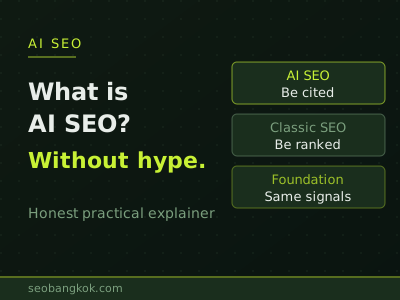
AEO and GEO are not the same as SEO, but they are built on the same foundation. The dedicated deep dive into AEO as a practice is in what is answer engine optimization. Understanding what each term actually describes, how they overlap, and where they differ in practice is more useful than debating which acronym is correct. This post takes each term seriously, maps the real differences, and ends with a clear recommendation for how to prioritise your time and budget.
To get the broader context for why AI search matters and what the data shows about citation signals, the What Is AI SEO? explainer covers that in detail. The deeper comparison of the individual AI search engines (ChatGPT, Gemini, Perplexity, Claude) is in ChatGPT vs Gemini vs Perplexity for SEO. This post focuses on the terminology and prioritization question.
What each term actually means
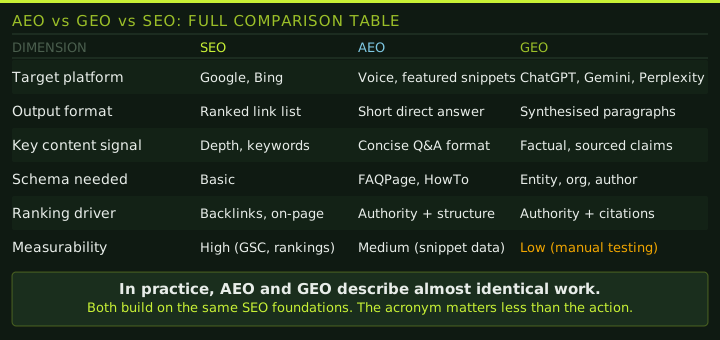
SEO (Search Engine Optimization) is the practice of improving a website's visibility in ranked link results on search engines, primarily Google and Bing. When someone searches for "SEO consultant Bangkok" and sees a list of ten blue links, SEO is what determines whether your link appears near the top of that list, and whether the user clicks on it. SEO is well-defined, well-measured, and has 25 years of research and best practice behind it.
AEO (Answer Engine Optimization) is the practice of getting content selected as a direct answer rather than a ranked link. The primary targets are featured snippets (position zero in Google), voice search answers, and the direct answer boxes that appear above organic results for many informational queries. AEO work focuses on concise, structured, directly-answering content, and on FAQ schema markup that makes content machine-readable as a Q&A format. The term became popular around 2019 with the rise of voice search.
GEO (Generative Engine Optimization) is the practice of appearing in AI-generated text from systems like ChatGPT, Perplexity, Google AI Overviews, and Gemini, explained in how ChatGPT Search changes SEO strategy. Unlike AEO, which targets a specific answer position in traditional search results, GEO targets inclusion in synthesised paragraphs generated by large language models. The term emerged in 2023 as AI-powered search became mainstream. A 2023 academic paper from Princeton formally defined GEO and documented its signals.
The practical difference between AEO and GEO is smaller than the definitions suggest. The signals that help with featured snippets overlap heavily with the signals that help with AI Overview citations. Both reward direct-answer content structure, FAQPage schema, domain authority, and clear entity signals. The main distinction is that GEO additionally involves brand citation monitoring across AI platforms, entity schema beyond what AEO typically requires, and an honest acknowledgement of low predictability that AEO optimisation never had to contend with.
Where they overlap and where they diverge
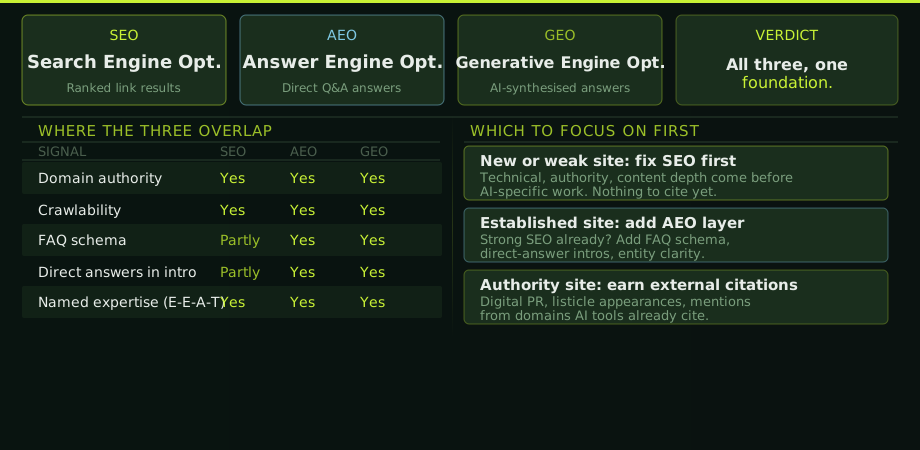
The overlapping foundation is substantial. Domain authority and backlink quality are the strongest predictors of both traditional rankings (SEO) and AI citation (AEO/GEO). Crawlability and indexation are prerequisites for all three. Named authorship and E-E-A-T signals benefit all three. Specific, factual, well-structured content benefits all three. If you do good SEO, you have already done the majority of what AEO and GEO require.
The divergences are real but modest. AEO requires FAQPage and HowTo schema more specifically than baseline SEO. GEO additionally rewards entity schema (Organisation, Person, LocalBusiness), because AI systems are entity-driven in a way that traditional keyword-matching algorithms are not. GEO also introduces the monitoring dimension: traditional SEO has stable, measurable rankings; AI citation is volatile and requires ongoing prompt testing to track. The E-E-A-T guide covers the quality signals that matter to all three disciplines.
The vendor hype problem
Every new acronym in search generates a wave of vendor content claiming that businesses must immediately pivot their entire digital strategy to address it. GEO and AEO are no different. Some claims in the space are worth addressing directly.
Claim: You need a separate AI SEO budget and strategy. Reality: if your traditional SEO is well-executed, the additional investment for AI search visibility is modest. Add FAQ schema, restructure intros, implement entity schema, and monitor citation quarterly. This does not require a separate budget line item unless you have no SEO foundation at all.
Claim: AI search is eating traditional search traffic. Reality: SparkToro research found that as of early 2026, AI-referred traffic represents a small fraction of total search-driven traffic for most sites, though it is growing rapidly. AI-referred sessions grew 527% year-over-year in 2025, but from a low base. Traditional organic search remains dominant by volume.
Claim: AI search favors fresh, AI-generated content. Reality: research consistently shows that well-established sites with strong domain authority are overrepresented in AI citations. New sites producing AI-generated content at scale are not the primary citation beneficiaries. Authority, built over time, is the dominant signal.
Which to focus on and in what order
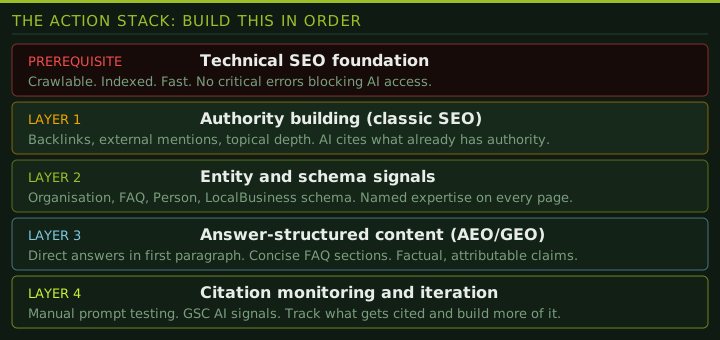
The prioritisation answer is straightforward and consistent with what strong AI search optimization practice recommends. If your site has significant technical problems, fix them first. Broken indexation, slow Core Web Vitals, and missing schema cannot be compensated for by AEO or GEO work. The technical SEO audit guide covers what to check.
With your technical foundation is solid but authority is weak, build authority. Domain authority is the single strongest predictor of both traditional rankings and AI citations. Publishing good content, earning relevant backlinks, and building external mentions are the levers. This is the same SEO work it has always been.
Where your technical foundation is solid and authority is moderate-to-strong, add the AEO/GEO layer: FAQPage schema on content pages, Organisation and Person schema sitewide, direct-answer opening paragraphs on every key page, named authorship with credentials, and a quarterly citation testing process. This work takes days to implement on an existing site, not months.
The Thailand and ASEAN opportunity
For businesses in Thailand and ASEAN, the GEO/AEO opportunity is particularly concrete because competition is low. The overwhelming majority of AI citations for English-language Thai business queries go to Western or generic sources, not to Thai businesses with genuine local expertise. A Thai SEO consultancy with strong domain authority, clear entity signals, and direct-answer content covering Thai market specifics can capture AI citations that no large Western competitor is positioned to earn.
This is not a theoretical opportunity. It is observable right now by testing prompts in ChatGPT and Perplexity and checking who currently gets cited for queries like "best SEO consultant Bangkok" or "local SEO Thailand." The answer in most cases is that the citations are poor, generic, or absent. That is the gap.
AEO vs GEO vs SEO questions
What is the difference between AEO and GEO?
AEO (Answer Engine Optimization) targets direct answer extraction in featured snippets and voice search. GEO (Generative Engine Optimization) targets inclusion in AI-generated summaries from ChatGPT, Perplexity, and Google AI Overviews. In practice, the signals that help with one help with the other, and most practitioners use the terms interchangeably.
What is the difference between AEO/GEO and SEO?
SEO optimises for traditional ranked link results. AEO/GEO optimise for direct answer extraction and AI-generated summaries. The underlying signals overlap significantly: domain authority, crawlability, content quality, and entity clarity benefit all three. The additional AEO/GEO work is modest: FAQPage schema, direct-answer intros, entity schema, and named authorship.
Which should I focus on first: SEO, AEO, or GEO?
SEO first, always. Technical foundation, then authority, then the AEO/GEO layer. AI-specific optimisation on a site with weak foundations produces minimal results. Fix the fundamentals first, then add the AI-specific work. This order produces results for both traditional search and AI citation simultaneously.
Do I need separate content for AI search and traditional search?
No. Content that performs best for AI citation is also the content that performs best for traditional search: specific, factual, well-structured, by a named expert, directly answering the target query. The main difference is format: lead with the direct answer rather than building to it. This is restructuring, not new content creation.
Is there a risk of over-optimizing for AI search?
The risk is misprioritization, not over-optimization. Spending significant effort on AI citation work before fixing technical SEO or building domain authority is poor allocation. If budget is limited, 80% on traditional SEO fundamentals and 20% on AI-specific additions is the safest split.