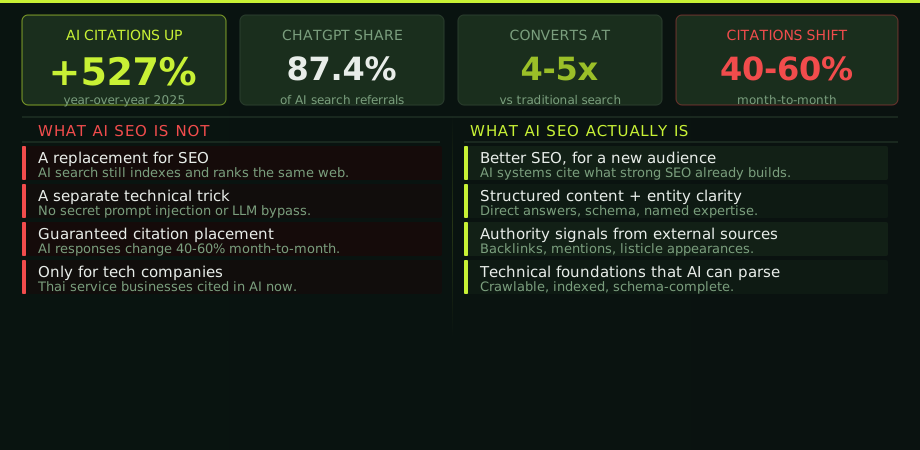
Let us start with what AI SEO is not. It is not a replacement for traditional search engine optimisation. It is not a separate technical trick involving prompt injection or special AI-readable markup. It is not a guaranteed path to appearing in Google AI Overviews or ChatGPT citations, and how ChatGPT Search changes SEO strategy covers that tool in depth. And it is not primarily relevant to technology companies. Thai service businesses, local consultancies, and B2B companies are being cited in AI answers right now.
What AI SEO is, stripped of the acronym soup and vendor positioning, is this: the practice of building the signals that AI-powered search systems use to select which sources to cite in generated answers. Those signals are not new. They are the same authority, technical health, and content quality signals that have always driven search rankings, weighted toward structured content that answers questions directly and entities that are clearly defined.
The central claim of this post, and of the broader AI search optimization service, is that AI search is not replacing SEO. The dedicated practical view of AEO as one specific practice within AI SEO is in what is answer engine optimization. It is exposing weak SEO faster. A site that struggles on page two of traditional results will not appear in AI answers. A brand with thin authority will not be cited by ChatGPT. Content that is vague, generic, and non-specific is being skipped by systems that evaluate information quality sentence by sentence.
How AI search actually selects sources
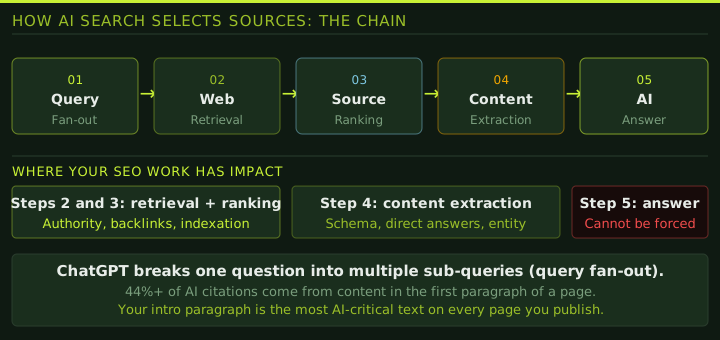
When a user submits a query to ChatGPT Search, Google AI Overviews, or Perplexity, the system does not generate an answer from its training data alone. It retrieves pages from the indexed web, ranks them using a combination of authority and relevance signals, extracts specific passages, and synthesises those passages into a generated answer with source citations. This retrieval-augmented generation process is why your SEO signals matter to AI citation.
The query fan-out process makes this more complex. ChatGPT does not process a single query. It breaks the user's question into multiple sub-queries, retrieves results for each, and synthesises across them. A question like "what is the best SEO consultant in Bangkok?" might generate sub-queries about SEO consultants, Bangkok digital marketing, SEO agency reviews in Thailand, and consultant pricing. A site that answers one of those sub-queries well is more likely to appear in the final answer.
What the research actually shows
Several studies in 2025 and 2026 have looked at which signals correlate with AI citation. The findings are consistent. SE Ranking's August 2025 research across 8,500 ChatGPT prompts found that the top predictors of LLM citation were domain authority, high-quality backlinks, mentions in best-of listicles, total backlink count, and unique referring domains. Growth Memo's February 2026 analysis found that content in the first paragraph of a page accounted for 44% or more of all AI citation extractions.
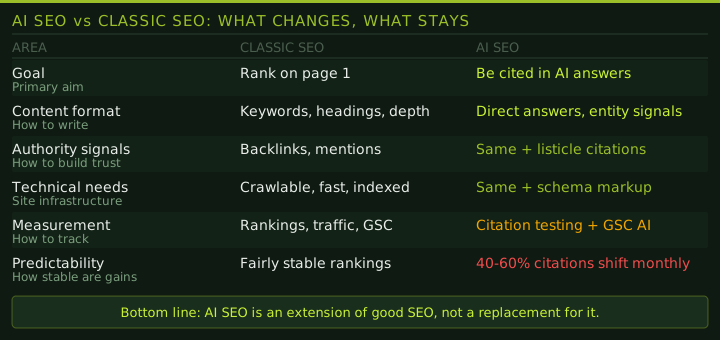
SparkToro's January 2026 research found that there is less than a 1-in-100 chance that ChatGPT gives the same list of brands in any two responses to the same question. Between 40 and 60 percent of cited sources change month-to-month. This is the honest reality of AI citation: it is far less stable than traditional rankings, and anyone promising consistent top placement is overstating what the field currently allows.
What the data consistently supports is that building the same signals that drive traditional SEO produces the best correlation with AI citation. Domain authority and backlink quality are the strongest predictors. This means the path to AI visibility runs through strong SEO, not around it.
What AI SEO actually differs from classic SEO
The core signals are the same. The additional work that AI search rewards above what traditional SEO demands covers three areas.
Structured content for extraction. AI systems pull from the first paragraph of a page in more than 44% of citations. Content that buries its main point in paragraph three or four, as much long-form SEO content does, is less likely to be cited. Every page that you want to appear in AI answers should open with a direct, factual answer to the query it is targeting. This is a content restructuring task, not a technical one.
Entity clarity through schema. This is the focus of entity SEO for AI search. AI systems work with entities and their relationships, not just keywords. Your business needs to be unambiguously identified: what it is, where it operates, who runs it, what it does. Organisation schema, LocalBusiness schema where applicable, Person schema for named authors, and FAQPage schema for content that directly answers questions all contribute to entity clarity. This is technical work that most sites have not fully completed.
Named authorship and expertise signals. Anonymous content is less likely to be cited than content attributed to a named person with verifiable credentials. Every piece of substantive content should have a named author with a bio that establishes relevant expertise. This applies to blog posts, service pages, and any page you want to be considered as a citation source. It is a direct implementation of the Experience component of E-E-A-T, see also the E-E-A-T guide.
What to do first
Where your site has significant technical problems, weak authority, or thin content, the right first step is fixing those issues. The AI-specific work is an additional layer on top of good SEO. Adding FAQPage schema to a site that cannot be properly crawled accomplishes nothing. Restructuring intro paragraphs on pages with no backlinks provides minimal leverage.
The practical priority order is: fix technical SEO foundations, build authority through content and links, add entity clarity through structured data, then restructure content to lead with direct answers. This sequence produces results for both traditional search and AI citation simultaneously.
For businesses in Thailand and ASEAN, the opportunity is real and the competition is low. Most Thai businesses have not started thinking about AI search visibility. A site with solid SEO foundations and the additional AI-specific layer in place can earn AI citations in categories where even larger Western competitors have not yet optimised. The AI search optimization service covers this full stack in a single engagement, starting with an audit that establishes exactly where the gaps are.
AI SEO questions
What is AI SEO?
AI SEO is the practice of building the signals AI-powered platforms use to select citation sources. It covers the same authority, technical health, and content quality signals as regular SEO, plus structured content for extraction, entity clarity through schema, and named authorship. It is an extension of regular SEO, not a replacement for it.
Is AI SEO different from regular SEO?
It is an extension of regular SEO. Every structural weakness traditional SEO tolerates, AI search amplifies. The additional work involves structured content that leads with direct answers, FAQPage and entity schema, and named authorship with verifiable credentials. Fix your regular SEO first; then add the AI-specific layer.
How does AI search select which sources to cite?
AI systems retrieve pages from the indexed web, rank them by domain authority, content relevance, and structural quality, then extract specific passages. Research shows domain authority is the single strongest citation predictor, followed by unique referring domains, intro paragraph content (44%+ of citations), FAQ schema, and entity signals.
Do I need to do anything special for AI SEO?
With your SEO foundations are strong: add FAQPage schema, open every page with a direct answer to its target query, define your business entity clearly with structured data, and add named authorship. If your foundations are weak, fix those first. AI-specific work on a technically broken or low-authority site produces minimal results.
Can I guarantee my site appears in Google AI Overviews?
No. Between 40 and 60 percent of cited sources in AI answers change month-to-month. No one can guarantee placement. What you can do is build the consistently correlated signals: domain authority, relevant backlinks, structured content, clear entity signals, and direct answers in opening paragraphs.