
A clean competitor SEO analysis is one of the highest-leverage exercises in the entire SEO programme. Done well, it tells you where to invest the next quarter's content and link work with reasonable confidence that the investment will pay back. Done badly, it produces a thousand-row spreadsheet that nobody reads and nothing gets shipped from.
The difference between the two is almost entirely about discipline at the front of the workflow. Pick the wrong competitors and every subsequent step amplifies the wrong signal. Pick the right ones and the rest tends to fall into place.
Step one: pick SERP rivals, not business rivals
Your business competitors and your SEO competitors are rarely the same set. The companies your sales team compares deals with are the ones competing for revenue. The websites competing for search visibility are different. They include media publishers, affiliate sites, large directories, Reddit threads, Wikipedia, and global brands that incidentally rank for your terms.
To find your real SEO competitors, work from the SERPs backwards. List the ten to twenty most important queries your business depends on. Search each one in an incognito window. Record the domains in the top ten. The domains that repeat across many of those searches are your real competitor set. The ones that appear once or twice are noise.
For a Bangkok-based clinic, the list might include: a competing clinic group, a major hospital, a medical-tourism portal, a Reddit thread, a TripAdvisor page, and a Wikipedia article. The clinic group is the business competitor; the rest are SEO competitors. The analysis works against all of them, not just the obvious one.
Step two: pull the gap data
With the competitor set chosen, the data work is straightforward. Most SEO tools have a keyword gap report or content gap report; the names vary but the function does not. The report takes your domain plus three to five competitor domains and returns the keywords that they rank for and you do not.
The raw output is rarely actionable. A typical mid-sized site comparing against four competitors will get back somewhere between two thousand and twenty thousand keywords. The work is in the filtering, which is step three.
Two other gap reports run alongside the keyword gap, both worth pulling at the same time.
- Backlink gap. Domains that link to competitors but not to you. Useful for identifying media, partnerships, directories, and editorial relationships that are reachable but currently missed. The broader principles of backlink earning sit in how to earn high-quality backlinks.
- Topical gap. Content topics or clusters where competitors have published depth and you have not. The natural extension of this is in content clusters and topical authority, which translates the gap into a content roadmap.
Pull all three at once, save them in a single spreadsheet with one tab per gap, and treat them as the input to the filtering work.
Step three: filter for winnable opportunities
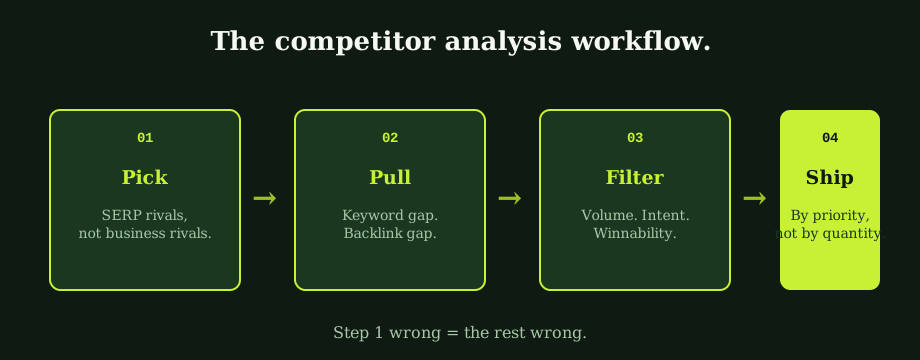
The keyword gap list at this stage probably has thousands of rows. Most of them are noise, and the analysis pays off only when the noise has been filtered out. Three filters, applied in order.
- Relevance. Strip out anything not genuinely related to what your business does. A clinic site's gap report will contain medical content from publishers; a software site's gap report will contain general technology news from media outlets. Both are irrelevant to your search strategy. Be ruthless: when in doubt, cut.
- Intent. Of the relevant keywords, separate them by intent. Informational queries ("what is X") are content opportunities. Commercial queries ("best X", "X vs Y") are conversion-stage opportunities. Transactional queries ("buy X", "X price") are bottom-funnel. The mix you target depends on where your existing site is weakest. The deeper view of intent matching sits in search intent in SEO.
- Winnability. Of the relevant, intent-matched keywords, which can you realistically rank for in the next six to twelve months. Check the SERP for each candidate query, look at the domain authority of the sites ranking, and ask honestly whether your site has any chance of competing at that level. The keywords where one or more weak pages currently rank in the top ten are the most winnable; the ones where every result is a Forbes or a Wikipedia are the least.
What survives all three filters is the actionable list. A good filter pass usually reduces ten thousand raw keywords to fifty to two hundred real opportunities.
Step four: prioritise with the 2x2 matrix
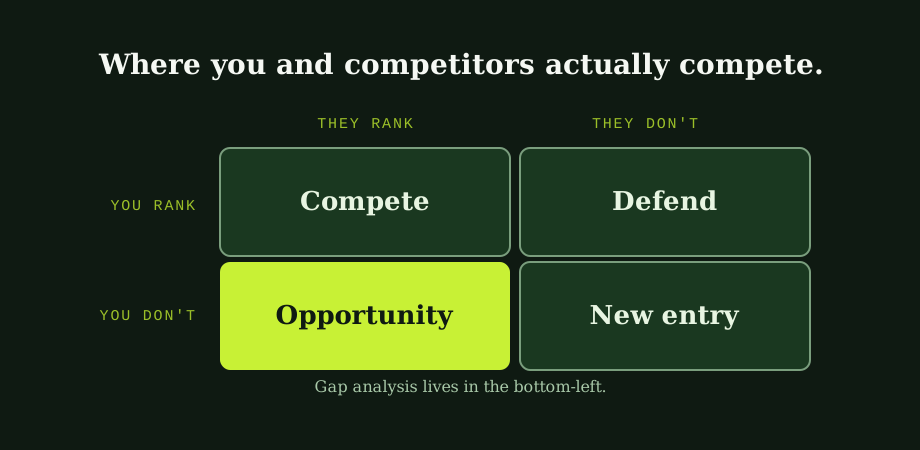
The hero image at the top of this post is the prioritisation framework. Every keyword that survived the filters belongs in one of four quadrants.
Compete (both rank). You and at least one competitor both rank in the top twenty. The work here is incremental: push your page higher with better content, more internal links, and earned backlinks. This is the lowest-effort segment because you already have the foundation.
Defend (only you rank). You rank, no competitor does. Mostly a monitoring task: watch for competitor movement and shore up the page when a competitor enters the SERP. Trying to grow rankings further here often produces diminishing returns.
Opportunity (only they rank). Competitors rank, you do not. This is the bottom-left of the matrix and the entire reason you ran the analysis. The keywords in this quadrant are where new content investment compounds fastest, because the SERP has already proved the keyword is rankable for sites in your weight class.
New entry (neither ranks). Neither you nor your selected competitors rank in the top ten. Treat these with caution. They are usually unwinnable (some other class of site dominates the SERP) or low-demand (nobody searches them enough for top-ten rank to matter). A small number are genuine green-field opportunities, but most are not.
For most sites, the next quarter of work lives in the bottom-left. Six to ten focused pieces of content targeting filtered opportunity keywords, supported by internal linking and modest link-earning, outperform thirty pieces written without the analysis.
What competitor analysis is not
It is not a brief to copy competitors. The temptation, on seeing a thousand keywords a rival ranks for, is to publish your version of each of their pages. This usually fails for two reasons. The first: copying produces undifferentiated content that ranks below the original. The second: the competitor's keyword profile reflects their history, audience, and priorities, not yours. Matching it page-for-page builds a site optimised for someone else's strategy.
The right use of the gap data is selective. You pick the keywords that fit your actual positioning, your authority, and your ability to be genuinely useful on the topic. The rest is information about the market, not a checklist of pages to write.
Common mistakes that reduce the return
Three patterns reliably reduce what teams get from a competitor analysis.
- Treating it as a one-off audit instead of an ongoing input. The opportunity list is the starting point of a six-month content plan, not the deliverable. The analysis pays off only when the keywords get written about, which most teams underestimate the time required for.
- Skipping the SERP review. Filtering by volume and difficulty number alone misses the qualitative signal: what kind of pages rank, what format Google rewards, whether the SERP is dominated by ads or by aggregators. Five minutes per candidate keyword in incognito mode is usually enough to surface this.
- Picking competitors by reputation rather than data. The flagship rival might not be the one to study. Smaller, scrappier competitors that have grown quickly often have more learnable signal than market leaders whose rankings are sustained by brand authority you cannot replicate.
The underlying point: competitor analysis is one input into a content strategy, not the strategy itself. The deeper view of how it fits sits in how to build a content strategy that actually supports SEO.
How often to refresh
For most businesses, once a year is enough. The underlying SERP landscape moves slowly in most industries, and a full re-analysis more often than that rarely produces new strategic information. A lighter quarterly check on the specific opportunities you have prioritised is worth running to track movement.
The exception is when the competitive set genuinely shifts. A new competitor enters. An existing one relaunches their site. A major Google update changes who ranks. Any of these warrants a refreshed analysis even outside the annual cycle.
Our SEO consultancy Bangkok engagements start with a structured competitor analysis on most projects. It is the cheapest way to ground a content roadmap in evidence rather than assumption. An SEO consultant in Bangkok can run the four-step workflow end-to-end in roughly a day for a mid-sized site. The output usually informs three to six months of content investment. Our SEO Bangkok work routinely produces this analysis as a planning artefact before any content gets commissioned.
Common questions
What is a competitor SEO analysis?
A competitor SEO analysis is a structured exercise that compares your site's visibility in Google search against the sites that actually appear above and around you in the SERPs for queries that matter to your business. The output is a prioritised list of keyword opportunities, content gaps, and backlink targets. The purpose is not to copy competitors but to identify the most efficient places to deploy time and content investment, which is almost always in the gap between what they rank for and what you rank for.
How do I find my SEO competitors?
Not by asking your sales team. The companies you compete with for revenue are often different from the websites you compete with for search visibility. Search engines see competitors as anything that ranks for the keywords you want, which includes media publishers, affiliate sites, large directories, Wikipedia, Reddit, and global brands that incidentally rank for your terms. Find your real SEO competitors by listing the ten to twenty most important queries your business depends on, searching each one in incognito mode, and recording which domains appear in the top ten results.
What is a keyword gap analysis?
A keyword gap analysis is the specific output of a competitor SEO analysis that lists the keywords your competitors rank for and you do not. Tools like Ahrefs, Semrush, and Sistrix all offer a keyword gap or content gap report that takes your domain plus three to five competitor domains and returns the keywords that the competitors rank for but you do not. The raw list is rarely actionable: it usually contains thousands of keywords, most of them irrelevant or unwinnable. The real work is filtering.
How often should I run a competitor SEO analysis?
For most businesses, once a year is enough to refresh the strategic picture, with a lighter quarterly check to track movement on the specific opportunities you have prioritised. A full re-analysis more often than this rarely produces new information, because the underlying SERP landscape moves slowly in most industries. The exception is when your competitive set genuinely shifts, when a new competitor enters the market, when an existing competitor relaunches their site or publishes aggressively, or when a Google update changes who appears in the SERPs.
A competitor analysis tells you where the gap is. Closing it needs the same evidence base an SEO audit produces for your own site: technical constraints, page targeting and internal links, in priority order.