The structural problem with SEO ROI: the cost happens now. The revenue happens later. Paid search spend and revenue arrive in the same week. SEO spend in January produces measurable revenue somewhere between July and the following January. Any honest ROI report has to reconcile these two timelines. Most reports try to avoid that. They either ignore the lag entirely. Or they report a one-month ROI figure that does not actually exist yet.
The framing that follows works in practice. It is not the only valid framing. But it is the one that consistently produces reports stakeholders find defensible. The kind that hold up to follow-up questions.
What "ROI" actually means in this context
The simple formula is straightforward: (organic revenue minus SEO cost) divided by SEO cost, expressed as a percentage. The harder question is what counts in each input.
Organic revenue. Most analytics platforms can show conversions attributed to organic traffic. The complication is the attribution model. Last-click attribution gives organic credit only when the organic visit was the last touch before conversion. That understates SEO. Organic search often appears earlier in the buyer journey. First-touch attribution credits organic with every conversion where it was the first visit. That overstates. Not every research visit produces a sale. Both extremes mislead. The realistic answer sits between them.
SEO cost. The honest cost calculation includes everything. Team salaries and benefits. Agency fees. Content production: writing, editing, design. Tooling: Search Console is free, but Ahrefs and Semrush are not. Plus an allocation of shared overhead. Most ROI reports either ignore the team-cost component or include only the agency line. Both make the ROI look better than it is. The cost side of the equation matters at least as much as the revenue side. The wider view of what an SEO programme actually costs sits in how much does SEO cost in Thailand.
Why SEO ROI is harder than paid media ROI
Paid search ROI is comparatively simple. Three things are precise. Spend is exact: Google billing. Traffic is immediate: clicks arrive within minutes. Attribution is largely direct: most paid clicks last-click attribute cleanly. SEO breaks all three.
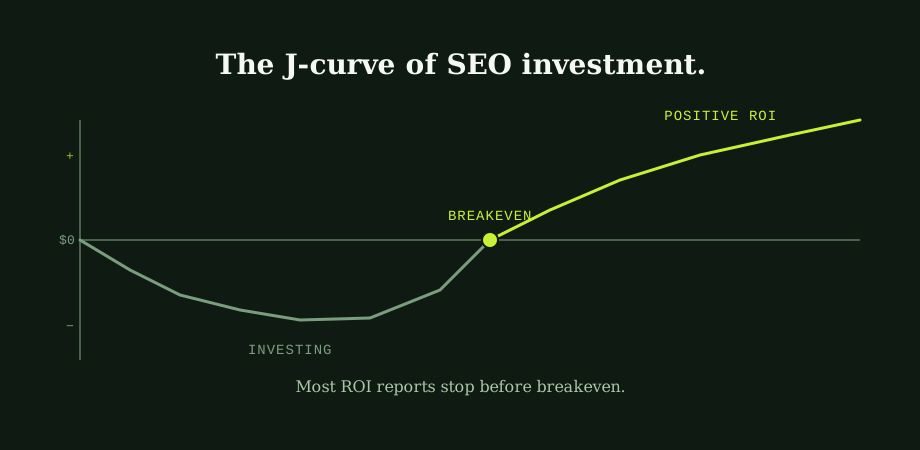
The first break is time. SEO investment in month one rarely produces measurable revenue until month six. The work all happens before the ranking signals consolidate. Writing content. Earning links. Fixing technical issues. Improving ranking. The classic shape is the J-curve in the hero image above. Cumulative investment goes deep into negative territory before any of it returns.
The second break is attribution. SEO contributes to buyer journeys across many touchpoints. Discovery research. Comparison queries. Brand-search after content. Product evaluation. Last-click attribution captures only the final touch. It misses most of these. Multi-touch attribution captures them. But it requires data and tooling most teams do not have.
The third break is the brand effect. SEO content that ranks well drives demand for branded search later. Someone reads your article on a long-tail query in March. They remember your brand in June. They search your brand name directly. They convert. The June conversion gets attributed to direct or branded traffic. Not to the March organic visit that planted the seed. The conversion is real. The attribution to SEO is structurally invisible.
These three together make a clean cost-to-revenue calculation almost impossible for SEO in short reporting windows. The realistic-timeline view that contextualises all of this sits in how long does SEO take.
The three calculation models
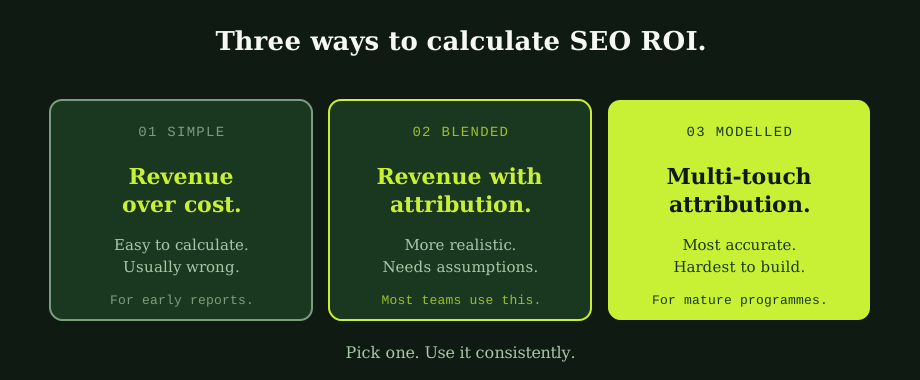
The three models and when each fits.
Simple ROI. Organic revenue from last-click attribution, divided by full SEO cost. The fastest calculation. The one most reports default to. It usually understates SEO ROI. Last-click misses the contribution to assisted and brand conversions. The simple model is acceptable in the first quarter of a programme. The team needs a number. The more sophisticated approaches require data not yet available. Calling it ROI without acknowledging the attribution model is misleading.
Blended ROI. A blended attribution model gives some credit to assisted conversions and to brand-search uplift. The calculation is organic revenue with attribution, divided by full SEO cost. The blended model requires an assumption. Typically: organic deserves the last-click revenue, plus a percentage of conversions where it appeared in the first three touchpoints, plus a portion of branded search uplift over a baseline. The assumption can be defended by showing the underlying data. Most mature SEO programmes use some version of this.
Modelled ROI. Multi-touch attribution applied properly. Brand lift studies. Control groups where possible. Explicit modelling of the lag effect. Most accurate. Rare in practice. It requires data infrastructure, statistical capability, and time most marketing teams cannot dedicate. The modelled approach is appropriate for mature programmes with enterprise-scale data and stakeholders sophisticated enough to evaluate the methodology.
The most common reporting mistake is using the simple model and presenting it with the confidence of the modelled one. Pick a model that fits your maturity level. Use it consistently. Switching models between reports produces ROI figures that move for methodology reasons rather than performance reasons.
The J-curve and the time-horizon problem
The hero image shows the structural problem in one line. Cumulative SEO investment goes deep into negative territory in the first six months. It reaches a low point around month four to six. Then it climbs back toward breakeven around month nine to twelve. From there, it continues into positive ROI.
The implications for reporting are large.
- Any ROI report run in the first six months will mathematically show negative ROI. The investment is in; the return has not yet arrived. Reporting "negative 60 per cent ROI" in month four is technically correct and substantively misleading.
- The shape of the curve, not the position on it, is the right Q1 metric. "Are we tracking against the expected J-curve" is a more honest framing than "what is our ROI today."
- Annual ROI averages mask the J-curve. Year one ROI may be negative because the curve has not bottomed; year two ROI is the first window where the calculation makes sense.
- The cumulative figure matters more than the periodic. Monthly ROI for SEO is mostly noise; quarterly is better; cumulative over the full programme lifetime is what actually answers the business question.
What to do before the data is in: report on leading indicators. Rankings. Impressions. Content production rate. These precede revenue impact. Be explicit that the lagging indicators are not yet readable. The leading-indicator framework sits underneath the wider view in which SEO metrics actually matter.
Common attribution traps
Patterns that produce ROI numbers that look defensible but actually mislead.
- Last-click attribution exclusively. The most common trap. SEO usually appears earlier in the journey than the conversion, and last-click misses everything before the final touch. Almost all SEO programmes are under-reported under pure last-click.
- Including branded search in organic revenue without separating it. Branded search conversions are largely demand that exists regardless of the SEO programme. Counting them in organic ROI overstates the SEO contribution. Strip branded queries out and report unbranded organic ROI separately.
- Inconsistent cost definitions between periods. Q1 ROI calculated with only agency fees, Q2 ROI calculated with full team costs included. The numbers cannot be compared. Lock the cost definition before the first report goes out.
- Ignoring organic-driven offline conversions. For B2B, much of the SEO impact lands as sales-qualified leads that close offline, weeks or months after the original organic visit. Reports that only count online conversions miss most of the value.
- Comparing SEO ROI to paid media ROI directly. The two channels work over different time horizons and produce different kinds of value. Direct comparison usually favours paid (it shows results faster) and obscures the compounding return SEO produces over time.
Each of these traps is fixable. Most require explicit stakeholder conversation before the methodology is locked. The traps come from misalignment. What the team can measure differs from what leadership thinks "ROI" should answer.
Building a defensible ROI report
A useful structure that holds up under scrutiny.
- State the methodology upfront. Which attribution model. Which cost definition. Which time window. Which baseline. The reader should know what they are looking at before they see any numbers.
- Show the inputs separately. Total organic revenue. Total SEO cost. The numerator and denominator of the calculation, with breakdowns. The reader should be able to recreate the ROI figure from the underlying data.
- Show the trend, not just the snapshot. Single-period ROI numbers are misleading because the J-curve is real. Show the rolling cumulative figure over at least four quarters.
- Include the leading indicators. Rankings, impressions, clicks, content production. These move before ROI moves and let leadership see whether the next-quarter ROI is likely to be up or down.
- Include the assumption sensitivity. If your attribution model gives organic credit for 40 per cent of assisted conversions, what does the ROI look like at 30 per cent and 50 per cent? This is the question sophisticated stakeholders will ask; pre-empt it.
- Connect to a decision. What does the report ask leadership to decide? Continue investing at the current level? Increase? Reduce? A report that does not connect to a decision rarely changes anything.
The closer the report's structure tracks how the underlying calculation actually works, the more defensible it is in follow-up conversations. The wider measurement framework that this sits inside lives in how to measure SEO content performance.
Common ROI reporting mistakes
The patterns to avoid.
- Reporting ROI before the J-curve has bottomed. In months one to six, the answer is "we are in the investment phase," not a forced ROI percentage. Pretending otherwise damages credibility when the negative figure inevitably appears.
- Changing methodology to make the number look better. Cherry-picked attribution windows or selective cost definitions get caught quickly. The team that gets caught loses years of credibility.
- Reporting a single ROI figure as if it were a precise number. SEO ROI calculations involve assumption-heavy attribution. The honest figure is a range, not a point. "Between 180 and 240 per cent depending on attribution assumption" is more defensible than "210 per cent."
- Ignoring the brand-search component. SEO that produces direct or branded conversions later is doing its job. Reports that exclude this attribution miss real value. Include it explicitly with the methodology shown.
- Not benchmarking against the alternative use of capital. The question is not whether SEO ROI is positive; it is whether SEO ROI is better than what the same budget would produce in paid search, content marketing without SEO, or other marketing channels. Comparative framing is what leadership actually wants.
The honest version of SEO ROI
SEO ROI is a long-window question with assumption-heavy answers. Any report that pretends otherwise is producing comfort, not truth. The honest version states the methodology. Shows the inputs. Accounts for the J-curve. Separates branded from unbranded organic. Presents the ROI as a range rather than a precise number. Reports built this way are harder to write and easier to defend. That is the trade most SEO teams should be making by their second year.
Our Bangkok SEO work with established clients includes the quarterly ROI report as a standard deliverable. It is built around the J-curve framing. The attribution model fits the client's data maturity. Our Bangkok SEO services include the Search Console and conversion-tracking set-up that makes any of this measurable. The deeper view of the GA4 side sits in how to set up conversion tracking in GA4. An SEO consultant in Bangkok can audit your existing ROI reporting and identify which of the common attribution traps are quietly distorting the numbers.
Common questions
How do you calculate SEO ROI?
The simple formula is (organic revenue minus SEO cost) divided by SEO cost, expressed as a percentage. The harder question is what counts in each input. Organic revenue requires deciding which conversions to attribute to organic search. SEO cost should include everything: team salaries, agency fees, content production, tools, and an allocation of overhead. Most ROI calculations either ignore part of the cost or use last-click attribution exclusively. A more realistic calculation uses blended attribution that gives organic search credit for both first-touch and assisted conversions, divided by the full cost of running the SEO programme.
Why is SEO ROI harder to measure than paid search ROI?
Paid search ROI is comparatively simple because spend is precise, attribution is largely direct, and the relationship between spend and traffic is immediate. SEO ROI is harder for three structural reasons. The first is the time lag: SEO investment in month one rarely produces measurable revenue until month six to twelve. The second is attribution: SEO contributes to the buyer journey across many touchpoints that last-click attribution does not capture. The third is the brand effect: SEO content that ranks well drives demand for branded search later, which gets attributed to direct or branded traffic instead of organic.
How long until SEO ROI is positive?
For most programmes, cumulative SEO investment turns positive somewhere between months nine and eighteen, with substantial variation by site age, industry competitiveness, and starting position. The cumulative spend dips into negative territory in the first six months while ranking signals are building, reaches its lowest point around month four to six, then climbs as rankings and traffic compound. The classic shape is a J-curve. The implication for reporting is significant: any ROI report run in the first six months will mathematically show negative ROI.
What metrics should an SEO ROI report include?
At minimum: cumulative SEO investment over the reporting period, organic traffic and conversion totals, the attribution model being used and its assumptions, the calculated ROI figure with the formula shown explicitly, and a comparison to the previous period using the same methodology. Useful additions include the ranking trajectory for target keywords, the impression and click trend in Search Console, the contribution of organic to assisted conversions, and a forward-looking section explaining what will change in the next quarter. The most credible reports show their work.
Reporting is only convincing when the baseline was recorded before the work started. Our case studies follow that format, with the tracked figures and the measurement caveats stated openly.