One question separates a useful metric from a useless one: would seeing this number change a decision? If the answer is no, it does not belong in your report, however nice it looks on a chart.
That single test cuts most SEO dashboards in half. Total impressions creep up. Total keywords ranked creep up. Sitewide average position creeps up. None of that tells you whether you should keep going, change tactics, or invest more.
The six metrics worth tracking
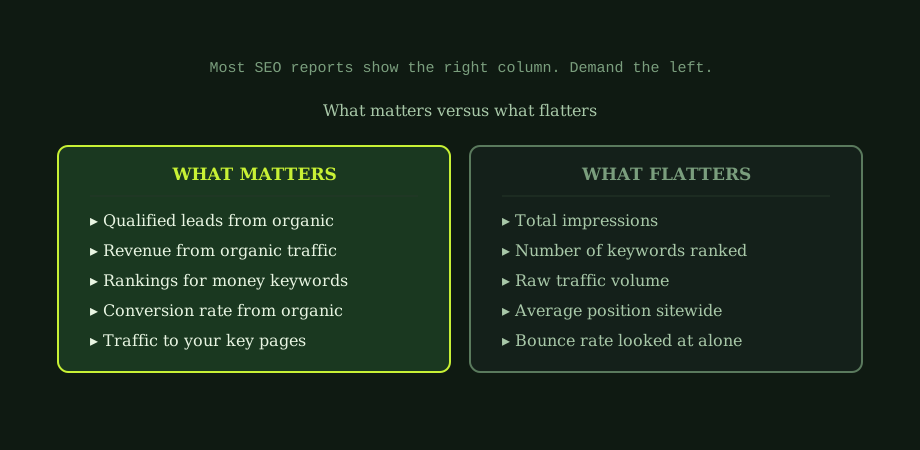
Build your monthly report around these six. They tell you what is working, what is not, and where to look next.
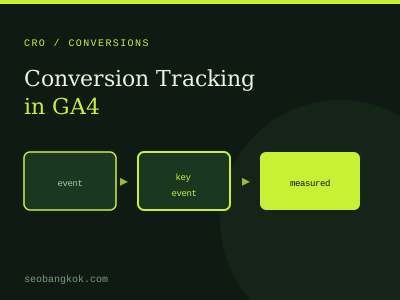
- Leads or sales from organic search. The number you build the rest around. Set it up properly in your GA4 installation and confirm it fires by following how to set up conversion tracking in GA4. If this number does not move, nothing else matters.
- Revenue from organic. If you can attribute it, this is the real goal. A campaign that grew traffic 40 percent but added no revenue is not winning.
- Rankings for money keywords. Not every term, just the 10 to 20 that bring actual buyers. These are the ones worth checking in detail.
- Conversion rate from organic traffic. Traffic quality, not just volume. A rising conversion rate means the visitors you are pulling in are the right ones.
- Traffic to your key pages. Not all traffic is equal. Watch the pages that actually drive enquiries or sales, not every page on the site.
- Coverage and errors in Search Console. The leading indicator. A spike in crawl errors or indexing issues lets you catch a problem before it shows up as lost traffic.

The vanity metrics to stop reporting
These are not useless data, but they should never be the headline. Each one looks like progress and almost always points the wrong way.
- Total impressions. Easy to grow by chasing low-value terms. Higher impressions on the wrong queries is a bigger pile of irrelevant traffic.
- Number of keywords ranked. A site can rank for thousands of terms and earn nothing if none of them are commercially useful.
- Raw traffic volume. Useful only if you know who is in it. A doubling of traffic that buys nothing is wasted hosting.
- Average position sitewide. Averaging position across thousands of terms hides what is going on. The handful that matter to your business can drop while the average rises.
- Bounce rate alone. A high bounce rate on a help article is fine. The content-specific cut of these principles lives in how to measure SEO content performance. A high bounce rate on a sales page is a problem. Looked at without context, the number tells you nothing.
How to read movement honestly
One month of data is rarely enough to draw a conclusion. SEO moves slowly and unevenly, so anything you decide on a single month of numbers will often be wrong. Look at three-month trends for slow metrics like rankings and revenue, and use month-on-month or week-on-week comparisons only for the fast ones, like indexing or a launch you are watching for problems.
And remember that small dips are not signals. A keyword wobbling between position 4 and 7 is noise. A keyword falling from 4 to 28 and staying there is a signal. Set the bar at "would this make me change something?" before you act.
Reports that do not answer those questions are the bigger problem. Knowing how to set realistic SEO targets first, and pairing them with a realistic view of SEO timelines, makes the numbers above easier to interpret.
What good reporting actually looks like
Stop reporting what flatters. Report what predicts. Six metrics, monthly, with a short narrative explaining what changed and why, is worth more than a 30-slide dashboard. The goal of an SEO report is not to look busy, it is to tell you what to do next. A monthly read-out from a serious SEO Bangkok team should leave you knowing exactly that.
Want reporting that is short, honest, and tied to real business numbers? That is how we work. Our SEO consultancy includes the measurement setup and the monthly read-out. An experienced SEO expert in Bangkok can review what you track today, strip out the noise, and rebuild a report you actually use.
Common questions
What is the most important SEO metric to track?
Leads or sales from organic search. Everything else is a means to that end. Impressions, rankings, and traffic are useful signals along the way, but they only have value when they translate into someone actually contacting you or buying. A site that ranks well and gets a lot of traffic but produces no enquiries has an SEO problem that no amount of more traffic will fix. Pick the action that represents real business value for you, set it up properly in your analytics, and put that number at the top of every report. If you only had one metric to look at, this is it.
Is traffic a good SEO metric?
Traffic on its own is a flattering metric, not a useful one. A site can double its traffic and earn the same revenue, because the new visitors arrived through queries that do not match what you sell. What matters is traffic to the pages that actually convert, from searches that match your buyers. Tracking total traffic encourages chasing volume; tracking traffic to key pages encourages chasing the right visitors. The same goes for keyword counts and impressions. They are easy numbers to grow and easy numbers to report, but growing them does not automatically grow the business.
Why do agencies report vanity metrics?
Because they are easy to grow and easy to show. Total keywords ranked, impressions, and traffic almost always trend up over time when any work is being done, even if none of it produces business results. So a report full of those numbers looks like progress regardless of whether the campaign is succeeding. The metrics that are harder to move, like leads, revenue, and rankings for genuinely competitive money keywords, are also the ones that prove whether the work is worth what you pay. A good provider centres the harder numbers and explains the easier ones as context.
How often should I check my SEO metrics?
Most metrics are best viewed monthly. SEO moves slowly enough that a daily check produces noise rather than information, and reacting to daily wobbles tends to make decisions worse. A monthly cadence shows the trend without the static. Two exceptions are worth a faster look: Search Console coverage and errors after a launch or a big change, where catching a problem within a few days saves real damage, and money-keyword positions during an active campaign, where a weekly glance helps you notice movement. The rule of thumb: if a metric would not change a decision this week, it does not need to be checked this week.
Metrics matter most when something moves unexpectedly. Diagnosing a traffic drop sets out how to read the change before acting on it.