Medical SEO is not really SEO with a healthcare topic. It is the layer that goes on top of a clinic that has already done the harder work. That harder work is genuine medical authority. Real doctor profiles. Visible accreditations. A track record patients can verify. Without those foundations, even excellent technical SEO will not move rankings for any query that matters. With them, the rest compounds.
Three things make medical SEO in Thailand its own thing.
YMYL changes the rules
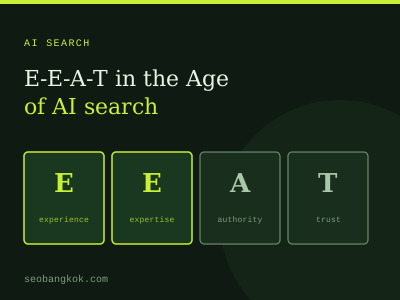
Google's quality raters work from a public manual. The financial-services sibling that completes the YMYL trio is in SEO for financial services in Thailand. It gives medical content its own pages of stricter criteria. Their job, and the algorithm that loosely models it, evaluates clinic sites against four signals: experience, expertise, authority, and trust. The phrase E-E-A-T gets thrown around in every SEO blog. For medical content it is not theoretical. A page about a knee replacement, written anonymously, with no medical reviewer named and no clinic accreditation visible, will not rank. The content depth does not save it. Quality raters are instructed to flag exactly that pattern.
The question for clinic SEO is not which keywords to target. The real question is whether the trust signals exist that let any keyword work.
Three audiences, three search behaviours
Thailand's medical sector serves audiences that search in fundamentally different ways.
International medical tourists arrive at clinic websites at the end of a long research process. Often three to nine months of comparing clinics. Watching procedure videos in English. Reading reviews on third-party platforms. Shortlisting quietly. By the time they enquire, the decision is mostly made. They search procedure terms, city names, and safety questions: "rhinoplasty Bangkok results", "is IVF in Thailand safe for foreigners", "best dental implant clinic Phuket reviews". The dental sub-vertical that overlaps with the medical-tourism layer here is unpacked in SEO for dental clinics in Thailand. The clinic that shows up across all those search types builds shortlist presence weeks before the enquiry lands.
Domestic Thai patients search in Thai, often with shorter buying cycles, and rely more on Google Maps results and Google Business Profile photos than on dedicated English-language content. The map pack matters more than the SERP. Reviews in Thai, posted recently, count more than older English reviews. A practical guide on the foundational mechanics sits in local SEO for Thailand businesses.
Expats living in Thailand sit somewhere between the two, searching mostly in English with a mix of clinical and convenience queries: "English-speaking dentist Sukhumvit", "GP Phuket near Patong", "fertility clinic Chiang Mai". They want the same trust signals as medical tourists but with a stronger emphasis on convenience and ongoing care.
A clinic that wins one of these audiences and ignores the other two is leaving most of its real addressable market behind.
The trust signals that actually move rankings
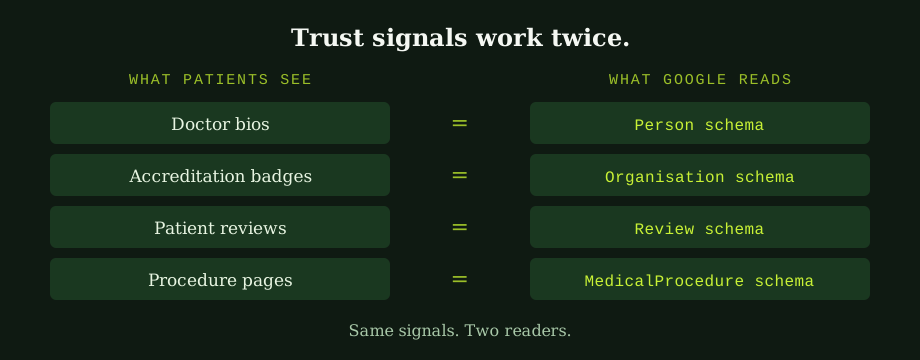
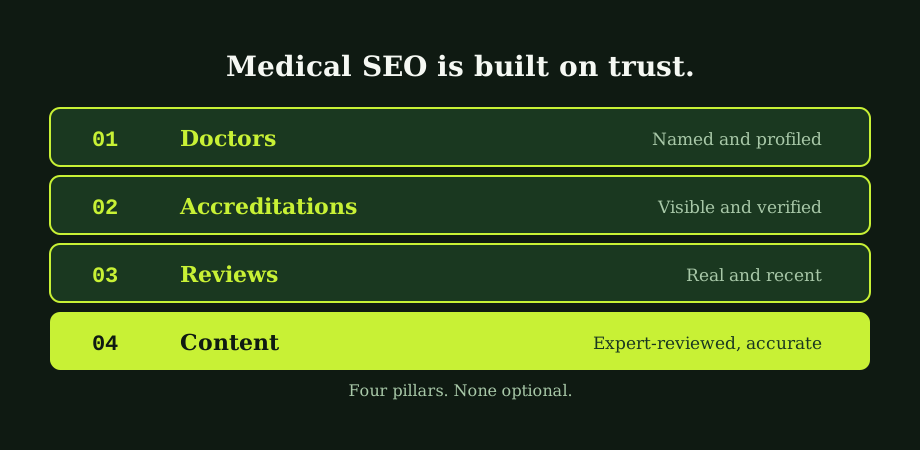
Every meaningful medical SEO signal does two jobs at once. It helps a human patient decide, and it tells Google the site is trustworthy. The same element serves both, when it is built properly.
Doctor profiles. Every doctor whose work appears on the site needs a full profile page. Name, photo, training history, board certifications, professional memberships, clear specialisation. The page becomes the canonical source for that doctor. It carries Person schema so Google reads the entity correctly. When the doctor writes or reviews any other page on the site, that page links back to the profile and identifies the author clearly. This single discipline lifts E-E-A-T more than any other tactic on most clinic sites.
Accreditations. JCI accreditation, Thai Medical Council registration, specialist board memberships, ISO certifications relevant to medical operations, hospital affiliations. These signals belong in the footer of every page, on the about page, and inside Organisation schema. Patients verify them at the point of decision, and Google reads them as proof points. The deeper background on the framework, particularly as AI search adopts its own version of it, sits in E-E-A-T in the age of AI search.
Real patient stories and reviews. Real, attributed, verifiable. Cosmetic procedure pages benefit from before-and-after photographs where regulation allows and consent is documented. Google Business Profile reviews, accumulated steadily over time and answered by the clinic, matter enormously for both the map pack and overall trust. Invented testimonials are the single biggest unforced error in medical SEO; quality raters are specifically instructed to penalise sites where reviews appear fabricated.
Expert-reviewed content. Every clinical page, every procedure guide, every FAQ should carry an author or medical reviewer credit. Last-updated dates should be real and recent. Citations should link to source material from medical journals, the Ministry of Public Health, the World Health Organization, or recognised medical associations. This is the most labour-intensive of the four pillars, and the one most often skipped.
The patient journey is long, and most clinics show up too late
Medical tourism patients run a long journey. The adjacent wellness vertical that shares the same tourism overlap is in SEO for spas and wellness in Thailand. Months of broad research in their own language. Weeks of clinic comparison. A few rounds of enquiry and consultation. Then a trip booking. Most clinic sites only target the bottom of that funnel. The result is predictable: a site that ranks for branded queries and very little else, while every research-stage search goes to international medical tourism portals.
The shift that wins is content for the early stages. Procedure explainers written for patients, not for doctors. Honest cost guides. Aftercare expectations. What recovery in Thailand looks like. Visa and travel logistics for procedure visits. Real before-and-after stories with real patients consenting to share. A clinic that publishes this kind of content properly, reviewed by named medical staff, becomes the answer to research queries months before any rival clinic ever shows up.
The principle behind the long buyer journey is universal; the Thai context for international patients sits in SEO for Thai businesses targeting foreign customers.
Multilingual is non-negotiable
English is the baseline, never the destination. Most serious Thai clinics serve patients in three or four language markets at once. The realistic minimum looks like this:
- English for the bulk of international medical tourism, expat residents, and increasingly the global research phase before patients commit to any clinic.
- Thai for domestic patients, who remain a larger share of revenue at most clinics than overseas operators sometimes assume.
- Chinese for the substantial mainland patient base across cosmetic, dental, fertility, and dermatology work.
- Arabic for the Middle Eastern patient segment, particularly strong in fertility, orthopaedics, and complex surgical care.
Each language version needs proper localisation. Not machine translation. And clean hreflang signals. Machine-translated medical content reads as fake to native speakers, and trust is the only thing the SEO programme is really selling.
Where clinic websites lose patients
Across the dozens of Thai clinic sites worth auditing, a small set of mistakes shows up repeatedly.
- Anonymous content. Procedure pages and blog posts written without a named author or medical reviewer. Quality raters flag this on sight. Fix the author attribution before anything else.
- Buried accreditations. JCI logos and board certifications tucked away on an obscure about page, instead of being a visible part of the global template. They should be in the footer of every page.
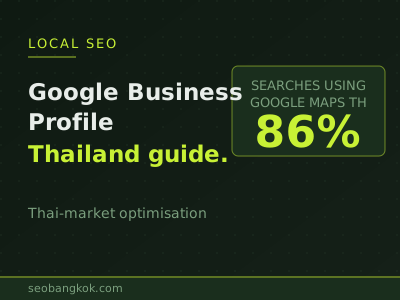
- Stale Google Business Profile. Old photos, infrequent posts, last review answered eighteen months ago. The map pack pays attention to recency, and so do patients. A practical playbook on this is in how to optimise Google Business Profile for Thailand.
- Auto-translated language versions. Particularly for Arabic, Chinese, and Korean, machine translation in medical contexts is dangerous and reads as such to native speakers. It also fails hreflang and ranks for nothing.
- Promotional tone on research-stage content. Hard-selling on pages that should be educational. Patients researching a procedure in their own time want answers, not sales copy. Trust evaporates fast when the tone tips into promotion.
Where to start
Order matters more than effort. Audit the trust signals first. No SEO investment compounds until E-E-A-T is in place. Name the doctors. Surface the accreditations. Build the medical reviewer credits. Set up the Person and Organisation schema. Then move to the long-tail research content patients actually search for. Then the multilingual layer. Trying to do all three at once, on a clinic site with none of the foundations in place, produces the same flat traffic curve every time.
Specialist healthcare SEO rewards a long programme over an aggressive short one. We plan and deliver it as part of our local SEO services in Thailand. The work combines the technical, trust, and multilingual layers into a single staged engagement. A short audit from an experienced SEO consultant in Thailand usually surfaces the two or three trust signals worth fixing first, before any keyword work begins. For clinics looking for the best SEO in Bangkok for healthcare specifically, the order is always the same: build the trust signals, then let the rest of the SEO programme work.
Common questions
What is YMYL and why does it matter for medical SEO?
YMYL stands for Your Money or Your Life, Google's category for content that can materially affect a reader's health, safety, finances, or legal standing. Medical content sits squarely inside it, alongside legal advice, financial guidance, and safety information. Google holds YMYL pages to a stricter quality standard than almost any other content type, and the assessment runs through its E-E-A-T framework: experience, expertise, authority, and trust. In practice this means a clinic site without named, qualified authors and visible accreditations will lose rankings to a clinic site that has both, even if the second site is technically worse on every other SEO factor.
How do medical clinics show E-E-A-T to Google?
Through a small number of consistent, repeated signals across the site. Doctors named on every page they wrote or reviewed, with full credentials, training history, and links to professional registries where they exist. Accreditations from bodies like JCI, the Thai Medical Council, or relevant board associations displayed prominently and confirmed in structured data. Patient stories sourced from real Google reviews, Google Business Profile, and platforms patients trust, never invented or rewritten. Content authored or reviewed by named medical professionals, with clear last-updated dates and citations to source material. Together these signals create a clear, machine-readable picture of a trustworthy medical operation.
How long does the medical patient journey take?
Months, in most cases, particularly for medical tourism. A patient considering significant procedure work in Thailand from overseas spends weeks to months reading guides, watching procedure videos, comparing clinics, reading reviews, and slowly narrowing a shortlist before reaching out to any clinic at all. The enquiry, once it lands, is usually followed by a video consultation, a quotation, more research, then often a second consultation before the trip is booked. The whole cycle, from first search to procedure date, frequently runs six to twelve months.
Should a Thai medical clinic translate its website?
Almost certainly yes, into the languages of its actual patient mix. English is the baseline for international medical tourism, but for many clinics in Thailand it is not sufficient on its own. Chinese is essential for the substantial mainland China patient base in cosmetic surgery, dermatology, IVF, and dental work. Arabic matters for the significant Middle Eastern medical-tourist audience in Bangkok, particularly for fertility and orthopaedic care. Each language version should be reviewed by a fluent speaker with medical literacy, and needs proper hreflang signals, its own URLs, and ideally its own localised content rather than a literal copy of the English original.