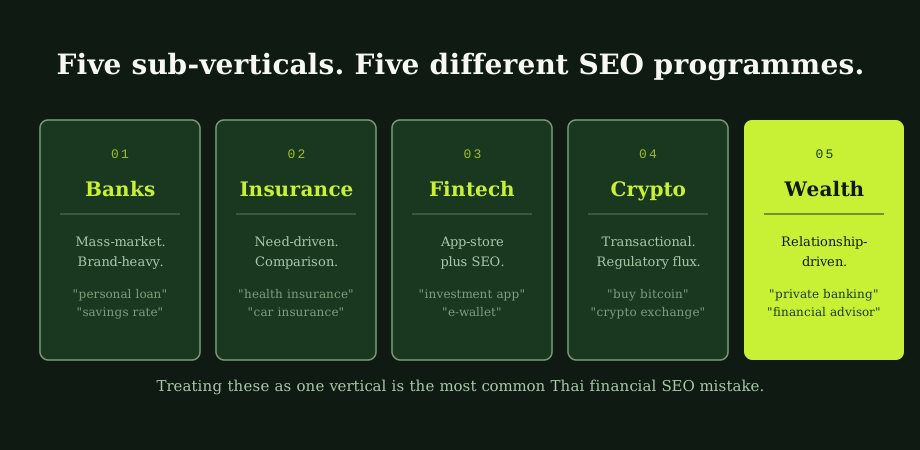
The most common Thai financial SEO mistake is treating the category as one vertical with one programme. Banks, insurance providers, fintech apps, crypto exchanges, and wealth advisors share regulatory pressure and YMYL framing but compete in essentially separate keyword markets with different buyer journeys, different trust signal requirements, and different production cycles. A programme that works for a bank rarely works for a crypto exchange and vice versa.
The five Thai financial sub-verticals
Each sub-vertical has its own keyword universe, its own competitive dynamic, and its own SEO programme structure.
Banks compete for mass-market brand-driven queries: "personal loan," "savings rate Thailand," "best current account," "home loan calculator." The competitive landscape is dominated by the five or six largest Thai banks (Bangkok Bank, Kasikornbank, SCB, Krungsri, BBL, TMB) whose brand authority compounds heavily on their domains. New entrants struggle to rank for primary banking keywords. The SEO programme that works for an established Thai bank centres on comprehensive product page coverage (every loan type, every account variant, every fee schedule), tools and calculators (mortgage calculators, savings projections), and Thai-language content depth. The local pack matters less than for service businesses because most banking research happens nationally, not locally.
Insurance competes for need-driven comparison queries: "health insurance Thailand," "car insurance comparison," "life insurance for expats," "travel insurance Thailand." The category is structurally favourable to comparison-style content (which generic content sites have learned to dominate), so Thai insurance brands compete against aggregators as much as against other brands. The SEO programme that works here centres on transparent product comparison content (the brand explains its own products honestly against alternatives), pricing tools and quote engines, and substantive content depth on insurance-specific concerns (claim processes, exclusions, what coverage actually means in practice).
Fintech apps compete for app-store visibility and search visibility simultaneously: "best investment app Thailand," "e-wallet Thailand," "stock trading app," "robo-advisor Thailand." The buyer journey runs through search to website to app store, and the SEO programme has to optimise for the full path including App Store Optimization (ASO) as an integral component. Fintech SEO is also unusually mobile-first; most fintech research happens on mobile devices because the product itself is mobile-first.
Crypto exchanges compete for transactional intent inside a regulatory environment that has shifted multiple times in recent years: "buy bitcoin Thailand," "Thai crypto exchange," "best crypto wallet," "Bitkub vs Zipmex." Thai crypto SEO carries the additional complication that the Thai SEC has moved between different regulatory frameworks for crypto promotion in recent years, which means content that was compliant when published can become non-compliant under updated guidance. Crypto SEO programmes have to include active regulatory monitoring as part of the content governance.
Wealth advisory and private banking compete for relationship-driven research queries: "private banking Thailand," "wealth management Thailand," "financial advisor Bangkok," "investment advisor Thailand." The buyer journey is much longer than for retail banking or insurance (often six to eighteen months from initial research to engagement), the search volumes are much lower, and the conversion criteria are heavily relationship-driven. Wealth SEO programmes look more like B2B technology SEO than like consumer banking SEO: deep thought-leadership content, named-author expertise, and trust signals built around credentials rather than rate comparisons.
The architectural implication: financial services brands that operate across multiple sub-verticals (a bank with insurance and wealth advisory products, for instance) need separated content tracks for each sub-vertical, not a unified programme.
The regulatory overlay above YMYL
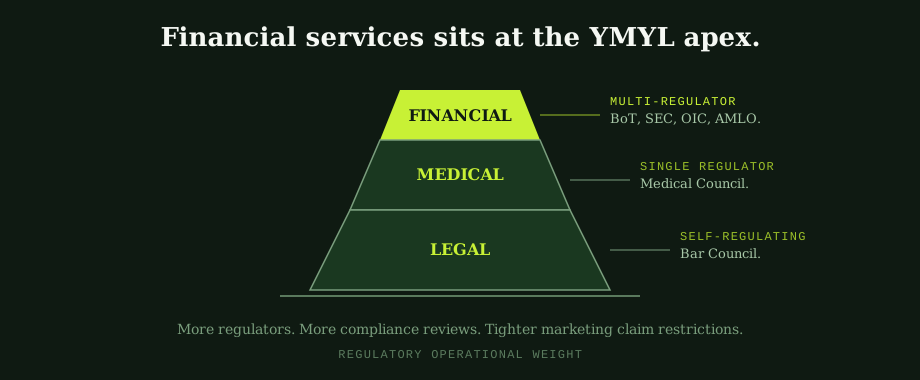
Standard YMYL content (medical, legal, financial) all requires elevated trust signals and editorial care. Financial services sits at the apex of the YMYL trio because the regulatory overlay adds operational complexity beyond what medical and legal content typically face. Four Thai regulators have direct authority over financial promotion.
The Bank of Thailand (BoT) regulates banking products. Marketing language for deposit products, lending products, and payment services has to comply with BoT guidance on representations of rates, fees, and product terms. The BoT has been increasingly active in policing misleading financial advertising in recent years.
The Securities and Exchange Commission (SEC) regulates investment products including mutual funds, securities, futures, and increasingly digital asset products. SEC-regulated content has the most restrictive claim rules in Thai financial marketing: forward-looking returns statements require specific disclosures, past performance claims require standardised disclaimers, and entire content categories (recommendations of specific securities, for instance) are restricted to licensed providers and licensed individuals.
The Office of Insurance Commission (OIC) regulates insurance products. Marketing language for life, health, motor, and general insurance products requires specific disclosure language, claim-payout representations need accuracy, and comparison content between products has rules around how comparisons can be made.
The Anti-Money Laundering Office (AMLO) intersects with financial promotion through KYC and AML compliance, particularly for fintech and crypto where customer onboarding processes are part of the marketing claims about ease and speed.
The practical SEO implication of this overlay is that financial content has to clear compliance review before publication. The wider E-E-A-T framework that financial YMYL content sits inside is in what is E-E-A-T and how does it affect rankings; the legal-vertical version of the YMYL trust signal stack that has overlap with financial is in SEO for law firms in Thailand.
Trust signals for Thai financial content
Four trust signal categories carry exceptional weight in Thai financial content.
Regulator licensing displayed prominently. BoT licence numbers for banks, SEC licence numbers for investment platforms, OIC numbers for insurance products, AMLO compliance statements where appropriate. The licences should be visible in the site footer (regulator-required for many product types anyway) and referenced explicitly on product pages where they support the trust signal. Sites that hide the licensing or display it only in legal small print undersell the strongest available trust signal.
Named senior executives with verifiable credentials. The firm's CFO, head of risk, head of compliance, head of investment, and head of customer protection should have biography pages with credentials (CFA, CPA, banking certifications, securities licences), academic background, years of experience, and professional photos. Financial content authored by named senior executives carries weight that anonymous "by our editorial team" content cannot replicate.
Third-party audits and certifications. ISO 27001 for security, SOC 2 for service organisations, external audit firm relationships (PwC, KPMG, Deloitte, EY relationships are credibility signals), and industry awards from credible bodies (Asian Banker, Euromoney). These third-party validations matter because users cannot evaluate financial expertise directly; they evaluate proxies for it.
Transparent product disclosures. Fee schedules visible, not buried in terms-and-conditions PDFs. Risk warnings written for understanding rather than for legal protection alone. Product terms that explain what users actually need to know. Transparency at this level builds trust independent of the underlying product quality.
The compliance review cycle and content production
Compliance review is the single biggest operational difference between financial SEO and SEO for less-regulated industries. A typical Thai business can publish a blog post within a day of writing it. A Thai bank, insurance provider, or investment platform has to route every piece of content through legal and compliance review before publication, which adds three to fifteen business days to each piece of content depending on firm policy and content type.
The implication for content production. A reactive content programme (responding to news, market moves, competitor launches) is structurally impossible for compliance-regulated content because the review cycle is longer than the news cycle. Financial content has to be planned weeks in advance with a queue of pieces in different stages of writing and review. The pipeline needs more pieces in production than for unregulated content because some pieces will be delayed by compliance review. The brief has to anticipate compliance concerns upfront (what claims need substantiation, what disclaimers will be required, what wording the firm's compliance team consistently rewords) so that initial drafts are reviewable rather than requiring full rewrites.
Firms that design their compliance review process around fast turnaround (clear briefs, internal style guides, pre-approved language libraries, dedicated reviewer time) can shrink the average cycle meaningfully. Firms that treat compliance review as an afterthought spend twice as long getting content to publication and lose to competitors with similar product but better operational discipline.
Local versus international audiences
Thai financial services SEO splits across audiences differently than other Thai verticals. The audience structure varies by sub-vertical.
Retail banking and insurance are overwhelmingly local Thai audiences. The customers are Thai residents banking with Thai banks in Thai baht. English-language content is useful for the expat segment (which is meaningful for some banks) but the primary search audience is Thai-language. The Thai market dynamics that this rests on are documented in Google's market share in Thailand.
Fintech has a more mixed audience. Some Thai fintech apps target Thai consumers primarily; others target expats or regional Southeast Asian users. The SEO programme has to identify the actual target audience and not over-invest in audiences that do not convert.
Crypto historically had a more international audience (English-speaking Thai users and expats overlapping) though the audience has trended more Thai as crypto adoption broadens domestically.
Wealth advisory and private banking often serves both Thai high-net-worth individuals and foreign-resident or expat HNWIs. The audience is high-value and small in volume; the content programme has to address both groups with bilingual content where appropriate. The bilingual SEO framing is in Thai and English SEO: should you target both languages.
Conversion paths for financial services
The conversion paths for financial services differ from other consumer verticals in two important ways. First, the buyer journey is longer (typical financial decisions take weeks to months of research). Second, the conversion criteria are heavily trust-driven; perceived security and credibility matters more than for almost any other consumer purchase.
The conversion path elements that work consistently. Multiple consultation booking options (in-person, video, phone, LINE, email) rather than single-channel commitment. Long-form trust-building content alongside conversion-focused product pages. Clear application processes with realistic timelines stated upfront. KYC and onboarding pages that explain what documentation will be needed rather than treating onboarding as a black box. Calculators and tools that allow users to model their specific situation. The wider conversion framing for Thai market specifically is in conversion rate optimization in Thailand.
Common mistakes in Thai financial SEO
- Treating financial services as one vertical. Banks, insurance, fintech, crypto, and wealth all need different programmes; a one-size-fits-all approach fails everywhere.
- Hiding regulator licensing. Licences are the strongest available trust signal and should be displayed prominently, not buried.
- Anonymous content. "By our editorial team" content cannot establish the E-E-A-T that named senior executive authorship provides.
- Compliance review treated as a publishing roadblock. The review cycle has to be designed into the content production process, not bolted on at the end.
- Generic risk warnings. Boilerplate risk language that has nothing to do with the specific product reads as legal CYA rather than genuine disclosure.
- Opaque pricing. Hidden fees behind "contact us" pages lose conversions; transparent fee schedules build trust.
- Ignoring app-store SEO for fintech. The buyer journey for fintech runs through both search and app-store discovery; programmes that optimise only one underperform.
- Crypto content that does not track regulatory updates. The Thai SEC has shifted crypto guidance multiple times; static crypto content can become non-compliant under updates.
The honest version of financial services SEO in Thailand
Thai financial services SEO done well integrates a compliance-aware content production cycle with deep sub-vertical-specific content and exceptional trust signals. The work compounds slowly compared to less-regulated industries because the review cycles slow individual pieces, but the competitive dynamics also favour patient operators because the same regulations that slow your content slow competitor content. Firms that build their operational machinery around the regulatory reality (rather than treating compliance as friction) often outperform competitors with similar products but worse content operations.
Our work with Thai financial services clients spans the multi-regulator content review reality and the sub-vertical-specific SEO programme structure. The wider Thailand SEO company services include compliance-aware content operations as a standard component of financial-sector engagements. For brands wanting integrated digital marketing rather than SEO alone (often the right shape for fintech specifically), our digital agency Bangkok structure covers the broader programme. A short discovery conversation with our SEO marketing experts usually identifies which sub-vertical and which content production tempo fits the business in front of us.
Common questions
What makes financial services SEO different from other YMYL verticals?
Financial services SEO carries the heaviest regulatory overlay of any YMYL vertical. The marketing claims that legal and medical content can make with appropriate disclaimers are much more restricted in financial content because multiple Thai regulators (Bank of Thailand, the Securities and Exchange Commission, the Office of Insurance Commission, the Anti-Money Laundering Office) all have authority over different aspects of financial promotion.
How many sub-verticals does Thai financial services SEO cover?
Five distinct sub-verticals each need different SEO programmes. Banks compete for mass-market brand-driven queries. Insurance competes for need-driven comparison queries with transparent benefits comparison and pricing tools. Fintech apps compete for combined app-store and search visibility. Crypto exchanges compete for transactional intent inside a shifting regulatory environment. Wealth advisory competes for relationship-driven research where content depth and trust signals matter more than volume.
What trust signals matter most for Thai financial SEO?
Four signal categories carry exceptional weight. Regulator licensing displayed prominently (BoT, SEC, OIC, AMLO references). Named senior executives with verifiable credentials and biography pages. Third-party audits and certifications (ISO standards, SOC certifications, external audit relationships). Transparent product disclosures including fee schedules and plain-language risk warnings.
How does compliance review affect financial SEO content production?
The compliance review cycle structurally changes content production. A Thai financial services business has to route content through legal and compliance review before publication, which adds three to fifteen business days. Content cannot be produced reactively in response to news cycles. The production cadence has to be planned weeks in advance, the review queue managed actively, and the content pipeline structured to keep work flowing while individual pieces are in review.