Most dental SEO advice on the open web is written for North American or European single-market dentists where the audience is local, the procedures are routine, and the trust signals are built on standard medical credentials. Thai dental SEO needs to layer additional considerations on top of that foundation: a meaningful international audience, procedure-specific content depth that explains both the medical work and the travel logistics, before-and-after photography handled at a level above the typical local-clinic norm, and pricing transparency that converts the cost differential from rumour into verified expectation. The clinics that get all of these right capture an outsized share of the dental tourism market; the clinics that ship typical local-clinic SEO from a template miss it.
The two audiences for a Thai dental clinic
Most Thai dental clinics of any meaningful scale serve two distinct audiences whose research behaviour and decision criteria differ substantially.
Local Thai patients typically search for general dentistry in their area: cleanings, fillings, root canals, basic restorative work. The search behaviour mirrors the broader Thai consumer pattern documented in Google's market share in Thailand: nearly all searches happen on Google, the local pack drives most discovery, and bookings often complete via LINE chat rather than on the website. Local Thai patients are price-conscious but already inside the Thai pricing structure, so the relative-savings framing that dominates international content does not matter as much. The conversion path is short and local-SEO-driven.
International dental tourism patients search from their home country (Australia, UK, US, Singapore, Hong Kong, Middle East) months before booking. The procedures they search for are concentrated in higher-cost work where the savings absolute value is largest: dental implants, all-on-four full-arch restorations, significant veneer work, full-mouth restorations, and cosmetic dentistry. The decision involves cost comparison, clinic credentials review, before-and-after photo verification, and often a video consultation before commitment. The international patient SEO programme is structurally closer to a luxury hospitality SEO programme than to a typical dental clinic programme.
The architectural implication: the website has to serve both audiences without diluting either. Most Thai dental clinics try to do this with a single bilingual site and most do it badly because the trust-signal balance and content depth needs differ between the two audiences. The cleaner pattern is to structure the site as one domain with two clearly differentiated content tracks. The bilingual SEO framing that this rests on is in Thai and English SEO: should you target both languages.
What makes dental SEO different from general medical SEO
The shared YMYL foundation between dental and general medical SEO is real (verified credentials, identifiable practitioners, clear specialties, transparent fees, appropriate medical disclaimers), but three specific factors make dental work distinct.
Procedure-specific search is dominant. Dental search behaviour is structured around discrete procedures more than general medical search. Patients search for "veneers cost," "dental implants Thailand," "all on four near me," "teeth whitening Bangkok" rather than for general practitioners. The clinic site needs a procedure-by-procedure content structure with each major procedure given dedicated depth: 1,500 to 3,000 words per major procedure page covering what the procedure involves, who needs it, expected timelines, before-and-after examples, pricing, FAQ on common concerns, and the dentists who perform it. Clinics that ship general "our services" pages with 200 words per procedure cannot rank against clinics that ship procedure-depth content.
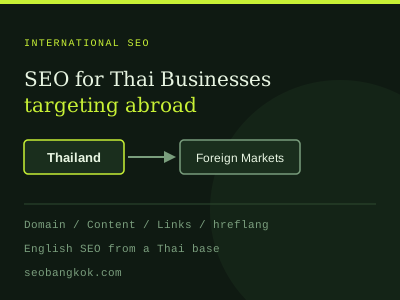
International search shifts the keyword landscape. Local Thai patients search in Thai for general procedures. International patients search in English for specific procedures plus destination ("dental implants Thailand," "veneers Bangkok price," "all on four cost in Thailand"). The two keyword landscapes barely overlap. A clinic targeting both audiences needs parallel content tracks, not translated content. The wider context of Thai businesses serving international audiences is in SEO for Thai businesses targeting foreign customers.
Visual content carries more weight. Dental work has highly visible outcomes (smile, alignment, colour, restoration shape) that patients can evaluate from photos in a way that general medical work cannot be evaluated. Before-and-after photo galleries are not just trust signals but a primary content type that patients consume directly. The SEO implication: image optimisation, photo schema markup, video walkthroughs, and visual content programming all carry more weight in dental SEO than in most clinical verticals.
The four reasons that belong in the content
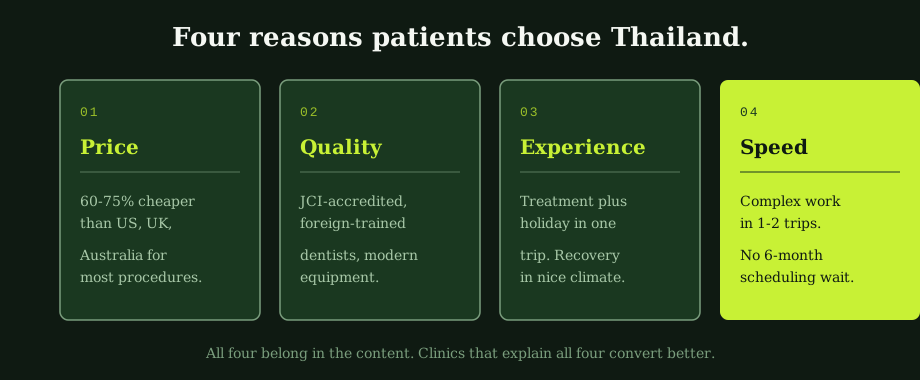
The "why Thailand for dental work" question is the implicit subtext of every international patient's research. Clinics that answer it explicitly in their content convert better than clinics that leave the question hanging or address only one dimension.
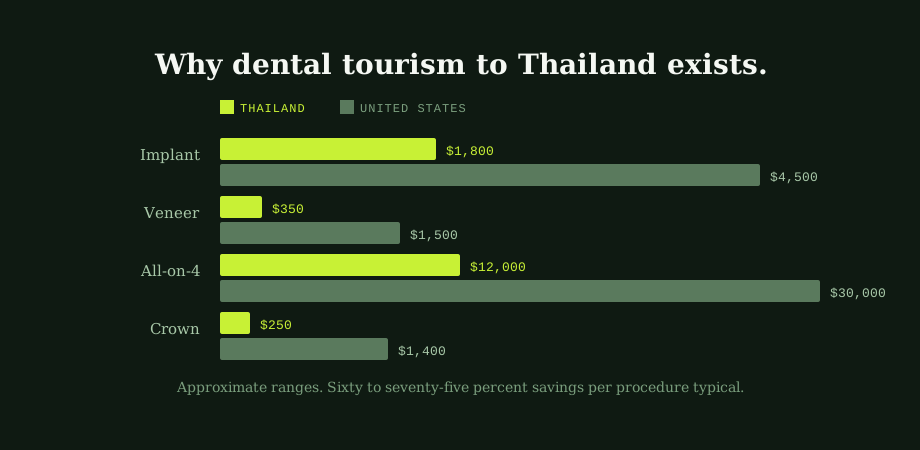
Price. The cost differential is the headline reason patients consider Thailand but it cannot be the only argument or it implies that Thailand is the cheap option rather than the right option. Procedure pricing displayed transparently (with appropriate caveats about case-specific variation) converts better than "contact us for pricing." The fee-transparency principle that applies to legal services in the same way also applies here: clinics that publish pricing ranges outconvert clinics that keep them opaque.
Quality. The price argument falls apart without a parallel quality argument. The trust signals that build the quality case: JCI accreditation (where the clinic has it), foreign-trained dentists (US-trained, UK-trained, Australian-trained dentists are particularly persuasive to those source markets), modern equipment specifically named (CBCT 3D imaging, digital impressions, in-house lab capability), and clinic accreditations from the relevant Thai medical bodies. The wider YMYL trust signal framework that this rests on is in what is E-E-A-T and how does it affect rankings.
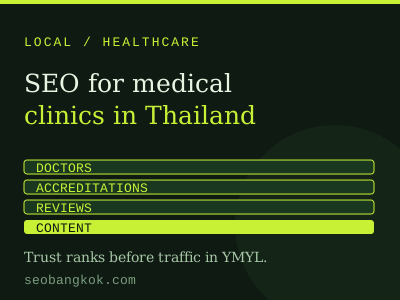
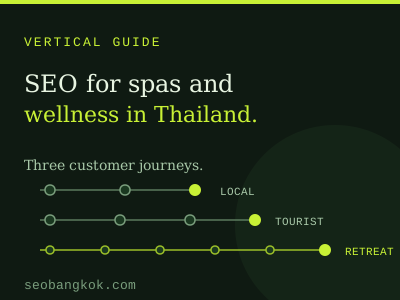
Experience. Combining treatment with a holiday is part of why dental tourism exists rather than just medical care. The content can lean into this honestly: recovery in a pleasant climate, accommodation partnerships, recovery itineraries, the cultural side of being in Thailand for a week or two. The vertical overlap with general medical and wellness tourism is in SEO for medical clinics in Thailand and SEO for spas and wellness in Thailand.
Speed. The reason most patients underweight initially but appreciate after research: dental work that takes six months to schedule in their home country can be completed in one or two trips to Thailand because the clinics have more capacity, more equipment, and less institutional friction. For working professionals weighing the cost of multiple appointments and the time off work involved, the speed dimension can be the deciding factor independent of price.
Before-and-after photography handled correctly
Before-and-after photography is one of the highest-converting trust signals in dental SEO and one of the easiest to do badly. The patterns that work versus the patterns that backfire matter enough to address directly.
The patterns that work. Same-lighting and same-angle pairs (different lighting between before and after reads as misleading), patient consent and disclaimers visible (each gallery set should include a brief consent note and a statement that results vary by case), explicit procedure names attached to each set (veneers, implants, full-mouth restoration), dates of the work where possible (recent work is more credible than undated archives), and the dentist named who performed the work. Schema markup using ImageObject and MedicalProcedure helps search engines understand the content type. The page-speed implications of large image sets specifically are in how page speed affects both your SEO rankings and your conversion rate.
The patterns that backfire. Stock images of unrelated patients used as illustrative (read as misleading and damage trust badly). Heavily processed images where the after photo is brightened, whitened, or smoothed beyond what the procedure produced (sophisticated patients identify this and discount the entire site). Photos used across competitor sites (a reverse-image search reveals shared stock, which destroys credibility in a single click). Galleries with only flattering cases and no honest moderate-improvement examples (patients identify cherry-picking and discount the implicit promise).
International source market SEO
The international audience side of dental tourism SEO requires source-market work that local-only clinics do not need. Three layers matter.
Content written for the source market's reading level and concerns matters first. Australian patients researching dental implants in Thailand have different anxieties than British patients (Australian patients tend to focus on dentist credentials, British patients on regulatory differences, American patients on cost-quality trade-offs). The content can address all three but ideally with named-source content that respects each audience's perspective.
Technical international SEO is the second layer. Correct hreflang implementation across English variants where appropriate (en-AU, en-GB, en-US can target source markets if the content differentiation justifies it). Server location and CDN choices that produce fast load times from major source markets. Page-speed optimisation specifically for international visitors, where the latency component compounds with bandwidth limitations. The wider technical foundation is in our international SEO services for clinics taking the cross-border audience seriously.
Link earning from source markets is the third layer. Australian dental forums, British expat publications, US dental tourism aggregator sites, and consumer-protection-style review platforms all influence the source-market perception of Thai dental clinics. A clinic that earns positive mentions across these surfaces builds the off-site trust signals that the on-site content alone cannot establish.
Local SEO for the Thai-patient side
The local-Thai-patient side of the practice runs on the standard Thai local SEO foundations. Google Business Profile as the primary discovery surface, accurate categories, local pack-targeted reviews, Thai-language content for the procedures most relevant to local patients, and NAP-consistent citations across the major Thai directories. The local SEO foundation for any Thai business of this type sits on our Thai-market local SEO services; the GBP-specific work is in how to optimise Google Business Profile in Thailand.
The cross-traffic between the two audiences is smaller than clinics often assume. A Thai patient searching for cleaning rarely converts on the same content that wins an international implant patient. The architecture has to keep the audiences separated for ranking purposes while still presenting a unified brand.
Common mistakes in Thai dental SEO
- One bilingual site that serves neither audience well. The Thai content and the English content need to be parallel tracks built for each audience, not the same content translated twice.
- Thin procedure pages. The 200-word "we offer dental implants" page cannot rank against a 2,500-word procedure-specific page.
- No before-and-after gallery, or a gallery with stock or borrowed images. Both fail. Real photography of real patients (with consent) is the only acceptable approach.
- Opaque pricing. "Contact us for pricing" on a dental tourism site loses the international audience that came specifically to evaluate cost.
- Unnamed dentists. Dental tourism patients want to know who specifically will perform their procedure. Anonymous "our team" content fails.
- No JCI or accreditation badges. Source-market patients look for these signals and clinics that have them but do not display them prominently undersell themselves.
- Ignoring third-party platforms. Dental tourism aggregator sites, Trustpilot, dental review platforms in source markets all influence perception. A clinic absent from these surfaces loses share to clinics present on them.
- Slow international load speeds. A Thai-hosted site with no CDN delivers poorly to source-market visitors and the conversion penalty is real.
The honest version of dental SEO in Thailand
Thai dental clinic SEO done well integrates four workstreams: deep procedure-specific content for both audiences, before-and-after photography handled at a level above the local-clinic norm, YMYL trust signals across credentials and accreditations, and international source-market SEO for the dental tourism audience. Each workstream takes one to two quarters to ship properly, and the foundation has to exist before the source-market work can compound. Clinics that try to short-circuit the foundation (running paid ads to a thin site, or building source-market backlinks before fixing the on-site content) typically waste budget without producing the dental tourism volume they expected.
Our work with Thai dental clinics targeting the international audience typically begins with the procedure-content depth and the YMYL trust signal layer, then layers the international source-market SEO on top once the foundation is rank-worthy. The international layer specifically runs through our international SEO services; the local-side runs through standard Thai-market work. The combined positioning for medical-vertical clinics sits on the Thailand SEO company overview. A short discovery conversation with our SEO marketing experts usually identifies whether the local-Thai or international-tourism side should be prioritised first based on the clinic's existing patient mix.
Common questions
Is dental SEO different from general medical clinic SEO?
Yes, in three meaningful ways. Dental tourism is a much larger international category than general medical tourism, so international search carries more weight. Dental procedures are more searchable as discrete categories (veneers, implants, all-on-four, crowns) which produces a content structure built around procedures rather than departments. Before-and-after photography is more central to dental marketing than to most medical work, which raises the visual content requirements significantly.
What does dental tourism look like as an SEO opportunity?
Thailand is one of the top three dental tourism destinations globally alongside Mexico and Hungary. International patients come primarily from Australia, the United Kingdom, the United States, and increasingly from Singapore, Hong Kong, and the Middle East. The procedure mix is heavily weighted toward high-cost work where the savings absolute value is largest: full-mouth restorations, all-on-four, implants, and significant veneer work. The search volume for procedure-plus-location queries is meaningful and the commercial intent is high.
How should a Thai dental clinic handle before-and-after photos in SEO?
Clear before-and-after pairs with the same lighting and angle (heavily processed images read as misleading), patient consent and disclaimers visible, explicit treatment names attached to each photo set, and dates that indicate freshness. Schema markup for the photo galleries helps Google understand the content type. Stock images of unrelated patients used as illustrative is misleading and damages trust badly; the correct approach is to invest in real photography of consenting patients.
What is the most important ranking factor for clinics targeting international patients?
The combination of procedure-specific content depth and international-source-market signals matters most. International patients evaluate clinics based on detailed treatment information rather than general clinic information. A clinic with deep procedure-by-procedure content (each major procedure given a 1,500 to 3,000 word dedicated page covering the procedure, the dentist credentials, expected timelines, before-and-after examples, pricing transparency, and FAQ on common concerns) outranks clinics with general about-us pages even when the underlying medical practice is identical.