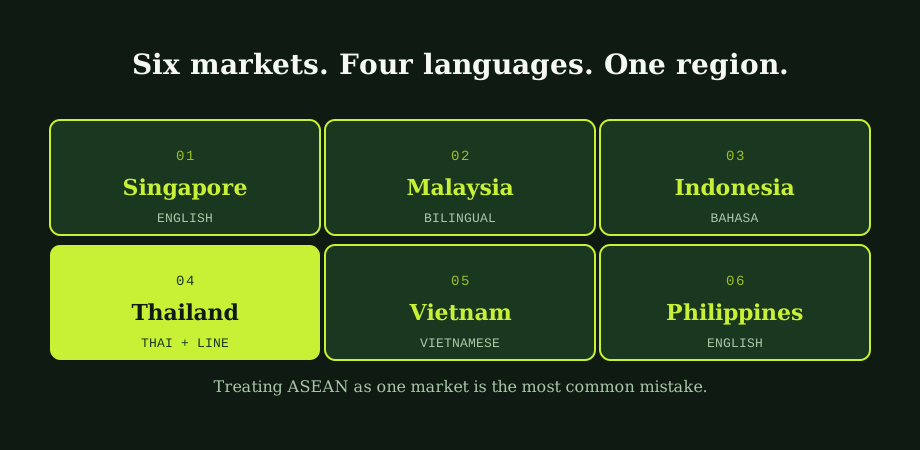
The opportunity that Southeast Asia represents for SEO is genuine. The region has roughly 670 million people. It is the world's seventh-largest combined economy. Digital adoption rates have outpaced most of the developed world over the last decade. The mistake most brands make is treating that opportunity as one thing. It is six related but distinct things.
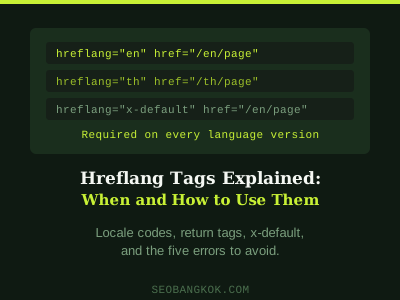
This piece is about the country-by-country reality and the strategic patterns that work across it. The technical-architecture side of multi-country SEO (hreflang, ccTLDs, subdirectories) lives in hreflang tags explained. This one focuses on the strategy.
Why "Southeast Asia SEO" is a misleading framing
The SERPs do not work at the regional level. Google serves country-specific results. They are based on the searcher's location, language, and device. The results differ enough that a single regional SEO programme rarely ranks in all the countries it targets.
A Bangkok-based brand that publishes English-language content for "Southeast Asia luxury travel" tends to lose. The brands that win publish Thai-language content for Thai luxury travel. Bahasa content for Indonesian luxury travel. Vietnamese content for Vietnamese luxury travel. The regional framing produces content that is generic by definition. Generic content competes against larger sites that do generic well.
The framing that works is "which one or two of these markets do we target first, and how do we win them decisively before expanding." The framing that does not work is "ASEAN expansion."
The six markets, briefly
Each market has its own character. The operational playbook for executing that strategy phase by phase is in how to build an SEO strategy for ASEAN expansion. Quick orientation across the major six.
Singapore. English-language, Google-dominant, high digital maturity. SERPs look similar to US and UK English-market SERPs. Commercial intent on most queries is somewhat lower because the market is small. Singapore search behaviour resembles a sophisticated English-speaking developed market. The barrier to entry is competition. Not language. For B2B and English-speaking consumer brands, this is often the right first ASEAN market. Low translation cost. The country is a regional business hub.
Malaysia. Bilingual SERPs with Malay (Bahasa Malaysia) and English mixed. Many queries return both Malay and English results in the top ten. Which language depends on the searcher. Content programmes need to choose a language focus. Trying to cover both equally rarely works. Most successful programmes pick English for B2B and Malay for consumer. The country-level patterns are softer than the others.
Indonesia. Bahasa Indonesia. Mobile-first to a degree most Western markets are not. By far the largest population in the region. The opportunity is large. SEO competition for Bahasa-language commercial keywords is comparatively underdeveloped relative to the market size. For consumer brands and e-commerce, Indonesia is usually the highest-volume opportunity in ASEAN.
Thailand. The Thailand-specific market-share data that grounds this is in Google's market share in Thailand. Thai language. Google-dominant for search. But unique local platforms matter for the wider digital programme. LINE Official Accounts for customer messaging. Pantip for community discussions that often rank in Thai SERPs. Shopee and Lazada for e-commerce that compete for many product queries. Thailand SEO is Thai-language content plus platform-specific presence on LINE and Pantip.
Vietnam. Vietnamese-language SERPs. Google sits around 85 to 95 per cent share depending on year. Coc Coc holds 5 to 15 per cent. Coc Coc is a Chromium-based browser with its own search engine. Serious Vietnam SEO programmes need to consider both. The Vietnamese e-commerce and content markets have grown extremely fast over the last five years. SEO competition is still maturing.
The Philippines. English and Tagalog mixed in SERPs. English dominant for most commercial queries. Mobile-heavy market with high social-media engagement. Many queries originate from Facebook content. For English-language B2C content, the Philippines is one of the easier ASEAN markets to enter. Competition is moderate. Translation costs are low.
What's actually similar across the region
For the parts that do hold across the markets.
- Google's mechanics are the same. Crawling, indexing, ranking algorithms, Core Web Vitals, structured data, all work identically across the markets. The technical SEO foundation is the same in every country.
- Mobile dominates everywhere. Mobile-first indexing applies across the region. In Indonesia, the Philippines, and Vietnam particularly, mobile share of search is dramatically above the global average.
- YouTube is universally important. Across all six markets, YouTube is the second-largest search engine and an outsized share of buyer research happens there.
- Local platforms matter for buyer journeys. LINE in Thailand, Lazada and Shopee region-wide, Tokopedia in Indonesia, Coc Coc in Vietnam, GoTo in Indonesia. Most buyer journeys touch these platforms even when the final transaction happens elsewhere.
- Voice search adoption is growing fast. Particularly in Indonesia and Vietnam, voice search use rates exceed most Western markets and shape how content needs to be written for conversational queries.
The universal mechanics are the floor. Everyone competing in the region has to get them right. Differentiation happens above the floor, in country-specific work.
What's actually different
The differences that matter for strategy.
- Language. Four primary languages across six countries. Bahasa Indonesia and Bahasa Malaysia are close but not identical; Thai, Vietnamese, and Tagalog are distinct from anything else in the region. English ranges from dominant (Singapore, Philippines) to professional-only (Indonesia, Thailand).
- Search platforms. Google dominates almost everywhere; Coc Coc in Vietnam is the exception. YouTube ranks for query types differently in different countries. TikTok-as-search-engine is increasingly meaningful for younger demographics across the region.
- Content expectations. What length, tone, and format performs varies dramatically. Thai SERPs reward shorter, more conversational content for most consumer queries. Indonesian SERPs reward listicles and explainers. Vietnamese SERPs reward in-depth comparison content. Singapore SERPs reward content closer to US/UK norms.
- Trust signals. Local-domain authority, named local authors, country-specific case studies, and ccTLDs (.sg, .id, .vn, .ph, .com.my, .co.th) all influence ranking in different proportions across the markets.
- E-commerce platform dominance. Shopee leads in most markets; Lazada in others; country-specific platforms exist alongside the regionals. For commercial keywords, the platform mix on the SERP varies by country.
Three ASEAN expansion strategies
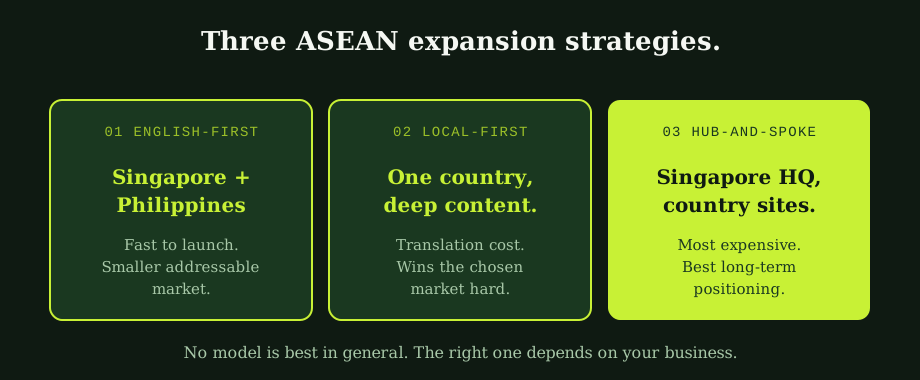
English-first. Focus on Singapore and the Philippines. English-language content carries most of the work. Lowest translation investment. Fastest time-to-launch. Smaller combined addressable market. The right choice for B2B SaaS and English-language services. Particularly in the first six to twelve months of regional expansion.
Local-first. Pick one non-English market: Thailand, Indonesia, or Vietnam. Invest deeply in local-language content for that one country. Higher translation cost. Longer time-to-results. Produces a defensible market position when done well. The right choice for consumer brands targeting one large market. Also for companies headquartered in or near the target country.
Hub-and-spoke. Singapore (or similar) as the regional content hub. Country-specific subsidiary sites for each major market. Highest investment. Longest timeline. Best long-term positioning. The right choice for mature programmes. Demand already validated in multiple markets. Country-level localisation needed to compete.
The Bangkok-based SaaS context where this strategic choice plays out concretely sits in SEO for IT and SaaS businesses in Bangkok, which treats the ASEAN opportunity as one of the three positioning options for Thai-based SaaS specifically.
Which market to enter first
The decision tree that works for most companies.
- What language do you currently sell in? If English-only, start with Singapore or the Philippines. If you sell in Thai already, Vietnam and the Philippines are the natural next markets (Thai SEO experience translates partially). If you have Bahasa capability, Indonesia is the obvious priority.
- What does your business model need? B2B SaaS targeting enterprise: Singapore. Consumer e-commerce volume: Indonesia. Manufacturing services: Vietnam. Tourism and hospitality: Thailand. Each market has natural fits.
- What can you genuinely localise to? Be honest about whether your team can produce credible local content. Translated marketing content that reads as translated rarely competes with native-quality competitor content; if you cannot do the local work well, do not enter that market yet.
- What's your timeline? English-first markets produce results in three to six months. Local-language markets produce results in six to twelve months. Hub-and-spoke architectures pay back over twelve to twenty-four months. Match the strategy to the timeline.
Common ASEAN expansion mistakes
The patterns that come up repeatedly when regional expansion programmes underperform.
- Single English-language site marketed as "for Southeast Asia." Competes against global brands that already do English content better, in markets where local-language content is winning the SERP. The market-leader strategy in ASEAN rarely runs through English-only content.
- Direct translation of source-language content. Translated content that reads as translated almost never matches native-quality competitor content. Localisation requires more than translation; it requires content that originates from the target market's perspective.
- Ignoring local platforms. LINE in Thailand, Coc Coc in Vietnam, Lazada and Shopee region-wide. The SEO programme that does not show up where buyers actually research loses to programmes that do.
- Wrong ccTLD strategy. Local ccTLDs send strong country signals but require separate technical infrastructure. The decision should be deliberate based on long-term market commitment, not an afterthought. The technical mechanics sit in hreflang tags explained.
- Expecting symmetric results across countries. Three markets entered at the same time will not produce three equivalent results. One will outperform; one will underperform; one will surprise. The portfolio approach is to track each independently and double down on what works.
The honest version of ASEAN SEO
ASEAN SEO is six SEO programmes treated as one. Companies that win in the region pick one or two markets first. They win those decisively. Then they expand based on what they learn. The companies that treat it as a single English-language regional play usually compete against global brands that already do that better. The local-language opportunity is what they should have been targeting.
Our SEO specialist in Thailand work routinely starts with the question of which ASEAN markets to target first, because the answer drives the entire content roadmap. Our technical SEO service includes the hreflang, ccTLD, and multi-country architecture decisions that the strategic choices in this post imply. The best SEO in Bangkok for an ASEAN-expansion programme is one that starts with the country-by-country analysis rather than the regional framing.
Common questions
Is SEO different across Southeast Asian countries?
Yes, substantially. The six major ASEAN markets speak four primary languages between them. Search behaviour, content expectations, mobile usage patterns, and local platform dominance vary dramatically across them. Singapore search behaviour resembles US English-market patterns. Indonesia is mobile-first to a degree most Western markets are not. Thailand has Thai-language SERPs heavily influenced by LINE Official Accounts and the Pantip forum. Vietnam has Coc Coc as a meaningful secondary search engine alongside Google. Treating the region as one market consistently loses to country-specific strategies.
Is Google dominant across Southeast Asia?
Google has very high market share across most ASEAN markets, but with important nuance. In Singapore, Malaysia, Indonesia, Thailand, and the Philippines, Google's share sits between 95 and 99 per cent. Vietnam is the exception: Coc Coc, a local Chromium-based browser with its own search engine, has somewhere between 5 and 15 per cent share, which is enough to matter for any serious Vietnam SEO programme. Bing, Baidu, and Yahoo have negligible share across the region.
Which ASEAN market should I enter first for SEO?
The right answer depends on what you sell and to whom. For B2B SaaS or B2B services in English, Singapore is usually the right first market. For e-commerce and consumer brands targeting volume, Indonesia is usually the right first market. For Thailand-headquartered companies expanding regionally, Vietnam and the Philippines often come next. The wrong first market for most companies is "all of ASEAN" as a single English-language play, which usually competes against global brands that already do that better.
Do I need separate websites for each ASEAN country?
Not necessarily. Three architectures work, each with trade-offs. A single .com site with hreflang tags for country-language variants is the lightest weight. A subdomain or subdirectory structure is heavier weight and provides clearer per-country localisation. Country-specific top-level domains are the heaviest investment and provide the strongest country signal to Google. Most companies start with hreflang on a single site and migrate to country sites once revenue justifies the investment.