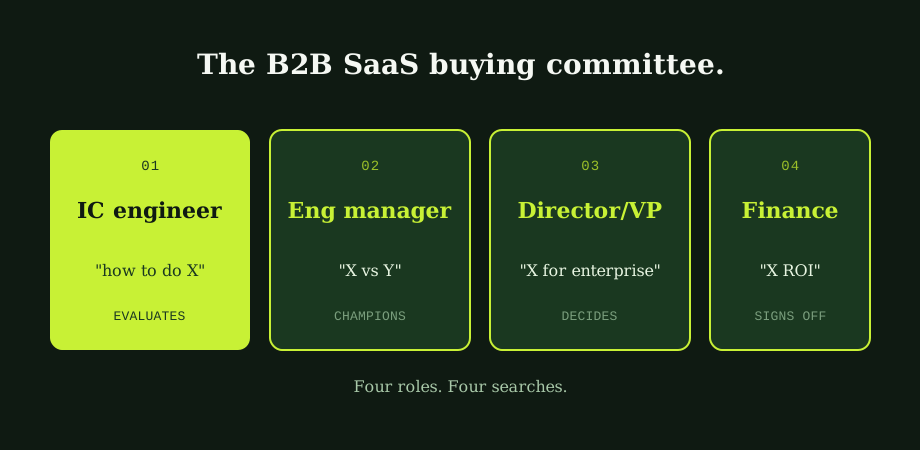
For most categories, SEO is a content discipline with technical underpinnings. For B2B SaaS, it is a stakeholder discipline with content underpinnings. The same product needs to be findable through several different search profiles. They almost never overlap. A page that pleases the IC engineer evaluating an API rarely pleases the CFO comparing total cost of ownership. Trying to write a page that does both usually produces one that does neither.
That framing changes how the programme gets built. Less: what is our brand keyword and where do we rank for it. More: for each stage of the buying committee's journey, what page exists. Who wrote it. How each reader finds their way to the next stage from there.
What makes B2B SaaS SEO different from B2C
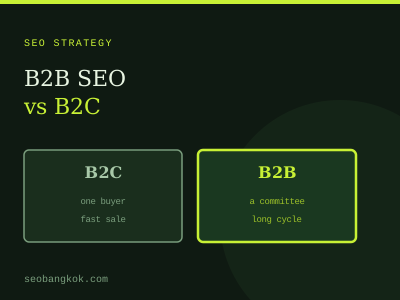
Three structural differences shape almost everything else. The first is the audience. A B2C purchase often involves one person making up their mind in minutes. A B2B SaaS purchase involves three to six stakeholders. They make up their minds over weeks. They have different jobs, different technical depth, different evaluation criteria. The same product has to be findable for several distinct search profiles in parallel.
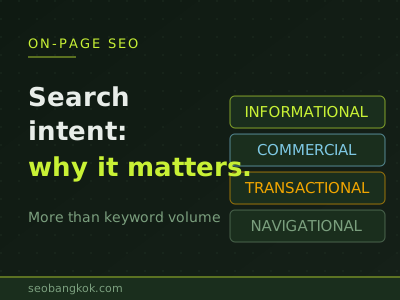
The second is intent. SaaS queries skew technical and comparison-heavy. Long tails of integration searches ("how to connect X to Slack"), use-case searches ("X for engineering teams"), and migration searches ("moving from Y to X") all matter. None look like the broad commercial keywords that dominate B2C strategy. The deeper view of intent matching sits in search intent in SEO.
The third is timeline. The buyer journey runs months, not minutes. Content has to support a stop-start research pattern, not a single purchase decision. An engineer reads three guides this week. The manager reads two comparisons next month. The director reviews case studies the month after. Pages that support that arc look more like reference documentation than marketing pages. The SEO programme has to lean accordingly. The wider B2B-versus-B2C contrast lives in B2B SEO and how it differs from B2C.
The three content types that serve the buying committee
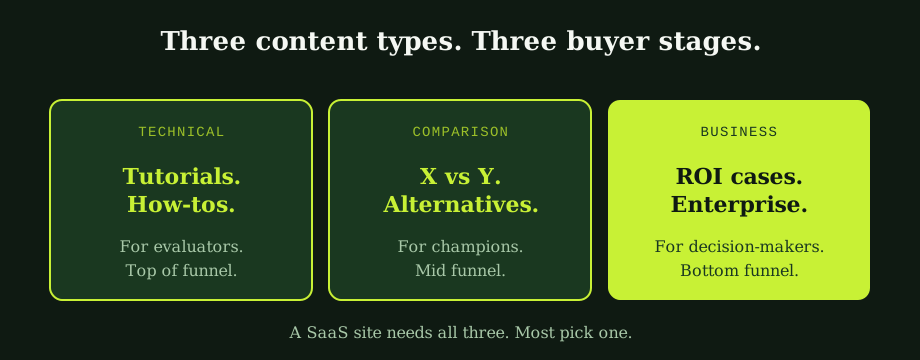
Technical tutorials and how-to content. The IC engineer evaluating your product searches for specific implementation questions: "how to authenticate webhooks in X," "X rate limits Python example," "connecting X to PostgreSQL." A page that answers cleanly and shows the product working in code earns trust in seconds. This is where engineering-led SaaS companies tend to win. Marketing-led companies tend to lose. The bar is technical accuracy, not persuasion.
Comparison and alternative-to content. The engineering manager doing the shortlisting searches for "X vs Y," "alternatives to Z," and "X pricing compared to Y." Honest comparison content earns more credibility than promotional content. The format that works is a clean side-by-side. It lists what each tool actually does well. It is specific enough that the reader can self-disqualify in either direction.
Business and ROI content. The director, VP, or CFO searches for "X for enterprise," "ROI of X," and increasingly "X case studies SaaS." Pages here need numbers. Named customers (with permission). The explicit cost-benefit framing the budget conversation will use. This is the category most SaaS sites underinvest in. It requires real customer cooperation. The writing is the hardest of the three.
A complete SaaS SEO programme covers all three. Most sites are competent at one and weak at the others. That means most sites have a clear next quarter of work. Just identify which content types are missing.
Where Bangkok-based IT and SaaS companies stand
The Bangkok IT and SaaS scene falls into roughly three groups, each with a different SEO position.
Thai SaaS startups serving ASEAN markets. The country-by-country view of the wider ASEAN opportunity sits in SEO for Southeast Asia. These companies have a real and underexploited opportunity. Search behaviour across Singapore, Malaysia, Indonesia, the Philippines, and Vietnam shares enough with Thai search behaviour. A regionally-tuned SaaS content programme can outperform global brands that treat ASEAN as a single English-language market. A Bangkok-based SaaS can write for ASEAN-specific use cases. Clear English. Attention to local payment methods, integrations, and business norms. The result: very little competition for those queries.
Regional offices of global SaaS companies. The phased playbook for executing regional expansion across ASEAN sits in how to build an SEO strategy for ASEAN expansion. These companies usually have strong corporate SEO globally. But a thin local presence in Thai search. The strategy is rarely to compete on global keywords. The corporate site already does that. Instead: build local-language content, local case studies, and ASEAN-relevant comparison content that the global site cannot produce.
Thai IT services and outsourcing firms. These companies compete in a much more crowded global market. US- and Eastern-European-based competitors have established authority. The SEO play is rarely on broad service keywords ("software development"). Almost always on specific technology stacks, specific industries, or specific delivery models. Pick the slices where less authority has been built. The principles of cluster-building and authority signals sit in how to build a content strategy that supports SEO.
The common thread across all three: "B2B SaaS in Bangkok" rarely competes on geography. The SERPs are global. The strategic choice is which slice of the global market your site is genuinely positioned to be the best answer for.
Technical SEO weighs more for SaaS than for content sites
Two technical factors that are noise for content sites are critical for SaaS. The first is page speed and Core Web Vitals. SaaS sites tend to be JavaScript-heavy single-page applications. Marketing pages get bolted onto the same domain or a subdomain. The marketing pages often inherit performance debt from the application. Slow marketing pages lose ranking and conversion at the same time. The diagnostic framework is in core web vitals explained.
The second is documentation indexation. SaaS companies usually have product documentation that ranks for valuable long-tail technical queries ("how to do X with our product"). When the docs are excluded from indexing, mis-canonicalised, or rendered behind authentication, the SEO programme loses one of its strongest assets. Review documentation indexation quarterly. Not just at launch.
Backlink earning in B2B SaaS
Earning links in B2B SaaS is genuinely harder than in B2C. The audiences for SaaS content are smaller. The press coverage is concentrated in a small number of trade publications. The link-earning approaches that work tend to be tied to genuine product utility. Open-source side projects. Free calculators or assessment tools that solve a real problem. Original research with proprietary data the company has access to. Integration partner pages on other tools' sites. Tactics that work for B2C (broad media outreach, link bait, viral content) rarely pay back.
How long the programme takes to pay back
SaaS SEO is a long programme. Three to six months to build out the missing content types and start seeing impression growth in Search Console. Six to twelve months for ranking improvements on commercial queries that drive sign-ups. Twelve to eighteen months for ROI to clearly cross over what the same budget would have produced in paid acquisition. Programmes shorter than this rarely produce the compounding benefit that makes SEO worth doing for SaaS at all.
Our SEO Bangkok work with IT services and SaaS clients usually starts with a buying-committee audit. Which of the four roles your site is currently findable for. Which it is missing. What the next quarter of content should produce to fill the gaps. The technical SEO services side handles the SaaS-specific concerns: Core Web Vitals on JS-heavy stacks, documentation indexation, structured data for software products. Content-led agencies often miss these. An SEO expert in Bangkok who understands B2B SaaS economics is closer to a product marketing role than to a traditional SEO one. The right engagement reflects that.
Common questions
Is SEO worth it for B2B SaaS companies?
For most B2B SaaS companies, SEO delivers a better long-term return than paid search and substantially better than paid social. The reason is the buyer journey. B2B software purchases involve multiple stakeholders researching independently before sales conversations begin, and they overwhelmingly start that research on Google. A company that ranks for technical how-tos, comparison queries, and enterprise-evaluation searches gets in front of every stakeholder at the moment each is making up their mind. The exception is very early-stage SaaS with a tiny addressable market.
How is SaaS SEO different from B2C SEO?
Three differences shape almost everything. The first is audience: B2B SaaS sites serve a buying committee of three to six people with different jobs, technical depth, and evaluation criteria. The second is intent: SaaS queries skew technical and comparison-heavy, with a long tail of integration-specific and use-case-specific searches that B2C rarely sees. The third is timeline: the buyer journey runs months, not minutes, and the content has to support a stop-start research pattern rather than a single purchase decision.
What are the most important content types for SaaS SEO?
Three types do most of the work. Technical tutorials and how-tos serve IC engineers in the evaluation phase. Comparison and alternative-to content serves engineering managers and technical buyers in the shortlisting phase. ROI case studies and enterprise-feature pages serve directors, VPs, and finance in the decision phase. Most SaaS sites do well on one of these three and badly on the other two; a complete programme covers all three with internal linking that lets a single reader traverse them in any order.
What's different about SEO for Bangkok-based IT and SaaS companies?
Two things stand out. The first is that Bangkok-based companies competing for English-language B2B SaaS searches compete with US, UK, and global players from day one; search engines do not give a Bangkok-headquartered company any local advantage in English. The second is that Bangkok-based SaaS targeting ASEAN markets has a genuine and underexploited opportunity: search intent in Singapore, Malaysia, Indonesia, and Vietnam shares enough with Thai search behaviour that a regionally-tuned SaaS programme can outperform global brands that treat ASEAN as a single English-language market.