The question that almost every foreign business asks when starting SEO in Thailand is whether they should optimise for Bing too, or whether DuckDuckGo deserves attention, or whether some Thai-specific search engine they have never heard of has meaningful local share. The answer in Thailand is shorter than in most other markets: no, no, and no. The data closes the question rather than opening it.
What Google's market share in Thailand actually is
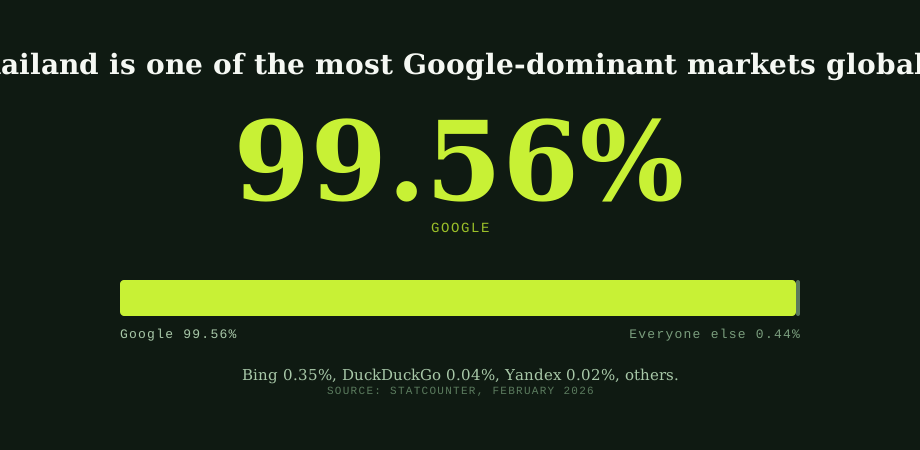
According to StatCounter's February 2026 data, search engine market share in Thailand breaks down as follows: Google 99.56 percent, Bing 0.35 percent, DuckDuckGo 0.04 percent, Yandex 0.02 percent, and all other engines combined for less than 0.05 percent. The wider annual review of Thai SEO that this market-share data anchors is in the state of Thai SEO in 2026. The desktop and mobile platforms show similar dominance, with Google's share on Thai mobile devices typically running fractionally higher than desktop because Android's market share is so high in Thailand and Google Search is the default Android experience.
The number has been stable in this range for several years. Older StatCounter data from 2019 and 2020 shows Google at similar levels in Thailand, fluctuating between roughly 99 and 99.7 percent depending on the month. There is no trend line suggesting any meaningful change. Bing's share in Thailand has not grown despite Microsoft's broader investments in search; DuckDuckGo's share has not grown despite increased privacy awareness globally; Baidu has no foothold despite Thailand's large Chinese tourism flows.
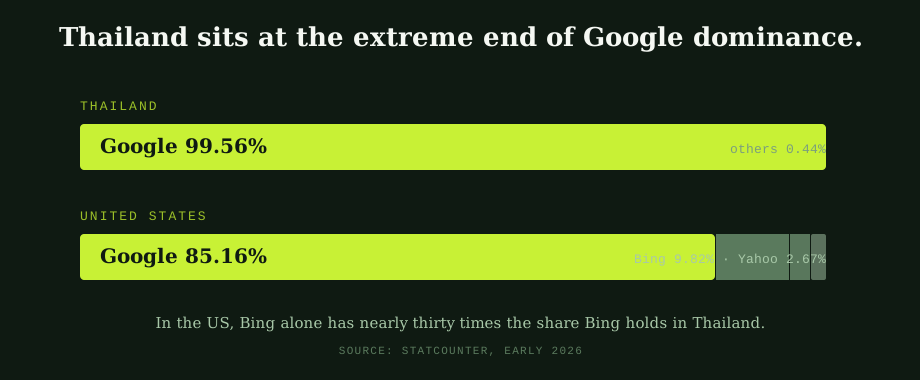
The contrast with other markets makes the Thai number easier to appreciate. In the United States, Google holds about 85 percent of search, with Bing at nearly 10 percent and Yahoo at almost 3 percent. In the UK and most of Western Europe, Google's share is higher (typically 90 to 95 percent) but Bing is still a measurable presence. Markets where Google has serious competition look very different: South Korea where Naver retains a meaningful position, Japan where Yahoo Japan still has share, Russia where Yandex holds significant ground, China where Baidu dominates and Google is essentially absent. Thailand belongs to neither category of those; it sits at the extreme end of Google dominance.
Why Thailand is one of the most Google-dominant markets globally
Several factors compound to produce the lopsided share.
Android dominates the Thai smartphone market. Android holds a much higher share of devices in Thailand than in many comparable markets, and Google Search is the default search experience on Android. The default effect is enormous: a search engine that ships pre-installed and pre-selected wins by simple inertia, and Thai consumers are no exception.
iPhones default to Google too. Apple's default search engine on Safari is Google globally (under the well-publicised Apple-Google search distribution agreement). So even the segment of Thai users on Apple devices is funnelled to Google by default. There is no major device category in Thailand where the default search is anything other than Google.
There is no domestic search competitor. The reason Naver dominates South Korea, Yandex Russia, Baidu China, and Yahoo Japan retains relevance is the same: each has a homegrown product that understands local language, culture, and content better than Google does in that market. Thailand has no such alternative. Thai-language search is served well enough by Google that a domestic alternative never developed traction.
Thai-language indexing in Google is mature. Google's Thai-language understanding has been adequate for over a decade. The technical bar that a competitor would need to clear to displace Google in Thai is high enough that none has tried seriously. The wider context of how this plays out for businesses operating in Thai is in Thai and English SEO: should you target both languages.
Bing has not invested in Thai market positioning. Microsoft's broader push into search through Edge browser bundling and Windows defaults produces a Bing share in markets like the US where Microsoft devices are common. In Thailand, where Android phones drive most search activity, the Windows-Edge channel barely exists. Microsoft has not invested in Thai-specific marketing, partnerships, or product features. The result is the 0.35 percent we observe.
What this means practically for your SEO strategy
The strategic implications are simpler than the same conversation in markets where multiple engines have meaningful share.
Search budget allocation is unambiguous. In Thailand, "SEO budget" and "Google SEO budget" are the same line item. Allocating any meaningful share of the budget to Bing-specific optimisation, Yandex-specific work, or DuckDuckGo-specific tactics is misallocation. The reciprocal is also true: a website that ranks well on Google in Thailand has essentially captured the market. Worrying about cross-engine performance is a problem for other countries.
Technical SEO standards are Google's standards. Core Web Vitals, mobile-first indexing, structured data conventions, the recent guidance on E-E-A-T, the AI Overviews behaviour , these are not "best practices" in Thailand; they are the only practices that matter for any meaningful share of traffic. The framing that this rolls into for established Thai businesses is in local SEO for Thailand businesses.
Ranking-monitoring tools should be Google-focused. Most ranking trackers default to monitoring multiple engines. In Thailand, the Bing and Yahoo trackers are essentially noise; only the Google data is signal. Configure tools to focus exclusively on Google for Thai-market work.
Content quality standards follow Google's signals. What Google rewards (depth, expertise, transparent authorship, citations, internal linking, page experience) is what produces traffic in Thailand. There is no "but Bing prefers shorter content" or "Yandex weighs backlinks differently" complication. One engine, one set of signals to optimise against.
This simplification is a feature, not a constraint. Thai businesses get to focus their entire SEO budget on excelling at one search engine rather than dividing attention across several. Foreign businesses entering Thailand can ignore optimisation patterns that matter in their home market but not here.
The AI search disruption: does it change the math?
The question that has emerged in the last twelve to eighteen months is whether AI search products like ChatGPT, Gemini, Perplexity, and Claude are going to disrupt Google's dominance, in Thailand or elsewhere. The honest answer is: not significantly yet, and even when they do, Google's position in Thailand specifically is unlikely to drop below roughly 95 percent during the next three to five years.
Three reasons.
Google AI Overviews are part of Google. When a user does a Google search and Google delivers an AI-synthesised answer at the top, that traffic still counts as Google traffic. The growth of AI Overviews does not reduce Google's market share; it just changes how Google delivers some of its results. The technical work for AI Overviews specifically is unpacked in how to optimise for Google AI Overviews.
The AI search products that are not part of Google (ChatGPT, Perplexity, Gemini as a standalone product) are growing in Thailand but from a small base. Total search-equivalent activity that bypasses Google entirely is still a low single-digit percentage of total information-seeking behaviour. It is growing. It is not yet large enough to materially shift the share equation.
Thailand-specific factors limit the speed of AI search adoption. English-language AI products dominate the AI search landscape; Thai-language AI search is less mature; the consumer market in Thailand defaults to mobile messenger apps (LINE in particular) for many information-seeking tasks rather than to browser-based AI assistants. The broader practice of optimising for AI search is in what is answer engine optimization; the budget framing for Thai businesses specifically is to keep ninety-plus percent of search investment on Google optimisation and allocate a modest portion to AI search optimisation as the surface grows.
The mobile-first reality
Even within Thailand's Google-dominant market, the mobile picture is more dominant than the desktop one. Mobile search in Thailand is essentially 100 percent Google for practical purposes. The drivers are the same Android dominance and iPhone-Google default that produce the overall share, but compound on mobile because:
- Default search is harder to change on mobile than desktop (fewer users know how, fewer reasons to try)
- Many mobile searches happen inside apps that pass through Google rather than browser address bars (Chrome, Google app, Google Assistant, voice search through Google)
- The growth of mobile search has outpaced the growth of any non-Google alternative
For Thai-market SEO, mobile-first is not a guideline but a requirement. The technical foundations for that are in Core Web Vitals explained. The implications for content strategy compound: Thai mobile users have specific patterns (heavy LINE integration, app-first behaviour, image-and-video preference) that change what good Thai-market SEO content looks like compared to desktop-dominated markets.
When non-Google channels still matter
Three narrow exceptions are worth knowing about even though they do not change the broader picture.
Cross-border businesses with US, UK, or Japanese audiences. If a Thai business serves customers in markets where Bing, Yahoo, or other engines have meaningful share, the optimisation work for those audiences naturally includes those engines. This does not change Thai-market work; it adds parallel work for the international audience. The framing for Thai businesses with foreign-market customers is in SEO for Thai businesses targeting foreign customers.
Niche expat or corporate audiences. A small share of Thai market activity comes from segments that default to non-Google engines. Older expats accustomed to Yahoo, corporate users on Microsoft-managed devices with Edge defaults, and a handful of privacy-conscious users on DuckDuckGo. The cumulative share is below 1 percent but if your business specifically serves one of these segments, the smaller engines are still in your audience mix.
LINE search. LINE is not a search engine in the traditional sense, but it functions as one for many Thai consumers. Search inside LINE for businesses, services, and content represents activity that Google does not capture. For consumer-facing Thai businesses, optimising LINE Official Account presence is parallel to (not part of) Google SEO and is a meaningful channel. The mechanics of LINE Official Account work are in LINE Official Account for Thai business.
The honest takeaway
For ninety-nine percent of businesses operating in Thailand, SEO is Google SEO. The strategic conversations that consume time in other markets (engine portfolio allocation, multi-engine reporting, cross-engine optimisation tradeoffs) are not strategic conversations in Thailand because the data closes them. The simplification frees budget and attention for the work that actually moves results: excellent content, strong technical foundations, deep local relevance, and the AI search layer that is starting to matter more.
The wider regional context (how Thailand compares to other ASEAN markets, where each one sits on the Google-dominance spectrum) is in SEO for Southeast Asia. The ASEAN expansion playbook for businesses moving from Thailand into other regional markets is in how to build an SEO strategy for ASEAN expansion, because the share picture in Indonesia, Vietnam, and the Philippines is structurally different and the work changes accordingly.
Our SEO agency Bangkok work for clients operating exclusively in the Thai market builds on this single-engine reality from day one: no Bing complications, no Yandex tracking, just sharp Google work. For businesses with regional ambitions, our international SEO services handle the multi-engine complexity that the cross-border surface introduces. The wider positioning is on the Thailand SEO company overview; a short discovery conversation with our SEO specialist in Thailand usually clarifies which model fits the business.
Common questions
What is Google's market share in Thailand?
Google holds approximately 99.56 percent of search traffic in Thailand as of February 2026 according to StatCounter, making Thailand one of the most Google-dominant markets in the world. Bing accounts for about 0.35 percent, DuckDuckGo 0.04 percent, Yandex 0.02 percent, and all other search engines combined for less than 0.1 percent. The share has been remarkably stable in this range for several years and shows no sign of meaningful change.
Why is Thailand so Google-dominant compared to other countries?
Several structural factors compound. Android holds a very high share of the Thai smartphone market and Google Search is the default on Android. Apple devices in Thailand also default to Google Search. There is no domestic search competitor with cultural or linguistic advantages, unlike Yandex in Russia, Baidu in China, Naver in South Korea, or Yahoo Japan. Thai-language search is well-served by Google. Bing has not invested in Thai market positioning. The result is a market where the default option dominates because no alternative has provided a reason to switch.
Should I bother optimising for Bing in Thailand?
For almost all Thai businesses the answer is no. Bing's 0.35 percent share in Thailand means that a typical Thai-market website receives roughly one Bing visit for every two hundred and eighty Google visits. The opportunity cost of allocating any meaningful budget to Bing-specific optimisation almost always exceeds the upside. The two narrow exceptions are businesses targeting the small expat segment that defaults to Bing, and businesses whose international audience includes markets where Bing share is meaningfully higher.
Does AI search change the Google dominance picture in Thailand?
Not significantly yet. ChatGPT, Perplexity, Gemini, and Claude are growing in Thailand but still represent a small share of search-equivalent activity. Google AI Overviews are part of Google itself, so their growth does not reduce Google's share. The likely trajectory over the next three to five years is that some share of buyer research shifts to AI assistants, but Google's overall dominance in Thailand specifically is unlikely to drop below roughly 95 percent during that transition. Budget allocation should keep ninety-plus percent of search budget on Google with a modest allocation for AI search optimisation.