The mistake that ends most ASEAN expansion programmes prematurely is launching too many markets at once. A team that has six months of approved budget and three target countries tends to spread the budget across all three. The result is a thin programme in each country. Ranking traction is fragmented. Link earning is fragmented. Measurement is fragmented. By the time the team realises which market actually had traction, the budget is gone.
The phased approach treats ASEAN expansion as a series of single-market programmes run in sequence, not as one regional programme run in parallel. Pick the right first market. Win it decisively over six to twelve months. Use what was learned to enter the second market faster and with better assumptions. The Bangkok-based SaaS context where this phased model plays out specifically is in SEO for IT and SaaS businesses in Bangkok.
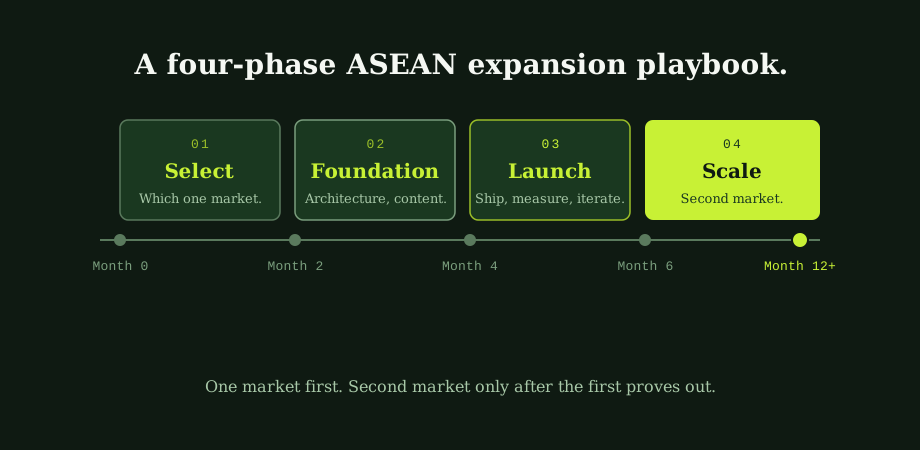
Phase 1: Select one market (months 0 to 2)
The selection phase is the work most teams underinvest in and the work that determines almost everything that follows. Pick the wrong first market and the next twelve months will be uphill regardless of execution quality.
Three questions decide the answer.
Where does language and content capability already fit? The cheapest path to launch is the market where the source-language content needs the least localisation. English-speaking ASEAN markets (Singapore, the Philippines) require only positioning adjustments. Markets that require Bahasa, Thai, or Vietnamese require investment in translation, native content creation, and often local team hires.
Where is the market priority highest? Different industries map to different first markets. B2B SaaS and English-language services usually map to Singapore for both the language fit and the role of Singapore as the regional business hub. Consumer e-commerce maps to Indonesia for population scale and the relatively underdeveloped Bahasa-language commercial SEO competition. Tourism and hospitality map to Thailand. Manufacturing-adjacent services often map to Vietnam.
What can your team realistically maintain? Be honest about whether you have the bandwidth to produce native-quality content in the chosen market over twelve months, not just at launch. Translated content that reads as translated rarely competes with native-quality competitor content. If you cannot maintain the production rate in the target language, do not enter that market yet; pick a different first market or invest in capability first.

The two-month selection window includes more than just picking a market. It includes ranking-volume validation (does enough commercial search demand exist in the target language?), competitive analysis of the top ten ranking domains in each market for the priority keywords, a localisation cost estimate that is honest about hidden costs (cultural review, quality assurance, local link earning), and a stakeholder alignment conversation that locks in the chosen market before resources are committed.
Phase 2: Foundation (months 2 to 4)
The foundation phase is the unglamorous work that determines whether the launch produces compounding traffic or scattered ranking signals.
The deliverables in this phase.
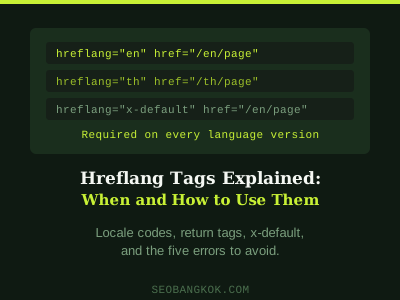
- Technical architecture decision. Single domain with hreflang versus subdirectories versus country ccTLD. Each architecture has trade-offs in cost, ranking signal strength, and long-term flexibility. The architecture choices are unpacked in hreflang tags explained; the decision should be made before any content is produced, because reversing it later is expensive.
- Translation pipeline. If the target market is non-English, the translation workflow needs to be operational before content production starts. Decide on translator quality tier, the cultural-review step, the per-page quality assurance check, and the version-control mechanism for source and target language together.
- Content priority list. Not all source-language content should be translated. Pick the twenty to fifty pages that produce most of the existing traffic and conversion, and translate those first. The rest waits. This is the same selection logic that drives most decisions in how to build a content strategy that actually supports SEO.
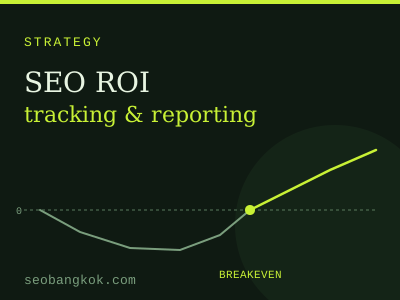
- Measurement framework. Search Console property set up for the target country, conversion tracking adjusted for the local market, and the baseline metrics captured before any launch happens. The downstream ROI question is unpacked in how to track and report SEO ROI.
- Local link earning plan. Local domain authority is one of the trust signals that varies most across ASEAN markets. The plan for how the target-country site will earn local links (press, partnerships, local directories where appropriate) should be in place before content ships, because link earning has its own months-long lead time.
Two months sounds like a long foundation phase. It is. Skipping any of these to launch faster produces programmes that look fine in month four and fail in month nine when the structural mistakes start compounding.
Phase 3: Launch (months 4 to 6)
The launch phase is when content ships and the technical foundation goes live. The work here is operational rather than strategic.
The launch deliverables.
- Ship the top-priority pages first. The twenty to fifty pages identified in foundation. Ship them in batches so that quality stays consistent, rather than all at once with declining attention.
- Verify hreflang implementation. Hreflang misimplementations are the single most common reason ASEAN expansion programmes fail to consolidate ranking signals correctly. Test the implementation against Google's own validation tools and check it weekly for the first month.
- Submit the new URLs to Google Search Console. Indexing in the target country can take weeks; faster indexing comes from sitemap submission, internal linking from existing high-authority pages, and external link mentions where possible.
- Establish measurement baselines. Capture the rankings, impressions, and click data for the target keywords in the first week after launch. These are the baseline against which all subsequent improvement is measured.
- Start the local link earning. Press outreach, partnership announcements, directory submissions where they have local credibility. The first links typically come from existing relationships; the harder ones come from genuine value creation in the target market.
The two-month launch phase is meant to ship the content, not to optimise it. Optimisation happens in phase four with data, not in phase three with guesses.
Phase 4: Scale (months 6 to 12+)
The scale phase is when the data starts to inform decisions and the second market enters consideration.
By month six, the launch content should have produced measurable signals: rankings have started to consolidate for the target keywords, impressions and clicks have started compounding, and at least some content has begun to outperform the rest. The scale-phase deliverables.
- Double down on the winners. The content that is ranking and earning traffic gets more investment: deeper articles, broader topic coverage, more aggressive internal linking. The compounding starts at the top of the ranking list and works outward.
- Cut the losers cleanly. Content that has not ranked in six months in the target market is usually not going to. Retire it, consolidate it, or accept that the assumptions were wrong and move on. Not every page deserves a refresh; some deserve deletion.
- Evaluate the second-market readiness. If the first market is producing the expected results, the second market enters foundation phase from month nine onward. If the first market is underperforming, the second market waits until the first one is producing results.
- Build the local team. By month twelve, programmes that intend to maintain serious presence in the target market should have a local presence of some kind: a hired content lead, a local agency partner, or at least a regular cultural-review check by someone native to the market.
- Lock in the measurement loop. Quarterly review of ranking trajectory, monthly review of leading indicators, and a six-monthly review of whether the strategic assumptions still hold. The honest measurement framework that this rolls into is in how to measure SEO content performance.
The scale phase is where the second market begins. Done right, second-market entry takes half the time of first-market entry because the team has learned what works and what does not. Done wrong, the second market makes the same mistakes as the first and produces the same delayed results.
The e-commerce dimension
For consumer e-commerce specifically, the ASEAN expansion playbook adds two layers that pure B2B expansion does not have. The first is platform integration: Shopee, Lazada, and country-specific marketplaces often drive more product discovery in ASEAN markets than direct search to brand sites. The second is product feed quality: translated product titles, descriptions, and category structures matter as much as translated marketing content. The wider e-commerce SEO foundation that this layer sits on is in our e-commerce SEO service page; the regional layer is what changes.
Common ASEAN expansion mistakes
The patterns that show up repeatedly when expansion programmes underperform.
- Launching two or three markets simultaneously. Splits attention, content production, link earning, and measurement across too many fronts. Phased entry consistently outperforms parallel entry, even when the budget would theoretically support both.
- Skipping the selection phase. The team picks the market based on stakeholder preference rather than market readiness analysis. The phase one work is what makes the rest of the programme defensible.
- Treating translation as the localisation work. Translation is the lightest layer. Cultural adaptation, local examples, native-quality content, and country-specific trust signals all matter more than a clean translation.
- Underinvesting in foundation. Hreflang done wrong, no measurement baseline, no local link plan. The launch happens and looks fine; the month-nine results reveal that the foundation was structurally weak.
- Holding on to losers too long. Content that has not ranked in six months in the target market is rarely going to. The scale phase requires the discipline to cut what is not working, which most teams find harder than the work that produced it.
- Entering the second market while the first is still underperforming. Doubling the surface area before the first one is producing results doubles the problem rather than diversifying it. The second market is a reward for the first one succeeding, not a hedge against it failing.
Each of these is fixable with discipline rather than budget. The teams that do ASEAN expansion well tend to spend less than the teams that do it poorly; the difference is sequencing, not spend.
The honest version of ASEAN expansion strategy
ASEAN expansion done well is one market at a time, with the second market starting only after the first has compounded. Done well, it produces a defensible position in two or three markets over twenty-four months. Done badly, it produces thin programmes in five markets that compete against global brands with bigger budgets and never win any of them.
Our SEO agency Bangkok work with regional brands runs this playbook in practice, starting from the market-selection conversation rather than the content roadmap. The SEO ASEAN market expansion covers the architecture, hreflang, and country-site setup that the playbook calls for. The wider services positioning for clients running multi-market programmes sits on the Thailand SEO company services overview. An SEO consultant in Thailand who has run the playbook for B2B and consumer brands can usually identify the first-market choice within a single discovery session.
Common questions
How long does an ASEAN expansion SEO programme take?
A realistic first-market programme runs twelve to eighteen months from selection to compounding traffic. The phases are: market selection and validation in months zero to two, foundation work in months two to four, launch in months four to six, and scale from month six onward. Second-market entry typically starts at month nine to twelve once the first market has shown clear ranking and traffic momentum. Programmes that try to launch two markets simultaneously almost always underperform compared to phased entry.
Which ASEAN market should I enter first?
The right first market depends on two factors: where your current language and content capability already fits, and where the market priority is highest for your business. For B2B SaaS and English-language services, Singapore is usually the first market. For consumer brands targeting volume, Indonesia is usually first. For Thailand-headquartered companies expanding regionally, Vietnam and the Philippines are common next steps. The wrong first market is whichever one you have neither the language capability nor the market priority for.
What does an ASEAN expansion SEO programme actually cost?
The cost varies dramatically by approach. A single English-language site with hreflang for Singapore and the Philippines can be built on top of an existing SEO programme for relatively low incremental cost. A local-language programme for one country typically requires substantial translation and localisation investment plus local content creation. A hub-and-spoke architecture across multiple country sites is the most expensive and is appropriate only for mature programmes with validated demand in multiple markets. Most programmes start with the lower-cost approaches and scale up only after the first market proves itself.
Can I launch SEO in multiple ASEAN markets at once?
You can, but it rarely works as well as a phased approach. Launching simultaneously in two or three markets means splitting limited content production, link earning, and measurement attention across them. The result is typically thin programmes in every market and a strong programme in none. The phased approach consistently outperforms multi-market simultaneous launches in both ranking outcomes and resource efficiency.