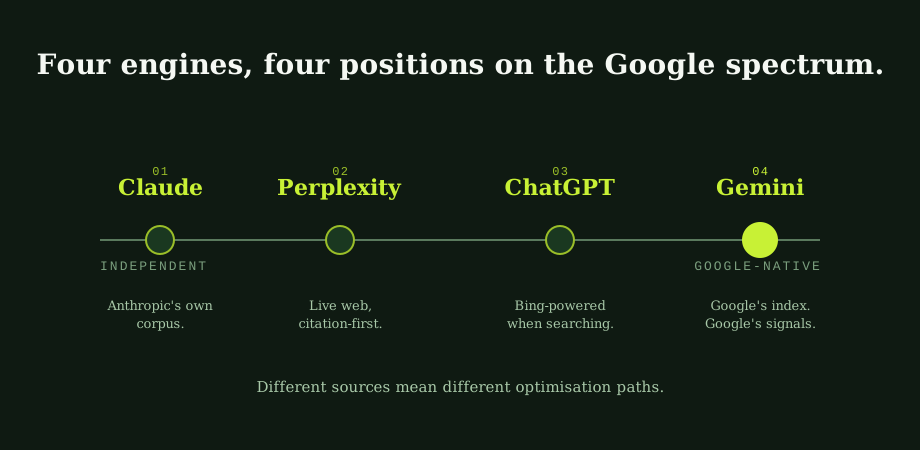
The reason these four engines reward different things is that they do not all share the same underlying source material. ChatGPT in search mode runs queries through Bing's index. Gemini queries Google's index. Perplexity uses its own crawler combined with various search APIs and emphasises live-web freshness. Claude relies most heavily on its training data with optional tool-augmented search. The differences in source produce differences in what gets cited, which produces differences in what the optimisation work looks like.
For most businesses, the practical answer is that the underlying SEO foundation matters across all four (about 80 percent of the work overlaps), but the engine-specific tactics that produce the remaining 20 percent diverge meaningfully. Understanding the divergence helps allocate the budget correctly rather than spreading it evenly across surfaces that do not all matter equally for any given audience.
The four engines, briefly
ChatGPT is the most-used AI assistant globally and the one most professional researchers default to. When it answers questions that require fresh information, it runs searches through Bing's index. When it answers questions that do not require fresh information, it draws from its training data through 2024-2025 (the cutoff updates periodically). The model is GPT-4 or its successors. The user base is large and growing, with particularly strong adoption in B2B research, software development, and considered consumer purchases.
Gemini is Google's AI product, integrated directly with Google Search and with Google AI Overviews. It uses Google's index as its retrieval substrate and inherits Google's ranking signals. The user base is the broadest by default because Gemini appears inside the search experience that most people already use; the standalone Gemini product has a smaller dedicated user base than ChatGPT but the embedded use case (AI Overviews in normal search) reaches far more people. The Google AI Overviews mechanics specifically are unpacked in how to optimise for Google AI Overviews.
Perplexity is the search-first AI product. Its core differentiator is transparent citation: every claim in an answer shows the source it came from, and users frequently click through to verify and read more. The user base skews technical, research-heavy, and citation-conscious (financial analysts, healthcare professionals, journalists, software engineers). Perplexity uses its own retrieval system combined with various search APIs and emphasises recency and authority.
Claude is Anthropic's assistant. Its training data is its primary knowledge source; web search is available as a tool but is less central to the default user experience than it is for the other three. The user base is concentrated in software development, technical writing, business analysis, and consumer use cases where conversational depth matters more than live-web freshness. Brand entity recognition matters disproportionately for Claude citations because the model draws on its training data more heavily.
How they differ technically
The technical differences compound to produce the strategic differences. Five axes matter.
Source freshness. Perplexity is the freshest by design (live web search is the default). Gemini is fresh through Google's index, which updates continuously. ChatGPT is fresh when it triggers a search but draws from training data otherwise, which means the "default" answer is months to a year behind. Claude is the least live-web-fresh because search is opt-in.
Citation transparency. Perplexity is most transparent (citations shown beside every claim). ChatGPT shows sources but more subtly and not always for every claim. Gemini shows AI Overviews citations with varying prominence. Claude cites less aggressively and synthesises more.
Retrieval source. Gemini uses Google's index. ChatGPT uses Bing's index when in search mode. Perplexity uses a mix of its own crawler and multiple search APIs. Claude uses its training data as primary, with optional tool-augmented search. This means a site that is well-indexed by Google but poorly indexed by Bing will appear more reliably in Gemini than in ChatGPT.
Training data weight. Claude draws heavily on training data; ChatGPT also; Gemini somewhat (more retrieval-heavy); Perplexity minimally (mostly live-web). Entity recognition (being known as a coherent brand in the training data) matters more for Claude and ChatGPT.
Conversational depth. Claude and ChatGPT support longer, more conversational interactions; Gemini and Perplexity are more single-query optimised. Long-form content that supports multi-turn reasoning fits Claude and ChatGPT use cases better.
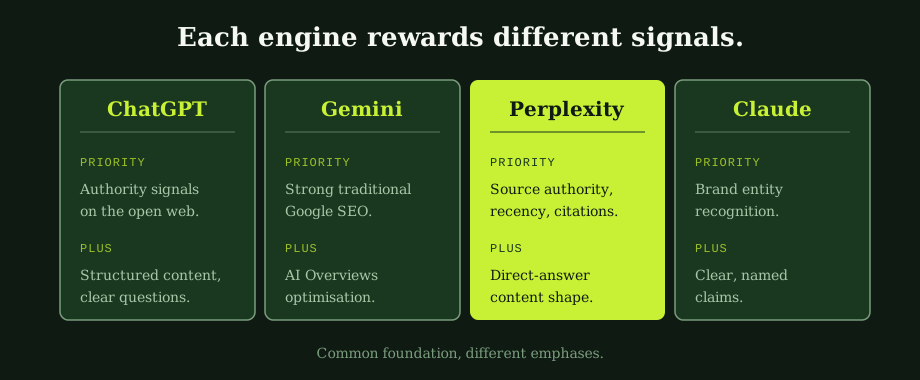
What each engine rewards
The optimisation priorities for each engine, in plain terms.
ChatGPT priorities
ChatGPT rewards two things primarily: authority signals on the open web (being mentioned across many credible sources) and structured content that answers specific questions clearly. The training-data weight means that brands recognised across the wider web tend to appear in ChatGPT outputs even on queries that do not trigger live search. The structured-content weight means that question-shaped content (with the question phrased as a heading and the direct answer immediately following) gets surfaced more often than long-form essays where the answer is buried. The wider context for ChatGPT search behaviour is in how ChatGPT search changes SEO strategy.
Gemini priorities
Gemini rewards everything that strong Google SEO already rewards, because Gemini uses Google's index. This is good news for businesses that have invested in Google SEO over years: that investment compounds into Gemini visibility automatically. The additional layer that Gemini rewards specifically is content structured for AI Overviews extraction: clear question-answer pairs, schema markup, and direct claims with named subjects. The targeted optimisation work for Gemini is essentially the AI Overviews playbook. Gemini SEO as a discipline overlaps about 90 percent with traditional Google SEO plus AI Overviews-specific tactics.
Perplexity priorities
Perplexity rewards three things heavily that the others reward more lightly: source authority specifically as it relates to citation-worthiness, recency of the content, and clean direct-answer shape. The product's citation-first design means it is constantly evaluating which sources are credible enough to cite by name; sources that consistently appear in Perplexity citations build a reputation that compounds. Recency matters more than for the other engines because Perplexity emphasises live-web search; an article published two years ago competes with articles published this month for the same query. Direct-answer shape (the answer is clearly stated as a sentence or short paragraph) is rewarded because Perplexity quotes from sources liberally. Perplexity SEO as a workstream is best thought of as the most demanding citation-worthiness exercise of the four engines.
Claude priorities
Claude rewards brand entity recognition more than the others because its training data weight is higher. A brand that appears consistently across many authoritative sources in the training data is more likely to be named in Claude responses on the topic. Clear, named claims that are easy to attribute help too: sentences where the subject is explicitly named are easier for Claude to extract and quote than sentences with implied subjects. The entity-SEO foundation that supports Claude visibility specifically is in entity SEO for AI search.
Audience differences
The optimisation question becomes simpler when audience comes into focus. Different audiences default to different engines.
- B2B SaaS and enterprise software: ChatGPT is the default for most engineering and product research. Claude has growing share among technical writers and analysts. Gemini matters for the general decision-maker audience that arrives via Google search.
- Financial services and healthcare: Perplexity over-indexes here because professionals in these fields value citation transparency. ChatGPT is also strong. Gemini matters less.
- Consumer e-commerce: Gemini (through AI Overviews) reaches the broadest consumer audience by default. ChatGPT matters for considered purchases. Perplexity and Claude are smaller shares for this audience.
- Tourism and hospitality: Gemini through Google AI Overviews is dominant because Thai and regional consumers default to Google. ChatGPT is growing for English-speaking travellers researching trips.
- Local services (restaurants, clinics, salons): Gemini through Google AI Overviews and the local pack is dominant. The other three engines are minor shares for hyper-local queries.
The audience-first framing answers the priority question more cleanly than abstract engine comparisons do.
How to prioritise the work
The right priority depends on which audience matters most for the business. The default priority order for businesses without a specific audience skew.
- Gemini first. Most businesses already have Google SEO investment. Gemini inherits that investment. Optimising for AI Overviews on top of existing SEO produces the highest immediate AEO visibility for the lowest incremental work.
- ChatGPT second. Largest dedicated AI assistant user base. Authority and structured-content investments compound across all engines and produce strong ChatGPT visibility specifically.
- Perplexity third. Smaller dedicated user base but disproportionately important for citation-sensitive industries. Optimising for Perplexity tends to lift the other engines because the underlying signals overlap heavily.
- Claude fourth. Smallest dedicated user base for typical SEO audiences but matters for technical and analytical use cases. The entity-recognition work that helps Claude also helps the others.
Businesses with specific audience skews should adjust. A financial-services firm should likely put Perplexity above Gemini. A B2B SaaS targeting engineers should likely put ChatGPT above Gemini. A consumer e-commerce brand should likely follow the default order. The audit framework that comes before this prioritisation is in the AI readiness audit. The methodology for measuring current visibility across all four engines specifically is in how to run an AI visibility audit.
The shared foundation
About 80 percent of the optimisation work is shared across all four engines. Investing in the shared 80 percent first, then layering engine-specific tactics on top, produces better results than trying to optimise for one engine in isolation.
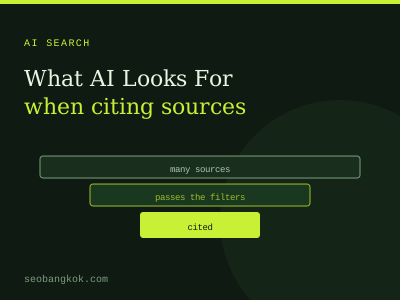
The shared foundation: strong technical SEO (the underlying signals all four engines partially use), clear authorship with named individuals and verifiable expertise, structured content with question-shaped headings and direct answers, schema markup (Article, Organization, FAQPage, HowTo where appropriate), brand entity strength across the wider web, citation-friendly claim structure with named subjects, and consistent positioning across sources. The citation-mechanics view of why these signals matter is in what AI search engines look for when citing sources.
The 20 percent that diverges is the engine-specific tactical work: AI Overviews structure for Gemini, broader brand mentions for ChatGPT, recency and citation cleanliness for Perplexity, entity recognition for Claude. None of this 20 percent is worth investing in before the shared 80 percent is in place.
The honest take on AI search engine priority
Most businesses are still in the early phase of AI search visibility work. Trying to optimise heavily for all four engines simultaneously usually produces thin work across all of them. The cleaner path is to ship the shared foundation strongly, layer Gemini-specific work on top (because the existing Google SEO investment makes this the cheapest incremental gain), then add ChatGPT-specific tactics, then Perplexity, then Claude. The order is not absolute, but the principle is: depth on one engine before breadth across all four.
Our SEO agency Bangkok work runs both the shared foundation and the engine-specific layers for regional brands. The dedicated LLM visibility optimization service covers the AI-search-specific workstream across all four engines. The wider services structure for businesses where AI search is part of a broader SEO programme sits on the SEO marketing agency overview. A short discovery session with our SEO marketing experts usually clarifies which engine matters most for the audience in front of us.
Common questions
Which AI search engine matters most for SEO?
It depends on your audience. Gemini matters most for businesses whose buyers already use Google search heavily, because Gemini powers Google AI Overviews and inherits Google's index. ChatGPT matters most for B2B and considered consumer purchases. Perplexity matters most for businesses where citation quality matters (financial services, healthcare, technical software). Claude matters most for businesses where strong brand entity recognition is the goal. The honest priority order for most businesses is Gemini first, then ChatGPT, then Perplexity, then Claude.
Do I have to optimise separately for ChatGPT, Gemini, and Perplexity?
Mostly no. About 80 percent of the optimisation work is shared across all four engines: clear authorship, demonstrable expertise, structured content, schema markup, citation-friendly claim structure, and strong entity signals. The remaining 20 percent diverges. Gemini rewards the existing Google SEO foundation more heavily. Perplexity rewards recency and clean citations more than the others. ChatGPT rewards source diversity. Claude rewards clear, named claims. For most businesses, focus on the shared 80 percent and add engine-specific tactics only after the foundation is strong.
How is Gemini different from ChatGPT for SEO?
The biggest difference is the underlying index. Gemini is built on Google's index and inherits Google's ranking signals, so traditional SEO investment compounds directly into Gemini visibility. ChatGPT in its search mode uses Bing's index plus its own training data. Practically, a site with strong Google rankings tends to appear in Gemini answers more reliably than in ChatGPT answers, because the underlying source list is the same. ChatGPT has stronger weight on training data exposure, which means brand presence matters more than recent ranking changes.
Why does Perplexity emphasise citations more than the others?
Perplexity was designed from the start as a search-first product that explicitly shows users where each claim in the answer comes from. The product positioning depends on transparent attribution: users see the source links beside every claim and click through to read more. Practically, this means appearing in Perplexity answers requires being a citation-worthy source: recent, authoritative, clearly written, and answerable to a specific question with a specific claim.