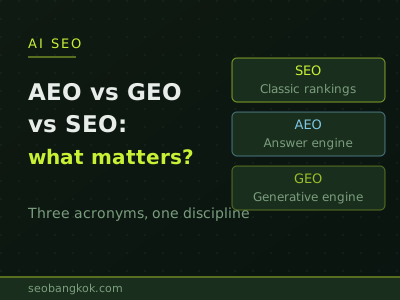
The mistake that almost every conversation about AEO opens with is treating it as a replacement for SEO. It is not. AEO is the layer above traditional search optimisation, not the layer that replaces it. A site with no SEO foundation rarely gets cited by answer engines because the same authority signals that drive ranking also drive citation. But strong SEO does not automatically produce strong AEO. Some of the work overlaps; some of it does not. Knowing which part is which is half the practice.
What answer engines actually are
An answer engine is any product that returns a synthesised answer rather than a list of links. ChatGPT, Claude, Perplexity, and Gemini are the obvious examples. The engine-by-engine comparison that shows how ChatGPT, Gemini, Perplexity, and Claude differ practically is in ChatGPT vs Gemini vs Perplexity for SEO. Google AI Overviews are a more recent example sitting inside the traditional search experience. Microsoft Copilot is another. Each one takes a user question, retrieves source material from across the web (and sometimes from training data), synthesises an answer, and cites or names the sources it used.
The category matters because the optimisation work is different from search-engine optimisation. A traditional search engine answers a query by ranking documents that match it. An answer engine answers a query by composing a response from multiple documents. Being highly ranked in a search engine produces clicks to your site. Being cited inside an answer-engine response produces awareness, brand recognition, and sometimes a direct click on the citation. The metrics that matter are different. The structural requirements of the content are different. The competitive landscape is different.
The ChatGPT-specific mechanics are unpacked in how ChatGPT search changes SEO strategy; the Google AI Overviews mechanics are covered in how to optimise for Google AI Overviews. Both surfaces are part of the broader AEO category but each has specific behaviour worth knowing.
Where AEO sits in relation to traditional SEO
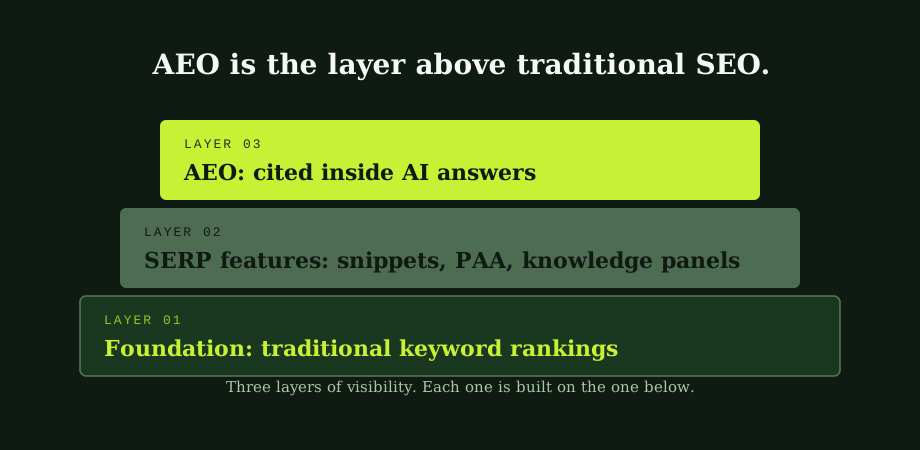
The clearest way to picture the relationship is as a stack of three layers.
The foundation layer is traditional ranking. Keywords, on-page optimisation, backlinks, technical SEO, the lot. This is the layer that produces most current organic traffic for almost every business. It is not going away in the next five years, regardless of what the AI commentary suggests.
The middle layer is SERP features. Featured snippets, People Also Ask, knowledge panels, image carousels, video carousels. These have been the bridge between traditional rankings and synthesised answers for several years. The same optimisations that produce featured snippets often also produce LLM citations: structured answers, clear question phrasing, schema markup.
The top layer is AEO proper. Being cited or named inside the synthesised answer that an AI search product produces. This is the newest surface and the one that the rest of this piece is about.
The layers compound. Sites that rank well in traditional search are more likely to get featured snippets. Sites that get featured snippets are more likely to get cited by LLMs. The reverse is not true: investing in AEO without the foundation layer in place rarely produces results, because the trust signals that LLMs use to decide which sources to cite are mostly the same signals that drive traditional ranking.
The four core practices of AEO
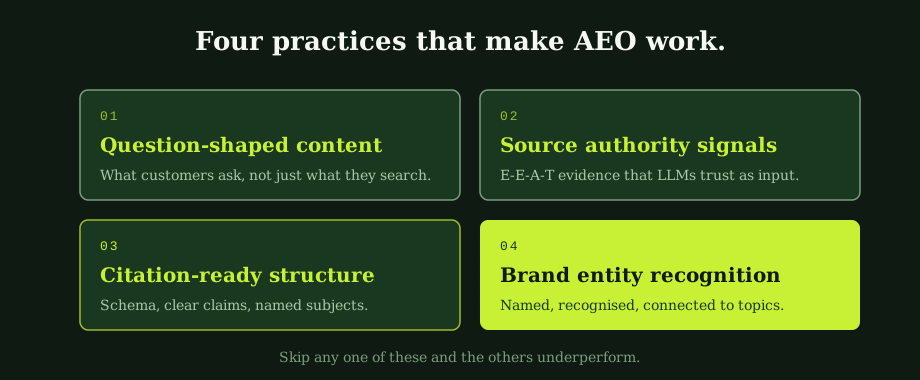
The actual work breaks into four areas. Each one is a distinct workstream and skipping any single one causes the others to underperform.
1. Question-shaped content
Answer engines respond to questions, not keywords. The difference is structural. Traditional SEO content targets a keyword phrase ("local SEO Bangkok") and builds a page around it. AEO content targets a question ("how do I improve local SEO for a Bangkok restaurant?") and structures the page so the answer is extractable.
Extractable means a few specific things. The question should appear as a heading or sub-heading on the page, phrased the way a customer would actually ask it. The direct answer should follow immediately, in two or three sentences that stand alone without context. Supporting detail comes after. This structure is not new (it is also how featured snippets are won), but for AEO it is essential: an LLM scanning your page for a passage that answers a user's question needs to be able to find it cleanly. The wider content strategy that this rolls into is in how to build a content strategy that actually supports SEO.
2. Source authority signals
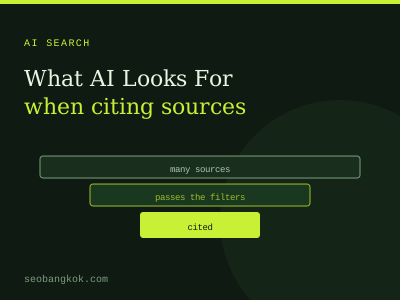
LLMs decide which sources to cite using authority signals that overlap heavily with what Google uses to rank pages, but with some specific differences. The standard E-E-A-T inputs matter: clear authorship with named individuals, verifiable expertise, demonstrable experience, transparent organisational identity. The AI search version adds a few extra inputs. Mentions of your brand on other authoritative sites build entity strength even without traditional backlinks. Consistent positioning across sources (your business is described the same way wherever it appears) helps LLMs build a confident entity profile. The full mechanics of how AI search engines decide who to cite are unpacked in what AI search engines look for when citing sources.
3. Citation-ready structure
The technical scaffolding matters. Schema markup, especially Article, Organization, and FAQPage schema, gives answer engines structured cues for what a page contains and who produced it. Clear, named claims are easier to cite than vague ones. Sentences that explicitly name the subject ("A Bangkok hotel typically pays fifteen to twenty-five percent commission to OTAs.") cite better than implied subjects ("It typically pays fifteen to twenty-five percent."). The structured-content view of this is in why structured content matters for AI search visibility.
4. Brand entity recognition
This is the area most teams underinvest in. An LLM cites a source it can recognise as a coherent entity. That means a brand that appears across multiple authoritative sources, is described consistently, has clear topical association with a specific subject area, and has a recognisable identity in search results. Entity work is closer to traditional PR and brand building than to technical SEO, but it produces results that the technical work alone cannot. The entity-specific framing is in entity SEO for AI search; the brand visibility audit angle is in how to check if your brand appears in AI search results.
How to measure AEO performance
Measurement is the area where most AEO conversations break down. Traditional SEO has clean metrics: rankings, impressions, clicks, conversions. AEO metrics are messier, partly because answer engines are private products that do not publish citation data, and partly because the impact often shows up as branded search growth rather than direct attribution.
The methods that actually work in practice.
- Direct testing. Pick the twenty questions your customers most often ask. Run them through ChatGPT, Gemini, Perplexity, and Claude. Note whether your brand is cited, named, or absent. Repeat monthly. This is qualitative but it is the most honest signal of where you stand.
- Citation monitoring tools. Several tools (Profound, Otterly, BrightEdge, and others) now crawl LLM outputs at scale and report citation share. The data quality varies and the methodologies are not fully transparent, but the directional signal is useful, particularly for tracking changes over time.
- Branded search volume. If AEO is working, customers who first encounter your brand inside an AI answer often then search for it directly. Branded search volume in Google Search Console is a useful proxy for AI search visibility, particularly when growth correlates with citation appearances.
- Qualitative customer feedback. Asking customers how they first heard of you, and including "AI assistant" or "ChatGPT" as a named option, catches signals that quantitative tracking misses.
None of these methods is as clean as a ranking report. Reports that claim precise AEO attribution are usually overstating their methodology. The honest measurement framework that wider SEO work rolls into is in how to measure SEO content performance; the AEO-specific version is messier by necessity.
Common AEO mistakes
The mistakes that recur across most AEO programmes.
- Treating AEO as SEO with different keywords. It is a different practice. Keyword targeting alone does not produce AEO results because answer engines do not work the way search engines do.
- Overinvesting before validating. Some businesses are pouring large budgets into AEO content before knowing whether their customers actually use AI search products. The audit work in the AI readiness audit answers this honestly before the spend starts.
- Optimising for one surface only. Each answer engine has different behaviour. Optimising heavily for ChatGPT without testing Gemini or Perplexity produces uneven results. The portfolio approach works better than the platform-specific one.
- Ignoring the entity recognition layer. Strong content with weak brand-entity signals underperforms. The LLM needs to recognise who is making the claim, not just that the claim was made.
- Skipping the SEO foundation. AEO without SEO foundation is sand without bedrock. The signals overlap heavily; investing only in the top layer produces fragile, short-lived results.
- Promising precise attribution. Anyone who tells you they can attribute AEO impact to the third decimal place is selling something. The honest stance is that AEO produces brand visibility insurance whose impact compounds slowly and shows up across several proxy metrics rather than one clean number.
Each of these is fixable with discipline rather than budget. The wider state-of-the-market review that situates GEO and AEO within the broader Thai SEO landscape is in the state of Thai SEO in 2026. The teams that do AEO well tend to spend less than the teams that do it badly; the difference is sequencing and honesty about what the work produces.
What AEO is actually for
The right framing for AEO is brand visibility insurance during a multi-year transition. Search engines are not disappearing in the next three to five years. They will continue to drive most discovery traffic for most businesses for the rest of this decade. But the share of buyer research that happens inside AI assistants is growing, particularly for B2B research and considered consumer purchases. Investing modestly in AEO now positions the brand for that surface without abandoning the traditional SEO work that still produces most of the current revenue.
The wrong framing is treating AEO as either irrelevant (it is not, for any business whose buyers research before purchasing) or as a replacement for SEO (it is not, for any business that currently gets traffic from Google). The middle path is the right one: keep the SEO foundation strong, layer AEO work on top, measure honestly, and let the share of attention shift as the surface itself shifts.
Our SEO agency Bangkok work with regional brands now runs both layers in parallel: traditional SEO for the current revenue, AEO for the next surface. The dedicated answer engine optimization service covers the AEO work specifically. The broader services positioning sits on the Thailand SEO company overview. A short discovery session with our SEO marketing experts usually identifies where the AEO investment should sit relative to the SEO foundation already in place.
Common questions
What is answer engine optimization in simple terms?
Answer engine optimization (AEO) is the work of getting your business cited inside the synthesized answers that AI search products like ChatGPT, Gemini, Perplexity, Claude, and Google AI Overviews give users. Traditional SEO is about ranking in lists of blue links. AEO is about being included in the answer itself. The two are related but distinct: AEO sits on top of traditional SEO, and most of its inputs come from the same content and authority signals, but the optimisation targets are different.
Is AEO the same as SEO?
No. AEO is a layer of work that builds on traditional SEO, not a replacement for it. A site with no SEO foundation rarely gets cited by answer engines, because the same authority signals that drive ranking also drive citation. But strong SEO does not automatically produce strong AEO. The optimisation work for getting cited by an LLM is different: the content needs to be question-shaped, the source authority needs to be machine-readable, and the brand needs to be recognisable as an entity. Most of the work overlaps with SEO. Some of it does not.
How do I measure if AEO is working?
Measurement is the hardest part of AEO and the area where most teams overpromise. The honest measurement methods are: direct testing (ask the major answer engines the questions your customers ask), citation monitoring tools that crawl LLM outputs at scale, growth in branded search volume as a proxy for AI surface visibility, and qualitative feedback from customers who mention finding you via an AI assistant. None of these is as clean as a ranking report. Reports that claim precise AEO metrics are usually overstating their methodology.
Is AEO worth investing in now?
It depends on whether your buyers are using AI search. For consumer purchases the share is still relatively small but growing fast. For B2B research, particularly software and services, the share is already meaningful and accelerating. The right framing is brand visibility insurance: the transition from search engines to answer engines will likely take three to five years, and investing modestly in AEO now positions the brand for that surface without abandoning the traditional SEO work that still produces most of the current traffic.