Schema is the umbrella term for structured data markup that gives search engines machine-readable information about page content. The foundational explainer covering what schema is and how it works is in what is structured data; this piece is the Thai-market practical implementation guide that covers what to deploy, in what order, with which Thai-specific considerations.
Why schema matters more in 2026
Two structural shifts in 2024 and 2025 elevated schema markup from useful-but-optional to high-leverage infrastructure.
AI search engines parse schema to identify entities. ChatGPT, Gemini, Perplexity, and Claude all use structured data signals when constructing answers from training data and retrieval. A business with rich Organization schema (including knowsAbout, slogan, areaServed, sameAs to social profiles) appears with more attribute depth in AI knowledge graphs than a business with minimal markup. The mechanics of how AI engines decide what to cite are unpacked in what AI search engines look for when citing sources.
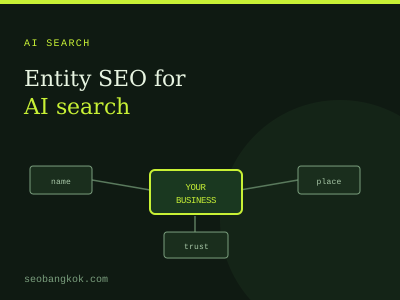
Google's Knowledge Graph integration has tightened. The Knowledge Graph relies on entity signals from schema, Wikipedia, Wikidata, and trusted third-party citations. Businesses absent from the Knowledge Graph rarely appear in AI-generated answers and consistently underperform branded query coverage. The Knowledge Graph foundation that this rests on is in entity SEO for AI search.
The compounding effect: schema work produces simultaneous returns across Google ranking, Knowledge Graph presence, and AI search citation. Few other technical SEO investments hit three surfaces at once.
The four schemas every Thai business should ship
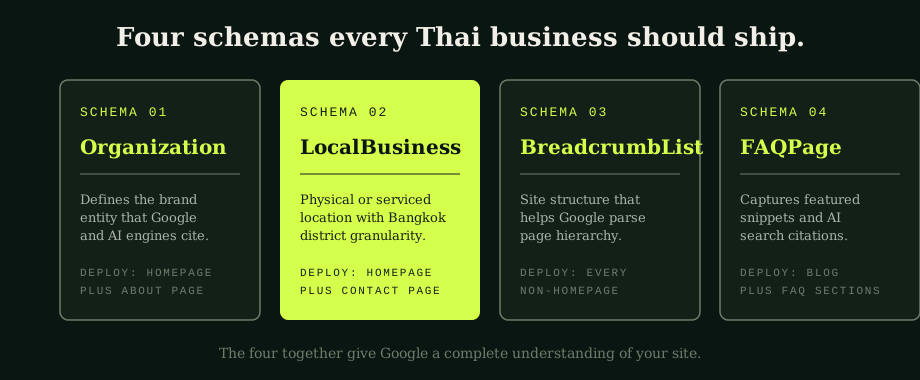
Most Thai businesses need exactly four schemas to capture the bulk of the ranking and citation value. More complex schemas (Product, Recipe, Event, etc.) are valuable for specific verticals but the four core types apply universally.
Organization schema defines the brand entity. It should appear on the homepage and the about page, with consistent values across both. Required fields: name, url, logo, description. High-value optional fields that meaningfully strengthen the entity signal: founder, foundingDate, areaServed, knowsAbout (key topics the business is authoritative on), slogan, sameAs (links to LinkedIn, Twitter, Facebook, and other identity-confirming platforms). Thai businesses with strong Organization schema appear in the Knowledge Graph with attribute depth that businesses without it cannot match.
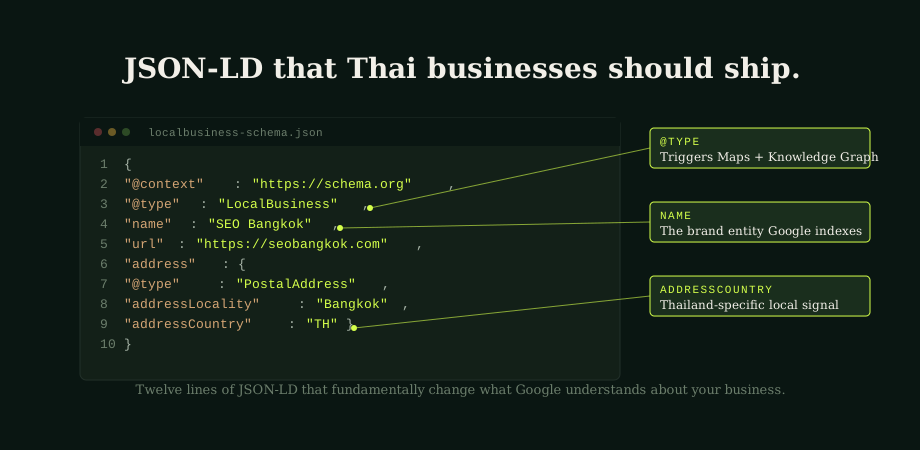
LocalBusiness schema defines the physical or serviced location. It should appear on the homepage and the contact page. LocalBusiness extends Organization with location-specific fields: address (with PostalAddress nested object), telephone, geo (with latitude and longitude), openingHoursSpecification (structured opening hours), areaServed (geographic service area). For Thai businesses serving multiple Bangkok districts or provinces, areaServed should list those districts explicitly rather than just stating "Thailand." The district-level granularity helps Google understand the geographic relevance for local search ranking.
BreadcrumbList schema declares site hierarchy. It should appear on every page except the homepage, with a list reflecting the actual breadcrumb path (Home → Section → Page). BreadcrumbList is the lowest-cost schema to deploy because the values come directly from the navigation structure already on the page, and it produces visible rich-result improvements (Google shows the breadcrumb hierarchy in search results rather than just the URL).
FAQPage schema captures the questions-and-answers content that increasingly drives both featured-snippet placement and AI search citations. Deploy on blog posts that have FAQ sections, on dedicated FAQ pages, and on service pages that include common-question content. The FAQ format is well-aligned with how AI engines structure their answers, which makes FAQ-marked content disproportionately likely to be cited verbatim by AI search.
LocalBusiness for Thai businesses
LocalBusiness schema for Thai businesses deserves additional unpacking because the Thai address format and the Bangkok district structure have specific implementation patterns.
The standard Schema.org PostalAddress fields are streetAddress, addressLocality, addressRegion, postalCode, addressCountry. The Thai-market mapping. streetAddress takes the building number, soi (lane), and street name as a single field; for businesses on a recognised landmark address, including the landmark in streetAddress aids both Google and human readers. addressLocality is the district name (Watthana, Sathorn, Klongtoey, etc.) , not "Bangkok" generally, but the specific district within Bangkok. addressRegion is the province (Bangkok itself if the district is within Bangkok province, or the actual province name for businesses outside Bangkok). postalCode is the five-digit Thai postal code. addressCountry is "TH" (the ISO code, not "Thailand" written out).
The most common Thai-market LocalBusiness mistake is using "Bangkok" as addressLocality instead of the actual district. Bangkok is too coarse for Google's local search ranking; the district-level specificity helps the business surface for proximity-based searches. The full Google Business Profile optimisation framework that complements this schema work is in how to optimise Google Business Profile in Thailand; the wider local SEO foundation is in the Thai-market local SEO foundation.
Thai-language script handling in JSON-LD
Thai script in schema markup requires three specific implementation patterns to render correctly across the parsing chain.
The first pattern is encoding. JSON-LD must be saved as UTF-8 without BOM (byte order mark). Some text editors add a BOM to UTF-8 files by default; this causes silent parsing failures in some downstream tools even though Schema.org validators accept the file. The result is schema that "looks valid" but fails to populate the Knowledge Graph correctly. The fix is to verify the encoding setting in your editor or content management system.
The second pattern is the inLanguage declaration. For Thai-content pages, the inLanguage field should be set at the appropriate schema level: inLanguage "th-TH" for Thai-language content, inLanguage "en-TH" for Thai-targeted English content (English content for the Thai market, distinct from generic en-US English). The inLanguage declaration helps Google understand which content variant to serve which audience and is a meaningful signal for Thai-Google ranking.
The third pattern is consistency between schema and visible content. Mismatched schema (Thai text in JSON-LD but English on the page, or vice versa) causes Google to flag the schema as potentially misleading and discount its ranking value. The schema content should match what users actually see on the page in the language they see it.
Bilingual schema markup
Thai businesses with parallel Thai and English content need a specific schema architecture rather than mixing languages within single schema blocks. The pattern that works.
For each language variant of a page, deploy a separate JSON-LD block with the inLanguage value set to that language. The Thai-content version uses Thai-language values in name, description, and other text fields; the English-content version uses English values for the same fields. Both schemas can reference the same Organization entity via the @id field, which tells Google these are alternative language versions of the same underlying business.
The bilingual operational framing that this rests on is in Thai and English SEO. The technical schema implementation for hreflang plus parallel schema blocks together gives Google the clearest possible signal about which version to serve to which user.
Schema for AI search engines
The AI search optimisation layer of schema work concentrates on entity strength rather than rich-result triggers. Three optimisations matter most.
The sameAs property links the Organization entity to its representations on other platforms (LinkedIn company page, Twitter profile, Facebook page, Wikipedia entry, Wikidata entry, Crunchbase, industry directories). Each external link reinforces the entity in the AI engine's training data. Businesses with three or more sameAs links to credible platforms consistently appear with more attribute depth in AI knowledge representations than businesses with one or none.
The knowsAbout property declares the topics the business is authoritative on. AI engines parse knowsAbout to decide whether the business is a relevant citation for category queries. A Thai SEO agency with knowsAbout values like "Search Engine Optimization, Technical SEO, International SEO, E-commerce SEO, Bangkok, Thailand" appears in AI citations for those category queries more frequently than a business without the topical signals declared.
The areaServed property identifies the geographic markets the business serves. For Thai businesses, areaServed should list the specific provinces or regions, not just "Thailand" generically. International-focused Thai businesses should additionally include source-market countries (Japan, Singapore, US, UK, etc.) to signal cross-border service capability. The E-E-A-T framing that this entity work fits inside is in what is E-E-A-T and how does it affect rankings.
Validation and testing
Two validators matter for production schema work. Schema.org's validator confirms the markup follows the schema vocabulary correctly. Google's Rich Results Test confirms whether the markup actually triggers the rich-result feature Google is designed to display for that schema type. The two often agree but sometimes diverge; the Rich Results Test is the more relevant authority for ranking impact because it reflects what Google itself uses.
Beyond initial validation, three ongoing testing patterns matter. Live-site validation should run weekly because schema can break when content management systems update or when developers modify templates without realising the schema is embedded. Schema-to-content consistency checks should run when business details change (a new address, renamed services, updated phone number) to ensure the schema reflects the current truth. Performance impact testing should run periodically because some schema implementations add measurable page weight; the Core Web Vitals trade-off should be evaluated explicitly. The wider Thai-network CWV considerations are in Core Web Vitals for Thai networks.
Common schema markup mistakes
- Mismatched schema and visible content. Declaring an address, phone, or business name in schema that does not appear on the page. Google flags this as potentially misleading.
- Stale schema not updated when business details change. The phone number changed six months ago but the schema still has the old one.
- Multiple conflicting Organization schemas. Different pages declaring different name or url values for what should be the same entity.
- Missing inLanguage on bilingual sites. Without explicit language declaration, Google guesses, often incorrectly.
- "Bangkok" as addressLocality instead of the district. Costs the proximity-based local search ranking that district-level granularity provides.
- UTF-8 BOM causing silent parse failures. Validates in tools but fails to populate Knowledge Graph correctly for Thai-script content.
- Hidden schema behind JavaScript execution. Google's JavaScript rendering is improving but still slower than direct HTML parsing.
- FAQPage schema on pages without visible FAQ content. Google explicitly penalises this as schema spam.
- Validating in Schema.org but not Google's Rich Results Test. The two have different acceptance criteria and Rich Results Test matters more.
- Treating schema as set-and-forget. Weekly validation catches breakage before it affects rankings.
The honest version of schema for Thai businesses
Schema markup done well for Thai businesses produces compounding returns across Google ranking, Knowledge Graph presence, AI search citation, and local search visibility. The work is technical but tractable: the four core schemas (Organization, LocalBusiness, BreadcrumbList, FAQPage) cover the bulk of the value, and the Thai-specific implementation patterns (district-level addressLocality, UTF-8 without BOM, inLanguage declarations, bilingual schema architecture) are straightforward once the patterns are documented. The wider state-of-the-market context that explains why schema work pays off more in 2026 than in previous years is in the state of Thai SEO in 2026.
Our technical SEO work for Thai clients includes the full schema implementation across Organization, LocalBusiness, BreadcrumbList, FAQPage, and any vertical-specific schemas the business needs. The work runs through our technical SEO service as part of standard technical foundations. For businesses where schema is one component of a wider SEO rebuild, the integrated SEO services Bangkok programme covers schema alongside content, performance, and architecture work. A discovery conversation with our Bangkok SEO consultancy typically begins with a schema audit to identify which of the four essentials are missing or under-implemented. As a Bangkok SEO agency serving Thai and international clients, we treat schema implementation as foundational infrastructure rather than as an optional enhancement.
Common questions
What are the four essential schema types for Thai businesses?
Organization defines the brand entity. Deploy on homepage and about page. LocalBusiness defines the physical or serviced location with Bangkok district granularity. Deploy on homepage and contact page. BreadcrumbList declares site structure. Deploy on every non-homepage page. FAQPage captures featured snippets and AI search citation opportunities. Deploy on blog posts and FAQ sections. The four together give Google a complete understanding of the business and its site structure.
How do you handle Thai script in JSON-LD?
Three patterns. Save JSON-LD as UTF-8 without BOM so Thai characters render correctly across all parsing systems. Use the inLanguage field (th-TH for Thai, en-TH for Thai-targeted English) at the appropriate schema level. For bilingual sites, use parallel schema blocks with different inLanguage values rather than mixing languages within one block. Thai-script businesses that get encoding wrong often see schema validate in tools but fail in Google's Knowledge Graph.
How does schema markup affect AI search engines?
AI search engines (ChatGPT, Gemini, Perplexity, Claude) use schema to identify entities and decide what to cite. A business with rich Organization schema including knowsAbout, slogan, areaServed, sameAs to social profiles appears with more attribute depth in AI knowledge graphs. Schema markup produces simultaneous returns on Google ranking and AI search citation, which makes it disproportionately valuable in 2026 compared to even three years ago.
What are common schema markup mistakes?
Six common mistakes. Mismatched schema and visible content. Stale schema not updated when details change. Multiple conflicting Organization schemas across pages. Missing inLanguage on bilingual sites. Schema validating in Schema.org but failing in Google's Rich Results Test. Hidden schema behind JavaScript that requires execution before Google can parse it.